
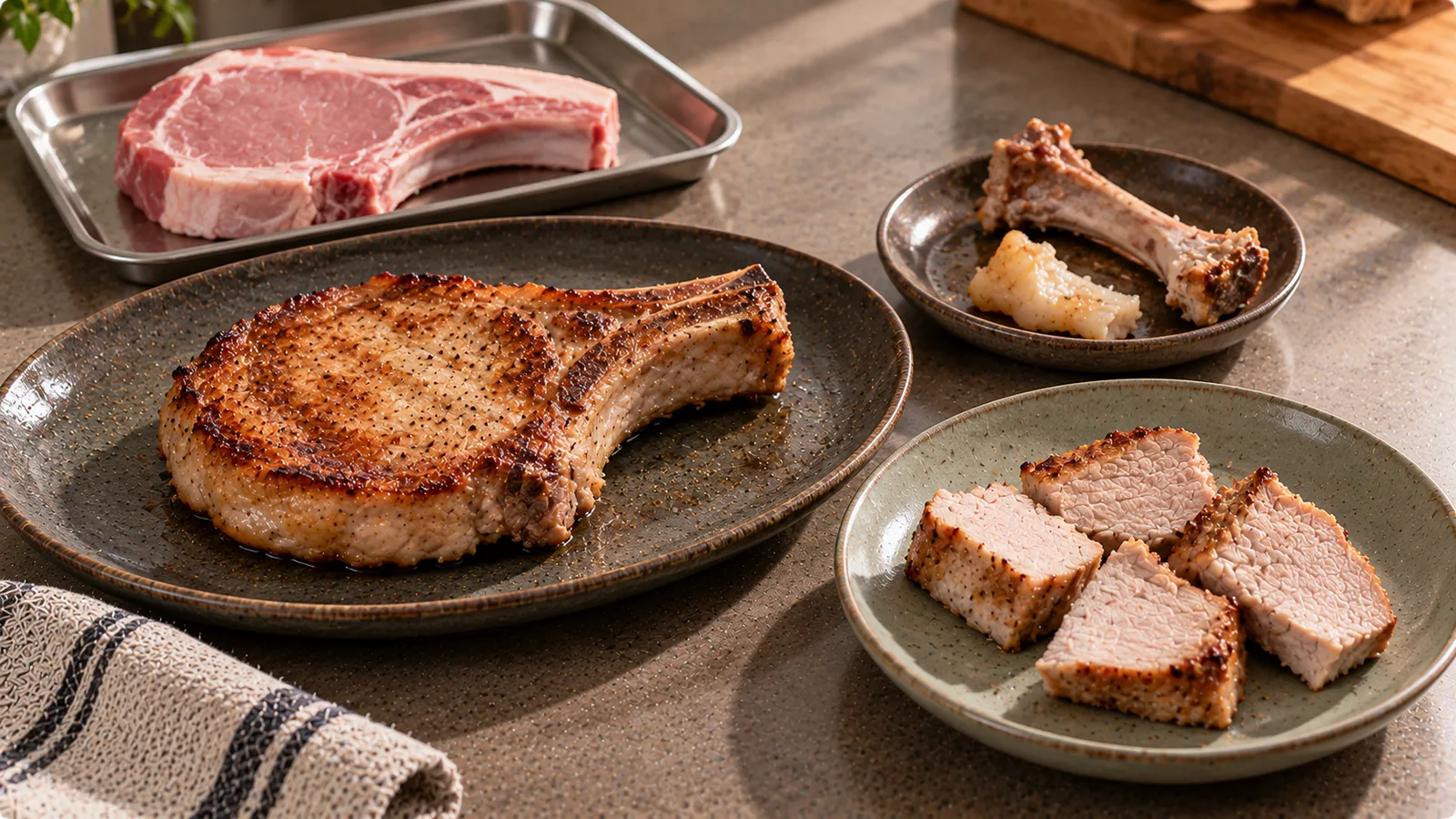
Pork chops can be a protein-rich main dish, but their calorie content depends on the cut, visible fat, bone, cooking method and whether you weigh them raw or cooked.
A lean, boneless pork chop is not nutritionally identical to a thick bone-in chop with a fatty edge. Even two chops of similar total weight can contain different amounts of edible meat.
The most useful approach is to compare calories per 100 g of edible pork and then calculate the portion you actually eat.
How many calories are in pork chops?
The following figures are approximate reference ranges for plain pork chops without breading, sauce or added cooking fat.
| Pork chop type | Calories per 100 g | Protein per 100 g |
|---|---|---|
| Raw, lean meat with visible fat trimmed | 120–155 kcal | 20–23 g |
| Raw, lean and fat combined | 155–210 kcal | 18–22 g |
| Cooked, lean meat with visible fat trimmed | 170–215 kcal | 26–31 g |
| Cooked, with some fat retained | 210–280 kcal | 24–29 g |
These are illustrative ranges, not universal values for every pork chop. Exact figures vary by anatomical cut, trimming, cooking loss and database entry.
A practical starting estimate for a plain, cooked, relatively lean pork chop is around 190–210 kcal per 100 g of edible meat.
For a fatty chop, use a value appropriate to its actual fat content rather than automatically applying the lean estimate.
Calories by serving size
Using an illustrative value of 200 kcal and 28 g protein per 100 g of cooked edible pork:
| Cooked edible portion | Calories | Protein |
|---|---|---|
| 75 g | 150 kcal | 21 g |
| 100 g | 200 kcal | 28 g |
| 125 g | 250 kcal | 35 g |
| 150 g | 300 kcal | 42 g |
| 175 g | 350 kcal | 49 g |
| 200 g | 400 kcal | 56 g |
| 250 g | 500 kcal | 70 g |
These calculations exclude oil, butter, breadcrumbs, sauces and side dishes.
They also assume that the weighed portion contains only edible pork, not bone.
Bone-in versus boneless pork chops
A bone-in pork chop includes weight that is not eaten.
For example, suppose a cooked chop weighs 220 g including the bone.
After eating, the remaining bone and other uneaten parts weigh 45 g.
The edible portion is:
220 g − 45 g = 175 g.
At an estimated 200 kcal per 100 g:
175 × 200 ÷ 100 = 350 kcal.
If you had entered the full 220 g as cooked edible meat, the calculation would have been:
220 × 200 ÷ 100 = 440 kcal.
That would overestimate the portion by 90 kcal in this example.
How to measure a bone-in chop
The simplest method is:
- Weigh the cooked chop before eating.
- Eat the meat you intend to consume.
- Weigh the remaining bone and other discarded parts.
- Subtract the remaining weight.
- Use a nutrition entry for cooked edible pork.
If you leave edible fat or meat uneaten, include it in the remaining weight.
This method is particularly useful when the bone is large or the chop has a thick fatty edge.
Raw versus cooked weight
Pork usually loses water during cooking.
That means 100 g of cooked pork generally represents more raw meat than 100 g of raw pork.
As moisture decreases, calories and protein become more concentrated per 100 g of cooked food.
The total calories do not increase simply because water evaporates.
Worked example: a raw pork chop
Suppose you start with:
- 200 g raw edible pork.
- 160 kcal per 100 g raw.
- No added oil or sauce.
Estimated calories before cooking:
200 × 160 ÷ 100 = 320 kcal.
After cooking, the edible pork weighs 150 g.
If no meaningful energy was lost with rendered fat or juices, the whole cooked portion still contains approximately 320 kcal.
Calories per 100 g cooked:
320 ÷ 150 × 100 = 213 kcal.
The same portion is therefore:
- 200 g raw pork at 160 kcal per 100 g.
- 150 g cooked pork at approximately 213 kcal per 100 g.
Both calculations give approximately 320 kcal.
Important: Actual cooking can render fat into the pan or remove energy-containing juices. This example isolates water loss and should not be treated as an exact cooking-yield rule.
Should you log pork chops raw or cooked?
Either method can work.
The key is to match the weight to the database entry.
| What you measured | Appropriate entry |
|---|---|
| Raw boneless meat | Raw pork chop, matching cut and trimming |
| Cooked boneless meat | Cooked pork chop, matching cut and trimming |
| Raw bone-in chop | Raw bone-in entry with an appropriate edible-yield method |
| Cooked bone-in chop | Cooked edible meat after subtracting bone |
| Breaded fried chop | Breaded pork chop or a recipe including coating and oil |
Do not weigh a cooked chop and enter the result under a raw-food listing.
Do not use the full bone-in weight with a database value intended for boneless edible meat.
How much does visible fat change the calories?
Fat provides approximately 9 kcal per gram, compared with approximately 4 kcal per gram for protein.
That makes the amount of retained fat an important variable.
Consider two cooked pork portions of equal weight:
- One is mostly lean meat.
- The other contains a thick strip of fat that is eaten.
The second portion can have substantially more calories even though both portions weigh 150 g.
Should you remove the fat?
That is a matter of preference and dietary goals.
For accurate tracking, what matters is whether you eat the fat or leave it on the plate.
If you trim fat before cooking, select a lean or trimmed entry.
If you eat the fatty edge, use a value that includes fat.
Avoid counting the fatty edge as lean pork.
How cooking methods affect pork chop calories
Cooking methods can change the final calories by adding fat, coatings or sauces.
Grilled pork chops
Grilling without substantial added fat is relatively straightforward to estimate.
Use the edible cooked weight and an appropriate cooked-pork entry.
Remember that fat may drip away during grilling, so a generic raw-to-cooked conversion is not exact.
Pan-fried pork chops
Pan-frying may add calories from oil or butter.
For example, if a portion retains an estimated 5 g of added oil:
5 × 9 = approximately 45 kcal.
If the pork itself contributes 300 kcal, the combined estimate is:
300 + 45 = 345 kcal.
Do not automatically count all oil poured into the pan as consumed. Some may remain in the pan.
Conversely, do not ignore oil that is absorbed by the food.
Breaded pork chops
Breading introduces additional ingredients:
- Flour.
- Egg.
- Breadcrumbs.
- Frying oil.
A breaded chop can contain substantially more calories than the same amount of plain pork.
For a homemade version, calculate the ingredients actually used in the finished portion.
A generic plain-pork entry is not suitable for schnitzel or another breaded preparation.
Pork chops with creamy sauce
Cream, butter, cheese and other sauce ingredients can materially change the total.
Log the pork and sauce separately unless your chosen database entry already includes the sauce.
Pork chop nutrition beyond calories
Pork provides complete protein and several micronutrients.
Depending on the cut and preparation, pork chops can contribute:
- Protein.
- Thiamin (vitamin B1).
- Vitamin B6.
- Vitamin B12.
- Zinc.
- Selenium.
- Phosphorus.
Exact amounts depend on the specific cut and food-composition record.
Pork chops are not carbohydrate-rich foods on their own. Most carbohydrates in a pork-chop meal usually come from breading, sauces or side dishes.
For verified food-specific nutrient values, consult USDA FoodData Central.
Is a pork chop a good protein source?
A plain cooked pork chop can provide a substantial amount of protein.
Using the illustrative cooked value of 28 g protein per 100 g:
- 100 g provides about 28 g protein.
- 150 g provides about 42 g.
- 200 g provides about 56 g.
The exact amount depends on the edible portion and the cut.
A fattier chop may have less protein per 100 g because more of its weight is fat.
If you track protein, weigh the edible portion and choose a matching database entry.
Pork chop versus pork tenderloin
Both are pork, but they are not interchangeable nutrition entries.
Pork tenderloin is generally a lean cut.
Pork chops can come from different parts of the loin and may contain a bone and varying amounts of fat.
A trimmed, lean chop may be nutritionally similar to tenderloin, while a fattier chop can be considerably more energy-dense.
Do not assume that every pork chop has the same calories as pork tenderloin.
A complete meal example
Imagine a dinner consisting of:
| Food | Amount | Illustrative calories |
|---|---|---|
| Cooked edible pork chop | 150 g | 300 kcal |
| Boiled potatoes | 200 g | 170 kcal |
| Steamed green beans | 150 g | 45 kcal |
| Added butter | 10 g | 72 kcal |
| Total | 587 kcal |
These figures are illustrative.
The meal's actual calories depend on the pork cut, potato variety, exact products and preparation.
If the pork was cooked with oil or served with sauce, those ingredients need to be considered as well.
How to estimate an unweighed restaurant pork chop
If you cannot weigh the meal, avoid pretending the estimate is exact.
Record:
- Whether the chop was bone-in.
- Its approximate size and thickness.
- Whether the fatty edge was eaten.
- Whether it was grilled, fried or breaded.
- Sauces and sides.
- How much of the chop was left.
A useful diary note could be:
Restaurant pork chop, bone-in, approximately 150–180 g edible cooked meat, fatty edge partly eaten, pan-fried, sauce separate.
Later, choose a reasonable cooked-pork entry and record the uncertainty.
A photo can help recall the portion but cannot reliably measure the bone or hidden fat.
Food safety: cooking pork chops
For whole cuts of pork, including pork chops, the USDA recommends a minimum internal temperature of 63°C (145°F) followed by a 3-minute rest.
Use a food thermometer inserted into the thickest part, avoiding contact with bone.
Ground pork has different cooking-temperature guidance and should not be treated as a whole pork chop.
Official guidance: USDA FSIS — Safe Minimum Internal Temperature Chart.
Follow any stricter instructions applicable to your product or local public-health guidance.
The most accurate way to track pork chops
For a home-cooked pork chop:
- Identify the cut if possible.
- Decide whether to use raw or cooked weight.
- Weigh the edible portion consistently.
- Exclude bone and uneaten parts.
- Choose a database entry that matches fat trimming.
- Add cooking oil, breading and sauce as needed.
- Save the result as a custom meal if you prepare it regularly.
For a bone-in chop, subtracting the leftover bone can improve the estimate substantially.
For a fatty chop, using the correct fat level may matter more than estimating the weight to the nearest gram.