
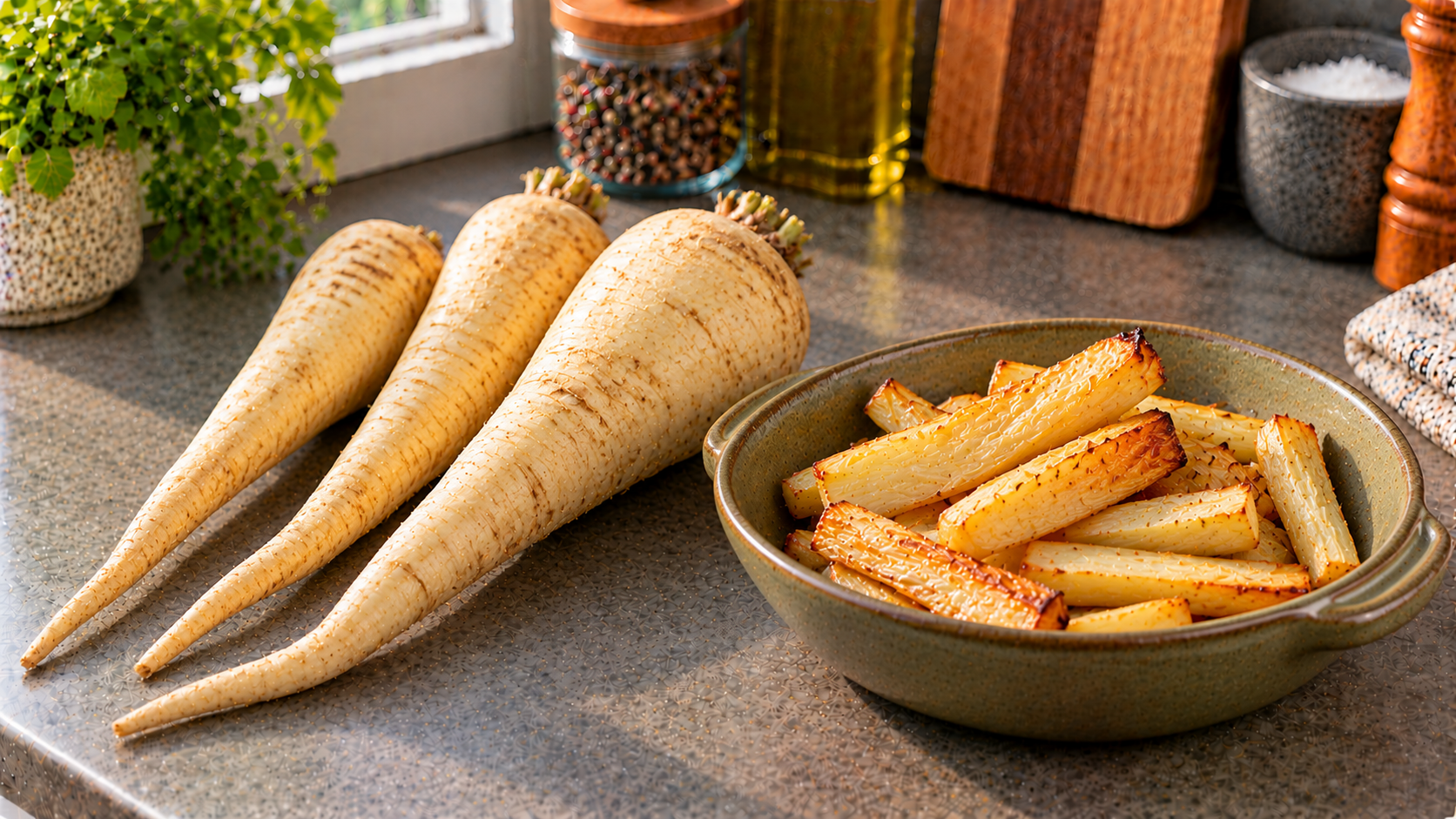
Parsnips contain about 75 kcal per 100 g raw and 71 kcal per 100 g boiled, drained and without added salt, according to USDA FoodData Central. They are pale, tapered root vegetables with a sweet, earthy flavour, and are often used in winter soups, roasted vegetable trays and mash. Unlike very watery salad vegetables, parsnips contain a meaningful amount of carbohydrate, so portion size matters when tracking calories.
Parsnip nutrition: raw and boiled
The figures below describe edible parsnip roots, rather than greens, carrots, turnips or recipes with oil. They come from two USDA SR Legacy food records.
| Nutrient per 100 g | Raw | Boiled, drained |
|---|---|---|
| Energy | 75 kcal | 71 kcal |
| Protein | 1.20 g | 1.32 g |
| Carbohydrates | 17.99 g | 17.01 g |
| Dietary fibre | 4.9 g | 3.6 g |
| Fat | 0.30 g | 0.30 g |
| Water | 79.53 g | 80.24 g |
Sources: USDA raw parsnips, FDC 170417, and USDA boiled parsnips, FDC 170009. These are two separate reference foods; the small difference in energy does not prove an exact calorie loss when any particular parsnip is boiled. Water changes, nutrient losses and food sampling all influence per-100-g figures.
Calories in 50–300 g of parsnips
For weighed cooked parsnips with no added fat, use the boiled reference of 71 kcal per 100 g.
| Cooked edible weight | Calories | Carbohydrate | Fibre |
|---|---|---|---|
| 50 g | 36 kcal | 8.5 g | 1.8 g |
| 100 g | 71 kcal | 17.0 g | 3.6 g |
| 150 g | 107 kcal | 25.5 g | 5.4 g |
| 200 g | 142 kcal | 34.0 g | 7.2 g |
| 250 g | 178 kcal | 42.5 g | 9.0 g |
| 300 g | 213 kcal | 51.0 g | 10.8 g |
These are mathematically scaled and rounded values, not separate laboratory tests. Calories = cooked edible grams × 71 ÷ 100. For example, 180 g of plain boiled parsnips provide about 128 kcal. If weighed raw, multiply the edible weight by 75 ÷ 100 instead.
How many calories are in one parsnip?
There is no universal weight for a small, medium or large parsnip. One trimmed raw root weighing 100 g provides approximately 75 kcal; 150 g provides around 113 kcal; and 200 g provides 150 kcal. These are weight-based examples rather than fixed size classifications. When preparing parsnips, remove the top, damaged portions and peel if you discard it, then weigh what will actually be eaten. For a whole batch of different-sized roots, weighing the combined edible amount is usually easiest.
Raw, steamed, boiled and roasted parsnips
Raw parsnip can be grated into salads. Boiled or steamed parsnips are tender and can be mashed or blended into soup. Roasted parsnips develop browning and a sweeter flavour as moisture decreases and their surface changes during cooking. The finished weight may differ from the starting weight, so 100 g roasted cannot automatically be assigned the same per-100-g values as 100 g raw or boiled.
For a homemade recipe, an effective method is to record all edible raw ingredients, add fats and other ingredients, and calculate the batch total. Then allocate the total according to the cooked servings actually eaten. If using a nutrition database for the weighed finished food, select a preparation-specific entry instead.
How much does oil add to roasted parsnips?
Consider 400 g of raw parsnips plus 20 g of olive oil. The roots contribute approximately 300 kcal and the oil approximately 180 kcal, giving roughly 480 kcal for the batch before sauces or other ingredients, if all oil is consumed. Four equal portions would each contain about 120 kcal. If some oil is left on the baking tray, the energy actually eaten may be lower.
A honey glaze, butter, maple syrup, nuts or cheese can raise the total. There is no reliable generic calorie value for every tray of roasted parsnips. A restaurant portion may also contain more oil than a home-cooked one.
Parsnip mash, soup and chips
Plain parsnip mash retains the calories of the parsnip used, adjusted for cooking and portioning. Adding milk, cream, butter or potatoes changes the nutrition. A blended parsnip soup can contain stock, onion, beans or cream, so a single vegetable-only value is unsuitable for the complete bowl.
Parsnip chips or crisps often lose water during baking or frying. Consequently, a 100 g serving of finished crisps can represent far more than 100 g of fresh roots. Oil can increase calories further. Use packaging data for commercial snacks, and calculate the full ingredient recipe for homemade versions.
Are parsnips higher in calories than carrots or turnips?
Parsnips are generally more carbohydrate-dense than many non-starchy vegetables. In the selected USDA references, raw parsnips provide 75 kcal per 100 g whereas raw turnips provide around 28 kcal. That comparison is about specific raw-food records, not the nutritional quality of entire meals.
Parsnips, carrots and turnips are different roots; for a like-for-like comparison with carrots, use the carrot calories and portions guide.
Parsnips also differ from carrots in taste, starch and fibre content. Substituting parsnips in a recipe changes both flavour and energy. Do not treat white carrots, turnips, rutabaga and parsnips as interchangeable database entries, even if they look similar in a shop.
Carbohydrates, fibre and natural sweetness
The raw USDA reference lists about 17.99 g total carbohydrate and 4.9 g fibre per 100 g. Cooked parsnips have about 17.01 g carbohydrate and 3.6 g fibre per 100 g in the selected record. USDA total carbohydrates include fibre; EU food labels usually report available carbohydrate separately from fibre. Take that difference into account when entering numbers into a nutrition app.
Parsnips taste sweet because of naturally present carbohydrates, but this is not identical to adding refined sugar to a dish. Their fibre may support normal bowel function and fullness as part of a varied diet. People who are not used to fibre-rich meals can introduce larger portions gradually.
Vitamins, minerals and balanced meals
Parsnips contribute potassium and folate, with values depending on the source and cooking method. Boiling can reduce some water-soluble nutrients when cooking water is discarded. They are not a concentrated protein or fat source. For a substantial meal, combine them with another vegetable and a suitable protein source, such as lentils, beans, eggs, tofu, fish or poultry.
Parsnips can be part of an energy-conscious eating pattern, but they do not independently cause weight loss. Portion weight and the complete recipe are more informative than whether a food is called a vegetable or a starch.
Practical tracking checklist
Use 75 kcal per 100 g for parsnips weighed raw, and 71 kcal per 100 g for the specified boiled and drained food. Remove discarded peel and ends from edible weight. Account for oil, butter, sweet glazes and creamy sauces. For packaged or restaurant products, prefer matching product information to plain-root estimates.
Sources
- USDA FoodData Central: parsnips, raw — FDC 170417.
- USDA FoodData Central: parsnips, cooked, boiled, drained, without salt — FDC 170009.
All serving and recipe examples are calculated from these reference values and ingredient quantities, not measured averages for every product.