
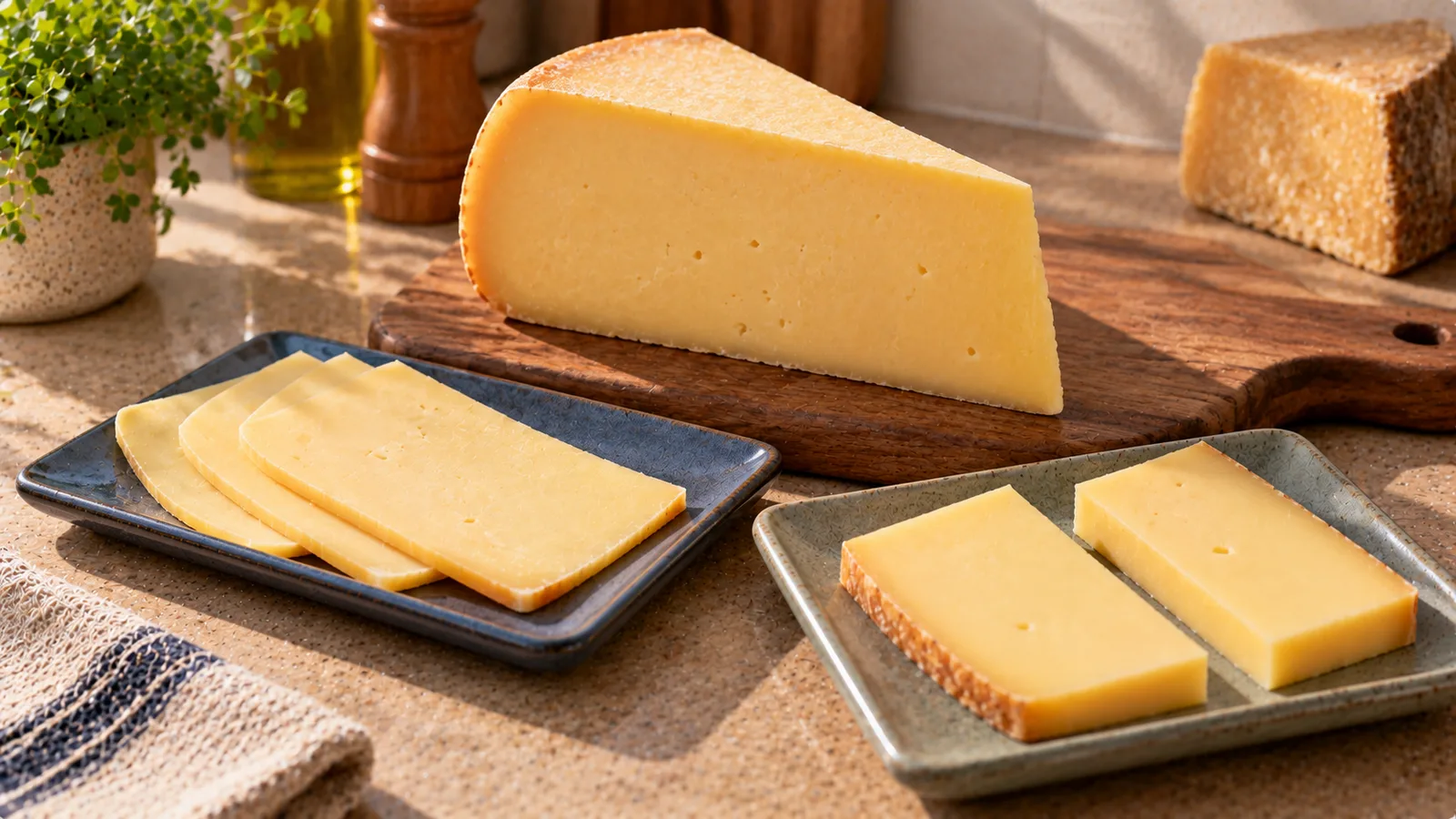
Gouda is a semi-hard cheese with a relatively high energy density because much of its calories come from fat, while it also provides a substantial amount of protein.
A typical full-fat Gouda provides roughly 350–370 kcal per 100 g, although the exact value varies by brand, age and fat content.
For everyday tracking, the most important question is usually not the value per 100 g but how much Gouda is actually in your meal.
Gouda calories at a glance
Approximate values for a typical full-fat Gouda:
| Amount | Calories |
|---|---|
| 10 g | 35–37 kcal |
| 20 g | 70–74 kcal |
| 25 g | 88–93 kcal |
| 30 g | 105–111 kcal |
| 40 g | 140–148 kcal |
| 50 g | 175–185 kcal |
| 75 g | 263–278 kcal |
| 100 g | 350–370 kcal |
These are practical estimates rather than universal values. Use the nutrition label when you have the exact product.
Nutrition in 100 g of Gouda
A typical full-fat Gouda may provide approximately:
| Nutrient | Per 100 g |
|---|---|
| Calories | 350–370 kcal |
| Protein | 24–26 g |
| Fat | 27–30 g |
| Carbohydrates | 0–3 g |
The exact composition varies.
Reduced-fat Gouda can contain less fat and fewer calories, while some mature varieties may have slightly different values because of changes in moisture during aging.
How many calories are in one slice of Gouda?
There is no universal weight for a slice.
Pre-sliced cheese can be very thin, while a slice cut at home may be considerably heavier.
If Gouda contains 360 kcal per 100 g:
20 g slice
360 × 20 ÷ 100 = 72 kcal
25 g slice
360 × 25 ÷ 100 = 90 kcal
30 g slice
360 × 30 ÷ 100 = 108 kcal
This is why counting only the number of slices can be misleading.
Two slices weighing 20 g each contain much less cheese than two slices weighing 30 g each.
Calories in two slices
Using the same 360 kcal per 100 g example:
- two 20 g slices = 40 g = 144 kcal
- two 25 g slices = 50 g = 180 kcal
- two 30 g slices = 60 g = 216 kcal
For accurate food logging, the combined weight is more useful than the slice count.
Calories in 50 g of Gouda
If the cheese contains 360 kcal per 100 g:
360 × 50 ÷ 100 = 180 kcal
A 50 g portion may also provide roughly 12–13 g of protein, depending on the product.
This can make Gouda a meaningful source of protein, but it also contributes a substantial amount of fat and energy.
Gouda protein
Typical Gouda contains around 24–26 g of protein per 100 g.
Approximate protein amounts might therefore look like this:
| Gouda | Approximate protein |
|---|---|
| 20 g | 5 g |
| 30 g | 7–8 g |
| 40 g | 10 g |
| 50 g | 12–13 g |
| 100 g | 24–26 g |
Cheese can contribute useful protein to a meal, but it is not necessary to use a large portion to obtain it.
Gouda fat
Much of Gouda's energy comes from fat.
A typical full-fat variety may contain approximately 27–30 g of fat per 100 g.
That means a 30 g portion could provide roughly 8–9 g of fat.
Because fat provides more energy per gram than protein or carbohydrate, relatively small changes in the amount of cheese can noticeably change the calorie total of a meal.
Does Gouda contain carbohydrates?
Usually very little.
Many Gouda cheeses contain only a small amount of carbohydrate per 100 g, although the exact number on the label can vary.
For most meals, Gouda contributes considerably more protein and fat than carbohydrate.
Why calorie values differ between Gouda products
Two Gouda labels do not have to show identical calories.
Differences can result from:
- fat content;
- moisture content;
- age of the cheese;
- reduced-fat formulations;
- manufacturing differences;
- nutrition-label rounding.
For example, one Gouda might contain 352 kcal per 100 g while another contains 374 kcal.
Neither value is automatically wrong.
For a packaged product, use its own label whenever possible.
Young vs aged Gouda
Aging changes the texture, flavor and moisture of cheese.
As Gouda matures, it generally becomes firmer and more concentrated.
However, age alone is not enough to calculate its exact calorie content.
The nutrition label remains the better source for a specific product because two aged cheeses can still differ in fat and moisture.
Full-fat vs reduced-fat Gouda
Reduced-fat Gouda can provide fewer calories because some of the fat has been removed.
For example, imagine:
- regular Gouda: 360 kcal per 100 g
- reduced-fat Gouda: 280 kcal per 100 g
For a 30 g portion:
Regular:
360 × 30 ÷ 100 = 108 kcal
Reduced-fat:
280 × 30 ÷ 100 = 84 kcal
The difference would be about 24 kcal for that serving.
The actual difference depends on the products being compared.
How to calculate calories from the package
Suppose your Gouda label says:
356 kcal per 100 g
and you eat:
35 g
Use:
calories = calories per 100 g × grams eaten ÷ 100
356 × 35 ÷ 100 = 124.6 kcal
You could log approximately:
125 kcal
This method works for any portion size.
Example: Gouda in a sandwich
Suppose a sandwich contains:
- 80 g whole-grain bread;
- 30 g Gouda;
- tomato;
- lettuce;
- mustard.
If the Gouda contains 360 kcal per 100 g:
360 × 30 ÷ 100 = 108 kcal from Gouda
The complete sandwich will contain more calories because the bread and other energy-containing ingredients must also be counted.
This distinction is useful when estimating mixed meals: the cheese value is only one component of the total.
Example: Gouda on a burger
Suppose you add one 25 g slice of Gouda to a burger.
At 360 kcal per 100 g:
360 × 25 ÷ 100 = 90 kcal
The burger's total energy still depends on:
- the bun;
- meat or plant-based patty;
- cooking oil;
- sauces;
- vegetables;
- other toppings.
The cheese should not be treated as the calorie value of the whole meal.
Example: Gouda in an omelet
An omelet contains:
- 3 eggs;
- 25 g Gouda;
- vegetables;
- a measured amount of cooking oil.
The Gouda contributes approximately 90 kcal if it contains 360 kcal per 100 g.
Eggs and oil must be logged separately.
When tracking homemade meals, calculating each energy-containing ingredient is usually more reliable than searching for a generic database entry such as “cheese omelet.”
Example: grated Gouda
Grated cheese can be difficult to estimate visually because it spreads over a large area.
Suppose you use 40 g of grated Gouda.
At 360 kcal per 100 g:
360 × 40 ÷ 100 = 144 kcal
A loose handful is not a standardized serving.
If accuracy matters, weighing the cheese before adding it to the meal is simpler than trying to estimate the amount afterward.
Gouda as a snack
A small portion can be combined with foods that add volume, fiber or different nutrients.
For example:
- 25 g Gouda;
- an apple;
- raw vegetables;
- whole-grain crackers.
The 25 g cheese portion would provide roughly 90 kcal if the Gouda contains 360 kcal per 100 g.
The complete snack total depends on the other foods.
Gouda and sodium
Cheese can also contribute a meaningful amount of sodium or salt.
The exact amount varies by product, so check the label when sodium or salt intake matters to you.
Do not assume that two cheeses with similar calories necessarily contain the same amount of sodium.
Calories and sodium are separate nutritional characteristics.
Is Gouda high in calories?
Gouda is energy-dense compared with foods that contain much more water, such as many vegetables and fruits.
That does not make it inherently “good” or “bad.”
A more useful question is whether the portion fits the meal and your overall dietary pattern.
For example, 20–30 g can add:
- flavor;
- protein;
- fat;
- calcium and other nutrients;
- roughly 70–110 kcal depending on the product.
A 100 g portion is a very different quantity and may provide around 350–370 kcal.
Portion size changes the picture
Consider the same Gouda at 360 kcal per 100 g:
| Portion | Calories |
|---|---|
| 15 g | 54 kcal |
| 25 g | 90 kcal |
| 35 g | 126 kcal |
| 50 g | 180 kcal |
| 70 g | 252 kcal |
| 100 g | 360 kcal |
The food itself has not changed. Only the amount has.
This is why using the actual weight is especially useful for calorie-dense foods such as cheese.
How to log Gouda accurately
For packaged Gouda:
- Check the calories per 100 g or per serving.
- Check whether the serving size matches the amount you ate.
- Weigh your portion when practical.
- Calculate the value for the actual grams consumed.
- Include the cheese as part of the complete meal rather than forgetting toppings or fillings.
If you do not know the exact brand, a generic Gouda database value can be a reasonable estimate, but it should be treated as an estimate.
If you only know the number of slices
Check the package for the total weight and number of slices.
For example:
A 200 g package contains 8 slices.
Average weight per slice:
200 ÷ 8 = 25 g
If the cheese contains 360 kcal per 100 g:
360 × 25 ÷ 100 = 90 kcal per slice
Two slices would be approximately:
180 kcal
This is more reliable than assuming every cheese slice has the same weight.
If the package gives calories per serving
Suppose the label states:
90 kcal per 25 g
and you eat 40 g.
Calculate:
90 × 40 ÷ 25 = 144 kcal
You do not need to convert to a per-100-g value first, although doing so would produce the same result.
Practical takeaway
Typical full-fat Gouda contains roughly 350–370 kcal per 100 g, with approximately 24–26 g protein and 27–30 g fat.
For common portions, that works out to roughly:
- 20 g: 70–74 kcal;
- 25 g: 88–93 kcal;
- 30 g: 105–111 kcal;
- 50 g: 175–185 kcal.
The exact product label should take priority over generic averages.
For food tracking, weighing the portion is more reliable than relying on terms such as “one slice,” because slice thickness and weight can vary considerably.
Nutrition data sources
The portion examples use 360 kcal per 100 g. The separate reduced-fat Gouda example is not verified by this standard-Gouda USDA record.
The USDA references below describe the particular foods and preparation states named in their records; they do not establish every rounded example or product variation in this article. Check the label of a specific product when available.
- USDA FoodData Central — Cheese, gouda (FDC 171241; 356 kcal/100 g).