
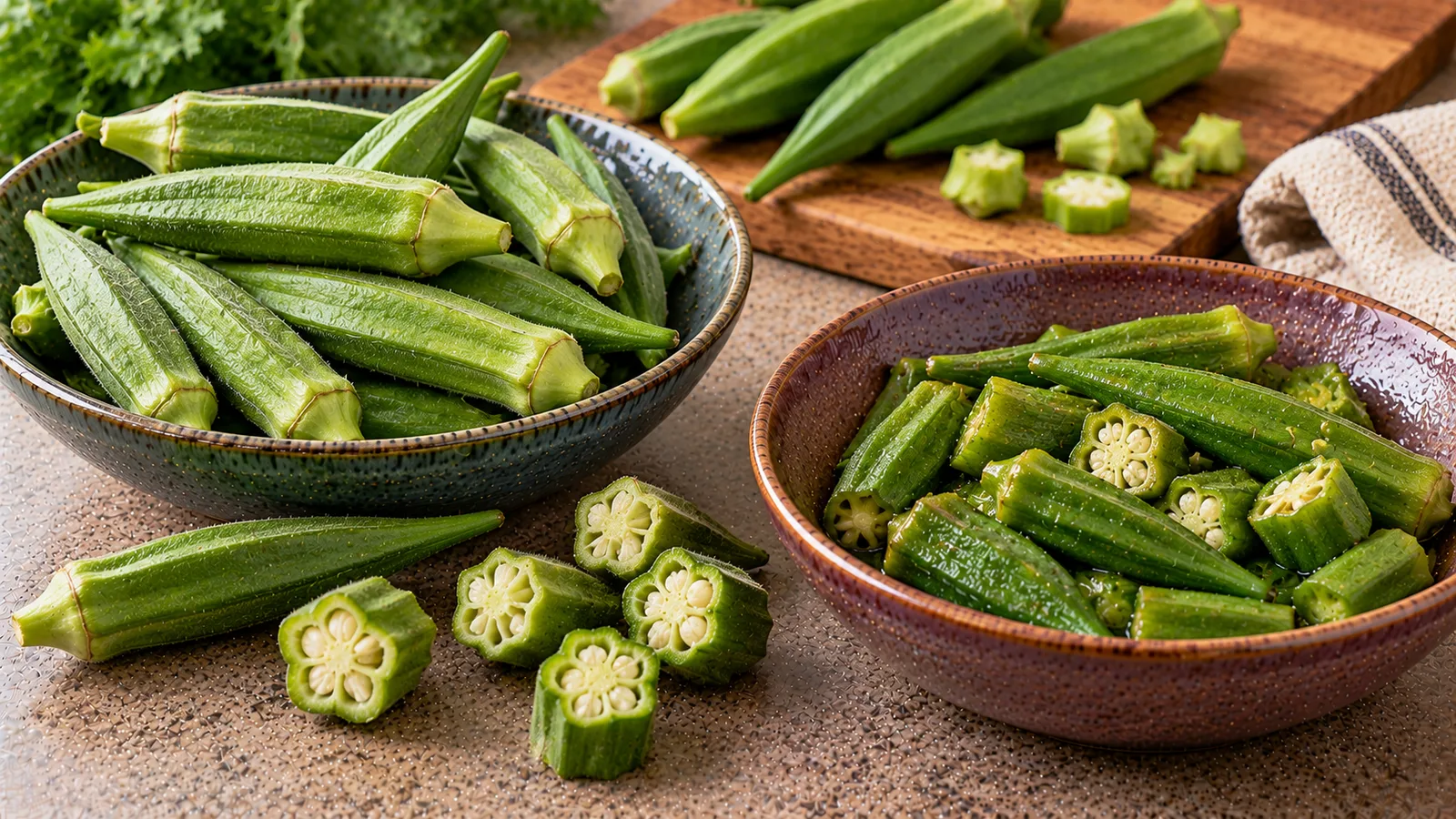
Okra, sometimes called lady's fingers, is the green edible pod of Abelmoschus esculentus. It is used whole or sliced in stews, soups and quick vegetable sides. The reference figures here describe the pods themselves, not a curry or a breaded restaurant serving. A dish that contains okra also contains whatever was cooked with it. That distinction is more useful than a single number copied onto every recipe. This guide answers three questions: what 100 g provides, how a weighed portion changes the calculation and why the method of cooking matters. The numbers are reference estimates, not measurements of a specific batch.
Raw and boiled okra are different food records
For raw edible pods, the USDA SR Legacy record FDC 169260 lists 33 kcal per 100 g. The boiled, drained, unsalted record FDC 169261 lists 22 kcal per 100 g. The University of Florida IFAS Extension compares these two entries in a published nutrient table. It is important not to interpret 33 to 22 as an automatic 33% energy loss from one pot. Different entries are standardized to 100 g in different states, and boiling changes both water content and the composition remaining after drainage. Neither entry is a universal prediction for steaming, frying, roasting or gumbo. Choose the entry matching the food and the weight actually tracked.
Portion examples you can actually weigh
A raw side of 150 g is about 50 kcal using 33 kcal per 100 g. A separate 150 g serving weighed after boiling and draining is about 33 kcal using 22 kcal per 100 g. One hundred grams raw is 33 kcal; 200 g raw is 66 kcal. The same weights of the reference boiled product give 22 and 44 kcal. A kitchen scale gives a more reliable answer than counting pods: a thick pod weighs more than a short tender one. Weigh the edible amount after removing tough stems, and record whether the figure came from the raw scale or the cooked plate.
| Measure | Raw (33 kcal/100 g) | Boiled, drained (22 kcal/100 g) |
|---|---|---|
| 50 g | 17 kcal | 11 kcal |
| 100 g | 33 kcal | 22 kcal |
| 150 g | 50 kcal | 33 kcal |
| 200 g | 66 kcal | 44 kcal |
Why 100 g cooked may look less energetic
In USDA reference data, raw okra has around 90 g water per 100 g while the cooked, drained reference contains more water. Some solids can also enter the cooking water. The lower energy density does not prove that simply boiling 100 g of raw okra makes its original 33 kcal disappear. If you weigh 200 g raw, cook that exact batch and then divide it across two bowls, the safest home estimate is to keep track of the original edible ingredients and any added fats. If you weigh only a finished restaurant plate, use the most appropriate prepared-food entry and say that it is an estimate. Avoid mixing both methods in one calculation.
Protein, carbohydrate and fibre
The USDA raw entry reports about 1.93 g protein, 0.19 g fat, 7.45 g carbohydrate by difference and 3.2 g fibre per 100 g. The boiled, drained entry provides about 1.87 g protein, 0.21 g fat, 4.51 g carbohydrate by difference and 2.5 g fibre. These numbers describe modest protein and fat and a meaningful contribution of fibre from an everyday vegetable. The American "carbohydrate by difference" convention can include dietary fibre; some European nutrition labels display available carbohydrate and fibre in separate fields. Do not compare those two carbohydrate figures as though they were defined identically. Neither version should be advertised as a treatment for a disease.
Oil changes the answer faster than the vegetable
Steamed or boiled okra without added oil stays close to a low-energy vegetable side. Pan-frying is different because oil can remain in the portion. As an arithmetic illustration, 200 g raw okra is 66 kcal on the raw basis. If 5 g of oil remains in that prepared dish, add about 45 kcal, making approximately 111 kcal for the entire dish before any other ingredients. At 10 g of retained oil, the additional energy is roughly 90 kcal. These are transparent recipe estimates using 9 kcal per gram of fat, not laboratory findings for fried okra. If some oil stays in the pan, count only what is retained as best you can.
Frozen, canned and battered products
Plain frozen okra may be convenient, but an entry for frozen vegetables should not be silently substituted for raw fresh pods. Some frozen products have been blanched; some canned products contain salt or sauces. Drain a canned product if the nutrition label specifies drained weight. For a frozen mixture, use the nutritional information for the ingredients actually inside the packet. Breaded and deep-fried okra is a separate prepared food: the coating, absorbed oil and portion size can dominate the energy total. Even air-frying with a coating is not the same as boiling plain pods. If a branded label is available, it generally gives a more relevant estimate than a generic raw entry.
Texture and sensible ways to cook
Okra releases soluble mucilage when cut or heated. That characteristic can help thicken stews and is not evidence of a high calorie load. Whole pods, wide cuts and short cooking methods behave differently from long-simmered chopped pods. For a simple side, rinse, trim only the hard cap, cook until tender and weigh the finished portion after draining. If you use tomatoes, onions, flour or oil, record those additions individually. Avoid assuming every recipe with the word "okra" has the same nutrients. Cooking changes texture and water balance; it does not create an exact universal calorie multiplier.
For the broader weighing method, see how to track raw versus cooked food weights.
Worked example: meal divided into portions
Imagine a household prepares 300 g raw okra and adds 10 g oil, with no other caloric ingredients. The raw reference gives 99 kcal for the vegetable and the oil gives up to about 90 kcal if retained. The entire recipe is therefore roughly 189 kcal, before any cooking losses or added ingredients. If it serves three equally, that is around 63 kcal per share. This method is useful when the cooked weight changes. If the recipe also includes rice or meat, those ingredients must be counted separately. The example is not an estimate of the nutrient content of a particular restaurant dish.
Sources and interpretation
The raw and cooked values are documented in the University of Florida IFAS comparison and the USDA SR Legacy records for raw okra, FDC 169260 and boiled and drained okra, FDC 169261. FoodData Central search helps find other preparation states. Values are per 100 g of edible product in the state named. Variations in cultivar, cutting, cooking, water and labels can change the result. For practical tracking, consistently choose a raw-ingredient method or an appropriate finished-product method and keep oils and coatings visible.