
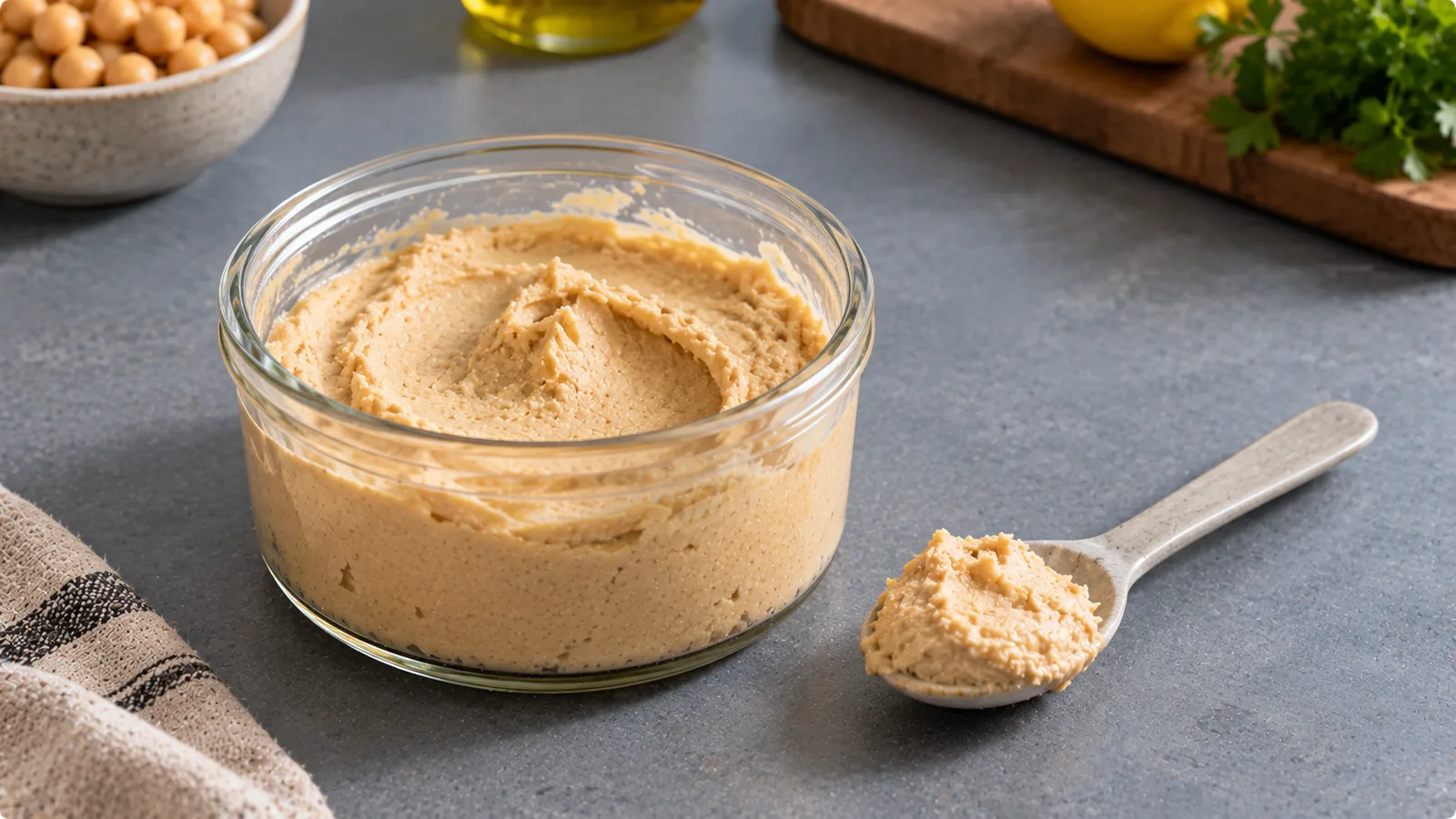
Hummus is a spread made primarily from cooked chickpeas, tahini, lemon juice, garlic and seasonings. Many recipes also include olive oil or another added oil.
Its calorie content depends on the proportions of those ingredients.
A useful working estimate for ordinary prepared hummus is approximately 170–250 kcal per 100 g, although products outside this range exist.
For a quick calculation, 200 kcal per 100 g is a convenient example value. It is not a universal nutritional value for every hummus product.
The most reliable number for packaged hummus is the energy value printed on its nutrition label.
Hummus calories by serving size
The following table uses an illustrative hummus containing 200 kcal per 100 g.
| Hummus portion | Approximate calories |
|---|---|
| 10 g | 20 kcal |
| 15 g | 30 kcal |
| 30 g | 60 kcal |
| 40 g | 80 kcal |
| 50 g | 100 kcal |
| 75 g | 150 kcal |
| 100 g | 200 kcal |
| 150 g | 300 kcal |
| 200 g | 400 kcal |
These values are calculated examples, not measurements of a particular brand.
To calculate your actual portion:
Calories = portion weight in grams × calories per 100 g ÷ 100
For example, if your hummus contains 235 kcal per 100 g and you eat 45 g:
45 × 235 ÷ 100 = 105.75 kcal, or approximately 106 kcal.
This method works regardless of whether the hummus is homemade or purchased.
How many calories are in a tablespoon of hummus?
A tablespoon is a volume measurement, not a fixed weight.
A level tablespoon of hummus may weigh approximately 15 g, but the actual amount varies with the product's consistency and how generously the spoon is filled.
Using 15 g as an example:
| Energy density | Calories in 15 g |
|---|---|
| 170 kcal/100 g | 26 kcal |
| 200 kcal/100 g | 30 kcal |
| 230 kcal/100 g | 35 kcal |
| 250 kcal/100 g | 38 kcal |
A heaped tablespoon can contain considerably more hummus than a level tablespoon.
If you regularly track food intake, weighing a typical spoonful once can help establish a more realistic personal estimate.
There is no need to weigh every spoonful indefinitely if approximate tracking is sufficient for your goals.
What counts as one serving?
There is no single portion size that everyone must eat.
A small amount used as a sandwich spread might be 20–30 g.
A dip accompanying vegetables could be 40–60 g.
A larger portion served with bread, salad or a grain bowl might be 75–100 g or more.
These are practical eating examples, not official serving-size recommendations.
| How hummus is used | Example amount |
|---|---|
| Thin sandwich spread | 20 g |
| Spread in a wrap | 30 g |
| Small vegetable dip | 40 g |
| Generous vegetable dip | 60 g |
| Part of a main meal | 100 g |
The relevant portion is the amount you actually eat.
A package may describe a serving as 30 g or another quantity. That serving declaration does not necessarily match your personal portion.
Hummus nutrition per 100 g
Hummus contains a mixture of carbohydrates, fat and protein.
The proportions depend on the recipe and brand.
The following is an illustrative profile for a prepared hummus near 200 kcal per 100 g.
| Nutrient | Approximate amount |
|---|---|
| Energy | 200 kcal |
| Protein | 6 g |
| Total fat | 13 g |
| Carbohydrates | 14 g |
| Fiber | 5 g |
This is an example composition rather than a standardized value.
Nutrition labels may use different conventions for carbohydrates and fiber, particularly across countries. Consequently, multiplying rounded macronutrients by standard energy factors may not reproduce the declared calories exactly.
For authoritative ingredient-level reference data, consult USDA FoodData Central.
When using a specific packaged product, its nutrition declaration should take priority over generic estimates.
Why hummus calories vary
Two containers labeled hummus can have noticeably different energy values.
The main reasons are ingredient proportions, added oil and water content.
Chickpeas
Cooked chickpeas provide carbohydrates, protein and fiber.
They also contribute energy, so hummus is not a calorie-free vegetable dip.
The amount of chickpeas relative to the other ingredients influences both the nutrition profile and the texture.
Tahini
Tahini is made from ground sesame seeds.
Because sesame seeds contain substantial fat, tahini is relatively energy-dense.
A recipe with more tahini may contain more calories per 100 g than a recipe with less tahini, assuming other ingredients remain comparable.
Tahini also changes flavor and consistency.
Added oil
Olive oil and other oils contribute approximately 9 kcal per gram of fat.
An extra 10 g of oil adds roughly 90 kcal to the entire recipe.
Whether that produces a large increase per serving depends on the total yield.
For example, adding 10 g oil to a 500 g batch contributes approximately 18 kcal per 100 g before accounting for the slight increase in batch weight.
Water and lemon juice
Water adds weight without adding meaningful energy.
Lemon juice adds relatively little energy compared with tahini or oil.
A recipe diluted with additional water may have fewer calories per 100 g, even when the total calories in the batch are almost unchanged.
This is why calorie density and total recipe calories should be considered separately.
Homemade versus store-bought hummus
Homemade hummus is not automatically lower in calories than supermarket hummus.
A homemade recipe with generous tahini and olive oil can be more energy-dense than a commercially prepared product.
Conversely, a homemade recipe with moderate tahini and no additional oil may be less energy-dense.
Commercial hummus also varies widely.
Some products emphasize chickpeas; others contain relatively more oil.
To compare fairly, use:
- Calories per 100 g.
- Protein per 100 g.
- Fat per 100 g.
- Fiber per 100 g.
- Salt or sodium content.
- Ingredient list.
Avoid comparing one product's 30 g serving with another product's 50 g serving without converting both to the same basis.
Example: calculating homemade hummus calories
Suppose you prepare a batch using:
| Ingredient | Quantity |
|---|---|
| Cooked chickpeas, drained | 400 g |
| Tahini | 60 g |
| Olive oil | 20 g |
| Lemon juice | 40 g |
| Garlic | 10 g |
| Water | 70 g |
| Seasonings | Small amount |
For an illustrative calculation, assume these ingredient energy values:
| Ingredient | Example calories |
|---|---|
| Chickpeas, 400 g | 520 kcal |
| Tahini, 60 g | 360 kcal |
| Olive oil, 20 g | 180 kcal |
| Lemon juice, 40 g | 9 kcal |
| Garlic, 10 g | 15 kcal |
| Water and seasonings | Approximately 0 kcal |
| Total | 1,084 kcal |
These ingredient values are rounded examples. Actual values vary with the chickpeas, tahini and other products.
The listed ingredients weigh approximately 600 g before processing.
If the finished hummus weighs 600 g:
1,084 ÷ 600 × 100 = 181 kcal per 100 g.
A 50 g serving would provide approximately 90 kcal.
If the finished yield is different, recalculate using the actual finished weight.
The important point is that the batch's total calories come from the ingredients, while calories per 100 g depend on the final weight.
Why the finished weight matters
Blending, draining, adding water and transferring the mixture between containers can change the final weight.
If you calculate nutrition for a homemade recipe, the most useful workflow is:
- Weigh each ingredient actually used.
- Calculate its calories from a consistent data source.
- Add all ingredient calories.
- Weigh the finished hummus.
- Divide total calories by finished weight.
- Multiply by your serving weight.
Suppose the batch contains 1,084 kcal.
At a final weight of 600 g, it provides about 181 kcal per 100 g.
At a final weight of 550 g, it provides about 197 kcal per 100 g.
The total calories remain the same in this simplified example, but the energy density changes.
This distinction is particularly useful when comparing thick and thin hummus recipes.
Does hummus contain protein?
Yes.
Chickpeas and tahini both contribute protein.
However, hummus should not automatically be treated as a concentrated protein food.
If a particular hummus contains 6 g protein per 100 g, a 30 g portion supplies:
30 × 6 ÷ 100 = 1.8 g protein.
A 100 g portion supplies 6 g.
The amount is useful as part of a meal, but a small spoonful is unlikely to make a major contribution to a high-protein target.
For a more protein-focused meal, combine hummus with foods that provide additional protein, depending on your preferences.
Fiber in hummus
Chickpeas naturally contain dietary fiber.
Prepared hummus may therefore contribute fiber, although the exact amount depends on the recipe.
If a product contains 5 g fiber per 100 g:
- 30 g provides 1.5 g fiber.
- 50 g provides 2.5 g fiber.
- 100 g provides 5 g fiber.
These calculations assume the label's fiber value is accurate for the product.
Fiber content should be read from the package or calculated from the actual recipe rather than inferred solely from the presence of chickpeas.
Is hummus high in fat?
Hummus often contains meaningful amounts of fat because tahini and added oil are common ingredients.
The amount varies.
A product with 13 g fat per 100 g provides:
- 3.9 g fat in 30 g.
- 6.5 g fat in 50 g.
- 13 g fat in 100 g.
The type of fat matters as well as the total amount.
Sesame seeds and olive oil contribute predominantly unsaturated fats, although exact fatty-acid proportions depend on the ingredients.
For general information about dietary fats, see the American Heart Association's dietary fats guidance.
A food containing fat is not automatically unsuitable for a balanced diet. Portion size and the overall eating pattern are relevant.
How much hummus is 100 calories?
The answer depends on the product's energy density.
Use this formula:
Grams for 100 kcal = 100 × 100 ÷ calories per 100 g
| Hummus energy density | Amount for approximately 100 kcal |
|---|---|
| 170 kcal/100 g | 59 g |
| 190 kcal/100 g | 53 g |
| 200 kcal/100 g | 50 g |
| 220 kcal/100 g | 45 g |
| 250 kcal/100 g | 40 g |
For example, 100 kcal corresponds to 50 g of hummus containing 200 kcal per 100 g.
These quantities are mathematical conversions, not recommendations to limit hummus to 100 calories.
Calories in hummus with common accompaniments
Hummus is frequently eaten with bread, crackers, vegetables or as part of a larger meal.
The accompanying foods can contribute as much energy as the hummus itself.
The following examples use hypothetical values.
| Meal component | Example calories |
|---|---|
| Hummus, 50 g at 200 kcal/100 g | 100 kcal |
| Raw cucumber, 150 g | 20 kcal |
| Carrot sticks, 100 g | 40 kcal |
| Whole-wheat pita, 65 g | 175 kcal |
| Crackers, 30 g | 130 kcal |
Using those example values:
- Hummus plus cucumber: approximately 120 kcal.
- Hummus plus carrots: approximately 140 kcal.
- Hummus plus pita: approximately 275 kcal.
- Hummus plus crackers: approximately 230 kcal.
The actual totals depend on the quantities and products used.
Do not assign the full meal's calories to hummus alone.
Hummus in sandwiches and wraps
When hummus is used as a spread, its portion is often smaller than when served as a dip.
For example, a wrap may contain 30 g hummus.
At 200 kcal per 100 g, that contributes 60 kcal.
A sandwich with 20 g hummus would contain 40 kcal from the spread.
The bread, vegetables, cheese, meat or other fillings need to be counted separately.
For accurate tracking, record hummus as its own ingredient rather than estimating the entire sandwich from the spread alone.
Is hummus suitable for weight management?
Hummus can fit into many different eating patterns.
It offers a combination of nutrients, but it still contributes calories.
Whether it supports a particular weight-management goal depends on portion size, the foods eaten alongside it and overall energy intake.
A small amount used as a flavorful spread may be practical.
A large bowl eaten with substantial amounts of bread or crackers can form a much more energy-dense meal.
Neither observation makes hummus inherently good or bad.
For weight management, a consistent understanding of actual portions is more useful than categorizing foods as automatically slimming or fattening.
How to compare hummus labels
When choosing between products, start with the nutrition values per 100 g.
Imagine two hypothetical hummus products:
| Nutrient per 100 g | Product A | Product B |
|---|---|---|
| Energy | 180 kcal | 245 kcal |
| Protein | 6 g | 5 g |
| Fat | 10 g | 19 g |
| Fiber | 5 g | 4 g |
| Salt | 0.8 g | 1.2 g |
Product A has fewer calories per 100 g in this example.
But the best choice depends on more than one number.
Consider taste, price, ingredient preferences, portion size and any relevant dietary needs.
If you eat 40 g of Product B and 100 g of Product A, the smaller portion of Product B still contains fewer total calories.
Always distinguish calorie density from calories actually consumed.
Roasted red pepper and other flavored hummus
Flavored hummus may contain roasted peppers, beetroot, herbs, chili or other ingredients.
These additions can change calories per 100 g, but the direction is not predictable from the flavor name alone.
A vegetable addition may dilute the energy density.
Additional oil, nuts or seeds may increase it.
Some products contain both.
The correct approach is to read the label rather than assume that a particular flavor is lighter or heavier.
For homemade flavored hummus, include every added ingredient in the calculation.
Reduced-fat hummus
A product labeled reduced-fat may contain less fat than a reference product, but that does not necessarily mean its calories are reduced by the same percentage.
The product may have a different water content, chickpea proportion or other ingredients.
Compare calories per 100 g directly.
Also consider whether you prefer the taste and texture enough to use the product consistently.
The nutrition label gives a more reliable answer than a marketing description alone.
Hummus versus whole chickpeas
Hummus and cooked chickpeas are related but not nutritionally identical.
Plain cooked chickpeas contain no added tahini or oil.
Traditional hummus generally contains at least some tahini and may contain added oil.
As a result, prepared hummus can have a higher fat content than plain chickpeas.
However, exact calorie comparisons depend on the water content and the particular recipe.
If you want to compare them, use equivalent weights and reliable nutritional values for both foods.
How to track hummus without overcomplicating meals
A simple method works for most situations:
- Use the package's calories per 100 g.
- Estimate or weigh the portion eaten.
- Calculate calories for that portion.
- Count bread, crackers and other foods separately.
- For homemade hummus, calculate the batch once and save the recipe.
If your hummus contains 210 kcal per 100 g and you eat 65 g:
65 × 210 ÷ 100 = 136.5 kcal.
You can record approximately 137 kcal.
There is little value in reporting more decimal places than your portion measurement supports.
Practical conclusion
Hummus does not have one fixed calorie value.
Its energy density depends mainly on the chickpea, tahini, oil and water proportions.
A broad working estimate of 170–250 kcal per 100 g can help with quick calculations, but the specific product label or a homemade recipe calculation is more reliable.
Use grams rather than spoon counts whenever precision matters, and remember to include the foods served with hummus.
The most useful number is not simply calories per 100 g. It is the calories in the portion you actually eat.