
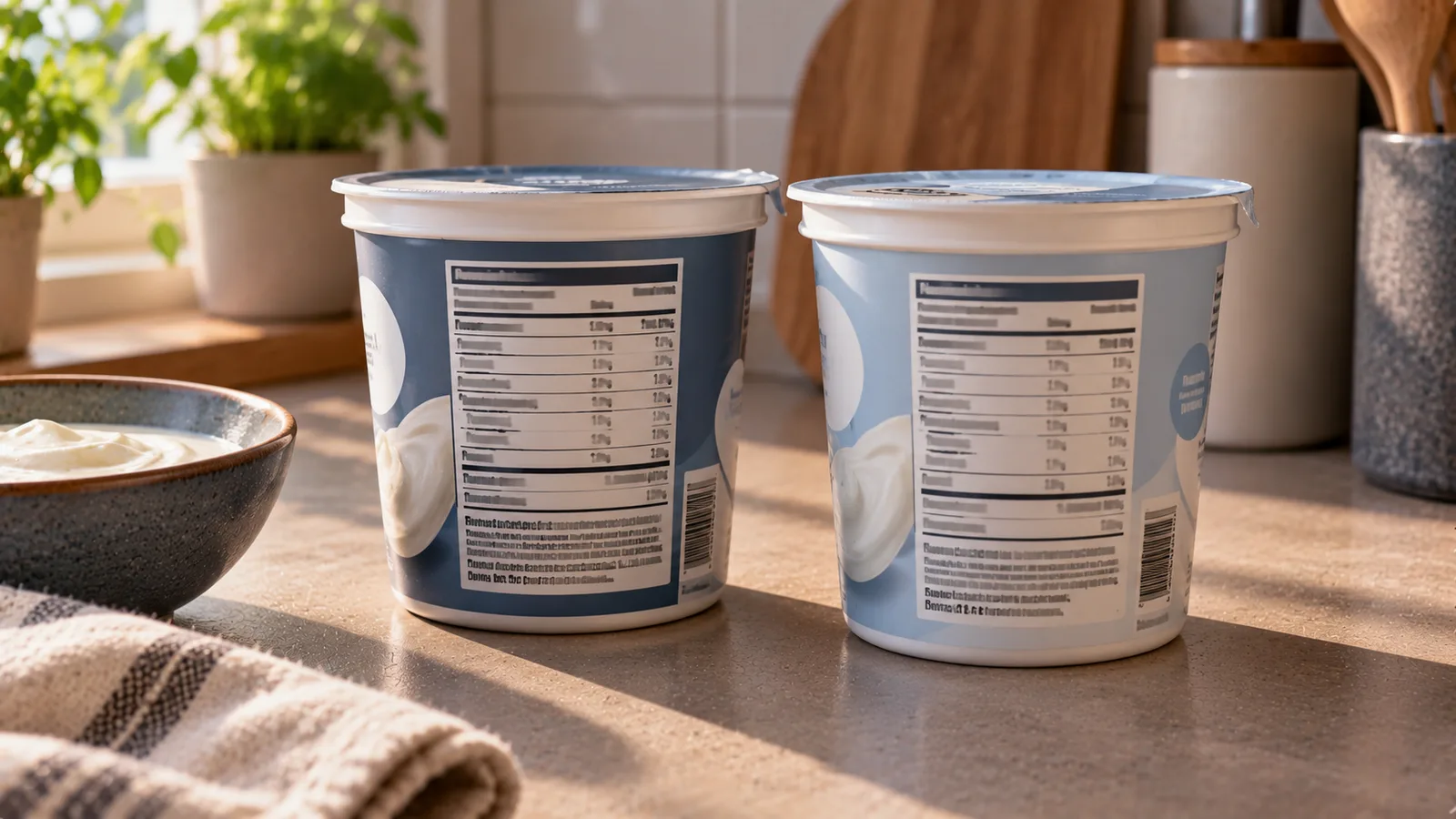
A reduced-fat version of a food is not simply the regular version with one nutrient removed.
When manufacturers reduce fat, the product's recipe, texture, water content and sometimes its sugar, starch, protein or salt content can change as well.
That means the useful comparison is not:
"Reduced fat or regular?"
It is:
"What actually changed between these two comparable products?"
The nutrition label can answer that question.
Reduced-fat vs regular at a glance
| What to compare | Why it matters |
|---|---|
| Fat per 100 g | Shows the difference in fat concentration |
| Saturated fat | May change differently from total fat |
| Calories per 100 g | Shows whether lower fat meaningfully reduced energy density |
| Sugars | Helps identify whether the formulation changed in another direction |
| Protein | Can differ between versions |
| Salt | May increase, decrease or remain similar |
| Serving size | Determines the difference in the amount you actually eat |
| Ingredient list | Shows how the product was reformulated |
The front of the package tells you the claim.
The complete label tells you what the claim means for that particular food.
What does "reduced fat" actually mean?
In the European Union, nutrition claims such as "reduced" are regulated.
A claim that the content of one or more nutrients has been reduced generally requires a meaningful reduction compared with a similar product, subject to the conditions established in EU rules.
For reduced-fat products, the comparison is therefore relative to a reference product.
That is important because "reduced fat" does not mean:
- fat-free;
- low-calorie;
- low-sugar;
- low-salt;
- automatically healthier overall.
It means the product has less fat according to the conditions applying to the claim.
Less fat does not always mean proportionally fewer calories
Fat provides more energy per gram than carbohydrate or protein.
So reducing fat can reduce the calorie density of a product.
But the size of that reduction depends on what replaces the fat and how the whole recipe changes.
Consider a simplified example:
| Per 100 g | Regular product | Reduced-fat product |
|---|---|---|
| Energy | 250 kcal | 210 kcal |
| Fat | 18 g | 11 g |
| Saturated fat | 7 g | 5 g |
| Carbohydrate | 12 g | 16 g |
| Sugars | 5 g | 6 g |
| Protein | 9 g | 10 g |
| Salt | 0.8 g | 0.9 g |
The reduced-fat version clearly contains less fat.
But calories fell by 40 kcal per 100 g rather than by an amount that can be inferred from the fat number alone.
Why?
Because the entire formulation changed.
This is why calories should be compared directly instead of assuming how much they changed.
Check comparable products
A fair comparison requires products that serve roughly the same purpose.
For example:
- regular plain yogurt vs reduced-fat plain yogurt;
- regular mayonnaise vs reduced-fat mayonnaise;
- regular cheese vs a reduced-fat version of a similar cheese;
- regular dressing vs the reduced-fat version of the same type.
Comparing reduced-fat strawberry yogurt with full-fat plain Greek yogurt introduces additional differences unrelated to fat reduction.
The flavors, sugar content, protein content and recipe may all differ.
When possible, compare like with like.
Start with the per-100-g column
In the EU, nutrition information is generally provided per 100 g or 100 ml.
This makes it useful for comparing similar products.
Suppose two products list:
Regular
- 290 kcal per 100 g
- 24 g fat
Reduced fat
- 220 kcal per 100 g
- 14 g fat
The reduced-fat product has both less fat and lower energy density.
Now consider another pair:
Regular
- 120 kcal per 100 g
- 5 g fat
Reduced fat
- 105 kcal per 100 g
- 3 g fat
The second product still has less fat, but the calorie difference is much smaller.
Both labels can legitimately matter. The practical significance depends on the product and how much you eat.
Then calculate your actual portion
Per-100-g values are excellent for comparison, but people do not always eat 100 g.
Suppose:
Regular spread
- 600 kcal per 100 g
Reduced-fat spread
- 450 kcal per 100 g
For a 20 g serving:
Regular:
600 × 0.20 = 120 kcal
Reduced fat:
450 × 0.20 = 90 kcal
Difference:
30 kcal per serving
That is the difference relevant to this particular portion.
If your serving is 40 g, the difference doubles.
If you use only 10 g, it halves.
Do not assume sugar was added
A common statement is that manufacturers "remove fat and replace it with sugar."
That can happen in some formulations, but it is not a rule.
Different products may use:
- water;
- starches;
- gums or thickeners;
- protein ingredients;
- sugars;
- emulsifiers;
- other ingredients
to achieve the desired texture and taste.
The correct approach is simple:
check the label of the actual product.
Do not assume the sugar content increased merely because the fat content decreased.
But do compare sugars
Although an increase is not inevitable, sugars are still worth comparing.
For example:
| Per 100 g | Regular yogurt | Lower-fat yogurt |
|---|---|---|
| Calories | 95 kcal | 90 kcal |
| Fat | 5.0 g | 1.5 g |
| Sugars | 4.5 g | 9.0 g |
| Protein | 5.0 g | 4.8 g |
In a hypothetical comparison like this, the reduction in fat is accompanied by a higher sugar content.
That does not automatically make either product "good" or "bad."
It simply shows why looking at one nutrient is insufficient.
Also check whether you are comparing the same flavor and product type. A sweetened flavored product should not be used to draw conclusions about all lower-fat yogurts.
Check saturated fat separately
Total fat and saturated fat are related but not identical.
A product may have less total fat while the relative change in saturated fat is different.
If saturated fat is relevant to your dietary goals, compare that line directly.
Do not infer it solely from total fat.
Salt can change too
Reformulating a product can alter salt content.
This is particularly relevant for foods such as:
- cheese;
- sauces;
- dressings;
- spreads;
- ready meals;
- savory snacks.
A reduced-fat version may have:
- more salt;
- less salt;
- approximately the same amount.
Again, there is no universal rule.
Read the number.
Protein may change
Some lower-fat dairy products can have a similar or even somewhat higher protein concentration than their regular counterparts, while other products may show little difference.
For someone comparing foods for protein intake, this can be useful.
Compare:
- grams of protein per 100 g;
- protein in the portion you actually eat;
- calories in that same portion.
Do not assume the reduced-fat version automatically has more protein.
The ingredient list explains part of the difference
Nutrition values tell you what changed numerically.
The ingredient list can help show how the product was reformulated.
For example, a reduced-fat sauce might contain more water and thickening ingredients to preserve texture.
A lower-fat dairy product may simply be produced from milk with a lower fat content.
Different food categories require different approaches.
This is another reason not to generalize from one reduced-fat product to every other one.
Example: yogurt
Plain yogurt provides a relatively straightforward comparison.
A regular and lower-fat plain yogurt may differ mainly in:
- milk fat;
- calories;
- sometimes protein concentration.
But once you compare flavored versions, other variables appear:
- added sugars;
- fruit preparation;
- sweeteners;
- starches;
- flavorings.
If your goal is specifically to understand the effect of reducing fat, compare plain products of a similar type first.
Example: cheese
Cheese is more complex.
Reducing fat can affect:
- texture;
- moisture;
- flavor;
- melting properties;
- calorie density.
Because cheese is relatively concentrated, a meaningful difference per 100 g may become much smaller when translated into a modest serving.
For example, a 60 kcal difference per 100 g becomes:
60 × 0.30 = 18 kcal
in a 30 g portion.
Whether that difference matters depends on your overall eating pattern.
Example: mayonnaise and dressings
Spreads and dressings can show much larger calorie differences because regular versions may contain substantial amounts of oil.
A lower-fat version can replace part of that fat with water and other ingredients.
Here the difference in energy density can be considerable.
But portion size still matters.
If one product encourages a much larger serving because it is perceived as "lighter," the real intake difference may be smaller than the label comparison suggests.
Example: ready meals
The phrase "reduced fat" on a ready meal does not describe the entire nutritional profile.
Two meals can differ in:
- calories;
- protein;
- vegetables;
- fiber;
- salt;
- portion size;
- saturated fat.
For a complete meal, compare the complete meal.
Do not allow a single front-of-pack claim to substitute for reading the rest of the nutrition information.
Serving size can reverse your impression
Imagine:
Regular product
- 200 kcal per 50 g serving
Reduced-fat product
- 160 kcal per 50 g serving
At equal portions, the reduced-fat version saves 40 kcal.
But if someone eats 75 g of the reduced-fat version because it seems lighter:
160 × 1.5 = 240 kcal
The reduced-fat label did not fail.
The portion changed.
This illustrates why product composition and eating behavior are separate issues.
Does reduced fat help with weight management?
It can, but not automatically.
A lower-energy version of a frequently eaten food can reduce calorie intake if:
- the portion remains similar;
- the food replaces the regular version;
- the calorie difference is meaningful;
- the change does not lead to compensatory eating elsewhere.
For example, saving 10 kcal on a food eaten occasionally is unlikely to transform a person's overall diet.
A larger difference in a food eaten frequently may be more relevant.
The label alone cannot predict the final effect on body weight.
Regular foods can also fit a calorie-controlled diet
Choosing the regular version is not inherently incompatible with weight management.
Someone may prefer:
- a smaller amount of regular cheese;
- full-fat plain yogurt that they find more satisfying;
- a modest amount of regular dressing;
- the taste of the original product.
If the portion fits the overall diet, the word "regular" is not a nutritional problem by itself.
The relevant comparison is the complete food and the amount consumed.
Taste and satisfaction matter
Food choice is not only a mathematical exercise.
If you strongly prefer the regular version, choosing a reduced-fat product you dislike may not be useful.
On the other hand, if you cannot tell much difference between two products and one provides a meaningful calorie reduction, the reduced-fat version may be an easy substitution.
A sustainable choice should consider:
- nutrition;
- portion;
- taste;
- price;
- frequency of use;
- convenience.
"Reduced fat" and "low fat" are not the same claim
These terms should not automatically be treated as synonyms.
"Reduced" is a comparative claim: the product contains less of a nutrient than a comparable reference food according to the applicable rules.
"Low" is based on specific threshold conditions.
A food can therefore be reduced in fat without necessarily qualifying as low fat.
This distinction is useful when reading front-of-pack wording.
A five-step label comparison
When choosing between regular and reduced-fat versions, use this sequence.
1. Confirm that the products are comparable
Same food type, similar flavor and similar intended use.
2. Compare calories per 100 g or 100 ml
This shows the difference in energy density.
3. Compare total and saturated fat
See how large the actual reduction is.
4. Check sugars, protein and salt
Look for other meaningful formulation differences.
5. Calculate your normal portion
Translate the label difference into the amount you actually eat.
This takes only a few seconds once you become familiar with the label.
Worked comparison
Suppose you are choosing between two versions of the same spread.
| Per 100 g | Regular | Reduced fat |
|---|---|---|
| Calories | 320 kcal | 235 kcal |
| Fat | 27 g | 15 g |
| Saturated fat | 5.0 g | 3.0 g |
| Carbohydrate | 12 g | 18 g |
| Sugars | 4 g | 5 g |
| Protein | 3 g | 3 g |
| Salt | 1.0 g | 1.1 g |
Your normal portion is 30 g.
Regular:
320 × 0.30 = 96 kcal
Reduced fat:
235 × 0.30 = 70.5 kcal
Difference:
approximately 26 kcal per portion
Now you have enough information to make a practical decision.
The reduced-fat version has:
- substantially less fat;
- fewer calories;
- slightly more carbohydrate and sugar;
- similar protein;
- slightly more salt.
Whether it is preferable depends on which differences matter to you.
When the calorie difference is tiny
Sometimes two products have very similar energy values despite a visible fat difference.
For example:
- regular: 118 kcal per 100 g;
- reduced fat: 108 kcal per 100 g.
If you normally eat 150 g:
difference = 15 kcal.
In that situation, taste, protein, sugar, salt, price or preference may matter more than the small calorie difference.
"Reduced fat" can be technically meaningful without being practically important for every goal.
When the difference is large
Other products may show a much larger energy difference.
For example:
- regular: 650 kcal per 100 g;
- reduced fat: 420 kcal per 100 g.
For a 25 g serving:
Regular:
650 × 0.25 = 162.5 kcal
Reduced fat:
420 × 0.25 = 105 kcal
Difference:
approximately 58 kcal
For someone who eats that food regularly and likes both versions equally, this may be a useful substitution.
The point is to calculate rather than assume.
Do not compare isolated numbers from different serving systems
If one label emphasizes values per serving and another emphasizes values per 100 g, convert them to the same basis.
Otherwise, serving-size differences can make one product appear artificially lower.
In Europe, the per-100-g or per-100-ml declaration makes comparison relatively straightforward.
For products using serving-based information, check the actual serving quantity before comparing numbers.
The front label is a starting point, not the conclusion
A reduced-fat claim can help identify one specific difference.
It cannot tell you everything about:
- total calories;
- sugar;
- protein;
- salt;
- fiber;
- portion size;
- ingredient quality;
- how much you will eat.
Turn the package around and compare the full nutrition declaration.
That is where the useful comparison happens.
The main takeaway
Reduced-fat foods genuinely contain less fat relative to the relevant comparison product under the rules governing the claim.
But that single fact does not tell you how much the calories changed or what happened to sugar, protein, salt, water and other ingredients.
When comparing reduced-fat and regular foods:
- compare like with like;
- use the per-100-g or per-100-ml values;
- check calories directly;
- compare total and saturated fat;
- check sugars, protein and salt;
- translate the difference into your actual portion.
Sometimes the reduced-fat version provides a meaningful calorie reduction.
Sometimes the difference is small.
And sometimes you may simply prefer the regular product in a portion that fits your overall diet.
The label provides the numbers. The useful decision comes from comparing the whole product rather than judging it by one claim.
Sources
- European Commission, Regulation (EC) No 1924/2006 on nutrition and health claims made on foods.
- European Commission, Regulation (EU) No 1169/2011 on the provision of food information to consumers.
- European Food Safety Authority (EFSA), scientific information on dietary fats and nutrient reference values.
- World Health Organization (WHO), healthy diet guidance.
- U.S. Food and Drug Administration (FDA), guidance on nutrition labeling and nutrient-content claims.