
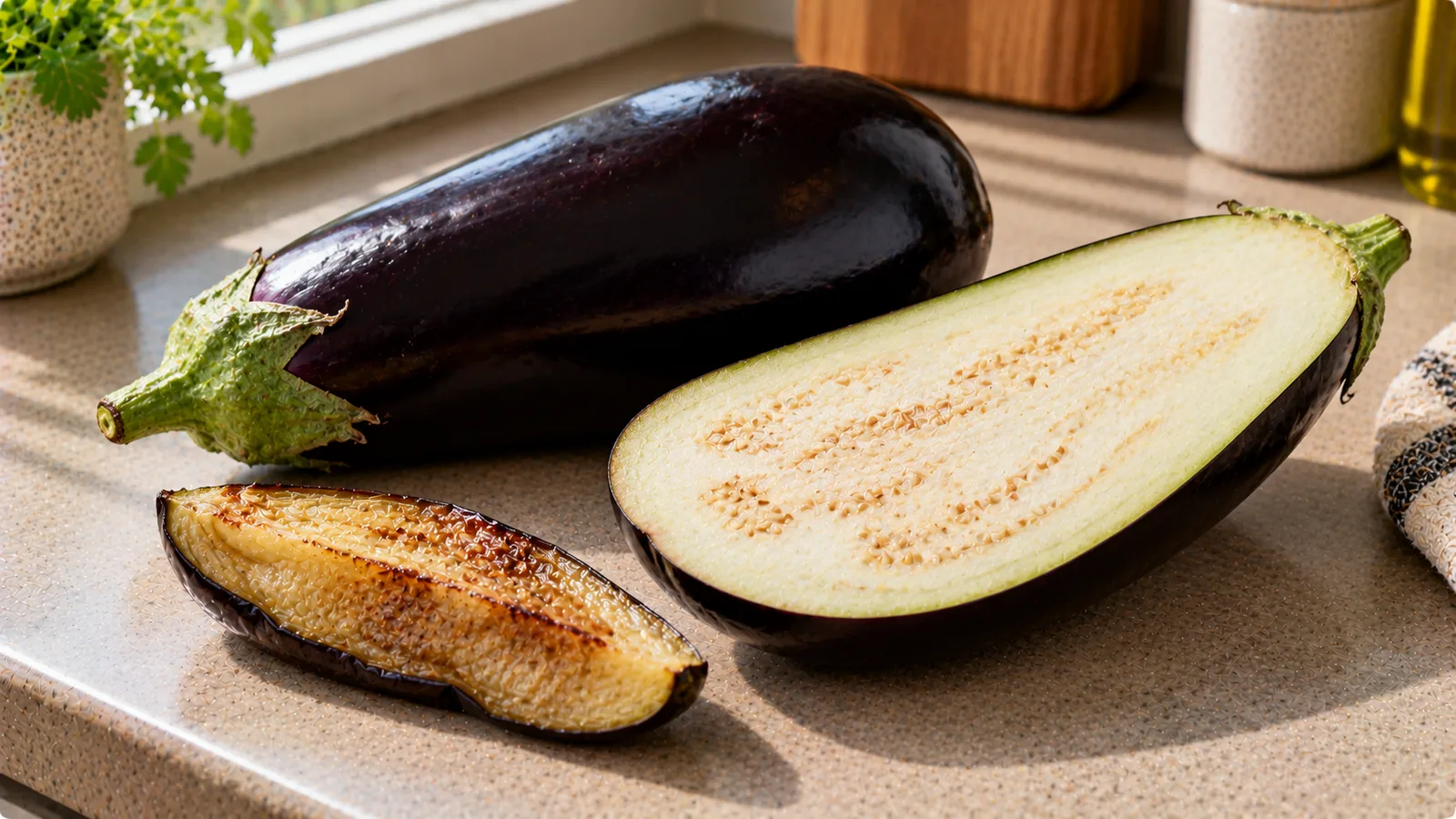
Eggplant, also called aubergine, is a relatively low-calorie vegetable commonly used in roasted dishes, stews, curries, grilled vegetables and Mediterranean recipes.
However, there is a substantial difference between the calories in plain eggplant and those in eggplant prepared with generous amounts of oil.
Raw eggplant contains approximately 25 kcal per 100 g, according to a commonly used USDA food composition reference.
That means 200 g of raw eggplant provides approximately 50 kcal before cooking oil, sauces or other ingredients are added.
The most important question when tracking eggplant calories is not simply whether the vegetable is raw or cooked. It is how much edible eggplant is consumed, how its weight changes during cooking and how much additional fat is actually eaten.
Eggplant calories by serving size
The table below uses 25 kcal per 100 g of raw eggplant.
| Raw eggplant, edible weight | Approximate calories |
|---|---|
| 50 g | 13 kcal |
| 100 g | 25 kcal |
| 150 g | 38 kcal |
| 200 g | 50 kcal |
| 250 g | 63 kcal |
| 300 g | 75 kcal |
| 400 g | 100 kcal |
| 500 g | 125 kcal |
These figures are rounded estimates for the edible raw vegetable.
They do not describe a cooked dish containing oil, cheese, breadcrumbs or sauce.
The formula is straightforward:
Calories = edible weight in grams × 25 ÷ 100
For example, 350 g raw eggplant contains approximately:
350 × 25 ÷ 100 = 88 kcal.
Source: USDA FoodData Central, eggplant, raw.
Eggplant nutrition per 100 g
A widely used USDA reference gives the following approximate values for raw eggplant.
| Nutrient | Per 100 g raw eggplant |
|---|---|
| Energy | 25 kcal |
| Protein | 0.98 g |
| Fat | 0.18 g |
| Total carbohydrate, US definition | 5.88 g |
| Dietary fiber | 3.0 g |
| Total sugars | 3.53 g |
| Water | 92.3 g |
| Potassium | 229 mg |
| Vitamin C | 2.2 mg |
These are representative composition values rather than exact measurements of every eggplant.
Variety, maturity, growing conditions and laboratory methods can affect the result.
Why carbohydrate figures differ between countries
USDA total carbohydrate figures generally include dietary fiber.
European nutrition labels report available carbohydrate separately from fiber.
Using the figures above, a simplified subtraction gives:
5.88 g total carbohydrate − 3.0 g fiber = approximately 2.9 g available carbohydrate per 100 g.
This is an explanatory approximation, not an analytical conversion guaranteed to match a European laboratory result.
For nutrition tracking, check which carbohydrate definition your database uses.
References: USDA FoodData Central and Regulation (EU) No 1169/2011.
How many calories are in one whole eggplant?
Eggplants vary widely in size.
A small eggplant and a large globe eggplant may differ by several hundred grams.
Rather than assuming one standard weight, weigh the edible portion.
The following are illustrative examples, not official size categories.
| Example size | Edible weight | Approximate calories |
|---|---|---|
| Small | 200 g | 50 kcal |
| Medium | 300 g | 75 kcal |
| Large | 450 g | 113 kcal |
| Very large | 600 g | 150 kcal |
A whole eggplant weighing 420 g contains approximately 105 kcal if all 420 g are edible.
If the stem and other discarded parts are included in the original weight, subtract them before calculating.
Should eggplant be weighed before cooking?
For recipes, weighing the prepared raw eggplant is usually convenient.
Remove the stem and any parts you will not eat.
Record the edible weight, then calculate additional ingredients separately.
If you use a cooked-food database entry instead, weigh the cooked food and select a reference that matches the cooking method.
Do not apply raw values to cooked weights without accounting for water changes.
Raw versus cooked eggplant
Cooking changes the weight and texture of eggplant.
The vegetable can lose water in the oven or absorb water during boiling.
This affects the calories per 100 g even when no oil is added.
Consider 300 g raw eggplant:
300 × 25 ÷ 100 = 75 kcal.
Suppose it is roasted without oil and weighs 210 g afterward.
If the loss of energy-containing material is negligible, the finished portion still contains approximately 75 kcal.
But its calorie density is now:
75 ÷ 210 × 100 = approximately 36 kcal per 100 g cooked.
That is a mass-balance illustration, not a universal value for roasted eggplant.
The finished vegetable contains less water, so its energy is distributed across a smaller weight.
Example: identical eggplant, different finished weights
| Preparation | Finished weight | Approximate total calories | Calories per 100 g finished |
|---|---|---|---|
| Raw starting portion | 300 g | 75 kcal | 25 kcal |
| Roasted without oil, example | 210 g | 75 kcal | 36 kcal |
| More heavily dried, example | 180 g | 75 kcal | 42 kcal |
Actual cooking can also remove juices and dissolved nutrients, so total energy is not always perfectly conserved in the edible portion.
The central point is that water loss can raise calories per 100 g without adding calories to the recipe.
Calories in boiled eggplant
Plain boiled eggplant requires no cooking oil.
Its total energy is generally close to that supplied by the original vegetable, subject to losses into cooking water.
However, the finished weight can change.
For example, 200 g raw eggplant starts with approximately 50 kcal.
If the cooked edible portion weighs 220 g because of water uptake, a simplified estimate would be approximately 23 kcal per 100 g finished.
If some soluble solids are discarded with the cooking water, the total may be slightly different.
For precise food logging, use a reliable boiled-eggplant database entry when available.
Do not assume that raw and boiled eggplant always contain exactly the same calories per 100 g.
Calories in baked or roasted eggplant
Baking is a common way to prepare eggplant.
The calories depend mainly on the starting vegetable and any added fat.
Roasted eggplant without oil
For 400 g raw eggplant:
400 × 25 ÷ 100 = 100 kcal.
Roasting can reduce the weight substantially, but the original vegetable contributes approximately 100 kcal before cooking losses.
Roasted eggplant with 10 g olive oil
Using approximately 884 kcal per 100 g olive oil:
- Eggplant, 400 g: 100 kcal.
- Olive oil, 10 g: 88 kcal.
- Total: approximately 188 kcal.
Roasted eggplant with 20 g olive oil
- Eggplant: 100 kcal.
- Olive oil: 177 kcal.
- Total: approximately 277 kcal.
These calculations assume all the added oil is eaten.
If oil remains on the baking tray, the actual consumed energy can be lower.
Source for ingredient energy values: USDA FoodData Central.
Why fried eggplant can contain many more calories
Eggplant has a porous, sponge-like structure.
During frying, oil can enter spaces within the vegetable, especially as water is lost.
Consequently, the calories of fried eggplant can vary substantially depending on the method.
It is not scientifically reliable to assign one universal calorie value to all fried eggplant.
The amount of oil used is not necessarily the same as the amount consumed.
Some oil may remain in the pan, while some may be retained by the eggplant.
Example: 250 g eggplant with different amounts of oil
The raw eggplant contributes approximately 63 kcal.
| Oil actually consumed | Calories from oil | Combined approximate calories |
|---|---|---|
| 0 g | 0 kcal | 63 kcal |
| 5 g | 44 kcal | 107 kcal |
| 10 g | 88 kcal | 151 kcal |
| 20 g | 177 kcal | 240 kcal |
| 30 g | 265 kcal | 328 kcal |
The table assumes olive oil at approximately 8.84 kcal per gram.
The amounts are hypothetical scenarios, not measured absorption rates.
A dish cooked with 30 g of oil does not automatically mean that all 30 g were consumed.
How to estimate oil in pan-fried eggplant
For home cooking:
- Weigh the oil added to the pan.
- Weigh the raw edible eggplant.
- Record other ingredients.
- If substantial oil remains, account for it rather than assuming all of it was eaten.
- Divide the estimated recipe calories by the actual portion consumed.
Measuring the exact oil retained by a vegetable can be difficult.
A transparent estimate is better than claiming a precise absorption percentage without evidence.
Grilled eggplant calories
Eggplant can be grilled plain, lightly brushed with oil or marinated.
For plain grilled eggplant, the starting vegetable weight is a useful calorie reference.
For 200 g raw eggplant:
200 × 25 ÷ 100 = 50 kcal.
If 8 g olive oil is added and entirely consumed:
- Eggplant: 50 kcal.
- Oil: approximately 71 kcal.
- Total: approximately 121 kcal.
Marinades containing sugar, honey or other calorie-containing ingredients also contribute energy.
When buying ready-made grilled eggplant, use the product label if available.
A commercial product packed in oil can be substantially different from plain grilled vegetables.
Eggplant with skin or peeled
Eggplant skin is edible when properly prepared.
Many recipes leave it on, while others peel the vegetable.
Removing the skin changes the edible weight and may alter the fiber and micronutrient composition.
The raw reference values in this article are practical approximations for ordinary eggplant.
For a peeled portion, weigh the flesh actually used and choose a more specific database entry when available.
The calorie difference caused by peeling is usually less important than the difference between cooking with no oil and cooking with a substantial amount of oil.
Eggplant calories in popular dishes
The calorie content of eggplant itself should not be used as the calorie content of an entire prepared meal.
Eggplant parmesan
Eggplant parmesan may contain cheese, tomato sauce, breadcrumbs and oil.
These ingredients can provide a substantial proportion of the dish's energy.
The final value depends on the recipe and serving size.
Baba ganoush
Baba ganoush commonly contains roasted eggplant, tahini, lemon juice and seasonings.
Tahini and added olive oil can contribute significant calories.
A spoonful of baba ganoush should not be logged as an equal weight of plain eggplant.
Moussaka
Moussaka may contain eggplant, minced meat, potatoes, béchamel and oil.
Its calorie density depends on the specific recipe.
The vegetable alone is not representative of the finished dish.
Eggplant curry
An eggplant curry may include coconut milk, oil, lentils, tomatoes or other ingredients.
A curry prepared with substantial coconut milk or oil can contain considerably more calories than plain eggplant.
Breaded fried eggplant
Breadcrumbs, flour, eggs and frying oil change the nutritional composition.
The oil retained after frying can be an important source of additional energy.
Ratatouille
Ratatouille contains several vegetables and often olive oil.
The calorie value should be calculated from the entire recipe rather than from eggplant alone.
Calculate calories in an eggplant recipe
Consider a simple roasted eggplant dish.
| Ingredient | Amount | Estimated calories |
|---|---|---|
| Raw eggplant | 500 g | 125 kcal |
| Olive oil | 15 g | 133 kcal |
| Tomato | 200 g | 36 kcal |
| Garlic | 10 g | 15 kcal |
| Total | 309 kcal |
The values for tomato, garlic and oil are rounded reference estimates.
If the dish makes three equal servings:
309 ÷ 3 = 103 kcal per serving.
If one person eats half the recipe:
309 × 0.5 = approximately 155 kcal.
These calculations assume all listed ingredients are consumed.
If oil or cooking liquid is discarded, the actual intake may differ.
For a food diary, the recipe method is usually more accurate than selecting a generic entry such as “roasted eggplant.”
Calories per 100 g cooked versus calories per recipe
This distinction is particularly important for eggplant because cooking can greatly change its weight.
Suppose two recipes both start with 500 g raw eggplant.
Each contains approximately 125 kcal from the vegetable.
One is roasted without oil and finishes at 300 g.
The other is roasted with 20 g olive oil and finishes at 320 g.
| Recipe | Finished weight | Estimated total calories | Per 100 g finished |
|---|---|---|---|
| Without oil | 300 g | 125 kcal | 42 kcal |
| With 20 g olive oil | 320 g | 302 kcal | 94 kcal |
The oil-based calculation assumes all 20 g are consumed.
Both water loss and oil addition affect the finished calorie density.
When tracking a homemade dish, recording the raw ingredients and finished recipe weight helps avoid confusion.
Is eggplant high in carbohydrates?
Eggplant is not particularly concentrated in carbohydrates.
The USDA reference lists approximately 5.88 g total carbohydrate per 100 g raw eggplant under the American definition, including around 3.0 g fiber.
For a 250 g portion, that corresponds to approximately:
- 14.7 g US total carbohydrate.
- 7.5 g fiber.
- 7.2 g available carbohydrate by simplified subtraction.
These are approximate values.
If you compare American and European food databases, make sure the carbohydrate definitions match.
A database difference does not necessarily mean that one entry is incorrect.
Is eggplant a good protein source?
Raw eggplant contains approximately 0.98 g protein per 100 g.
A 300 g portion provides roughly 2.9 g protein.
It contributes some protein but is not a concentrated source.
A meal containing eggplant can include beans, lentils, tofu, fish, eggs or other protein-rich ingredients depending on dietary preferences.
The complete recipe determines the nutritional profile.
Eggplant and weight management
Plain eggplant has a relatively low energy density because it contains substantial water.
It can contribute volume and fiber to vegetable-based dishes.
However, eggplant does not directly cause weight loss.
Overall energy intake, dietary patterns, physical activity and individual circumstances matter.
A large portion of eggplant fried in considerable oil can contain substantially more energy than the same vegetable steamed or roasted without fat.
The practical takeaway is to track the preparation, not just the vegetable name.
Quick answers
How many calories are in 100 g raw eggplant?
Approximately 25 kcal using the cited USDA reference.
How many calories are in 200 g?
Approximately 50 kcal before additional ingredients.
How many calories are in a medium eggplant?
If its edible weight is 300 g, approximately 75 kcal. Actual sizes vary.
Does cooked eggplant have more calories?
Cooking without calorie-containing additions does not create energy, but water changes can alter calories per 100 g.
Why is fried eggplant higher in calories?
Oil retained and consumed during frying adds energy.
How much oil does eggplant absorb?
There is no universal absorption amount. It depends on preparation and the quantity of oil actually retained and eaten.
Sources
- USDA FoodData Central — eggplant composition and ingredient energy values.
- Regulation (EU) No 1169/2011 — European nutrition labeling definitions.
- USDA MyPlate — general vegetable guidance.
All values are estimates. Actual calorie content depends on edible weight, preparation, moisture changes and added ingredients.