
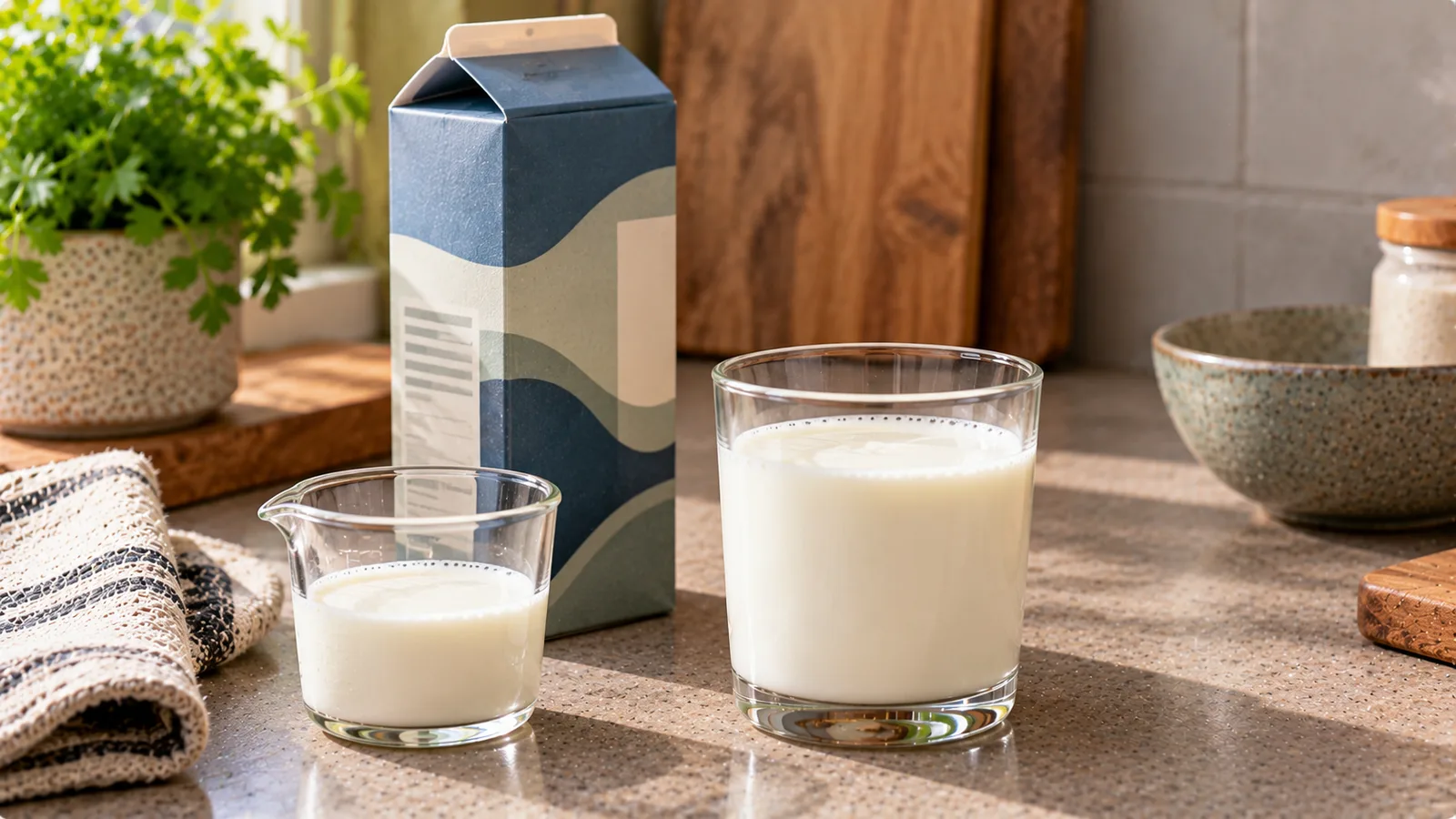
Buttermilk is a cultured dairy drink with a tangy flavor and a consistency that is usually thicker than ordinary milk. Its calorie content varies by brand, fat level and formulation, so the package nutrition label is the best source when you need an exact value.
As a practical reference, many plain cultured buttermilk products provide roughly 35–50 kcal per 100 ml.
A typical serving of 250 ml therefore contains approximately 90–125 kcal.
Buttermilk calories at a glance
| Amount | Approximate calories |
|---|---|
| 50 ml | 18–25 kcal |
| 100 ml | 35–50 kcal |
| 150 ml | 53–75 kcal |
| 200 ml | 70–100 kcal |
| 250 ml | 88–125 kcal |
| 300 ml | 105–150 kcal |
| 500 ml | 175–250 kcal |
These are representative ranges rather than universal values.
A specific product may fall outside them, especially if it contains more fat, added sugar, fruit or flavorings.
How many calories are in 100 ml of buttermilk?
Plain cultured buttermilk commonly contains around 35–50 kcal per 100 ml.
For a worked example, suppose your buttermilk contains:
40 kcal per 100 ml
Then:
- 50 ml = 20 kcal;
- 100 ml = 40 kcal;
- 150 ml = 60 kcal;
- 200 ml = 80 kcal;
- 250 ml = 100 kcal;
- 300 ml = 120 kcal;
- 500 ml = 200 kcal.
The calculation is:
calories = milliliters consumed × calories per 100 ml ÷ 100
If your label says 44 kcal per 100 ml and you drink 250 ml:
250 × 44 ÷ 100 = 110 kcal
Calories in one cup of buttermilk
Cup size depends on the measuring system.
A US cup is approximately 240 ml.
If the product contains 40 kcal per 100 ml:
240 × 40 ÷ 100 = 96 kcal
A 250 ml metric-style serving at the same calorie density would contain:
250 × 40 ÷ 100 = 100 kcal
For accurate tracking, using milliliters from the package or measuring jug is clearer than entering an unspecified “cup.”
Typical nutrition in plain buttermilk
Nutrition varies between products, but plain cultured buttermilk often provides approximately the following per 100 ml:
| Nutrient | Typical range per 100 ml |
|---|---|
| Calories | 35–50 kcal |
| Protein | 3–4 g |
| Carbohydrate | 4–5 g |
| Sugars | 4–5 g |
| Fat | 0.5–2 g |
The sugars in plain unsweetened buttermilk are often largely naturally occurring milk sugars such as lactose.
A flavored or sweetened product can contain substantially more carbohydrate and calories.
Why buttermilk calories vary
Several factors can change the calorie value.
Fat content
Fat provides about 9 kcal per gram, so a higher-fat buttermilk generally contains more calories than a low-fat version.
Two products can both be sold as buttermilk while having different fat percentages.
Added sugar
Plain cultured buttermilk does not need added sugar to contain sugars because milk naturally contains lactose.
Sweetened or flavored versions may contain additional sugar and therefore more calories.
Added fruit or flavorings
Fruit preparations, syrups or other ingredients can change both carbohydrate and calorie content.
Regional formulation
The word “buttermilk” does not always describe exactly the same commercial product in every country.
Traditional buttermilk and modern cultured buttermilk can differ in production and composition.
For calorie tracking, use the nutrition information for the product you actually consumed.
Low-fat vs higher-fat buttermilk
Consider two hypothetical products.
Product A
- 36 kcal per 100 ml;
- 0.5 g fat;
- 3.4 g protein;
- 4.2 g carbohydrate.
Product B
- 50 kcal per 100 ml;
- 2.0 g fat;
- 3.3 g protein;
- 4.5 g carbohydrate.
For a 250 ml serving:
Product A:
36 × 2.5 = 90 kcal
Product B:
50 × 2.5 = 125 kcal
The difference is 35 kcal for the same volume.
Neither number should be assumed for every product. The example simply shows why fat level and formulation matter.
Is buttermilk high in protein?
Buttermilk contains protein, but it is not usually an extremely concentrated protein food.
At approximately 3–4 g protein per 100 ml, a 250 ml serving may provide roughly:
7.5–10 g protein
For example, if a product contains 3.4 g protein per 100 ml:
250 × 3.4 ÷ 100 = 8.5 g protein
This can make buttermilk a useful protein contributor, but the amount is lower than in many concentrated dairy products such as some quark, skyr or high-protein yogurt products.
How many carbs are in buttermilk?
Plain buttermilk commonly contains around 4–5 g carbohydrate per 100 ml, although labels vary.
At 4.5 g per 100 ml, a 250 ml serving provides:
250 × 4.5 ÷ 100 = 11.25 g carbohydrate
Most of the carbohydrate in a plain dairy product may come from naturally occurring milk sugar.
Flavored products can contain more.
How much fat is in buttermilk?
The amount depends strongly on the product.
A low-fat version might contain approximately 0.5–1 g fat per 100 ml, while another version may contain around 1.5–2 g or more.
If a product contains 1 g fat per 100 ml, then 250 ml contains:
2.5 g fat
If another contains 2 g per 100 ml, the same serving contains:
5 g fat
This difference contributes to the calorie difference between products.
Is buttermilk the liquid left after making butter?
Historically, traditional buttermilk was the liquid remaining after butter was churned from cream.
Many commercial products sold as buttermilk today are instead made by culturing milk with suitable bacteria.
This matters because the composition of a modern packaged product should not be inferred from the historical definition.
For nutrition tracking, the label on the actual product is the relevant reference.
Buttermilk vs regular milk calories
The comparison depends on the fat content of both products.
A low-fat cultured buttermilk may contain calories similar to low-fat milk.
A higher-fat milk can contain more calories, while a higher-fat buttermilk may narrow the difference.
For example:
| Product | Illustrative calories per 100 ml |
|---|---|
| Low-fat buttermilk | 35–40 kcal |
| Higher-fat buttermilk | 45–50 kcal |
| Low-fat milk | 40–50 kcal |
| Whole milk | 60–70 kcal |
These figures are approximate.
When choosing between two actual products, compare their labels rather than assuming that buttermilk is always lower in calories.
Buttermilk vs kefir
Both are fermented dairy drinks, but they are different products.
Their calories depend largely on:
- milk fat;
- added sugar;
- flavorings;
- brand formulation.
A plain low-fat kefir and a plain low-fat buttermilk may have relatively similar calorie densities.
Sweetened kefir can contain considerably more calories.
The product name alone is not enough for an accurate comparison.
Is buttermilk good for weight loss?
No individual food causes weight loss by itself.
Body weight changes over time are influenced by overall energy intake and expenditure.
Plain buttermilk can fit into a calorie-controlled diet because a typical glass provides a moderate amount of energy along with protein and other nutrients.
Whether it supports your plan depends on:
- portion size;
- the rest of your diet;
- whether the product is plain or sweetened;
- your overall calorie intake.
A 250 ml glass containing 100 kcal can fit very differently into a day than a large sweetened 500 ml drink containing substantially more energy.
Buttermilk in cooking
Buttermilk is also used in:
- pancakes;
- waffles;
- cakes;
- breads;
- biscuits;
- marinades;
- dressings.
When buttermilk is used in a recipe, its calories become part of the total recipe calories.
Suppose a pancake recipe contains 400 ml of buttermilk at 40 kcal per 100 ml.
The buttermilk contributes:
400 × 40 ÷ 100 = 160 kcal
Those 160 kcal belong to the entire batch, not to each pancake.
If the recipe makes eight equal pancakes, the buttermilk itself contributes an average of:
160 ÷ 8 = 20 kcal per pancake
Other ingredients must be calculated separately.
Does cooking change the calories in buttermilk?
Heating does not simply remove the calories.
Water may evaporate during cooking, changing the final weight and calorie density of the finished dish.
The nutrients from the buttermilk remain part of the recipe unless some of the mixture is discarded.
For recipe tracking, count the amount of buttermilk added to the batch and then divide the complete recipe according to the final yield or portions.
Measuring buttermilk accurately
Because buttermilk is a liquid, milliliters are usually the simplest unit.
If the nutrition label provides values per 100 ml, measure the amount in milliliters and calculate directly.
For example:
Label:
42 kcal per 100 ml
Amount used:
180 ml
Calculation:
42 × 1.8 = 75.6 kcal
Rounded reasonably, that is about 76 kcal.
What if the label uses grams?
Some recipes or databases record buttermilk by weight.
For everyday use, the density of a milk-based liquid is close enough to water that grams and milliliters may appear numerically similar, but they are not formally identical units.
When precision matters, use the same unit as the package, recipe or verified database rather than assuming a perfect 1:1 conversion.
How to log a glass of buttermilk
For accurate food logging:
- identify the exact product;
- check calories per 100 ml;
- measure how much you drank;
- multiply the amount by the per-100-ml value;
- include any additions separately.
For example:
- buttermilk: 250 ml at 41 kcal/100 ml = about 103 kcal;
- honey: 10 g = additional calories;
- fruit: logged separately.
Do not use the calories for plain buttermilk if you drank a flavored version.
Common serving sizes
A serving does not have one universal size.
Useful practical amounts include:
100 ml: small amount used in a recipe or drink.
200 ml: modest glass.
250 ml: common larger glass.
300 ml: large drink.
500 ml: half-liter bottle or large portion.
If your product contains 40 kcal per 100 ml, these correspond to approximately:
- 100 ml = 40 kcal;
- 200 ml = 80 kcal;
- 250 ml = 100 kcal;
- 300 ml = 120 kcal;
- 500 ml = 200 kcal.
Plain vs flavored buttermilk
This distinction can make a substantial difference.
Suppose plain buttermilk contains:
40 kcal per 100 ml
and a flavored version contains:
70 kcal per 100 ml
For 300 ml:
Plain:
40 × 3 = 120 kcal
Flavored:
70 × 3 = 210 kcal
That is a difference of 90 kcal in one bottle-sized serving.
When comparing products, check the actual nutrition label rather than relying on the word “buttermilk.”
What to check on the label
For a packaged buttermilk product, look at:
- calories or energy;
- serving basis;
- protein;
- carbohydrate;
- sugars;
- fat;
- saturated fat;
- ingredient list;
- whether the product is plain or flavored.
In Europe, energy is commonly shown in both kilojoules and kilocalories.
Make sure you are reading kcal, not confusing it with kJ.
Converting kilojoules to calories
If you only have kilojoules, the approximate conversion is:
1 kcal = 4.184 kJ
For example, if a product contains 170 kJ per 100 ml:
170 ÷ 4.184 ≈ 40.6 kcal
So the product contains approximately 41 kcal per 100 ml.
Most packaged foods in the EU already display both values, so manual conversion is rarely necessary.
Practical takeaway
Plain cultured buttermilk commonly provides roughly 35–50 kcal per 100 ml, although the exact value depends on the product.
A typical 250 ml glass may therefore provide approximately 90–125 kcal.
For the most accurate result, use the value printed on your specific package and multiply it by the amount actually consumed.
The most important distinctions are the fat level, whether the product is plain or sweetened, and the serving size. Those factors can change the calories much more than the product name alone suggests.
Nutrition data sources and product differences
The records below describe only the named foods, fat levels and preparation states. USDA figures are per 100 g; manufacturer figures retain their stated unit. These sources do not independently prove every approximate figure in the article.
USDA FoodData Central (search by FDC ID):
- FDC 2259792 — Buttermilk, low fat (42.92 kcal/100 g)