
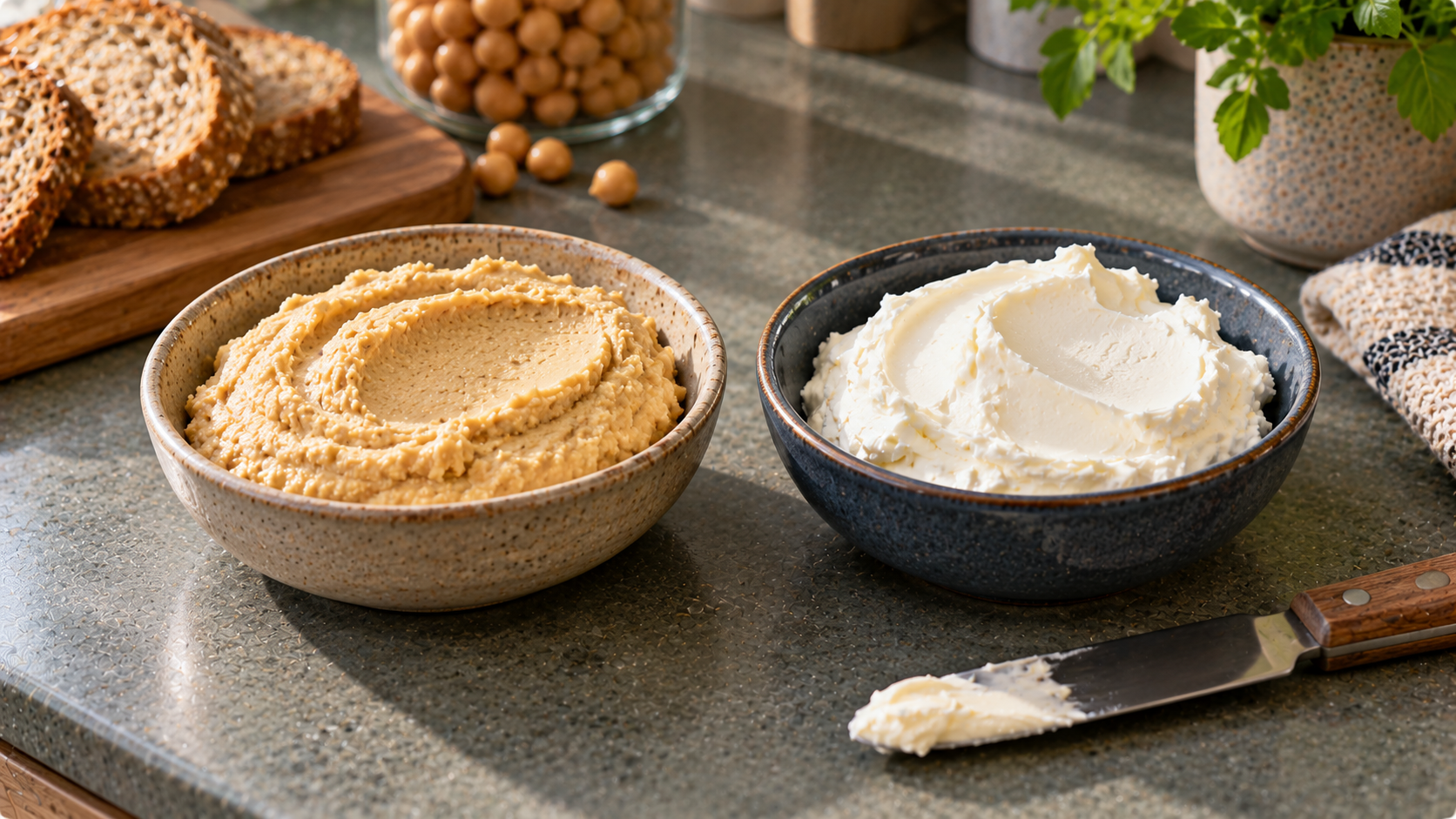
Hummus and cream cheese can fill the same role on a sandwich, bagel or cracker, yet their ingredients and nutritional strengths differ. Hummus is usually a chickpea-based spread blended with tahini, lemon and oil; regular cream cheese is a fresh dairy cheese. Neither is automatically a high-protein food or a low-calorie choice. The useful comparison is a matched serving of the particular products you buy, with the entire meal in view.
If the priority is plant-derived fiber, hummus will usually have the advantage. If a smooth, tangy dairy texture is needed for a filling or frosting, cream cheese may work better. But fat content, sodium, recipe and portion weight can change the result substantially. A statement such as “hummus always has fewer calories” is not reliable without checking labels.
What are you actually comparing?
Classic hummus combines cooked chickpeas, tahini (sesame paste), lemon juice, garlic and sometimes olive oil or another vegetable oil. Water, chickpea cooking liquid and acids affect texture, while the quantities of tahini and oil strongly influence energy density. Some store-bought products contain additional preservatives, starches or seasonings; others have remarkably short ingredient lists. A high-oil hummus and a lighter chickpea-rich hummus should not be treated as identical foods.
Conventional full-fat cream cheese is made from dairy ingredients such as milk and cream, with cultures and sometimes stabilizers or salt. Reduced-fat cream cheese, whipped cream cheese and protein-enriched fresh-cheese spreads are different formulations. Whipped products can look larger by volume without providing the same grams of food. Compare by weight, not simply by a spoonful or by how much fills a bagel.
These products are not substitutes for one another in every dietary pattern: hummus may contain sesame, whereas cream cheese contains milk. For allergy decisions, check the actual label rather than relying on a broad product name. EU law lists milk and sesame among allergens that require clear identification in ingredients. European Commission — allergen guidance.
Nutrition comparison: a realistic 30 g spread
The table below uses illustrative labels, not measurements of all hummus or cream cheese. Product A is a hypothetical plain hummus listing 230 kcal, 6 g protein, 16 g fat, 2 g saturated fat, 13 g carbohydrate, 5 g fiber and 1.1 g salt per 100 g. Product B is a hypothetical regular cream cheese listing 300 kcal, 6 g protein, 29 g fat, 19 g saturated fat, 4 g carbohydrate, 0 g fiber and 0.8 g salt per 100 g. Replace every entry with the numbers from the two packs you are considering.
Because recipes and fat contents vary by brand, compare these sample figures with the separate portion guides for hummus and cream cheese.
| Nutrient | Hummus A, 100 g | Cream cheese B, 100 g | Hummus A, 30 g | Cream cheese B, 30 g |
|---|---|---|---|---|
| Energy | 230 kcal | 300 kcal | 69 kcal | 90 kcal |
| Protein | 6 g | 6 g | 1.8 g | 1.8 g |
| Total fat | 16 g | 29 g | 4.8 g | 8.7 g |
| Saturated fat | 2 g | 19 g | 0.6 g | 5.7 g |
| Carbohydrate | 13 g | 4 g | 3.9 g | 1.2 g |
| Fiber | 5 g | 0 g | 1.5 g | 0 g |
| Salt | 1.1 g | 0.8 g | 0.33 g | 0.24 g |
The practical lesson is not that those exact figures apply to every supermarket shelf. It is that a portion comparison can reveal a modest calorie difference, a large difference in saturated fat, or the reverse of what you expected for salt. Flavored cream cheeses, reduced-fat versions and oil-heavy hummus can all change the ranking. Always compare the same units and remember that salt on an EU label is not the same unit as sodium on some other databases.
EU nutrition-labelling rules require energy, fat, saturates, carbohydrate, sugars, protein and salt on most prepacked foods; fiber may appear voluntarily. A blank fiber entry does not justify inventing a measured fiber value.
Protein: do either of these count as a protein food?
Both contain some protein, but a thin spread contributes much less than a meal-sized serving of beans, skyr, eggs or tofu. In the example, 30 g supplies only 1.8 g protein from either option. Even if a particular cream cheese lists more protein per 100 g, a 15–20 g coating adds only a fraction of that amount.
Chickpeas contribute plant protein to hummus, while cream cheese provides dairy protein. However, neither spread should be described as nutritionally equivalent to its underlying ingredient: hummus is diluted or enriched by tahini, oil, liquid and seasoning, while full-fat cream cheese provides a different fat-to-protein ratio from milk, cottage cheese or skyr.
For a protein-oriented lunch, use the spread for flavor and add a substantial protein component. A chickpea spread with 100 g cooked chicken, tofu or a measured serving of lentils is a different meal from bread coated with a thin layer of hummus alone. If the entire sandwich is to be assessed, calculate bread, spread and filling separately rather than claiming the spread supplies the protein goal.
Fat quality matters more than the word “fat” alone
Regular cream cheese can supply a relatively large proportion of saturated fat because it contains dairy fat. Hummus generally derives more of its fat from tahini and vegetable oils, so the fatty-acid pattern often contains more unsaturated fat. That is a typical formulation difference, not proof that every hummus is low in total fat or that every cream cheese has exactly the same saturated-fat number.
A 30 g portion from the hypothetical table contributes 0.6 g saturates from hummus versus 5.7 g from full-fat cream cheese. Across several daily meals, that can be relevant when someone is trying to replace some saturated fat with unsaturated fat. The NHS guidance on reducing saturated fat recommends checking product labels and considering lower-fat alternatives.
There is a second side to the comparison: adding large amounts of olive oil or tahini increases hummus calories. A tablespoon of oil cannot be treated as though it were extra chickpea fiber. Nor does a “plant-based” label make a product calorie-free. A reduced-fat cream cheese may have less fat than a particular rich hummus. Use the declared composition, not a simplistic plant-versus-dairy hierarchy.
Fiber, carbohydrates and how satisfying a portion feels
Chickpeas supply dietary fiber, while conventional cream cheese contains little or none. Hummus can therefore add some fiber to a sandwich or vegetable snack, although a small spread portion does not necessarily provide many grams. In our 30 g example it adds 1.5 g; a generous 60 g portion would add 3 g if the product matches the assumed label.
Cream cheese normally has fewer total carbohydrates per equal weight than many chickpea-based spreads. This can matter for a particular meal plan, but it does not mean hummus is unsuitable for balanced eating. The amount of bread, crackers or vegetables eaten alongside the spread may contribute much more carbohydrate than the spread itself.
Satisfaction also depends on food texture and the rest of the plate. A hummus-and-vegetable snack adds crunch, water and volume from the vegetables. A cream-cheese bagel may be filling because of the bagel's size, but the spread alone is not a complete meal. If hunger returns quickly, check overall meal protein, fiber and portion size before deciding that one spread is inherently “better for fullness.”
Salt: a label check that can reverse the result
Hummus is not necessarily lower in salt. Ready-made dips can contain appreciable salt, and recipes differ widely. Plain full-fat cream cheese may also vary by brand and processing. The illustrative 30 g comparison actually shows more salt in hummus (0.33 g) than cream cheese (0.24 g). A different pair of brands could reverse this.
In Europe, salt is listed per 100 g, making it straightforward to compare like with like. Multiply the per-100-g figure by the portion weight and divide by 100. For example, 1.4 g salt per 100 g means 0.42 g for 30 g. Check serving size carefully: marketing claims on the front of a tub may use portions that do not resemble your actual serving.
Also consider what accompanies the spread. Salted crackers, smoked salmon, cheese slices or seasoned meats can add more salt to the snack than either spread. The practical unit of choice is often the whole snack, not just the tub.
Allergens and different dietary needs
Traditional hummus commonly contains sesame via tahini, and sesame is a regulated allergen in the EU. Chickpeas themselves can also cause reactions in some people, even though chickpea is not one of the 14 EU allergens mandated for emphasis in the same way as sesame. Cream cheese contains milk proteins and lactose in varying quantities. Lactose intolerance is not the same as milk-protein allergy; do not assume a lactose-free dairy cream cheese is safe for someone allergic to milk.
A hummus labeled vegan may be suitable for someone avoiding dairy, but the ingredient list and cross-contact information still matter. Some flavored spreads contain yogurt, cheese or other unexpected ingredients. Conversely, reduced-lactose or lactose-free cream cheese does not become plant-based.
For younger children, pregnancy, immunocompromised consumers or anyone needing extra food-safety precautions, follow the package's storage and use-by instructions. Keep chilled spreads cold, use clean utensils, avoid leaving opened tubs on a warm table for extended periods and discard food that has passed safety limits. Do not infer microbiological safety from appearance or smell alone.
Taste and texture: when substitution actually works
Hummus has a savory, nutty and often garlicky character, with a dense texture that can range from smooth to coarse. It works well with roasted peppers, cucumber, carrots, flatbread and grain bowls. A little lemon or water can loosen a thick hummus; adding oil changes its calories. It can replace cream cheese on a savory sandwich when the flavor fits, but it will not reproduce the same dairy tang or set a cheesecake filling.
Cream cheese offers a mild dairy tang and spreadable, creamy richness. It pairs with herbs, smoked fish, cucumber, fruit and baked goods. Its behavior in hot dishes depends on product formulation: heat can alter texture, especially for reduced-fat varieties. In cold desserts and frosting, cream cheese often performs a structural job that chickpea hummus does not.
| Situation | Starting option | Why |
|---|---|---|
| Savory vegetable dip | Hummus | Chickpea flavor, often contributes fiber |
| Creamy cake frosting | Cream cheese | Appropriate dairy flavor and structure |
| Plant-based sandwich | Hummus, after allergen check | Usually dairy-free |
| Lower saturated-fat spread | Compare hummus with reduced-fat cream cheese | Product-specific values decide |
| Lower-salt option | Read both labels | Neither category always wins |
| Protein-focused lunch | Either as a condiment | Add a substantial protein source |
Two practical snack comparisons
Example 1 — toast with a measured spread. Take two slices of bread totaling 80 g. Add 30 g of either example product. The spread alone provides 69 kcal from hummus or 90 kcal from cream cheese, a 21 kcal difference. Bread calories are the same for both scenarios and must be added separately. If the cream cheese is reduced-fat or the hummus has more oil, the difference could narrow or reverse.
Example 2 — vegetables with dip. Serve 200 g raw vegetables with 60 g hummus. Under the example label, the dip contributes 138 kcal, 3.6 g protein and 3 g fiber. Sixty grams of the example cream cheese would supply 180 kcal, 3.6 g protein and 0 g fiber. Vegetables contribute their own nutrition in both cases. Sixty grams is a substantial dipping portion, not the same as a thin sandwich coating. Measure the serving actually eaten.
For meal planning, do not let the spread decision hide the larger differences among breads, crackers, vegetables, cheeses and other toppings. A modest layer of either spread can fit a varied diet; serving accuracy is typically more useful than declaring one food categorically good and the other bad.
Cost per actual serving, not per jar
Suppose, purely as a calculation, that hummus costs €1.80 for 200 g and cream cheese €1.50 for 200 g. The hummus costs €0.90 per 100 g or €0.27 per 30 g; cream cheese costs €0.75 per 100 g or €0.225 per 30 g, rounded to €0.23. These are hypothetical prices, not observed offers or a claim about any shop. Prices, promotions, brands and packaging vary.
A larger tub may have a cheaper per-100-g price but be poor value if some spoils before you finish it. Check use-by dates, opened-pack guidance and how many servings you will realistically use. Homemade hummus also has ingredient, preparation and refrigeration costs: count chickpeas, tahini, oil and other additions rather than assuming it must be cheaper than every ready-made dip.
A quick decision at the supermarket
Start with two specific products, not category averages. Read energy, total fat, saturates, protein and salt per 100 g. If fiber is declared, add it to the comparison. Multiply values by a realistic 30 g spread or 60 g dip. Then check ingredients and allergens, serving purpose, taste and cost. Finally assess the rest of the meal.
Choose hummus when its flavor, fiber and usually more unsaturated fat fit the dish; choose cream cheese when its dairy flavor and texture are the point, or when a particular lower-fat product better meets your needs. No spread alone determines whether a diet is nutritious.
Sources and methodology
- USDA FoodData Central — food composition search: consult the entries corresponding to the exact formulation; products differ.
- European Commission — nutrition labelling: mandatory label fields and optional fiber information.
- European Commission — guidance on allergens: milk and sesame declaration.
- NHS — how to eat less saturated fat: practical label comparison.
All numerical product and price examples on this page are explicitly hypothetical. They illustrate arithmetic, not verified branded-product data. Nutrition statements are general information rather than personal medical advice.