
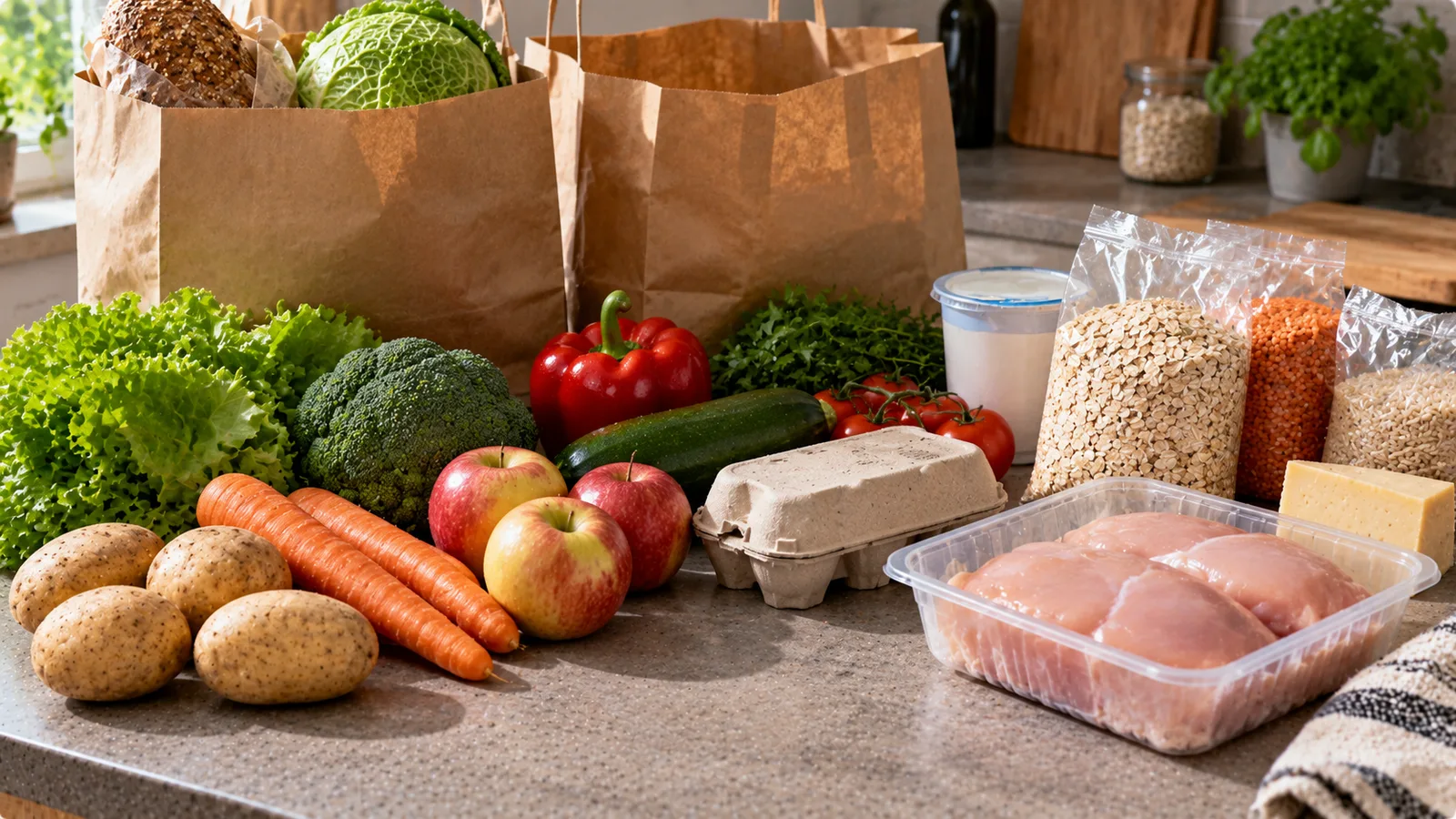
The cost of a healthy diet is not simply the price of a basket of vegetables, chicken and rice. It is the cost of buying enough food to cover your actual meals, in realistic package sizes, while accounting for ingredients you already own and food that may go unused.
A useful weekly food budget therefore answers three different questions:
- How much food will you eat?
- How much money will you spend at the checkout?
- How much of that spending belongs to this particular week?
Those amounts are related, but they are not always equal.
This guide shows how to build a weekly budget from meals rather than starting with an arbitrary spending limit.
What counts as a healthy diet?
A healthy diet is a pattern of eating, not a fixed shopping list.
It generally includes a variety of vegetables, fruit, whole grains, legumes and other suitable protein sources, while taking individual energy requirements and dietary needs into account.
The World Health Organization's healthy diet guidance describes principles such as adequacy, balance, moderation and diversity.
Germany's DGE dietary recommendations provide another practical framework for choosing food groups.
Neither source establishes one universal weekly grocery price. The cost depends on the country, shop, household, dietary restrictions, portion sizes and available cooking facilities.
The three numbers that make a budget useful
Consider a household that purchases a large bag of oats, a bottle of olive oil and ingredients for several meals.
Its financial picture has three layers.
| Measure | What it tells you |
|---|---|
| Checkout spending | Money actually paid during the week |
| Food consumed | Estimated value of ingredients eaten during the week |
| Food wasted | Value of purchased food discarded rather than eaten |
Suppose you buy a €5 bottle of olive oil but use only one-fifth of it.
Your checkout spending includes €5.
Your estimated weekly ingredient consumption includes approximately €1 of that oil.
The remaining €4 is still food inventory, not necessarily waste.
Keeping these categories separate prevents misleading comparisons between weeks.
Step 1: Set the household and meal scope
Before estimating prices, define exactly whom the budget covers.
Record:
- Number of people
- Days included
- Meals usually eaten at home
- Meals purchased outside the home
- Dietary restrictions or allergies
- Available cooking time
- Food already in the kitchen
A weekly budget for one person who eats lunch at work is not directly comparable with a budget for someone who prepares every meal at home.
Likewise, a two-person household does not always cost exactly twice as much as a one-person household because some ingredients can be shared more efficiently.
Step 2: Build a simple seven-day meal structure
You do not need 21 different recipes.
A practical week can reuse ingredients while varying how they are prepared.
For example:
| Meal category | Possible choices |
|---|---|
| Breakfasts | Oats with yogurt and fruit; eggs on whole-grain bread |
| Lunches | Lentil soup; rice with beans and vegetables |
| Dinners | Chicken with potatoes; pasta with tomato sauce and vegetables |
| Snacks | Fruit; yogurt; nuts |
| Flexible meal | Leftovers or a meal using remaining ingredients |
The objective is to cover your actual eating occasions without purchasing an entirely new set of ingredients for every recipe.
Repeating ingredients is not the same as eating identical meals every day.
Step 3: Convert meals into shopping quantities
A meal plan becomes financially useful only when it produces quantities.
For example, suppose your weekly plan requires:
| Ingredient | Required for the week |
|---|---|
| Oats | 350 g |
| Rice, dry | 400 g |
| Lentils, dry | 300 g |
| Eggs | 8 |
| Yogurt | 1 kg |
| Potatoes | 1.5 kg |
| Mixed vegetables | 3 kg |
| Fruit | 2 kg |
These are illustrative planning quantities, not universal dietary recommendations.
Actual requirements depend on portions, household composition and the other foods in the plan.
Check whether ingredients are already available before adding them to the shopping list.
Step 4: Compare unit prices, not just package prices
The most useful price comparison is usually the cost per kilogram, liter or other comparable unit.
Suppose two bags of rice cost:
| Product | Package | Price | Price per kg |
|---|---|---|---|
| Rice A | 500 g | €1.39 | €2.78 |
| Rice B | 1 kg | €2.29 | €2.29 |
Rice B is cheaper per kilogram.
However, the larger package is only the better purchase if you can store and use it.
If you need 400 g this week, your estimated ingredient consumption is:
- Rice A: 0.4 × €2.78 = €1.11
- Rice B: 0.4 × €2.29 = €0.92
The checkout cost remains €1.39 or €2.29, respectively.
These are hypothetical prices, not verified current retail offers.
For packaged foods sold in the EU, the food information regulation provides part of the regulatory framework for consumer information. Check the displayed unit price where available and confirm package weight.
Step 5: Build an example weekly grocery basket
The following is a fictional budgeting exercise for one adult in Germany, not a claim about current supermarket prices or a nutritionally complete meal plan.
It illustrates how to organize a basket before checking actual local offers.
| Food category | Example items | Budget |
|---|---|---|
| Vegetables | Carrots, cabbage, onions, tomatoes, frozen vegetables | €13.00 |
| Fruit | Apples, bananas, seasonal fruit | €6.00 |
| Grains and bread | Oats, rice, pasta, whole-grain bread | €8.00 |
| Legumes | Lentils, beans, chickpeas | €5.00 |
| Protein foods | Eggs, chicken, tofu or alternatives | €13.00 |
| Dairy or alternatives | Yogurt, milk or fortified alternatives | €7.00 |
| Fats and extras | Oil, seeds, seasoning allowance | €4.00 |
| Flexible reserve | Price differences or one missing ingredient | €5.00 |
| Total | €61.00 |
The €61 figure is an example of a planning method, not an estimate of what everyone should spend.
It may be too low for some households and unnecessarily high for others.
The exact basket must be checked against real package sizes, local prices and the meals you intend to prepare.
Step 6: Distinguish a weekly budget from a monthly average
A week with bulk purchases may look expensive even if those purchases reduce later spending.
Suppose your spending is:
| Week | Checkout spending |
|---|---|
| Week 1 | €78 |
| Week 2 | €51 |
| Week 3 | €57 |
| Week 4 | €54 |
| Four-week total | €240 |
The average is:
€240 ÷ 4 = €60 per week.
That average is more useful for planning than treating the €78 week as a permanent new baseline.
A calendar month is not exactly four weeks, so monthly budgeting should account for the actual number of days.
For a longer-term estimate:
Average weekly spending × 52 ÷ 12 = approximate monthly spending.
At €60 per week, that is approximately €260 per month.
Step 7: Account for food waste
Food that is purchased but never eaten raises the effective cost of meals.
Suppose you purchase €12 of fresh produce and discard €3 worth.
You paid €12 but consumed only approximately €9 worth.
This does not mean you should stop buying vegetables.
It means the quantities, storage or timing may need adjustment.
Useful changes include:
- Buying delicate produce for the next few days rather than the entire week
- Using frozen vegetables when practical
- Planning one meal around ingredients that need using
- Keeping track of what is already in the refrigerator
- Choosing quantities that match realistic appetites
The cheapest item per kilogram is not necessarily the cheapest usable food if much of it spoils.
Step 8: Compare the cost per useful portion
A recipe's total price matters less than its cost per portion when comparing meals.
For example:
| Recipe | Total ingredient cost | Portions | Cost per portion |
|---|---|---|---|
| Lentil soup | €5.40 | 4 | €1.35 |
| Vegetable pasta | €6.80 | 4 | €1.70 |
| Chicken and potatoes | €9.60 | 4 | €2.40 |
These are illustrative costs.
They exclude electricity, cooking equipment and any ingredients not included in the hypothetical totals.
To compare recipes consistently, use the same approach to pantry ingredients, oil, seasonings and leftovers.
Also consider whether portions are sufficiently substantial for the people eating them.
The cheapest diet is not necessarily the best diet
A low grocery bill alone does not demonstrate nutritional adequacy.
A shopping basket dominated by a small number of cheap foods may fail to provide sufficient variety or meet individual nutritional needs.
On the other hand, expensive branded products are not automatically more nutritious than basic foods.
Legumes, oats, seasonal vegetables, frozen produce and ordinary whole-grain products can all be useful budget components.
The goal is to find an affordable pattern that still meets dietary needs, rather than minimizing spending regardless of nutritional quality.
The WHO and DGE provide evidence-based frameworks for evaluating the overall pattern.
How to compare protein sources by cost
Instead of comparing only the price per package, estimate how much usable protein the product provides.
For example, consider two hypothetical products:
| Product | Package price | Protein in package | Cost per 20 g protein |
|---|---|---|---|
| Product A | €2.40 | 40 g | €1.20 |
| Product B | €3.00 | 75 g | €0.80 |
Product B costs more at checkout but less per 20 g of protein.
This comparison does not capture every nutritional difference.
Protein quality, total calories, fat, fiber, allergies, preparation losses and dietary preferences can also matter.
Use the actual product nutrition labels or a reliable database such as USDA FoodData Central when calculating nutrient quantities.
When frozen and canned foods can save money
Frozen and canned foods can make a weekly budget more predictable.
They may help when:
- Fresh produce frequently spoils before you use it
- You shop infrequently
- You cook for one person
- You need ingredients available for unplanned meals
- Seasonal fresh prices vary
Compare drained weight for canned products when relevant.
For frozen vegetables, compare the edible quantity and avoid assuming every prepared or seasoned product has the same composition.
Also consider storage capacity and the cost of keeping food available.
How food prices change over time
A budget that worked six months ago may no longer reflect current prices.
Food inflation differs by country and product category.
For European comparisons, Eurostat's Harmonised Index of Consumer Prices provides price-index data.
For Germany, Destatis consumer price statistics provide official inflation information.
These indexes describe price developments across categories; they do not tell you the current checkout price of a specific basket at your supermarket.
For personal budgeting, record the actual prices you pay and compare the same package sizes over time.
A practical weekly budget worksheet
Use this simple structure:
| Category | Planned | Actual |
|---|---|---|
| Vegetables | € | € |
| Fruit | € | € |
| Grains and bread | € | € |
| Legumes | € | € |
| Other protein foods | € | € |
| Dairy or alternatives | € | € |
| Oils and extras | € | € |
| Flexible reserve | € | € |
| Total | € | € |
After shopping, record what was purchased and what remains in storage.
At the end of the week, note the ingredients that were discarded or left unused.
This helps distinguish a genuine increase in food costs from a week when you simply replenished pantry supplies.
Three budgeting scenarios
Scenario A: Cooking for one
The main challenge is often package size.
Choose ingredients that can be used in several different meals.
For example, carrots can appear in soup, a rice dish and a sandwich.
Avoid buying large quantities solely because the unit price looks attractive.
Scenario B: Cooking for two
Shared ingredients may reduce the cost per portion.
A larger pot of soup or a tray of roasted vegetables can cover several meals.
However, the savings disappear if leftovers are not eaten or stored safely.
Scenario C: Limited time for cooking
Convenience has a value.
Prewashed vegetables, canned legumes and simple ready-to-use ingredients may cost more per kilogram but reduce preparation time.
Compare the total cost of a meal you will actually prepare, rather than the theoretical cost of a cheaper meal you are unlikely to cook.
What a realistic healthy food budget should include
Before settling on a weekly amount, check whether it covers:
- Enough food for the planned meals
- A suitable variety of food groups
- Actual package sizes
- Necessary dietary substitutions
- Snacks and drinks you regularly consume
- Pantry ingredients used during the week
- Some flexibility for price changes
- A plan for leftovers
If several categories are missing, the budget may look attractive on paper but fail during the week.
A repeatable 15-minute budgeting routine
At the beginning of each week:
- Check your refrigerator, freezer and pantry.
- Decide which meals you will actually prepare.
- Convert recipes into ingredient quantities.
- Subtract food you already have.
- Check current unit prices.
- Add a small reserve for substitutions.
- Shop from the list.
- Record actual spending and unused food.
After several weeks, your own spending history becomes a better starting point than a generic claim about the average cost of healthy eating.
The main takeaway
There is no single correct price for a healthy diet.
The most useful budget is built from real meals, realistic quantities, local unit prices and the food you already own.
Track checkout spending separately from the value of ingredients consumed, and review waste rather than focusing only on the cheapest package.
That approach produces a weekly food budget you can actually maintain.