
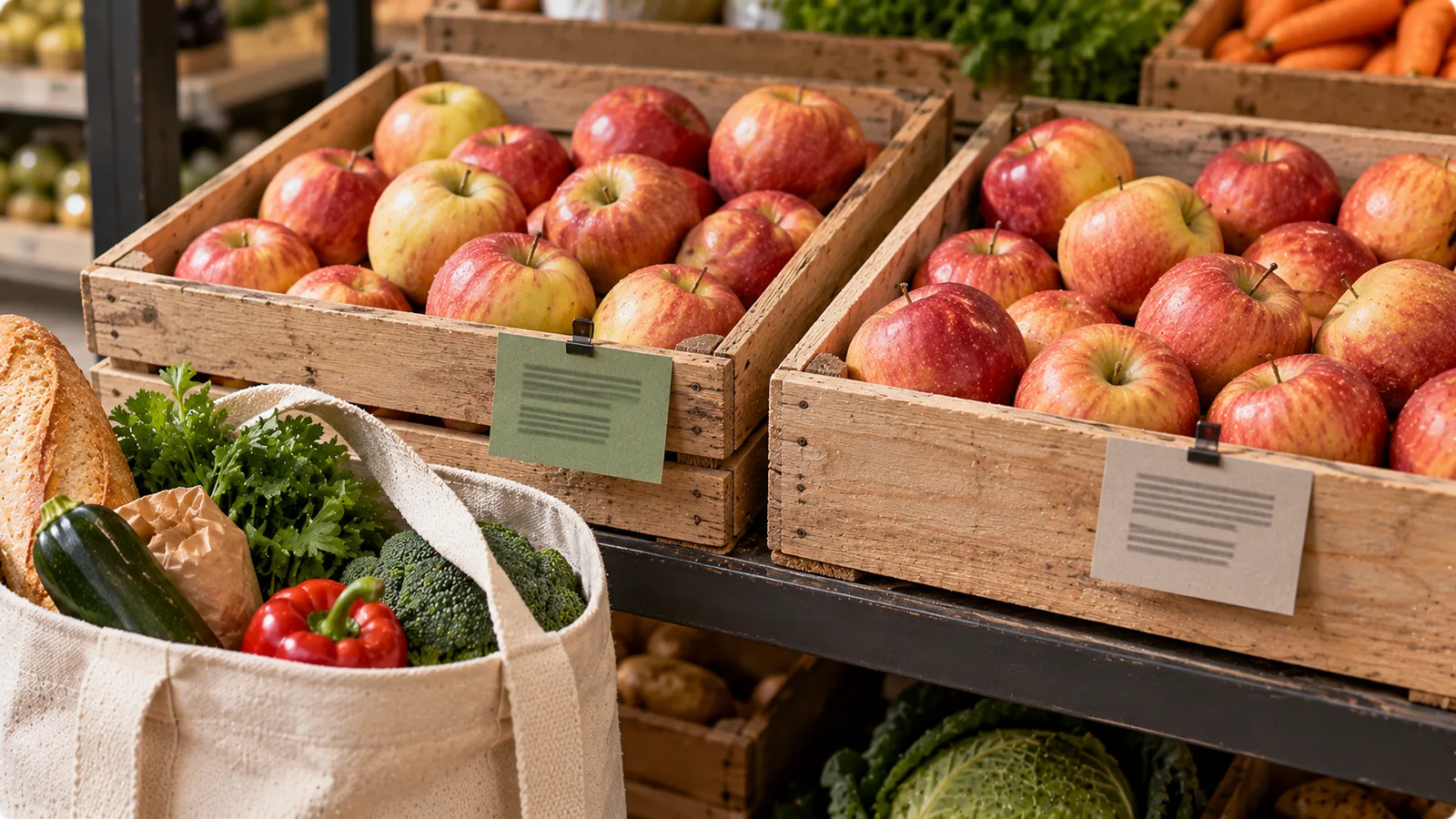
Organic food can cost more than conventional alternatives, but buying everything organic is not necessary to build a nutritious diet.
The useful budgeting question is not simply whether organic food is better. It is which organic purchases match your priorities and deliver enough value to justify their additional cost.
A practical approach combines label literacy, price comparisons, seasonal shopping and a clear distinction between personal preferences and established evidence.
What does organic actually mean?
In the European Union, organic food production is regulated under EU Regulation 2018/848.
Certified products must follow rules covering areas such as permitted agricultural inputs, animal husbandry and production practices.
The EU organic logo identifies products that meet the applicable certification requirements.
However, organic certification does not automatically mean that a food:
- Contains more vitamins or minerals.
- Has fewer calories.
- Is free of pesticide residues.
- Is locally produced.
- Has a lower environmental impact in every category.
- Is safer for every individual.
Organic is a production standard, not a universal nutritional ranking.
Start with the price difference
A price premium becomes easier to evaluate when expressed in euros rather than percentages alone.
Imagine the following hypothetical supermarket prices:
| Product | Conventional | Organic | Extra cost |
|---|---|---|---|
| Oats, 1 kg | €1.50 | €2.40 | €0.90 |
| Apples, 1 kg | €2.20 | €3.40 | €1.20 |
| Carrots, 1 kg | €1.30 | €2.10 | €0.80 |
| Eggs, 10 | €2.80 | €4.20 | €1.40 |
| Milk, 1 L | €1.15 | €1.65 | €0.50 |
These prices are illustrative, not current market quotations.
If you buy one unit of every product, choosing organic for all five costs €4.80 more.
That may be manageable occasionally, but repeating the same premium every week adds up.
Over 52 weeks, €4.80 per week becomes €249.60.
The purpose of the calculation is not to discourage organic purchases. It is to show their opportunity cost.
Decide what matters to you
Organic food may be worth a premium for different reasons.
Some shoppers prioritize farming practices, others animal welfare, pesticide-use rules, personal preferences or support for particular producers.
These goals are not identical.
For example, an organic certification can indicate compliance with specified production standards, but it does not guarantee that an individual farm has the lowest carbon footprint.
Likewise, choosing organic food is not a substitute for eating enough vegetables, fruit, legumes and other nutritious foods.
A clear priority helps prevent spending more without knowing what benefit you expect.
Use a three-tier shopping system
Tier 1: Organic products you deliberately prioritize
Choose a small number of foods where the production standard matters most to you and the premium fits your budget.
Examples might include eggs, milk or a frequently purchased fruit.
The exact choices depend on your values and local prices.
Tier 2: Organic only when the price is competitive
For other products, compare the shelf price and unit price.
Organic carrots at €1.80 per kilogram may be a reasonable choice if conventional carrots cost €1.70.
A small difference is easier to absorb than a large one.
Tier 3: Conventional products without hesitation
If organic versions would significantly reduce the quantity or variety of nutritious food you can afford, conventional options are a sensible choice.
Eating vegetables and fruit regularly matters more than avoiding them because organic alternatives are expensive.
Compare unit prices, not package prices
A smaller organic package can look cheaper at first glance while costing more per kilogram.
Consider:
| Package | Shelf price | Unit price |
|---|---|---|
| Conventional oats, 1 kg | €1.60 | €1.60/kg |
| Organic oats, 500 g | €1.30 | €2.60/kg |
| Organic oats, 1 kg | €2.10 | €2.10/kg |
The 500 g organic package has the lowest shelf price but the highest unit price.
For staples you use frequently, the price per kilogram or liter is the more useful comparison.
Organic does not mean pesticide-free
Organic farming restricts the use of many synthetic pesticides, but it does not prohibit every plant-protection product.
Approved substances and farming practices can still be used within the applicable rules.
Residues may also arise from environmental contamination or other sources.
Food safety authorities assess pesticide residues against regulatory limits.
It is therefore inaccurate to describe every conventional food as unsafe or every organic food as completely free of residues.
If reducing exposure to particular agricultural inputs is a personal priority, organic production standards may be relevant, but avoid interpreting the label as a zero-risk guarantee.
Is organic food more nutritious?
Research has not established that organic foods consistently provide substantially more of every essential nutrient.
Nutrient content depends on variety, growing conditions, ripeness, storage and preparation, among other factors.
Some studies identify differences in particular compounds or residue patterns, but these findings should not be generalized to every product or interpreted as proof of a universal health advantage.
For everyday meal planning, total dietary quality remains central.
A balanced meal made with conventional ingredients can be more nutritious than a highly processed organic snack.
When paying more may be reasonable
An organic purchase can be worthwhile when:
- The certification addresses a production practice you particularly value.
- The price premium is small.
- You buy the food frequently and prefer the organic option.
- The product is on promotion and you can use it before it spoils.
- You have already covered your essential grocery needs.
- You are comparing products of similar quality and quantity.
The decision should consider the complete budget, not just the label.
When the premium is probably not the best use of money
Consider the conventional alternative when:
- The organic product costs substantially more.
- The purchase would reduce the amount of nutritious food available.
- You would have to cut back on essential staples.
- The organic item is likely to spoil before use.
- The package is smaller than expected.
- The premium is driven mainly by marketing rather than a priority you actually hold.
This is particularly relevant for households with limited grocery budgets.
Seasonal shopping can matter more than the label
Seasonal produce may be more affordable because supply is higher.
However, seasonal does not always mean cheaper, and local produce is not automatically organic.
Compare actual prices.
For example, organic strawberries may be expensive outside their main season, while seasonal conventional berries offer better value.
Frozen vegetables and fruit can also be practical alternatives.
They may reduce waste and make nutritious ingredients available throughout the year.
Reduce waste before increasing your organic budget
Food waste can consume money that could otherwise be used for preferred products.
Suppose you spend €80 per week on groceries and discard 10% of the value.
That represents approximately €8 of wasted food each week.
Reducing that waste by half could free around €4 per week.
That money could cover selected organic upgrades without increasing the total grocery budget.
The figures are illustrative, but the principle is practical: buying the right quantity often matters more than buying a more expensive version.
Example: a €70 weekly grocery budget
Imagine a household with €70 available for food shopping.
One possible allocation is:
| Category | Weekly allocation |
|---|---|
| Vegetables and fruit | €20 |
| Grains and potatoes | €10 |
| Beans and lentils | €8 |
| Eggs, dairy and alternatives | €12 |
| Meat, fish or other proteins | €12 |
| Oils, seasonings and extras | €8 |
| Total | €70 |
This is only an example, not a recommended spending distribution for every household.
If the shopper wants to spend €4 more on selected organic products, they can compare where the money comes from.
A good plan should not require removing essential foods simply to preserve an organic label.
A simple decision rule at the supermarket
For each organic product, ask:
- What is the price per kilogram, liter or serving?
- How much more does it cost than the comparable conventional product?
- Which specific production-related benefit matters to me?
- Will I actually use the entire quantity?
- What would I give up elsewhere in my grocery budget?
If the premium is affordable and aligned with your priorities, the organic option may be reasonable.
If not, choosing conventional food is also a valid decision.
Common shopping mistakes
Assuming every organic product is healthy.
Organic biscuits, sweets and snacks can still be high in sugar, salt or calories.
Ignoring unit prices.
Smaller packages can hide large premiums.
Buying organic produce that spoils.
An unused product provides little practical value regardless of certification.
Treating organic as a guarantee of local origin.
Organic and local describe different characteristics.
Spending more before planning meals.
A shopping list based on realistic meals usually saves more money than choosing labels without a plan.
Sources
- European Commission: Organic Farming — EU organic production and certification.
- Regulation (EU) 2018/848 — legal framework for organic production and labeling.
- European Food Safety Authority — scientific information on food safety and pesticide residues.
- USDA MyPlate — general guidance on balanced food choices.
The bottom line
Buying organic food on a budget works best as a selective strategy.
Compare unit prices, identify the production standards you care about and avoid sacrificing dietary variety or essential groceries.
A small number of deliberate organic purchases is often more financially sustainable than trying to buy everything organic.