
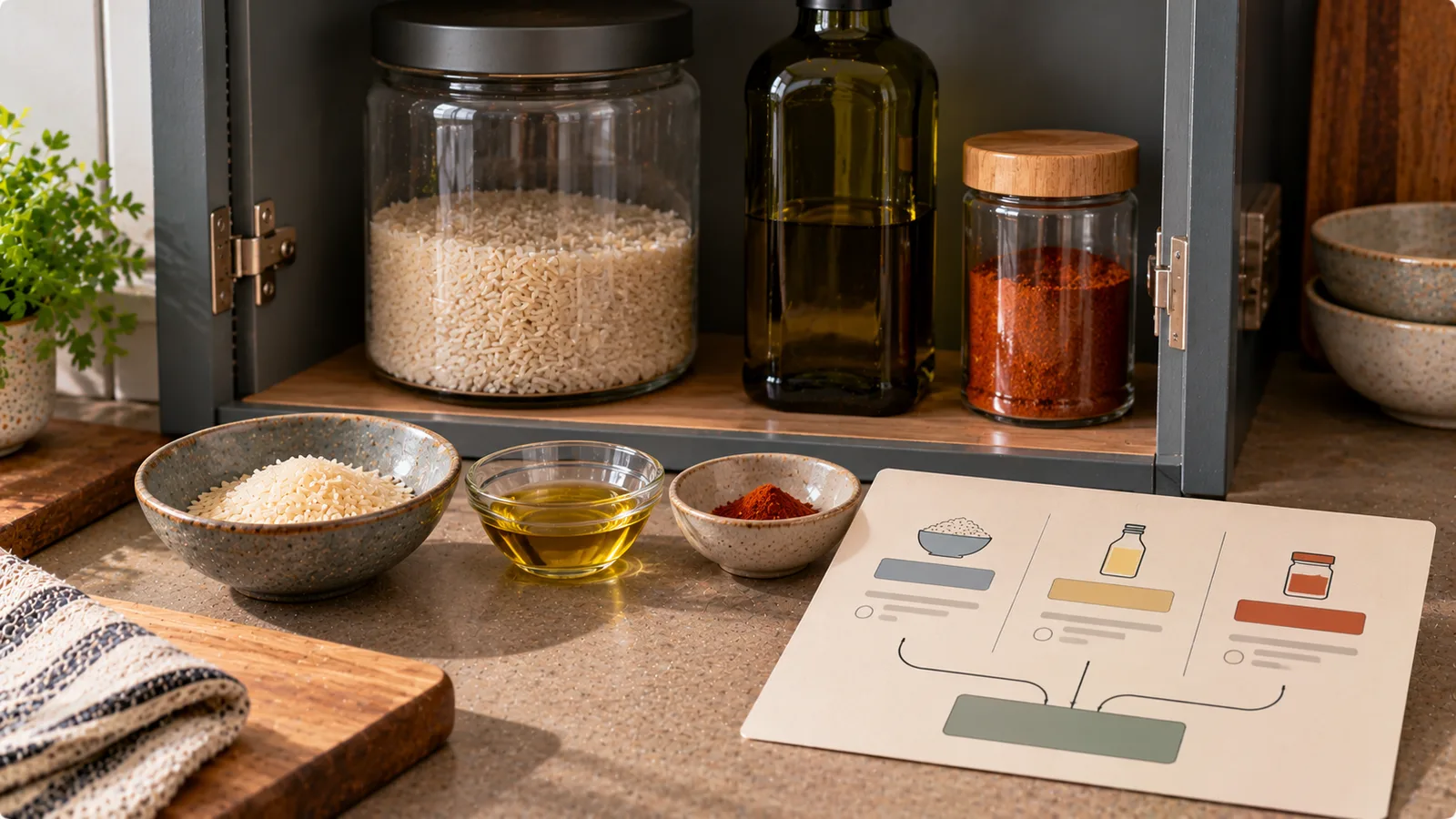
When you calculate the cost of a homemade meal, some ingredients are easy to price.
You bought chicken yesterday for €6 and used half of it, so approximately €3 of chicken went into the meal.
Pantry ingredients are less obvious.
The rice may have been bought three weeks ago. The olive oil may have been in the cupboard for two months. You may use only a few grams of flour, spices or dried herbs from packages purchased long before the current meal.
The key principle is simple:
Meal cost should normally reflect the amount of an ingredient consumed in the recipe, not the date when you paid for the package.
This separates two different ideas:
- cash flow: when money left your wallet or bank account;
- meal cost: how much of the purchased food was actually used in a particular meal.
The basic calculation
For most pantry ingredients, use:
Cost used = package price × amount used ÷ package amount
Suppose you bought:
1 kg of rice for €2.80
and use:
200 g
in a recipe.
The rice cost assigned to the recipe is:
€2.80 × 200 ÷ 1000 = €0.56
It does not matter whether the rice was purchased today or last month.
The recipe consumed €0.56 worth of that package.
Example: a meal using previously purchased ingredients
Imagine you make a simple bean-and-rice dinner for four portions.
You use:
- 250 g dry rice;
- 2 cans of beans;
- 400 g canned tomatoes;
- 150 g onion;
- 20 g olive oil;
- garlic;
- paprika;
- cumin.
Some ingredients were bought today. Others were already in the pantry.
Assume these purchase prices:
| Ingredient | Package | Package price | Amount used | Cost used |
|---|---|---|---|---|
| Rice | 1,000 g | €2.80 | 250 g | €0.70 |
| Beans | 1 can | €0.95 | 2 cans | €1.90 |
| Tomatoes | 400 g can | €0.85 | 400 g | €0.85 |
| Onion | 1,000 g | €1.80 | 150 g | €0.27 |
| Olive oil | 750 g equivalent | €7.50 | 20 g | €0.20 |
| Garlic | estimated from pack | — | used amount | €0.12 |
| Spices | allocated amount | — | used amount | €0.15 |
Estimated recipe cost:
€4.19
If the recipe makes four equal portions:
€4.19 ÷ 4 = about €1.05 per portion
The fact that the rice, oil and spices were bought earlier does not make them free.
They still contribute to the economic cost of the meal.
Purchase spending and consumption cost are different
This distinction becomes especially important when reviewing a grocery budget.
Suppose you buy a 5 kg bag of rice for:
€12
Your grocery spending that day increases by the full:
€12
But if tonight's dinner uses only 200 g, the meal does not contain €12 of rice.
Its rice cost is:
€12 × 200 ÷ 5000 = €0.48
So you can legitimately have:
€12 of grocery cash outflow today
but only:
€0.48 of rice cost in today's dinner
The remaining rice is inventory for future meals.
Why counting pantry ingredients as free is misleading
A common shortcut is to calculate only ingredients purchased specifically for today's recipe.
That can make a meal appear artificially cheap.
For example:
Chicken bought today: €4.00
Vegetables bought today: €2.00
Rice already at home: €0
Oil already at home: €0
Spices already at home: €0
Reported meal cost:
€6.00
But if the rice, oil and spices used were worth another €0.90, the actual ingredient cost was closer to:
€6.90
The difference may seem small for one dinner.
Across dozens of meals, it can materially distort your estimate of how much home cooking costs.
Start with unit cost
The easiest approach is to convert the package price into a useful unit cost.
For a 1 kg package of rice costing €2.80:
€2.80 ÷ 1000 = €0.0028 per gram
or:
€0.28 per 100 g
If the recipe uses 180 g:
180 × €0.0028 = €0.504
So the recipe uses approximately:
€0.50 of rice
Oil should be costed by the amount actually used
Oil is a classic pantry ingredient that is often ignored.
Suppose:
- bottle price: €8.40;
- bottle size: 750 ml;
- recipe uses: 25 ml.
Approximate cost:
€8.40 × 25 ÷ 750 = €0.28
If you use oil regularly, those small amounts accumulate across the month.
For more precise calculations, follow the package units or weigh the oil in grams when practical.
What about oil left in the pan?
For budgeting, you usually do not need laboratory-level precision.
If you poured 20 g of oil into the cooking process, assigning the cost of those 20 g to the recipe is a practical method.
Some oil may remain in cookware, but trying to recover a few cents through detailed residue calculations usually adds more complexity than value.
The purpose here is useful household costing, not accounting for every microscopic loss.
How to cost spices
Spices are often used in very small quantities.
Suppose a 50 g jar of paprika costs:
€2.00
Cost per gram:
€2.00 ÷ 50 = €0.04
If the recipe uses 3 g:
3 × €0.04 = €0.12
You can calculate every spice this way.
But for everyday meal budgeting, that may be unnecessarily detailed.
A practical spice allowance
If precise spice tracking is too time-consuming, use a consistent small allowance.
For example, you might estimate:
€0.10–€0.30
for ordinary dried spices and herbs in a recipe, depending on what was used.
This is less precise than ingredient-level costing, but usually more realistic than assigning spices a cost of zero.
Expensive ingredients such as saffron, vanilla beans or large quantities of specialty seasonings should be calculated separately.
Salt and tiny pantry amounts
Some ingredients contribute so little to meal cost that detailed calculation is not useful.
A few grams of salt may cost only a fraction of a cent.
You can reasonably group very small amounts into a general pantry allowance instead of pricing each one separately.
The goal is a useful estimate, not false precision.
Flour, sugar and baking ingredients
The same proportional method works well.
Suppose:
1 kg flour costs €1.40
A recipe uses:
300 g
Cost:
€1.40 × 300 ÷ 1000 = €0.42
If:
1 kg sugar costs €1.60
and you use:
120 g
Cost:
€1.60 × 120 ÷ 1000 = €0.19
Small ingredients such as baking powder can either be calculated from the package or included in a small pantry allowance.
Dried pasta, oats and grains
These are especially easy because packages usually provide clear weights.
Example:
500 g pasta costs €1.50.
Recipe uses 220 g.
€1.50 × 220 ÷ 500 = €0.66
For oats:
1 kg costs €1.80.
Breakfast uses 70 g.
€1.80 × 70 ÷ 1000 = €0.126
Approximately:
€0.13
Use the purchase price you actually paid when available
If you know what you paid for the package, that is generally the most useful number for personal budgeting.
Suppose your olive oil cost €7.50 even though it now sells for €9.00.
For historical meal-cost tracking, using the €7.50 purchase price reflects what that inventory actually cost you.
For planning future meals, however, the current replacement price may be more useful.
These answer slightly different questions.
Historical cost vs replacement cost
There are two valid approaches.
Historical cost
Use the price you actually paid.
Useful for:
- reviewing past grocery spending;
- calculating what previous meals actually cost;
- reconciling purchases with household spending.
Replacement cost
Use the current price you would pay to replace the ingredient.
Useful for:
- planning next week's meals;
- comparing future recipes;
- estimating whether a meal will still fit the current budget.
For routine household budgeting, do not mix the two approaches randomly within the same calculation.
What if you do not remember the old price?
You do not need to abandon the calculation.
Use a reasonable current or recent price and mark it mentally as an estimate.
For example, you find half a bag of lentils in the cupboard but no longer have the receipt.
If a similar 500 g package currently costs €1.80, you can use that as a practical estimate.
The result may not reproduce historical spending exactly, but it is better than treating the lentils as free.
Sale prices
Suppose you normally buy pasta for €1.50 but purchased the current package on sale for €1.00.
If you are calculating the cost of the meal made from that package, use:
€1.00
If you are planning whether the same meal will cost €3 next week, the normal current price may be more appropriate if the sale has ended.
Again, distinguish historical meal cost from future meal planning.
Bulk purchases
Bulk buying makes the difference between cash flow and consumption especially visible.
Imagine buying:
10 kg of rice for €22
The household spends €22 immediately.
But a dinner using 300 g consumes:
€22 × 300 ÷ 10,000 = €0.66
The remaining value stays in the pantry and will be allocated to future meals as it is consumed.
Partial packages
You do not need to know how much remains in the package to cost today's recipe if you know:
- original package size;
- original package price;
- amount used today.
For example:
A 500 g bag of couscous cost €2.
You use 120 g today.
Cost:
€2 × 120 ÷ 500 = €0.48
Whether the bag had 500 g or 300 g remaining before cooking does not change the cost per gram.
Drained canned ingredients
For canned foods, be careful about which weight corresponds to what you actually use.
A can may show:
- total net weight;
- drained weight.
If you discard the liquid and use only the beans, the drained weight is usually the more meaningful quantity for recipe portions.
For costing, however, you paid for the entire can.
If one whole can costs €0.90 and you use the whole drained contents, assign:
€0.90
to the recipe.
If you use half the drained contents and save the rest:
approximately €0.45
can be assigned to the current recipe.
A jar used across several meals
Suppose a 500 g jar of sauce costs:
€2.50
You use:
150 g
Cost assigned:
€2.50 × 150 ÷ 500 = €0.75
If you later use another 200 g:
€2.50 × 200 ÷ 500 = €1.00
The remaining 150 g still represents:
€0.75
of purchased food.
Across all uses, the allocations eventually total the original €2.50.
What about food that gets wasted?
Waste is a real household cost.
Suppose you buy a €2 bag of spinach.
You eat only 75% before the rest spoils.
There are two ways to view this.
For recipe costing, allocate the amount actually used to each recipe.
For household-budget analysis, the spoiled portion still represents money spent.
This is another reason meal cost and grocery spending are not identical.
If you want to understand food waste, track the unused value separately rather than artificially assigning it to a meal that never consumed it.
Cost per portion
Once all ingredient costs are allocated, add them together.
Example:
Rice: €0.70
Beans: €1.90
Tomatoes: €0.85
Onion: €0.27
Oil: €0.20
Garlic and spices: €0.27
Total:
€4.19
If there are four equal portions:
€4.19 ÷ 4 = €1.0475
Approximately:
€1.05 per portion
If portions are not equal, divide the cost according to the amount each person actually receives rather than assuming identical servings.
Costing unequal portions
Suppose a recipe costs:
€6
and produces:
1,200 g cooked food
Cost per gram:
€6 ÷ 1200 = €0.005
A 300 g portion costs:
300 × €0.005 = €1.50
A 450 g portion costs:
450 × €0.005 = €2.25
This method is useful when household members eat different portion sizes.
Do not confuse calories with cost allocation
A larger portion usually costs more because it contains more food.
But ingredients do not need to be allocated according to calories.
If two people eat different weights of the same mixed recipe, cooked weight is often a practical basis for dividing the recipe cost.
For separately served ingredients, calculate each component directly.
A pantry-cost shortcut
You do not have to calculate every tiny ingredient for every meal.
A practical system is:
Calculate accurately
- meat and fish;
- dairy;
- tofu and other proteins;
- grains and pasta;
- vegetables and fruit;
- canned foods;
- significant amounts of oil;
- expensive sauces or specialty ingredients.
Estimate or group
- salt;
- small quantities of common spices;
- tiny amounts of baking powder;
- a few drops of inexpensive condiments.
This captures most of the meal cost without excessive work.
Create reusable unit prices
If you frequently buy the same products, keep simple reference prices.
For example:
Rice: €0.28 per 100 g
Oats: €0.18 per 100 g
Pasta: €0.30 per 100 g
Olive oil: €0.011 per ml
Flour: €0.14 per 100 g
Then meal costing becomes much faster.
You only need to update these values when prices or package sizes change significantly.
Keep purchase tracking separate
If your goal is to control the monthly grocery budget, continue recording the full purchase when it happens.
Buying a €10 bottle of olive oil means:
€10 of grocery spending this month
even if you consume only €1 worth during the month.
Do not replace the purchase record with recipe allocations.
The two systems answer different questions.
Example: monthly grocery budget vs meal costs
Suppose in October you buy:
- €10 olive oil;
- €12 rice;
- €8 spices.
That is:
€30 of October grocery spending
Perhaps only:
- €2 of oil;
- €3 of rice;
- €1 of spices
are consumed in October meals.
That is:
€6 of pantry ingredients consumed
The remaining €24 has not disappeared.
It remains as food inventory for future months.
This explains why one month's grocery spending can be high even when the meals eaten that month seem inexpensive.
The reverse can also happen
In November, you may buy very little rice, oil or spices because the pantry is already stocked.
Your grocery receipts look unusually low.
But the meals still consume ingredients purchased in October.
If you call those ingredients free, November meals appear artificially cheap.
Allocating pantry ingredients by use solves that problem.
Which number should you use?
Use purchase spending when asking:
- How much money did I spend at grocery stores this week?
- Did I stay within my monthly grocery cash budget?
- How much money left my account?
Use allocated meal cost when asking:
- How much did this dinner cost?
- What is the cost per serving?
- Is this recipe cheaper than another recipe?
- What does a typical homemade lunch cost?
The numbers can differ without either being wrong.
Example: comparing two dinners
Meal A uses:
- chicken: €3.50;
- rice from pantry: €0.55;
- vegetables: €1.80;
- oil and spices: €0.25.
Total:
€6.10
Meal B uses:
- lentils from pantry: €0.70;
- pasta: €0.75;
- tomatoes: €0.90;
- vegetables: €1.20;
- oil and spices: €0.25.
Total:
€3.80
If you ignored pantry ingredients, both comparisons would be distorted.
Including the value actually consumed makes the comparison more useful.
Avoid double counting
If you track both grocery spending and recipe cost, do not add the two together and call the result your total food spending.
The €2.80 bag of rice is recorded once as a purchase.
Allocating €0.70 of that rice to a recipe is an analysis of where part of the €2.80 went.
It is not a second €0.70 payment.
This distinction is essential.
A simple workflow
When calculating a meal:
Step 1: List every meaningful ingredient.
Step 2: Record the package price and package quantity.
Step 3: Record the amount used.
Step 4: Calculate the cost of the amount used.
Step 5: Estimate only insignificant pantry items when precise calculation is not worthwhile.
Step 6: Add all ingredient costs.
Step 7: Divide by the number or weight of portions if you want cost per serving.
For monthly budgeting, separately record the full grocery purchases when they occur.
Example worksheet
A simple meal-cost worksheet can use these columns:
| Ingredient | Package price | Package size | Amount used | Recipe cost |
|---|---|---|---|---|
| Rice | €2.80 | 1,000 g | 200 g | €0.56 |
| Chicken | €7.00 | 1,000 g | 400 g | €2.80 |
| Peppers | €3.00 | 500 g | 250 g | €1.50 |
| Oil | €8.40 | 750 ml | 20 ml | €0.22 |
Total:
€5.08
If this makes three portions:
€5.08 ÷ 3 = €1.69 per portion
Additional minor spices could then be added as a small allowance.
When extreme precision is unnecessary
Household meal costing should improve decisions.
It should not become more expensive in time than the information is worth.
If calculating 0.7 g of oregano takes several minutes to save a one-cent error, use an estimate.
Spend precision where it matters most:
- expensive ingredients;
- ingredients used in large quantities;
- products with large price differences;
- recipes you make frequently.
Consistency is often more valuable than perfect precision.
A practical rule to remember
When a pantry ingredient was purchased earlier, ask:
How much of the package did this meal actually use?
Then allocate that fraction of the package price.
A €5 ingredient is not free because it was paid for last month, and the entire €5 does not belong to today's meal if only a small portion was consumed.
Separating when you paid from what the meal consumed gives you a much clearer picture of both grocery spending and the true cost of home-cooked meals.