
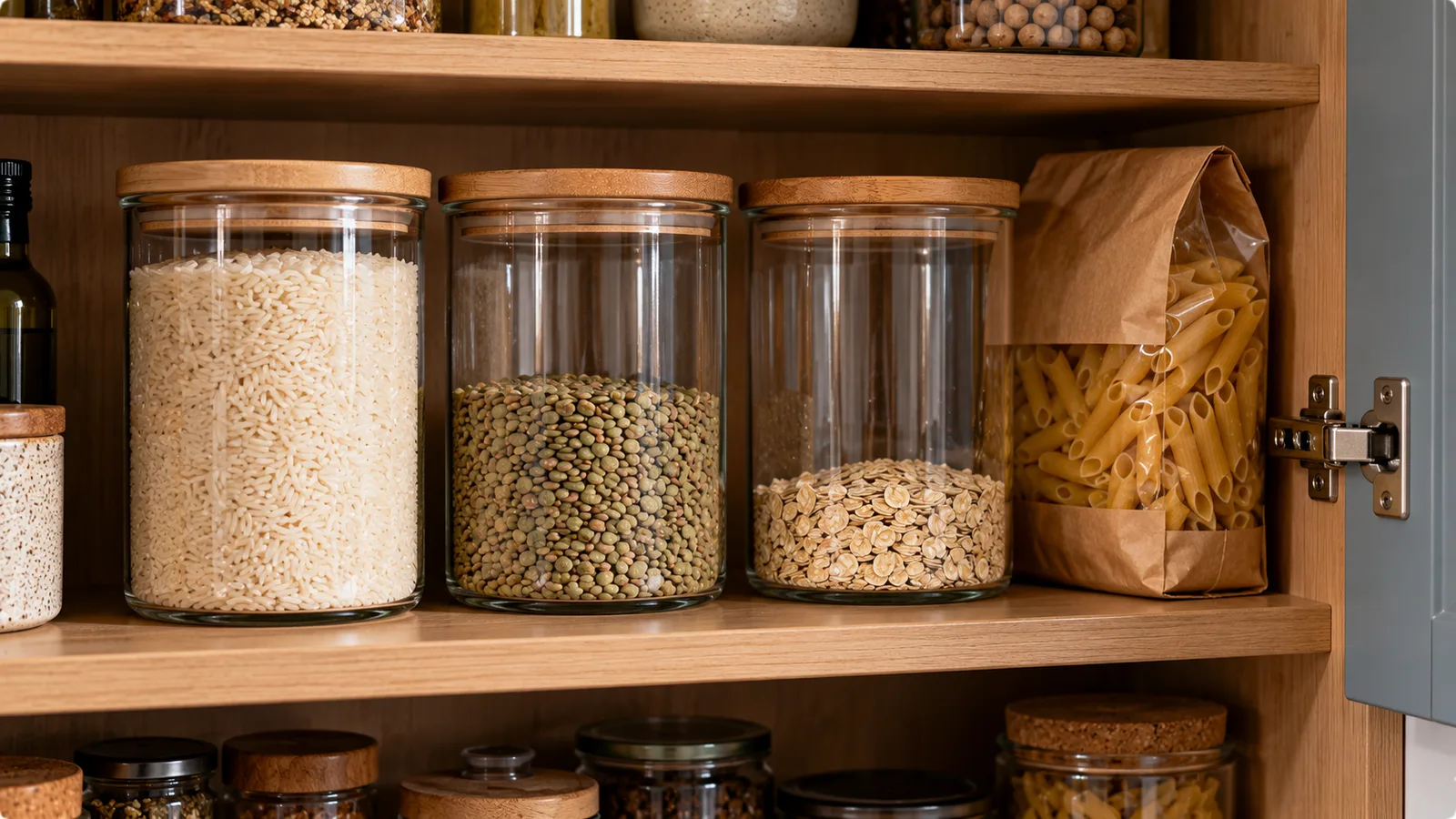
Buying groceries and consuming groceries are not the same thing.
You might spend €80 stocking up on rice, lentils, pasta and canned tomatoes this month, then use only a small portion of those purchases before the month ends.
If you look only at supermarket receipts, the month may appear unusually expensive. But much of that money is still represented by food sitting in your cupboards.
The reverse can happen the following month. You may spend very little because you are eating food purchased earlier.
A monthly pantry cost audit separates three questions:
- How much money did you spend on pantry purchases?
- How much pantry stock did you actually use?
- How much value remains in your cupboards?
This distinction makes grocery budgeting more useful and helps identify products that are repeatedly bought but rarely consumed.
What counts as pantry stock?
For this method, pantry stock means food you intentionally track as stored inventory.
Typical examples include:
- Rice, pasta, oats and other dry grains.
- Lentils, beans and other dried legumes.
- Canned vegetables, tomatoes and fish.
- Flour, sugar and baking ingredients.
- Cooking oils.
- Nuts, seeds and shelf-stable snacks.
- Unopened sauces and condiments.
You can extend the same method to freezer stock or long-lasting refrigerated foods, but keep categories separate if you want clear results.
There is no need to track every pinch of salt or every spice used in cooking.
Start with the products that account for meaningful spending or frequently accumulate in your kitchen.
The basic pantry audit formula
The core calculation is:
Opening stock value + purchases − closing stock value = stock value removed during the month.
This is a stock-flow calculation, not automatically the value of food eaten.
If some food was discarded, donated or transferred elsewhere, that value is included in the amount removed.
To estimate the cost of food actually used for meals:
Food used cost = opening stock + purchases − closing stock − waste − other non-consumption removals.
All amounts must be valued consistently.
For a household budget, actual purchase cost is a practical starting point.
The calculation works best when the opening and closing inventories use the same valuation method.
A complete monthly example
Suppose your pantry contains €120 worth of food at the beginning of April.
During April, you buy another €85 worth of pantry items.
At the end of the month, the remaining stock is valued at €145.
The calculation is:
€120 + €85 − €145 = €60 removed from pantry stock.
Now suppose you also identify €5 of discarded food and no other removals.
The estimated cost of food used is:
€60 − €5 = €55.
| Monthly measure | Amount |
|---|---|
| Opening pantry stock | €120 |
| Pantry purchases | €85 |
| Closing pantry stock | €145 |
| Total stock removed | €60 |
| Discarded food | €5 |
| Estimated food used | €55 |
You spent €85, but only €55 of the tracked pantry value was used for food.
Another €5 was discarded, while the pantry ended the month with €25 more stock value than it started with.
That is why spending and consumption should be reported separately.
Step 1: Count opening stock
Choose a consistent audit date, such as the first day of each month.
Record the pantry items you already have.
For each product, capture:
- Product name.
- Quantity remaining.
- Unit, such as grams, kilograms or pieces.
- Estimated purchase cost per unit.
- Total remaining value.
A simple opening inventory might look like this:
| Product | Remaining amount | Cost basis | Opening value |
|---|---|---|---|
| Rice | 1.5 kg | €2.00/kg | €3.00 |
| Pasta | 2 kg | €1.60/kg | €3.20 |
| Dry lentils | 1 kg | €3.00/kg | €3.00 |
| Canned tomatoes | 6 cans | €0.90/can | €5.40 |
| Olive oil | 0.5 L | €8.00/L | €4.00 |
| Total | €18.60 |
These are illustrative prices, not current supermarket quotes.
The goal is consistency, not perfect precision.
For opened packages, estimate the remaining quantity rather than counting the entire package.
Step 2: Record purchases during the month
Every time you buy tracked pantry products, add the purchase to your log.
You only need a few details:
| Date | Product | Quantity | Paid |
|---|---|---|---|
| April 3 | Rice | 2 kg | €4.20 |
| April 8 | Lentils | 1 kg | €2.80 |
| April 15 | Canned tomatoes | 4 cans | €3.60 |
| April 22 | Oats | 1 kg | €1.90 |
Total purchases in this example:
€4.20 + €2.80 + €3.60 + €1.90 = €12.50.
Use the amount actually paid, including discounts.
If a receipt contains pantry and fresh-food purchases, separate the categories.
Avoid recording the entire supermarket receipt as pantry spending.
Step 3: Count closing stock
On the final day of the month, check what remains.
Use the same units and valuation method as your opening inventory.
For example:
| Product | Opening | Purchased | Closing |
|---|---|---|---|
| Rice | 1.5 kg | 2 kg | 2.2 kg |
| Lentils | 1 kg | 1 kg | 1.4 kg |
| Canned tomatoes | 6 cans | 4 cans | 3 cans |
| Oats | 0 kg | 1 kg | 0.6 kg |
The difference shows how much inventory left storage.
For rice:
1.5 + 2 − 2.2 = 1.3 kg removed.
For lentils:
1 + 1 − 1.4 = 0.6 kg removed.
For tomatoes:
6 + 4 − 3 = 7 cans removed.
For oats:
0 + 1 − 0.6 = 0.4 kg removed.
These quantities are not automatically the amounts eaten. Check whether any stock was discarded, donated or otherwise removed.
Step 4: Separate consumption from waste
This is the most important correction in a useful pantry audit.
Imagine that seven cans of tomatoes disappeared from inventory.
Six were used in cooking, while one damaged can was discarded.
The inventory movement is seven cans.
The food consumed or used in meals is six cans.
The waste is one can.
If each can cost €0.90:
Food used: 6 × €0.90 = €5.40.
Waste: 1 × €0.90 = €0.90.
Keeping these values separate prevents waste from being incorrectly counted as food consumption.
A practical monthly report should show purchases, food used, waste and remaining stock as different figures.
How to value partially used packages
Opened packages are common in a pantry.
Suppose a 1 kg bag of oats cost €1.80.
At the end of the month, approximately 350 g remains.
Remaining value:
350 ÷ 1,000 × €1.80 = €0.63.
Estimated value used or otherwise removed:
€1.80 − €0.63 = €1.17.
If none was discarded, €1.17 is the estimated cost of oats used.
For a bottle of oil, use the same approach with millilitres or litres.
You do not need laboratory-level accuracy.
A consistent estimate is usually more useful than skipping opened packages completely.
What if the same food was bought at different prices?
Suppose you already have 1 kg of rice purchased for €2.00.
Later, you buy another 1 kg for €2.60.
You now have 2 kg of rice costing €4.60 in total.
One simple approach is the weighted-average cost method.
Average cost per kilogram = total cost of available stock ÷ total available kilograms.
€4.60 ÷ 2 = €2.30 per kilogram.
If 0.5 kg remains, its estimated value is:
0.5 × €2.30 = €1.15.
The weighted-average method is convenient for a household spreadsheet.
It is not the only possible inventory valuation method, but it avoids having to identify which individual grains came from which purchase.
A reusable monthly pantry audit table
You can build a spreadsheet with the following columns:
| Product | Opening value | Purchases | Closing value | Waste | Other removals | Food used |
|---|---|---|---|---|---|---|
| Rice | €3.00 | €4.20 | €5.06 | €0 | €0 | €2.14 |
| Lentils | €3.00 | €2.80 | €4.06 | €0 | €0 | €1.74 |
| Tomatoes | €5.40 | €3.60 | €2.70 | €0.90 | €0 | €5.40 |
| Oats | €0 | €1.90 | €1.14 | €0 | €0 | €0.76 |
| Total | €11.40 | €12.50 | €13.96 | €0.90 | €0 | €9.04 |
The table is illustrative.
For each row:
Food used = opening value + purchases − closing value − waste − other removals.
Check that your figures are internally consistent.
If a result is negative, investigate a missing purchase, incorrect quantity or inconsistent valuation before using the number.
What the monthly numbers tell you
A pantry audit becomes valuable when you compare several months.
Purchases are rising, but food used is stable
You may be building inventory.
That can be intentional, especially when purchasing shelf-stable food on promotion.
However, repeatedly increasing stock can tie up money and create storage problems.
Purchases are low, but food used is high
You may be consuming previously purchased stock.
This is not necessarily a sign that your ongoing food costs have permanently decreased.
Closing stock keeps increasing
Look for products that are being purchased faster than they are used.
A growing stock of rice, pasta or canned food may be useful up to a point.
Beyond that, it may indicate overbuying.
Waste is increasing
Review expiration dates, storage conditions, package sizes and how frequently the products are used.
The goal is to identify preventable waste rather than assign blame.
Stock value is not the same as cash available
A pantry containing €200 worth of food does not mean you have €200 in cash.
The inventory value represents what you paid for products still available to use.
Most households cannot recover the full purchase price by selling unwanted groceries.
Therefore, treat stock value as a budgeting measure, not a financial asset with guaranteed resale value.
Track quantities as well as euros
A product's price may change between months.
If you compare only monetary values, you might confuse higher prices with higher consumption.
For example:
Month A: 2 kg of rice used at €2/kg = €4.
Month B: 2 kg of rice used at €2.50/kg = €5.
The quantity consumed is unchanged.
The cost increased because the unit price rose.
Record both quantity and value for important products.
This helps distinguish changes in purchasing behavior from price changes.
Use the audit to improve grocery lists
The best use of the audit is to change future purchasing decisions.
Suppose you discover:
- Three unopened pasta packages.
- Two kilograms of unused lentils.
- Several cans of tomatoes.
- Very little rice remaining.
Your next grocery list should reflect those quantities.
Instead of buying every pantry staple automatically, check what you already own.
For example, plan a lentil soup or pasta dish using existing ingredients before purchasing more.
This can reduce spending without requiring smaller or less satisfying meals.
Identify slow-moving pantry products
A useful optional measure is the percentage of available stock used during the month.
Usage rate = quantity used ÷ (opening quantity + purchased quantity) × 100.
Suppose you began with 2 kg of lentils, purchased another 1 kg and used 0.3 kg.
Usage rate:
0.3 ÷ 3 × 100 = 10%.
This does not automatically mean the lentils were a bad purchase.
Dry lentils may store well, and you might intentionally keep a reserve.
But if you repeatedly buy more despite a low usage rate, consider pausing future purchases.
Compare usage rates within similar product categories rather than treating every food identically.
Watch for products approaching their dates
A pantry audit is also a useful moment to check dates and packaging.
Separate products that should be used soon.
For foods with a best-before date, the date generally concerns quality rather than automatically indicating that the food becomes unsafe immediately afterward.
A use-by date has a different food-safety meaning and should be respected.
Storage conditions and package integrity also matter.
For European guidance, consult the European Commission's food date marking information.
Do not taste food to determine whether a potentially hazardous product is safe.
Should you include freezer food?
You can, but a separate freezer section is usually easier to manage.
Frozen vegetables, meat, fish and prepared meals often have different units and storage considerations from dry pantry goods.
A combined monthly report can still show:
| Category | Opening | Purchases | Closing | Used and other removals |
|---|---|---|---|---|
| Pantry | Enter | Enter | Enter | Calculate |
| Freezer | Enter | Enter | Enter | Calculate |
| Long-life refrigerator items | Enter | Enter | Enter | Calculate |
Keep waste separate within each category.
This allows you to see where stock is accumulating.
How to handle shared household food
If several people use the same pantry, audit the household rather than attempting to assign every gram to one person.
Record total purchases and closing stock.
If household members buy groceries separately, collect those receipts in one shared log.
Otherwise, the calculation may show apparent consumption that is actually an unrecorded purchase.
If you need per-person estimates, divide costs using a clearly stated allocation rule.
Do not assume everyone consumes equal quantities unless that is a reasonable approximation for your purpose.
What about meals eaten outside the home?
Restaurant meals, workplace cafeteria lunches and takeaway purchases generally do not enter pantry inventory.
Track them separately as food spending.
This prevents double counting.
For example, if you spend €50 on groceries and €30 at restaurants, your cash food spending is €80.
But only the pantry-related portion of the grocery purchases belongs in the pantry stock calculation.
A complete food budget may include pantry, fresh groceries, freezer purchases and eating out as separate categories.
A practical monthly review routine
A useful audit does not need to take hours.
Try this sequence at the end of each month:
- Export or collect pantry purchases.
- Count the remaining tracked products.
- Value the remaining quantities consistently.
- Record discarded or donated stock.
- Calculate stock removed and food used.
- Compare results with the previous month.
- Identify products that are accumulating.
- Build next month's grocery list around existing stock.
If you have many products, start with the ten or twenty items that matter most to your budget.
Expand the system only if the additional detail is useful.
Three questions to ask after every audit
What did I buy but barely use?
These products may not need to appear on the next shopping list.
What did I use faster than expected?
These may deserve a larger planned quantity, especially if buying in bulk is economical and storage is adequate.
What was discarded?
Look for preventable causes such as buying too much, poor storage or forgetting opened packages.
These questions turn the audit into a practical purchasing tool.
Sources and further reading
For information about food waste and storage decisions, useful references include:
- European Commission: Food waste prevention.
- European Commission: Date marking and food waste.
- USDA FoodKeeper for storage guidance.
The inventory formulas in this article are household budgeting calculations, not official nutrition or accounting standards.
Make pantry spending easier to understand
A monthly pantry audit helps distinguish money spent from food actually used.
The essential calculation is straightforward:
Opening stock + purchases − closing stock = stock removed.
Then subtract waste and other non-consumption removals to estimate the cost of food used.
By tracking both quantities and costs, you can spot overbuying, understand changes in your grocery spending and make better use of the food already in your kitchen.
The objective is not to account for every grain of rice. It is to make your next grocery purchase more informed than the previous one.