
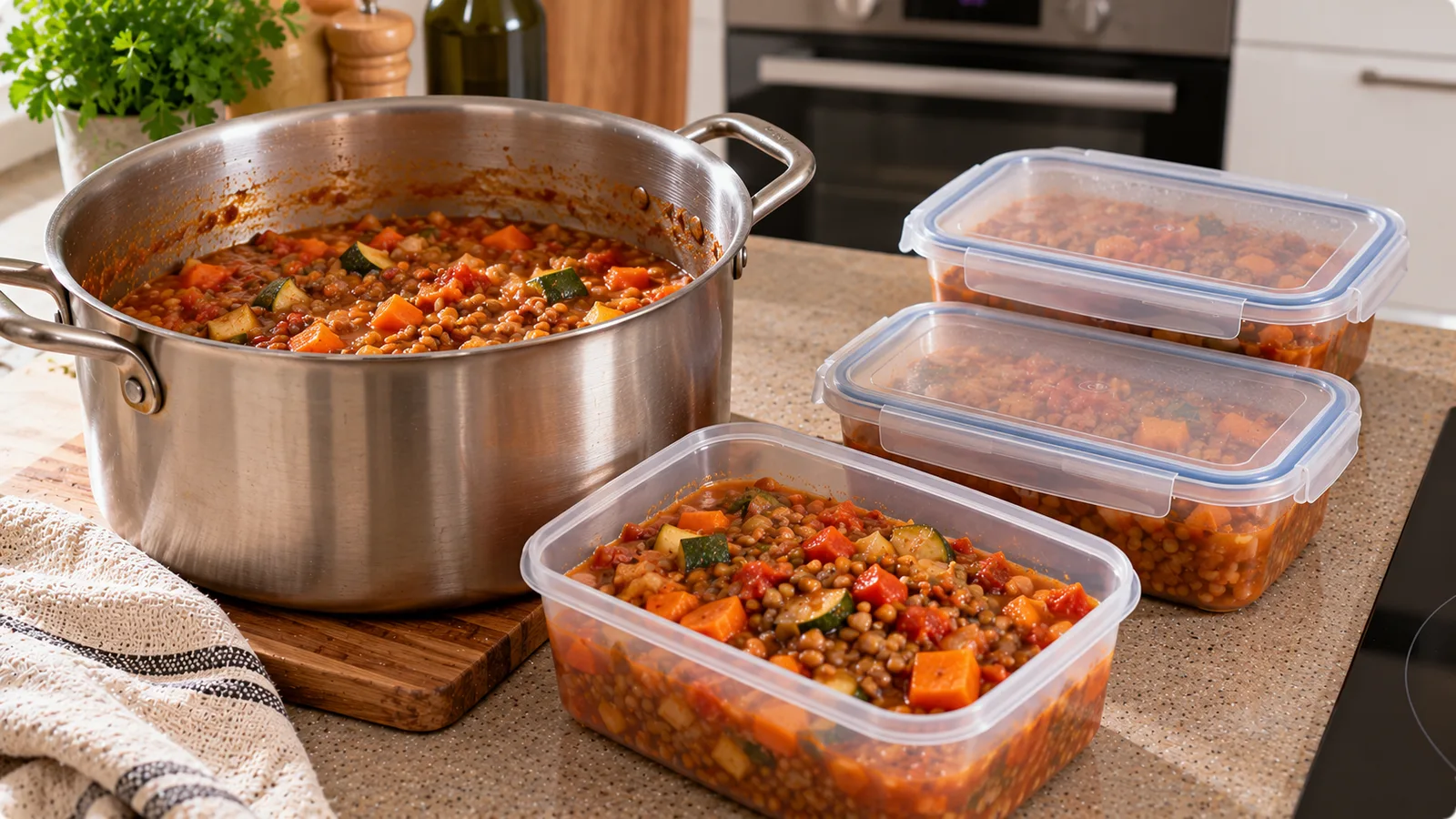
Batch cooking is often recommended as a way to spend less on food. Preparing several portions at once may reduce cooking time, help use larger ingredient packs and make it easier to avoid expensive last-minute meals.
But cooking a large batch also uses energy. The food may need cooling, refrigeration, freezing and reheating. An oven that runs for two hours can change the economics of a recipe, especially when electricity is expensive.
So does batch cooking actually save money?
Often yes, but the answer depends on total cost per portion—not simply how many portions you cook.
A useful comparison includes ingredients, cooking energy, storage, reheating and food that might be wasted.
The real cost of batch cooking
For a fair comparison, calculate:
Total batch cost = ingredient cost + cooking energy + storage energy + reheating energy + other relevant costs
Then divide by the number of portions actually eaten.
Cost per eaten portion = total batch cost ÷ portions consumed
If you prepare eight portions but throw away two, the denominator is six, not eight.
That distinction matters. A large batch is only economical when the food is eaten.
Which costs belong in the calculation?
| Cost | Include it? | Why it matters |
|---|---|---|
| Ingredients | Always | Usually the largest direct cost |
| Hob or oven energy | Always | Depends on power, time and cooking method |
| Refrigeration | When material | Especially for repeated or extended storage |
| Freezing | When material | Extra electricity may be required |
| Reheating | Yes | Each stored portion may need reheating |
| Containers | If purchased for the batch | Reusable containers should be spread over many uses |
| Food waste | Always | Uneaten food raises cost per consumed portion |
| Time | Optional | Important if comparing convenience or labor value |
You do not need laboratory precision. Consistent assumptions are more useful than ignoring major costs.
How to calculate cooking energy costs
For an electrical appliance, a simple estimate is:
Energy cost = electricity used in kWh × price per kWh
If you know the average electrical power:
Energy used in kWh = average power in kW × cooking time in hours
For example, an appliance averaging 1.2 kW over 90 minutes uses:
1.2 × 1.5 = 1.8 kWh
At an illustrative electricity tariff of €0.35/kWh:
1.8 × €0.35 = €0.63
This is not necessarily the appliance's actual consumption.
An oven or electric hob cycles its heating elements, so its rated maximum power should not automatically be treated as continuous consumption.
A plug-in energy meter, a smart appliance reading or reliable manufacturer data can improve the estimate.
For a gas hob, use the gas consumed and the applicable price per kWh, accounting for the way your bill measures gas. Do not compare the rated input of gas and electric appliances as if it were identical useful heat delivered to the food.
Example 1: Four portions versus eight portions of lentil stew
Imagine a household that cooks lentil and vegetable stew regularly.
The following amounts are illustrative assumptions, not measured market prices or universal energy consumption figures.
| Item | Four-portion recipe | Eight-portion recipe |
|---|---|---|
| Ingredients | €5.20 | €10.00 |
| Initial cooking electricity | €0.42 | €0.60 |
| Refrigeration and reheating | €0.12 | €0.32 |
| Total | €5.74 | €10.92 |
| Portions eaten | 4 | 8 |
| Cost per portion | €1.44 | €1.37 |
The eight-portion recipe saves approximately €0.07 per portion, or about €0.56 across eight portions compared with preparing two four-portion batches at the stated assumptions.
Why are the savings modest?
Because ingredient costs dominate. Cooking energy is a relatively small component of this example.
The larger batch benefits from a slightly better ingredient price and avoids repeating some cooking energy, but it still needs storage and reheating.
If ingredients cost the same per gram in both batches, the savings could be smaller.
Example 2: Does using the oven twice cost more?
Suppose a tray-bake recipe produces four portions and requires an oven to run for 60 minutes.
Assume its measured or estimated average electrical consumption is 1.5 kWh per cooking session.
At €0.35/kWh:
One session costs €0.525, approximately €0.53.
Cooking two separate batches uses:
2 × 1.5 = 3.0 kWh, or €1.05.
Now imagine you can cook eight portions in one larger oven session using 2.1 kWh.
Energy cost:
2.1 × €0.35 = €0.735, approximately €0.74.
The cooking-energy saving is:
€1.05 − €0.735 = €0.315, approximately €0.32.
However, if the larger batch requires two trays that cannot cook evenly together, or requires a much longer session, that saving may disappear.
The important factor is actual energy consumption per finished portion, not the number of trays alone.
Example 3: When batch cooking becomes more expensive
A large batch can lose money if portions are wasted.
Suppose an eight-portion recipe costs €12.00 in ingredients, cooking, storage and reheating.
If all eight portions are eaten:
€12.00 ÷ 8 = €1.50 per portion.
If only six portions are eaten:
€12.00 ÷ 6 = €2.00 per portion.
If a freshly prepared four-portion version costs €1.75 per eaten portion, the wasted large batch is more expensive.
Food waste can outweigh small energy savings.
This is why portion planning matters more than simply cooking the largest possible quantity.
A break-even formula for batch cooking
Suppose you want to compare two strategies for the same number of meals.
Strategy A: Cook smaller recipes several times.
Strategy B: Cook one large batch, store it and reheat portions.
The large batch saves money when:
Ingredient savings + avoided cooking costs > additional storage + reheating + waste costs
For a numerical example:
- Ingredient savings from larger packs: €1.20.
- Cooking energy avoided: €0.70.
- Additional refrigeration or freezing: €0.15.
- Additional reheating: €0.45.
- Expected extra food waste: €0.40.
Net saving:
€1.20 + €0.70 − €0.15 − €0.45 − €0.40 = €0.90.
Batch cooking wins by €0.90 under these assumptions.
If expected waste rises to €1.50, the result becomes a loss of €0.20.
The break-even point is specific to your recipes, energy prices and eating habits.
Is batch cooking cheaper with electricity or gas?
Neither fuel automatically makes batch cooking more economical.
The answer depends on:
- The tariff you pay per kWh.
- The appliance's efficiency.
- Heat lost to the kitchen.
- The type and size of cookware.
- Whether the appliance must be preheated.
- The total cooking duration.
- Whether food is cooked on a hob, in an oven or in a pressure cooker.
An induction hob may deliver heat to a pan efficiently, while a conventional oven heats a much larger space.
But the most efficient appliance for one recipe may not be the most efficient for another.
Compare the actual cost of producing the same finished meal.
Which cooking methods work well for large batches?
One-pot cooking
Soups, stews, curries and chili are strong candidates.
A single pot can often produce additional portions with less than a proportional increase in cooking time.
A lid also helps reduce unnecessary heat loss and evaporation.
Oven cooking
Batch roasting can work when the oven is already heated and food can cook properly without overcrowding.
Overfilled trays may steam instead of roast, or require longer cooking.
Pressure cooking
A pressure cooker can reduce cooking time for certain foods, particularly dried beans and tough cuts of meat.
Actual savings depend on the appliance and recipe.
Slow cooking
Slow cookers typically use relatively modest power but run for many hours.
A long cooking time does not necessarily mean high energy use, and low rated power does not guarantee the lowest total cost.
Compare total kWh.
Air fryer
An air fryer may be efficient for small portions, but its limited capacity can require multiple rounds for a large batch.
Repeated cycles may reduce or eliminate the advantage.
Does refrigerating or freezing the food cancel the savings?
Usually storage does not automatically cancel batch-cooking savings, but the effect depends on circumstances.
A refrigerator or freezer is already running in many households.
Adding several portions does not mean you should allocate the appliance's entire electricity bill to those meals.
The relevant cost is the incremental energy caused by storing the batch.
That can be difficult to measure precisely.
A freezer that must be purchased and operated solely for batch cooking is a different economic decision from using spare capacity in an existing freezer.
Likewise, placing hot food directly into storage can create additional cooling demand and potentially affect food safety.
Cool food promptly and safely in shallow containers, following official food-safety guidance, rather than leaving large pots at room temperature for hours.
Food safety matters as much as savings
Large batches require careful handling.
Cook foods to safe temperatures appropriate for their ingredients.
Divide large quantities into shallow containers so they cool quickly.
Refrigerate perishable cooked food promptly, generally within two hours, or within one hour in very hot conditions.
Keep refrigerators at approximately 4°C or below and freezers at approximately −18°C or below.
A common conservative guideline for refrigerated cooked leftovers is to consume them within 3–4 days or freeze them for longer storage.
Reheat leftovers thoroughly. For many mixed cooked leftovers, US food-safety guidance recommends reaching 74°C (165°F) throughout.
These are general principles; follow stricter product-specific or local guidance when applicable.
Never extend storage merely to justify the money spent cooking.
How to reduce reheating costs
Reheating method can influence the final result.
A microwave may use less energy than heating a full-size oven for one portion.
A covered pan with a little water can be practical for soups, grains and stews.
Avoid heating an entire eight-portion batch repeatedly when only one serving is needed.
Instead:
- Divide food into meal-sized containers.
- Refrigerate the portions you will eat soon.
- Freeze suitable portions intended for later.
- Reheat only the amount you plan to consume.
This can reduce repeated heating, improve convenience and help limit waste.
Is buying larger ingredient packs always cheaper?
No.
A larger pack may have a lower price per kilogram but still cost more overall if part of it goes unused.
For example:
- A 500 g pack costs €1.60: €3.20/kg.
- A 1 kg pack costs €2.70: €2.70/kg.
The larger pack saves €0.50 per kilogram if all the food is used.
But if 300 g are discarded, only 700 g are consumed.
Effective cost per kilogram eaten:
€2.70 ÷ 0.7 kg = €3.86/kg.
That is more expensive than the smaller pack.
Compare price per usable quantity, not just shelf price per kilogram.
Batch cooking versus meal prepping
The terms overlap but are not identical.
Batch cooking means preparing a larger quantity of one or more foods at once.
Meal prepping can also mean washing vegetables, preparing ingredients or assembling individual meals without cooking everything in advance.
You may save money through either approach.
For example, chopping vegetables once and cooking fresh portions on different days can reduce waste without requiring a large cooked batch.
Choose the method that fits your storage space and schedule.
A simple calculator you can use
Record the following for one recipe:
| Input | Your value |
|---|---|
| Total ingredients | €_____ |
| Cooking energy, kWh | _____ |
| Energy tariff, €/kWh | €_____ |
| Cooking energy cost | €_____ |
| Storage energy estimate | €_____ |
| Reheating energy cost | €_____ |
| Other batch-specific costs | €_____ |
| Portions prepared | _____ |
| Portions actually eaten | _____ |
| Total cost per eaten portion | €_____ |
Then calculate the same meal prepared in smaller quantities.
If the large batch is cheaper, the difference is your estimated saving.
If the figures are close, convenience, food quality and your likelihood of eating the leftovers may be more important than a few cents.
Five ways to make batch cooking more economical
1. Start with recipes you already enjoy. A cheap meal that nobody wants to eat again is not a saving.
2. Choose ingredients with several uses. Lentils, rice, beans and seasonal vegetables can be used across different dishes.
3. Fill the cooking appliance appropriately. Use its capacity efficiently without compromising cooking quality or safety.
4. Label and date portions. This reduces forgotten containers and avoidable waste.
5. Review the cost after a few weeks. Use your actual tariff, grocery receipts and number of portions eaten instead of relying on generic claims.
Frequently asked questions
Does batch cooking use less electricity?
It can, especially when one cooking session replaces several smaller sessions. But the result depends on appliance efficiency, cooking time and batch size.
Is batch cooking worth it for one person?
Yes, if portions can be stored safely and you enjoy eating them later. A smaller batch of three or four portions may be more practical than cooking ten.
Does freezing make batch cooking expensive?
Not necessarily. Incremental storage costs in an existing freezer may be modest, but reheating and food waste should still be included.
Is an oven cheaper when cooking several meals together?
It can be more efficient per portion when the oven is already hot and food cooks properly in one session. Overcrowding or longer cooking may change the result.
What is the biggest source of savings?
Often ingredient prices, avoided food waste and fewer convenience-food purchases matter more than small differences in cooking electricity.
How can I calculate my own energy cost?
Multiply measured or estimated appliance energy consumption in kWh by your electricity tariff per kWh. Add the cost of reheating and any relevant extra storage energy.
Sources and further reading
- U.S. Department of Energy: Energy Saver — household energy use and efficiency.
- USDA Food Safety and Inspection Service — safe cooling, storage and reheating of cooked food.
- FoodSafety.gov — safe food temperatures and leftovers.
- European Commission: Energy — European energy information and consumer context.
The bottom line
Batch cooking can save money after energy costs, but larger portions are not automatically cheaper.
Calculate the cost of ingredients, cooking, storage, reheating and waste, then divide by the number of portions actually eaten.
The best strategy is usually to cook a manageable quantity of food you will genuinely enjoy and consume safely.