
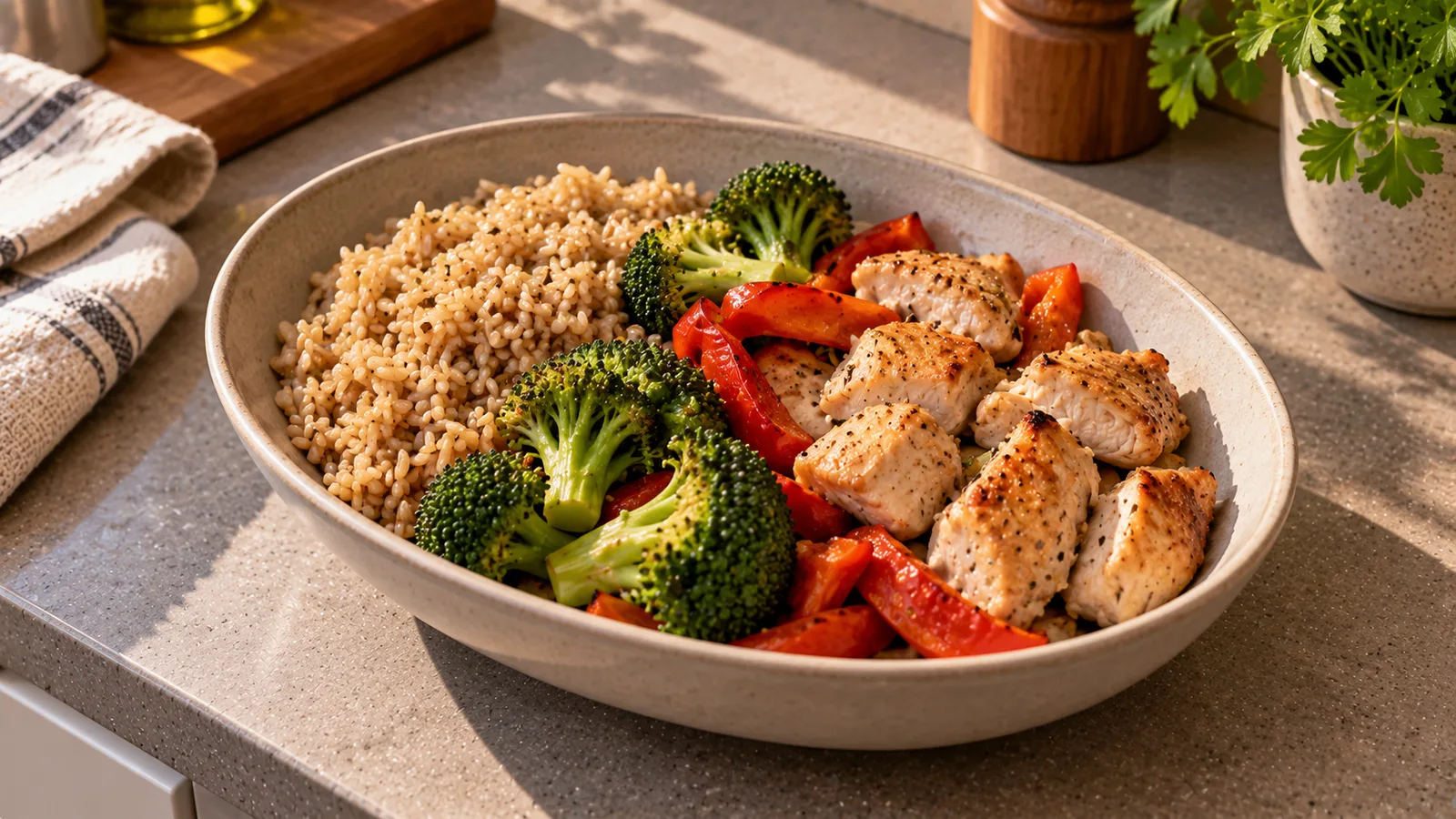
Portion sizes can be surprisingly difficult to estimate.
A bowl of rice, a handful of nuts, a piece of chicken or a spoonful of peanut butter may look straightforward, but the actual amount can vary substantially.
The Mealisa Portion Size Estimator is designed to give you a practical starting point when you do not have an exact weight.
> Tool: Portion Size Estimator
The interactive estimator can be placed at the top of this page. The guide below explains how to interpret portion estimates and when weighing food is more useful.
What is a portion size?
A portion is the amount of food you actually choose to eat at one time.
It is not necessarily the same as a serving size shown on a package or in a nutrition database.
For example, a cereal package might define one serving as 40 g.
You might actually pour:
- 30 g;
- 50 g;
- 70 g;
- or another amount.
For food tracking, the amount you actually eat is usually the number that matters.
Portion size vs serving size
These terms are often used interchangeably, but separating them can make tracking easier.
| Term | Practical meaning |
|---|---|
| Serving size | A reference quantity used on a label, database or guide |
| Portion size | The amount you actually put on your plate or eat |
A package serving can be useful as a reference.
It does not determine how much you personally must eat.
Why portion estimates matter
Nutrition values are normally tied to a quantity.
If a food contains 200 kcal per 100 g:
- 50 g = 100 kcal;
- 100 g = 200 kcal;
- 150 g = 300 kcal;
- 200 g = 400 kcal.
The food has not changed.
Only the amount has changed.
That is why a reasonable portion estimate can make a large difference when logging food.
The basic calculation
If you know the nutrition value per 100 g, you can calculate a portion with:
portion calories = calories per 100 g × portion weight ÷ 100
Example:
A food contains 180 kcal per 100 g.
Your portion is 135 g.
180 × 135 ÷ 100 = 243 kcal
The same method works for protein, carbohydrate, fat and other values expressed per 100 g.
When a scale is available
A kitchen scale is usually the simplest way to obtain a precise food weight.
A practical workflow is:
- place the container on the scale;
- tare the scale;
- add the food;
- record the weight;
- match the weight to the correct nutrition entry.
For foods that change during cooking, make sure the database entry matches whether the food was weighed raw or cooked.
When you do not have a scale
An estimate can still be useful.
You can use:
- package information;
- number of pieces;
- tablespoons or teaspoons;
- cups or other household measures;
- known container volume;
- hand-based estimates;
- comparison with a previously weighed portion;
- a food photo.
The objective is not to pretend that an estimate is exact.
It is to create a reasonable input from the information available.
Estimating by pieces
Some foods are naturally easy to count.
Examples include:
- eggs;
- slices of bread;
- bananas;
- apples;
- tortillas;
- cheese slices;
- packaged bars.
If your nutrition entry includes a reliable value per piece, counting can be faster than weighing.
However, individual pieces can vary in size.
For foods with large size differences, grams are usually more consistent.
Estimating with tablespoons and teaspoons
Spoons are convenient for foods such as:
- oils;
- nut butter;
- sauces;
- seeds;
- dressings.
But a tablespoon is a volume measurement, not a universal gram weight.
One tablespoon of oil does not weigh the same as one tablespoon of peanut butter.
If the product label provides grams per tablespoon, use that information.
Otherwise, treat household-spoon estimates as approximate.
Cups are useful, but food-specific
A cup describes volume.
The weight of one cup depends on what fills it.
A cup of:
- cooked rice;
- berries;
- flour;
- yogurt;
- chopped vegetables
will not have the same weight.
Do not use a generic “1 cup = X grams” conversion for every food.
Use a food-specific conversion whenever possible.
Estimating protein foods
For foods such as chicken, fish, tofu or meat, portion estimates can be based on:
- package weight divided into known portions;
- comparison with a previously weighed piece;
- hand-size references;
- visual estimation.
Suppose a 600 g package contains four similar chicken pieces.
A rough average is:
600 ÷ 4 = 150 g per piece
If the pieces differ noticeably, the estimate becomes less reliable.
Estimating rice, pasta and grains
Rice and pasta are common sources of tracking errors because their weight changes during cooking.
For example, 100 g dry rice does not remain 100 g after cooking.
It absorbs water and becomes heavier.
Therefore:
- dry weight should be matched with dry nutrition data;
- cooked weight should be matched with cooked nutrition data.
Do not apply dry-food calories per 100 g directly to 100 g of cooked food.
Estimating nuts
Nuts are energy-dense, so small differences in portion size can noticeably change the calorie estimate.
If possible:
- weigh the portion;
- use the package serving information;
- count pieces when a reliable piece weight is available.
A “handful” can be useful as a rough visual description, but different hands and different nuts produce different amounts.
Estimating oils and spreads
Oils, butter, nut butter and similar foods can contribute substantial energy in relatively small volumes.
When practical, measure them more carefully than low-energy foods.
For cooking oil, you can:
- weigh the amount added;
- measure it with a spoon;
- include it in a complete recipe;
- divide the total across portions.
Remember that not every gram added to a pan necessarily ends up in a particular serving, especially when cooking multiple portions.
Estimating vegetables
For many non-starchy vegetables, a modest estimation error often has a smaller effect on total calories than the same gram error for oil, nuts or chocolate.
That does not mean vegetables have no calories.
It means precision can be prioritized where it has the largest practical effect.
For example, estimating whether a bowl contains 180 g or 210 g of cucumber may matter less to the total meal estimate than forgetting the dressing entirely.
Estimate the high-impact ingredients first
When exact measurement is impossible, prioritize foods that can strongly influence the meal total.
These often include:
- oils;
- butter;
- creamy sauces;
- nuts;
- seeds;
- cheese;
- spreads;
- desserts;
- calorie-dense toppings.
Then estimate lower-impact ingredients.
This approach can produce a more useful meal estimate than spending excessive time trying to determine the exact weight of every vegetable.
Mixed meals are harder
A bowl of pasta with meat sauce cannot always be estimated accurately by looking only at its total size.
Two visually similar bowls can contain different amounts of:
- pasta;
- meat;
- oil;
- cheese;
- sauce.
If you prepared the meal yourself, a saved recipe is usually more useful.
If someone else prepared it, estimate the major components separately when possible.
Restaurant portions
Restaurant meals are difficult because exact ingredient quantities are rarely available.
A practical approach is:
- identify the main components;
- estimate their portions;
- include visible sauces, oils and toppings;
- use restaurant nutrition information when available;
- accept a wider uncertainty range.
An estimate does not become exact simply because the app displays a precise calorie number.
Portion estimates from photos
Photo-based tracking can reduce manual work when you cannot weigh a meal.
A photo may help estimate:
- food type;
- relative portion size;
- number of visible items;
- approximate volume.
It may struggle with:
- hidden ingredients;
- oil;
- dense sauces;
- food underneath other food;
- depth;
- recipes with visually similar but nutritionally different ingredients.
Photo estimates should therefore be treated as estimates rather than measurements.
Use a known object as context
Visual estimation can improve when the scale of the scene is clearer.
Useful context can include:
- a standard plate;
- a known bowl;
- cutlery;
- package dimensions;
- another object with a predictable size.
For repeated meals at home, using the same dishes can make visual comparison easier.
Hand-based portion estimation
Your hand can provide a portable reference when no scale or measuring tools are available.
Common approaches use:
- palm;
- fist;
- cupped hand;
- thumb.
These are approximate references, not standardized gram measurements.
Hand size varies between people, and foods have different densities.
Use the method for practical estimation rather than treating it as an exact conversion.
Package weight can simplify estimation
Suppose a 400 g package contains eight similar portions.
Average weight:
400 ÷ 8 = 50 g each
If you eat three:
3 × 50 = 150 g
This can be a useful shortcut when individual pieces are reasonably similar.
Use subtraction for partially eaten packages
A scale can also measure consumption indirectly.
Suppose a jar weighs 620 g before you use it and 585 g afterward.
Difference:
620 − 585 = 35 g
You used approximately 35 g.
This technique can be convenient for:
- peanut butter;
- sauces;
- spreads;
- oils;
- yogurt containers.
You do not need to transfer the food to another dish just to measure it.
Build your own visual references
One of the best ways to improve portion estimation is to occasionally weigh foods you normally estimate.
For example:
- pour your usual bowl of cereal;
- estimate its weight;
- weigh it;
- compare the result.
Repeat this with common foods.
Over time, you learn what:
- 30 g of nuts;
- 100 g of cooked rice;
- 150 g of yogurt;
- 120 g of chicken
look like in the dishes you actually use.
Portion size depends on context
There is no single correct portion size for every person and every meal.
The amount that makes sense can depend on:
- total energy needs;
- hunger;
- meal composition;
- activity;
- goals;
- other meals during the day;
- individual preferences.
A portion estimator should therefore help quantify food, not prescribe a universal amount everyone must eat.
Portion estimates and weight-loss goals
If you are tracking food while trying to lose weight, portion awareness can help explain why apparently similar meals have different calorie totals.
But smaller is not automatically better.
A useful meal still needs to be satisfying and nutritionally appropriate.
Instead of trying to minimize every portion, focus on understanding how different quantities fit into your overall intake.
Portion estimates and muscle-building goals
Someone trying to increase energy or protein intake may use portion estimation for the opposite reason: to check that meals are not consistently too small.
The same tool can therefore support different goals.
It estimates quantity.
Your broader nutrition plan determines what you do with that information.
Common portion-estimation mistakes
Treating every bowl as one serving
Bowls vary dramatically in size.
Ignoring cooking state
Raw and cooked weights are not interchangeable.
Using the same cup-to-gram conversion for every food
Volume-to-weight conversion is food-specific.
Forgetting calorie-dense additions
Oil, sauces, cheese and toppings can materially change the meal total.
Assuming package serving size is a rule
It is a reference quantity, not a mandatory personal portion.
Treating a photo estimate as exact
Computer vision can estimate what is visible, but it cannot directly weigh the food.
How precise do you need to be?
Precision should match the purpose.
If you are simply trying to understand your eating pattern, approximate portions may be enough.
If you are troubleshooting a persistent difference between planned and actual intake, weighing frequently eaten calorie-dense foods may provide more useful information.
You do not need maximum precision for every ingredient at every meal.
A practical precision hierarchy
When you want better accuracy, prioritize:
- calorie-dense fats and spreads;
- snacks and sweets;
- grains and starches;
- protein foods;
- sauces and toppings;
- lower-energy vegetables.
This is not a nutritional ranking.
It is a practical way to focus measurement effort where gram differences often have a larger effect on calorie estimates.
Example: estimating breakfast
Imagine breakfast contains:
- two eggs;
- bread;
- avocado;
- coffee with milk.
You might:
- count the eggs;
- use package information for bread slices;
- estimate or weigh the avocado;
- measure the milk.
There is no need to force every component into the same measurement method.
Example: estimating a rice bowl
A rice bowl contains:
- cooked rice;
- chicken;
- vegetables;
- sauce.
A reasonable workflow:
- estimate cooked rice in grams or cups;
- estimate chicken separately;
- estimate vegetables;
- include the sauce;
- use cooked entries for cooked ingredients.
If the meal is homemade and repeated frequently, create a saved recipe or meal to avoid estimating it from scratch each time.
Example: estimating a snack
Suppose you eat:
- yogurt;
- nuts;
- berries.
The yogurt container may provide an exact weight.
The nuts may be worth weighing because they are energy-dense.
The berries may be estimated more loosely if exact measurement is inconvenient.
The appropriate level of precision can differ within the same meal.
When to stop estimating and weigh instead
Consider using a scale when:
- you eat the food frequently;
- your estimates vary widely;
- the food is calorie-dense;
- you are learning what a typical portion looks like;
- a recipe needs accurate division;
- you repeatedly need to correct the same estimate.
A few measurements can improve many future visual estimates.
When estimation is enough
Estimation can be practical when:
- you are eating away from home;
- a scale is unavailable;
- exact nutrition information does not exist;
- the meal is occasional;
- greater precision would require disproportionate effort.
An imperfect estimate is often more useful than leaving the meal completely unlogged.
How Mealisa can use different portion inputs
Mealisa is designed to reduce the need for one rigid tracking method.
Depending on the food, portion information can come from:
- a photo;
- package data;
- barcode information;
- nutrition labels;
- manual grams;
- saved recipes;
- previous meals.
The useful question is not “Which method is always best?”
It is:
Which method gives enough information with the least unnecessary effort in this situation?
A simple portion-estimation workflow
When you need to estimate a portion:
- identify the food;
- check whether an exact package quantity is available;
- use grams when convenient;
- otherwise use pieces, household measures or visual references;
- match raw/cooked state correctly;
- pay extra attention to calorie-dense ingredients;
- record uncertainty rather than pretending the estimate is exact;
- reuse the entry if the same portion appears regularly.
Portion estimation becomes easier with repetition.
You do not need to guess perfectly.
You need a consistent method that produces a useful approximation.