
A food can be labeled vegan and still carry a warning that it may contain milk.
At first glance, those two statements may seem contradictory. They describe different things.
A vegan claim generally concerns the ingredients and production approach associated with avoiding animal-derived products. A milk-allergen warning concerns the possibility that milk proteins could enter the food unintentionally through shared equipment, facilities or other production processes.
A vegan label alone is not proof that a product is safe for someone with a milk allergy.
That distinction matters particularly for packaged chocolate, biscuits, snacks, desserts and other products manufactured in facilities that also handle milk.
Vegan does not automatically mean milk-allergen-free
A product formulated without milk ingredients may be suitable for a vegan diet.
However, the absence of milk from the recipe does not necessarily establish that milk proteins are absent from the finished product.
Manufacturing introduces another question: could an allergen enter through unintended cross-contact?
Examples include:
- Equipment used for both dairy-containing and dairy-free products.
- Shared processing or packaging lines.
- Inadequately controlled ingredient handling.
- Accidental transfer from another product during production.
These possibilities do not mean that every vegan product contains milk. They mean that ingredient choice and allergen control are separate considerations.
For a person with a medically diagnosed milk allergy, the distinction can be important even when the possible quantity is small.
Three different types of information on a package
| Package information | What it helps establish | What it does not establish |
|---|---|---|
| Vegan claim or symbol | Intended suitability for a vegan diet under the applicable claim or scheme | Guaranteed absence of milk-allergen cross-contact |
| Ingredient list and mandatory allergen emphasis | Whether milk is intentionally used as an ingredient, under the applicable labeling rules | Guaranteed absence of unintended cross-contact |
| Precautionary allergen statement, such as “may contain milk” | A warning about possible unintended allergen presence | A measured amount of milk protein in every package |
These statements answer different questions and should not be treated as interchangeable.
A vegan symbol is also not necessarily an official government certification. Different organizations and businesses may apply different criteria.
What does “may contain milk” mean?
A statement such as “may contain milk” is a precautionary allergen label.
It indicates that unintended milk-allergen presence may be possible despite milk not being a deliberate ingredient.
It does not mean that milk was intentionally added to the recipe.
It also does not tell you exactly how much milk protein is present or whether every package contains it.
In the European Union, precautionary allergen labeling is not harmonized in the same way as mandatory declaration of allergenic ingredients. Wording and risk-assessment practices may vary between manufacturers.
Therefore, the absence of a “may contain” statement is not, by itself, a universal guarantee that cross-contact cannot occur.
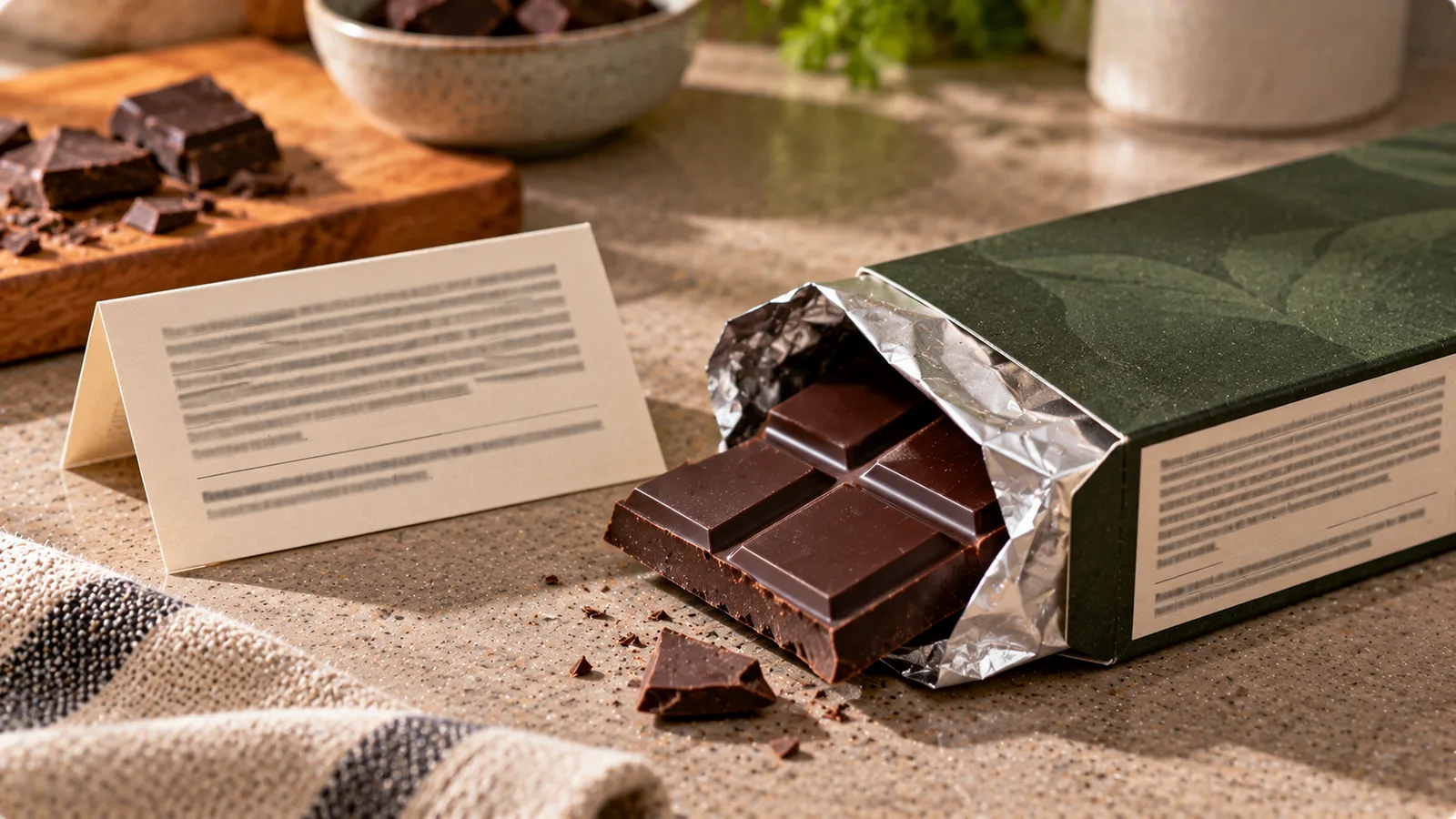
Example: vegan dark chocolate
Consider a dark chocolate bar with cocoa mass, sugar and cocoa butter as its main ingredients.
It may be marketed as vegan because milk is not deliberately included in the recipe.
The manufacturer may nevertheless use production equipment that also processes milk chocolate.
The package might therefore include a precautionary milk statement.
This is not proof that the product contains a specific quantity of milk.
But it is relevant information for someone who needs to avoid milk proteins because of an allergy.
Someone choosing vegan food for ethical or dietary reasons may evaluate that situation differently from someone managing an allergy.
The two needs should not be conflated.
Milk allergy is not the same as lactose intolerance
Milk allergy involves an immune response to milk proteins.
Lactose intolerance concerns difficulty digesting lactose, the sugar found in milk.
These are different conditions.
A product labeled lactose-free may still contain milk proteins and may therefore be unsuitable for someone with a milk allergy.
Similarly, a vegan claim does not replace a milk-allergen assessment.
For someone with a diagnosed allergy, follow the avoidance advice provided by their healthcare professional rather than relying on broad dietary marketing terms.
How milk ingredients are identified in the EU
Under EU Regulation No 1169/2011, milk and products thereof are among the substances or products causing allergies or intolerances that must be declared when used as ingredients, subject to specified exceptions.
Relevant allergenic ingredients must be emphasized in the ingredients list, for example through a different typeface, style or background.
Milk-derived ingredients can appear under names such as:
- Milk.
- Whey.
- Casein or caseinates.
- Milk powder.
- Cream.
- Butter.
The exact declaration depends on the product and applicable rules.
An ingredients list is therefore an essential part of checking whether milk has been intentionally included.
But mandatory ingredient labeling and unintended cross-contact are different issues.
A practical package-checking sequence
If milk allergy is relevant, assess the actual product rather than relying only on a vegan label.
1. Identify the exact product
Check the brand, flavor, package and country-specific version.
Similar-looking products can have different recipes or production arrangements.
2. Read the current ingredients list
Look for milk and milk-derived ingredients.
In the EU, intentionally used milk allergens must generally be identified according to the applicable labeling rules.
3. Check precautionary statements
Look for wording such as “may contain milk” or other information about possible milk cross-contact.
Do not assume that every manufacturer uses identical wording.
4. Do not treat a vegan symbol as an allergy certificate
A vegan claim is not automatically an assurance that a product meets the level of allergen control required for your individual medical situation.
5. Contact the manufacturer when necessary
If the label is unclear, ask about allergen management for the exact product and production version.
A vague reassurance that the recipe contains no milk is not the same as information about cross-contact controls.
6. Follow individual medical advice
For a diagnosed milk allergy, especially if reactions have been severe, follow the avoidance plan provided by your allergy specialist.
Do not use an uncertain product as a personal tolerance test.
What if there is no milk warning?
A missing precautionary statement does not automatically prove that a product is free from all possible milk cross-contact.
It may reflect the manufacturer's assessment, labeling practice or other factors.
Likewise, the presence of a warning does not quantify the risk for a particular individual.
The most useful information comes from the complete label, reliable manufacturer details and professional medical advice when appropriate.
Do not infer safety from silence alone.
Are vegan certification schemes all the same?
No.
Different vegan marks may be operated by different organizations with their own standards.
Some schemes address cross-contact or cleaning processes within their criteria, while others focus on ingredient origin and production practices.
You should not assume that a symbol provides a particular milk-allergen threshold unless the scheme explicitly documents that claim and it is relevant to the exact product.
If allergy safety is essential, verify the certification's actual requirements rather than relying on the appearance of the logo.
When this distinction matters most
The difference between vegan and milk-allergen-free is especially important when:
- Buying chocolate or confectionery.
- Choosing plant-based desserts.
- Selecting packaged snacks.
- Comparing products with different precautionary statements.
- Shopping for a person with a diagnosed milk allergy.
- Ordering food where shared preparation equipment may be used.
For unpackaged foods and restaurant meals, ingredient information and cross-contact questions may require direct communication with the food business.
A menu item described as vegan is not automatically guaranteed free of unintended milk proteins.
Common assumptions to avoid
“Vegan means no milk proteins can be present.”
Not necessarily. A vegan formulation and unintended cross-contact are separate issues.
“May contain milk means milk is an ingredient.”
No. It is generally a precautionary statement about possible unintended presence.
“No warning means zero risk.”
Not necessarily. The absence of a statement is not a universal analytical guarantee.
“Lactose-free is safe for milk allergy.”
Not necessarily. Lactose-free dairy products can still contain milk proteins.
“Every vegan logo follows one global standard.”
No. Criteria vary by scheme.
Sources and further information
- EU Regulation No 1169/2011 — allergen declarations and food information requirements.
- European Commission: Food Allergens — EU allergen-labeling framework.
- Food Allergy Research & Education — educational information on food allergies and avoidance.
- European Food Safety Authority — scientific information relating to food allergens and risk assessment.
The key distinction
Vegan describes a dietary or production-related claim; milk-allergen safety requires a separate assessment.
A product may contain no intentionally added milk ingredients yet still present a potential cross-contact concern.
For someone managing a milk allergy, read the full current label, consider precautionary information and follow their individual medical guidance.