
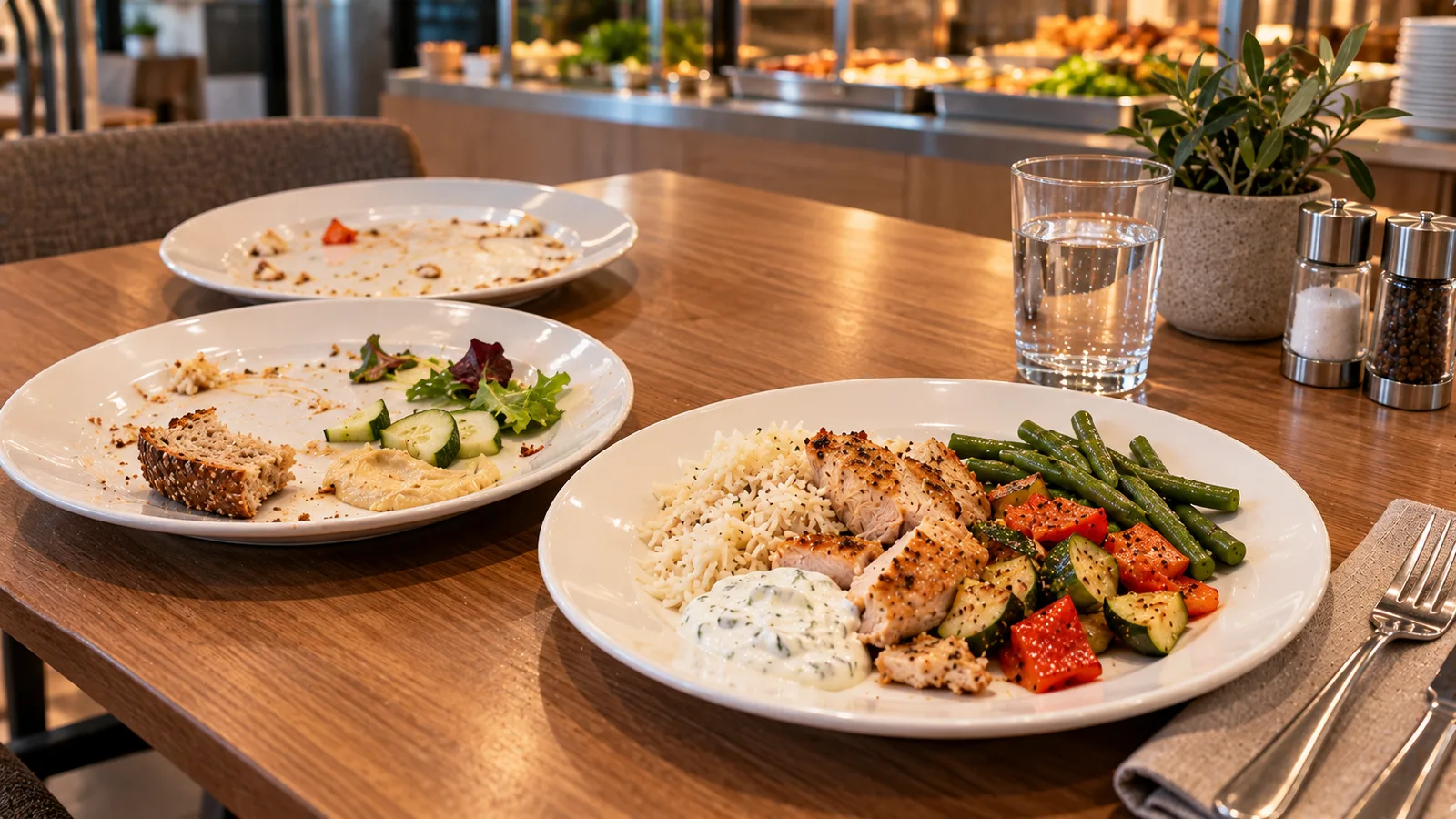
An all-you-can-eat buffet is one of the harder meals to log accurately.
The difficulty is not simply that there is a lot of food. A buffet combines several tracking problems at once:
- multiple plates;
- small portions of many foods;
- refills;
- mixed dishes;
- sauces and oils;
- foods prepared outside your control;
- uncertain portion sizes;
- forgotten items by the end of the meal.
The goal is therefore not to create an unrealistically exact calorie number.
A better goal is to build a reasonable record of what you ate, approximately how much you ate, and where the largest uncertainty remains.
Track the buffet plate by plate
The simplest method is to treat every trip to the buffet as a separate stage.
Instead of trying to remember the entire meal afterward, think in terms of:
Plate 1 → Plate 2 → refill → dessert → drinks
For example:
Plate 1
- grilled chicken;
- rice;
- roasted vegetables;
- small amount of sauce.
Plate 2
- beef;
- potatoes;
- salad;
- bread.
Dessert
- small piece of cake;
- fruit.
Drinks
- one soft drink;
- coffee with milk.
This structure is easier to reconstruct than one large entry called “buffet dinner.”
Why one photo of the first plate is not enough
If you use photo-based food tracking, a photo can help identify foods and estimate visible portions.
But the first plate does not represent the entire meal if you later return for:
- more rice;
- another serving of meat;
- extra sauce;
- dessert;
- another drink.
The practical rule is:
each meaningful refill should become part of the log.
If possible, photograph each plate before eating.
If that is inconvenient, make a quick note after each trip.
Separate identification from portion estimation
Two different uncertainties exist at a buffet.
What is the food?
You may know that an item is chicken but not know whether it was:
- grilled;
- fried;
- glazed;
- cooked with oil;
- prepared with a creamy sauce.
How much did you eat?
You may recognize the food perfectly but still be unsure whether the portion was:
- 80 g;
- 120 g;
- 160 g.
Do not treat these as the same problem.
First identify the food as specifically as reasonably possible.
Then estimate the amount.
Use visible portions before guessing grams
If no scale is available, start with what you can observe.
Useful descriptions include:
- one small chicken breast;
- two thin slices of roast beef;
- half a cup of rice;
- one serving spoon of potatoes;
- one small bread roll;
- two tablespoons of sauce;
- one small piece of cake.
You can then map these descriptions to an appropriate food database entry or approximate weight.
This is usually better than inventing an exact gram value with no visual basis.
Repeated foods should be added together
Suppose Plate 1 contains approximately:
100 g rice
and Plate 2 contains another:
80 g rice
Your meal should ultimately reflect approximately:
180 g rice
Do not log only the first serving.
The same principle applies to:
- meat;
- potatoes;
- noodles;
- bread;
- sauces;
- desserts;
- drinks.
At a buffet, small refills can materially change the total meal.
Example: tracking three plates
Imagine this meal.
Plate 1
- grilled chicken, approximately 120 g;
- cooked rice, approximately 150 g;
- mixed vegetables, approximately 100 g;
- sauce, approximately 2 tablespoons.
Plate 2
- beef, approximately 80 g;
- potatoes, approximately 120 g;
- vegetables, approximately 80 g.
Plate 3
- another 70 g rice;
- another 60 g chicken;
- approximately 1 tablespoon sauce.
The combined meal becomes approximately:
- chicken: 180 g;
- rice: 220 g;
- beef: 80 g;
- potatoes: 120 g;
- vegetables: 180 g;
- sauce: approximately 3 tablespoons.
Combining repeated foods after recording each plate gives you a cleaner final log without losing the refills.
Mixed dishes need a different approach
Buffets often include foods such as:
- lasagna;
- curry;
- casseroles;
- fried rice;
- pasta dishes;
- stews;
- creamy salads.
You may not know the exact recipe.
In that case, choose a database entry that reasonably matches the dish rather than trying to reconstruct ingredients you cannot see.
For example, if you ate restaurant-style chicken curry, logging plain chicken plus plain vegetables would likely omit important components such as sauce and cooking fat.
A comparable prepared-dish entry may be more realistic.
Do not pretend you know the restaurant recipe
A buffet meal prepared outside your control contains unavoidable uncertainty.
You usually do not know:
- exact oil quantity;
- exact sauce recipe;
- sugar added to glazes;
- fat percentage of meat;
- exact ingredient proportions;
- how much cooking liquid was retained.
Unless the restaurant provides reliable nutrition information, an estimate remains an estimate.
That is acceptable.
Food tracking can still be useful without pretending the number is exact.
Pay more attention to calorie-dense uncertainty
Not every estimation error matters equally.
Being wrong by 30 g when estimating lettuce has a different potential effect from being wrong by 30 g when estimating:
- oil;
- mayonnaise;
- creamy dressing;
- cheese;
- nuts;
- fried food;
- rich sauce;
- dessert.
When time is limited, spend more attention on foods where a modest portion error can produce a larger calorie difference.
Sauces deserve their own entry
Buffet sauces are easy to forget because they may occupy little space on the plate.
Examples include:
- mayonnaise-based sauces;
- creamy dressings;
- pesto;
- gravy;
- cheese sauce;
- sweet chili sauce;
- oil-based dressings.
If you added sauce separately, log it separately when practical.
Instead of logging only:
grilled chicken
consider:
grilled chicken + approximately 2 tbsp creamy sauce
The sauce can materially change the estimate.
Cooking oil is often invisible
Vegetables that look simple may have been:
- sautéed in oil;
- roasted with oil;
- brushed with butter;
- finished with dressing.
The same is true for meat, rice and noodles.
You do not need to automatically add a large amount of oil to every buffet food.
But you should avoid assuming that every prepared restaurant food is equivalent to an oil-free home-cooked version.
Choose database entries that reasonably reflect the preparation method when possible.
Fried food should be logged as fried food
If you ate fried chicken, tempura, fried fish or deep-fried potatoes, do not log the underlying ingredient as if it were grilled or boiled.
Preparation state matters.
Choose an entry representing the food as eaten.
This is more important than trying to estimate the exact amount of oil absorbed.
Small tastes still count when they accumulate
At a buffet you may take:
- one dumpling;
- half a spring roll;
- a spoonful of pasta;
- a bite of cheese;
- a small dessert;
- a second small dessert.
Individually, each item may seem too small to matter.
Together, they can represent a meaningful part of the meal.
You do not need obsessive precision, but include meaningful tastes and samples rather than automatically ignoring them.
Track drinks separately
Buffet tracking often focuses so heavily on plates that drinks disappear from the record.
Include caloric drinks such as:
- regular soft drinks;
- juice;
- sweetened tea;
- milk-based coffee;
- smoothies;
- other caloric beverages.
If you refill a drink, record the total amount consumed rather than only the first glass.
Water and zero-calorie beverages do not need calories added simply because they were consumed with the meal.
Alcohol should not be hidden inside the buffet estimate
If alcohol is part of the meal, record it as a separate beverage entry rather than trying to bury it in a generic buffet calorie estimate.
The type, serving size and number of drinks matter.
This keeps the buffet-food estimate and beverage estimate conceptually separate.
Desserts are easier to track individually
A dessert plate may contain several small items.
Instead of entering:
dessert plate
break it into recognizable components:
- small brownie;
- mini cheesecake;
- fruit;
- scoop of ice cream.
If the exact product is unknown, use comparable generic entries.
Again, the goal is a reasonable estimate, not fictional precision.
Use ranges when uncertainty is genuinely large
Sometimes one number gives a misleading impression of certainty.
Suppose a creamy pasta portion might reasonably be somewhere around 300–450 kcal depending on:
- actual portion size;
- sauce amount;
- cheese;
- preparation.
For analysis, it can be useful to recognize that the meal has a range of plausible values.
If your tracking app requires one number, choose a reasonable central estimate rather than automatically selecting the lowest possible entry.
Do not always choose the lowest-calorie database result
Searching for “restaurant curry” may produce entries with very different calorie values.
The lowest result is not automatically the best match.
Compare:
- preparation style;
- ingredients;
- serving size;
- whether sauce is included;
- whether the entry represents homemade or restaurant food.
Choose the closest plausible match.
Avoid compensating with exaggerated estimates
Uncertainty does not mean you should automatically log every buffet meal as an extreme worst-case scenario.
For example, if you ate one moderate plate and a small dessert, entering an arbitrary enormous calorie total does not make the diary more accurate.
Use the available evidence:
- plate photos;
- number of refills;
- visible portion sizes;
- dish type;
- restaurant nutrition data if available.
The estimate should be realistic in both directions.
A photo workflow for buffet tracking
If you use Mealisa or another photo-based tracker, a practical workflow is:
Before Plate 1
Take a clear photo showing the entire plate.
Before Plate 2
Take another photo.
For meaningful refills
Photograph the refill or add it manually.
Dessert
Record it separately.
Drinks
Add total beverage amounts.
After the meal
Review the entries and combine repeated foods if the app supports it.
This is more reliable than expecting one image to represent a meal that changed several times.
What if you forget to photograph a refill?
Do not discard the entire log.
Reconstruct what you remember.
For example:
Forgot photo — second serving was roughly one serving spoon of rice and two small pieces of chicken.
A rough additional entry is usually better than pretending the refill did not happen.
What if you cannot remember every item?
Prioritize the components most likely to influence the estimate.
Try to recall:
- main protein foods;
- starches;
- fried foods;
- sauces and dressings;
- desserts;
- caloric drinks;
- significant refills.
A few leaves of salad you cannot remember precisely will usually create less uncertainty than forgetting a second serving of fried food or dessert.
Restaurant nutrition information can reduce uncertainty
Some buffet restaurants or chains provide nutrition information.
When reliable information is available for the exact item, it may be preferable to a generic database estimate.
Check whether the listed value refers to:
- 100 g;
- one serving;
- one piece;
- one scoop;
- another defined portion.
You still need to estimate how many of those portions you actually ate.
Example: serving-based restaurant information
Suppose the restaurant lists:
Chicken dish — 220 kcal per serving
and you estimate that you ate:
1.5 servings
Then:
220 × 1.5 = approximately 330 kcal
The calculation is simple, but the quality of the result still depends on your serving estimate.
Shared buffet dishes
Sometimes food is brought to the table and shared rather than collected individually.
In that case, estimate your own share.
For example, four people share a platter, but the food is not divided equally.
Do not automatically log exactly one quarter unless you actually ate approximately one quarter.
Use the amount you personally consumed.
Buffets with small plates
Small-plate buffets can create a memory problem because each individual plate looks modest.
You might eat:
- plate 1;
- plate 2;
- plate 3;
- plate 4;
- dessert.
The total meal is the sum of all of them.
Tracking each trip separately prevents the small-plate format from hiding the cumulative amount.
Buffets with one large plate
The opposite problem also occurs.
One large plate may contain eight or ten foods.
In that case, divide the plate mentally into components.
For example:
- 1/4 plate rice;
- 1/4 plate chicken and beef;
- 1/4 plate vegetables;
- remaining area divided among several small foods.
A clear overhead or angled photo can help reconstruct the meal later.
Seconds are not a tracking failure
Returning for another serving does not make the meal impossible to log.
It simply means the log needs another entry.
For example:
Initial serving: 120 g potatoes
Refill: approximately 80 g potatoes
Total: approximately 200 g potatoes
This approach is much more useful than trying to force the entire meal into the first plate.
Do not use the plate size as a calorie estimate
A full plate does not have a fixed calorie value.
Two similarly sized plates can differ substantially.
One might contain:
- salad;
- lean protein;
- vegetables;
- rice.
Another might contain:
- fried foods;
- creamy pasta;
- cheese;
- rich sauces.
Track the foods and approximate amounts rather than assigning calories based only on how full the plate looks.
Buffet tracking does not need to be perfect to be useful
A meal with several unknown restaurant dishes will never be as precise as a meal prepared from weighed ingredients and a known recipe.
That does not make tracking pointless.
A reasonable buffet record can still show:
- that the meal was larger than usual;
- the main sources of calories;
- approximate protein and carbohydrate intake;
- how many servings or refills were eaten;
- whether drinks and desserts were significant.
The correct level of confidence matters more than fake precision.
A practical five-step method
When you want the shortest possible workflow, use this:
1. Record every plate.
Photo or quick note.
2. Identify the main foods.
Use preparation-specific names where possible.
3. Estimate visible portions.
Use grams, household measures, pieces or serving sizes.
4. Add refills, sauces, desserts and drinks.
Do not let small additions disappear.
5. Review uncertainty.
Choose realistic database matches and avoid pretending that restaurant portions are exact.
Example of a complete buffet log
Suppose the meal included:
First plate
- grilled chicken: ~120 g;
- rice: ~140 g;
- vegetables: ~100 g;
- creamy sauce: ~30 g.
Second plate
- beef: ~90 g;
- potatoes: ~120 g;
- vegetables: ~70 g;
- bread roll: 1.
Refill
- chicken: ~60 g;
- rice: ~80 g.
Dessert
- small cake: 1 piece;
- fruit: ~100 g.
Drink
- regular soft drink: ~400 ml.
The final log should represent all of these components rather than only the first plate.
You can combine repeated foods:
- chicken: ~180 g total;
- rice: ~220 g total;
- vegetables: ~170 g total.
The other items remain separate.
The key rule
For buffet tracking, accuracy usually improves more from remembering every meaningful serving than from trying to estimate the first plate to the nearest gram.
Think:
plates → refills → extras → drinks → review
Record what you can see, add what you return for, and acknowledge uncertainty where recipes or portions are unknown.
A realistic estimate with clear uncertainty is more useful than an exact-looking number built from incomplete information.
Sources
- U.S. Food and Drug Administration (FDA), Nutrition Facts Label and serving-size guidance.
- USDA FoodData Central, reference nutrient data for foods and prepared dishes.
- European Commission, food information and nutrition-labelling guidance.
- Regulation (EU) No 1169/2011 on the provision of food information to consumers.