
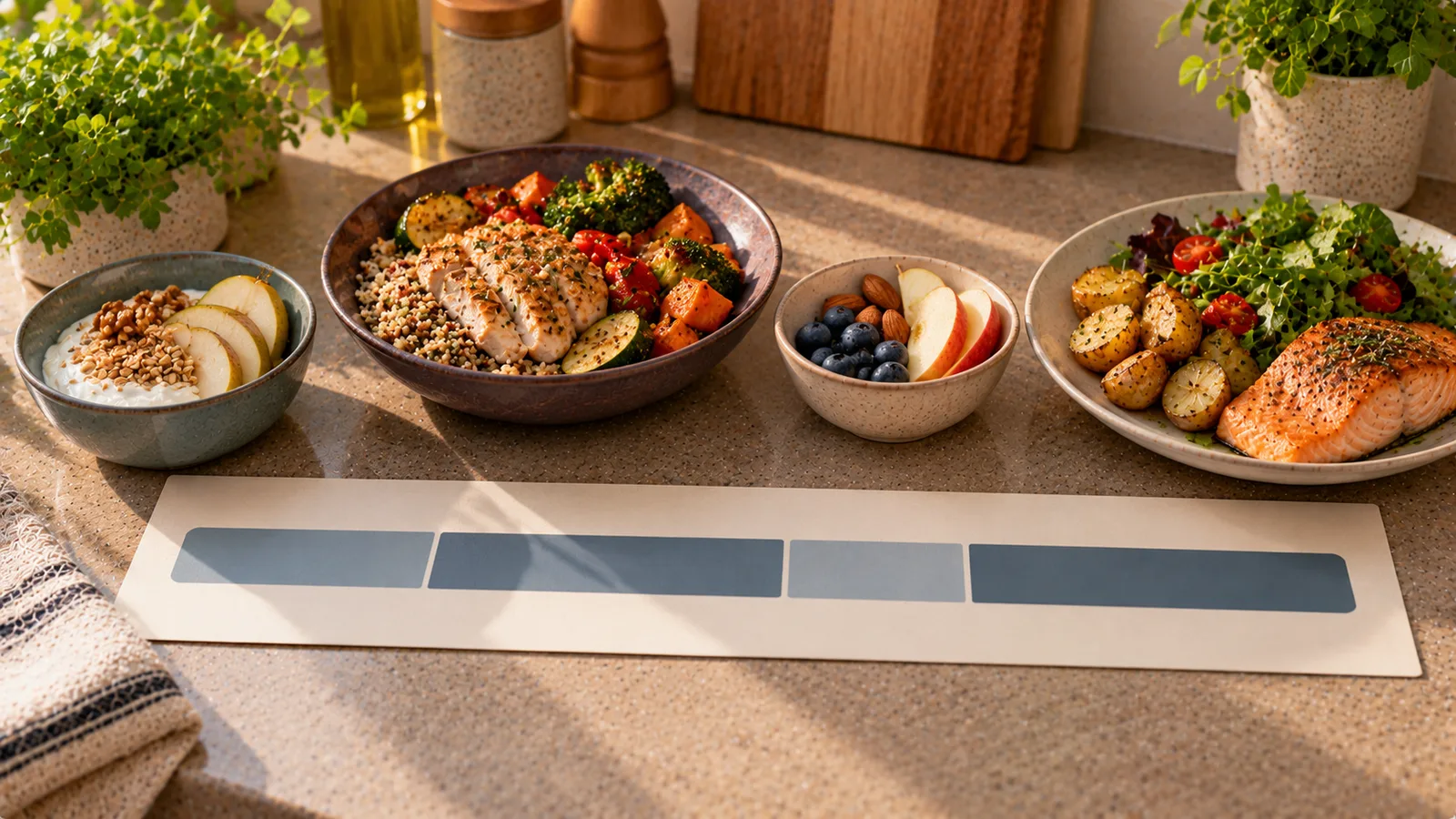
Once you have a daily calorie target, the next question is often how much of it should go to each meal.
There is no universal rule that breakfast, lunch and dinner must contain the same number of calories.
A useful calorie split should fit your:
- daily calorie target;
- number of meals;
- appetite pattern;
- work or school schedule;
- training schedule;
- preferred meal sizes;
- use of snacks.
The practical goal is to create a distribution that makes the whole day easier to follow.
Start with your daily calorie target
Suppose your target is:
2,000 kcal per day
Those 2,000 calories can be distributed in many ways.
For three meals with no snacks, an equal split would be:
2,000 ÷ 3 ≈ 667 kcal per meal
But equal meals are only one option.
You might prefer:
- 500 kcal breakfast;
- 650 kcal lunch;
- 850 kcal dinner.
The total is still:
500 + 650 + 850 = 2,000 kcal
The daily total has not changed — only the timing has.
A simple percentage method
Instead of choosing exact calorie numbers first, divide the day into percentages.
For three meals, one possible structure is:
- breakfast: 25%;
- lunch: 35%;
- dinner: 40%.
For a 2,000 kcal target:
Breakfast:
2,000 × 0.25 = 500 kcal
Lunch:
2,000 × 0.35 = 700 kcal
Dinner:
2,000 × 0.40 = 800 kcal
Total:
500 + 700 + 800 = 2,000 kcal
This works well when you naturally prefer a larger evening meal.
Three equal meals
If you prefer similar meal sizes, use roughly one-third of your calories at each meal.
For 1,800 kcal:
1,800 ÷ 3 = 600 kcal
A simple day could therefore be:
- breakfast: 600 kcal;
- lunch: 600 kcal;
- dinner: 600 kcal.
There is nothing inherently superior about this pattern. It is simply easy to calculate and plan.
Three meals plus one snack
If you want to reserve calories for a snack, allocate the snack first or include it in the percentage split.
One example:
- breakfast: 25%;
- lunch: 30%;
- dinner: 35%;
- snack: 10%.
For 2,200 kcal:
Breakfast:
2,200 × 0.25 = 550 kcal
Lunch:
2,200 × 0.30 = 660 kcal
Dinner:
2,200 × 0.35 = 770 kcal
Snack:
2,200 × 0.10 = 220 kcal
Total:
2,200 kcal
Three meals plus two snacks
Another possible structure is:
- breakfast: 25%;
- lunch: 30%;
- dinner: 35%;
- snack 1: 5%;
- snack 2: 5%.
For 2,000 kcal:
- breakfast: 500 kcal;
- lunch: 600 kcal;
- dinner: 700 kcal;
- snack 1: 100 kcal;
- snack 2: 100 kcal.
Again, these percentages are examples rather than nutritional requirements.
Four meals
Some people prefer four moderate meals rather than three larger ones.
An equal split of 2,400 kcal would be:
2,400 ÷ 4 = 600 kcal per meal
Or you could use:
- meal 1: 20%;
- meal 2: 25%;
- meal 3: 25%;
- meal 4: 30%.
For 2,400 kcal:
- meal 1: 480 kcal;
- meal 2: 600 kcal;
- meal 3: 600 kcal;
- meal 4: 720 kcal.
The useful split is the one that fits your actual day.
Two meals per day
If you normally eat two main meals, there is no need to artificially create a third meal just to divide calories evenly.
For 2,000 kcal, a simple split might be:
- first meal: 45% = 900 kcal;
- second meal: 55% = 1,100 kcal.
Or:
- first meal: 50% = 1,000 kcal;
- second meal: 50% = 1,000 kcal.
Larger meals may be harder or easier to manage depending on your appetite and routine, so choose a pattern that is practical for you.
You do not need exact percentages
A meal does not have to hit its planned calorie number exactly.
Instead of targeting exactly 600 kcal for lunch, you might use a range such as:
550–650 kcal
This gives you room for normal differences in ingredients, portions and appetite.
If one meal is slightly larger, another can be slightly smaller without requiring a complete redesign of the day.
Example with flexible ranges
Suppose your daily target is approximately:
2,000 kcal
You could plan:
- breakfast: 400–500 kcal;
- lunch: 550–650 kcal;
- dinner: 650–800 kcal;
- snacks: 150–300 kcal.
These ranges overlap with multiple possible daily totals, so they are not intended as four independent maximums.
They are planning ranges.
For example:
- breakfast: 450 kcal;
- lunch: 600 kcal;
- dinner: 720 kcal;
- snack: 230 kcal.
Total:
450 + 600 + 720 + 230 = 2,000 kcal
Build the split around your appetite
Your appetite does not necessarily follow an equal-meal schedule.
Some people are not very hungry in the morning but become much hungrier later.
For them, this may be easier:
- breakfast: 20%;
- lunch: 30%;
- dinner: 40%;
- snack: 10%.
Someone who wakes up hungry and prefers a substantial breakfast might choose:
- breakfast: 35%;
- lunch: 30%;
- dinner: 30%;
- snack: 5%.
The daily calorie target can remain the same in both cases.
Example: larger breakfast
Daily target:
2,000 kcal
Distribution:
- breakfast: 35%;
- lunch: 30%;
- dinner: 30%;
- snack: 5%.
Calories:
Breakfast:
2,000 × 0.35 = 700 kcal
Lunch:
2,000 × 0.30 = 600 kcal
Dinner:
2,000 × 0.30 = 600 kcal
Snack:
2,000 × 0.05 = 100 kcal
Total:
2,000 kcal
Example: larger dinner
Daily target:
2,000 kcal
Distribution:
- breakfast: 20%;
- lunch: 30%;
- dinner: 40%;
- snack: 10%.
Calories:
- breakfast: 400 kcal;
- lunch: 600 kcal;
- dinner: 800 kcal;
- snack: 200 kcal.
Total:
2,000 kcal
Neither distribution is automatically better simply because one puts more calories earlier or later.
The more useful question is which structure helps you eat consistently and comfortably.
Reserve calories for snacks intentionally
A common planning mistake is to allocate the entire calorie target to main meals and then treat snacks as additional calories.
If snacks are part of your normal routine, include them from the beginning.
For a 2,100 kcal target, you might reserve:
300 kcal for snacks
That leaves:
2,100 − 300 = 1,800 kcal
for the main meals.
You could then divide the remaining calories:
- breakfast: 500 kcal;
- lunch: 600 kcal;
- dinner: 700 kcal;
- snacks: 300 kcal.
Total:
2,100 kcal
Reserve calories for dessert if you regularly eat it
The same idea works for dessert.
Suppose your daily target is:
2,000 kcal
and you want approximately:
250 kcal for dessert
Remaining calories:
2,000 − 250 = 1,750 kcal
One possible distribution:
- breakfast: 450 kcal;
- lunch: 600 kcal;
- dinner: 700 kcal;
- dessert: 250 kcal.
Total:
2,000 kcal
Planning dessert as part of the day is mathematically different from adding it after the rest of the calorie target has already been used.
Work backward from a known meal
Sometimes one meal is relatively fixed.
For example, you know dinner will be approximately:
850 kcal
Your daily target is:
2,100 kcal
Remaining calories:
2,100 − 850 = 1,250 kcal
You can distribute those 1,250 kcal across breakfast, lunch and snacks.
For example:
- breakfast: 400 kcal;
- lunch: 600 kcal;
- snack: 250 kcal;
- dinner: 850 kcal.
Total:
2,100 kcal
This can be easier than forcing dinner to fit a predetermined percentage.
Restaurant dinner example
Suppose you expect a restaurant dinner of roughly:
1,000 kcal
Your usual daily target is around:
2,200 kcal
That leaves approximately:
2,200 − 1,000 = 1,200 kcal
for the rest of the day.
One possible structure:
- breakfast: 400 kcal;
- lunch: 550 kcal;
- snack: 250 kcal;
- dinner: 1,000 kcal.
Total:
2,200 kcal
This is a planning example, not a reason to severely restrict earlier meals to compensate for an uncertain restaurant estimate.
Training can influence meal placement
Some people prefer to place more of their daily food around training because that fits their appetite or routine.
For example, with a 2,400 kcal target and an evening workout:
- breakfast: 500 kcal;
- lunch: 650 kcal;
- pre-workout snack: 250 kcal;
- dinner after training: 1,000 kcal.
Total:
2,400 kcal
Someone training early may prefer a larger breakfast or post-training meal instead.
Calorie distribution can therefore be adapted to schedule rather than following a universal meal ratio.
Shift work and irregular schedules
Traditional breakfast-lunch-dinner percentages may be less useful when your work schedule changes.
Instead, divide calories across your actual eating occasions.
For example:
- meal after waking: 25%;
- main work meal: 30%;
- snack: 10%;
- meal after work: 35%.
The labels attached to the meals matter less than the total structure.
How to calculate any percentage
The calculation is:
Meal calories = daily calories × meal percentage
For a daily target of 2,300 kcal and a lunch allocation of 30%:
2,300 × 0.30 = 690 kcal
For a dinner allocation of 40%:
2,300 × 0.40 = 920 kcal
You can use the same method with any daily target.
Example distributions for 1,800 kcal
Three meals
- breakfast: 450 kcal;
- lunch: 600 kcal;
- dinner: 750 kcal.
Total: 1,800 kcal
Three meals and one snack
- breakfast: 400 kcal;
- lunch: 550 kcal;
- dinner: 650 kcal;
- snack: 200 kcal.
Total: 1,800 kcal
Four meals
- meal 1: 400 kcal;
- meal 2: 450 kcal;
- meal 3: 450 kcal;
- meal 4: 500 kcal.
Total: 1,800 kcal
These are examples, not required distributions.
Example distributions for 2,000 kcal
Larger dinner
- breakfast: 400 kcal;
- lunch: 600 kcal;
- dinner: 800 kcal;
- snack: 200 kcal.
Total: 2,000 kcal
Similar main meals
- breakfast: 600 kcal;
- lunch: 600 kcal;
- dinner: 600 kcal;
- snack: 200 kcal.
Total: 2,000 kcal
Two larger meals
- meal 1: 900 kcal;
- meal 2: 1,100 kcal.
Total: 2,000 kcal
Example distributions for 2,500 kcal
One possible four-eating-occasion structure:
- breakfast: 600 kcal;
- lunch: 750 kcal;
- dinner: 900 kcal;
- snack: 250 kcal.
Total:
600 + 750 + 900 + 250 = 2,500 kcal
Another person could distribute the same target very differently without changing the daily total.
Avoid turning meal targets into rigid limits
A planned 600 kcal lunch does not mean a 650 kcal lunch is a failure.
Meal calorie allocations are planning tools.
If lunch is 50 kcal higher than expected and your day still approximately fits your intended intake, there may be nothing that needs to be corrected.
Rigidly forcing every meal to an exact number can make planning unnecessarily difficult.
Adjust the remaining day rather than starting over
Suppose your target is:
2,000 kcal
You planned:
- breakfast: 450 kcal;
- lunch: 600 kcal;
- dinner: 750 kcal;
- snack: 200 kcal.
But lunch ends up being:
750 kcal
You have consumed:
450 + 750 = 1,200 kcal
Remaining:
2,000 − 1,200 = 800 kcal
You could use those 800 kcal across dinner and a snack in whatever way is practical.
You do not need to recreate the entire day's plan.
Do not confuse calorie distribution with macro distribution
Splitting calories across meals and splitting protein, carbohydrate and fat targets across meals are related but different questions.
For example, two meals can each contain 600 kcal while having very different amounts of protein, carbohydrates and fat.
This article focuses on distributing total energy.
If you are planning protein or other macros per meal, calculate those separately rather than assuming an equal calorie split automatically produces an equal macro split.
Meal timing does not change the arithmetic of the daily total
If a 2,000 kcal day contains:
- 500 kcal breakfast;
- 600 kcal lunch;
- 900 kcal dinner;
the total is 2,000 kcal.
If the same foods are rearranged as:
- 700 kcal breakfast;
- 700 kcal lunch;
- 600 kcal dinner;
the total is still 2,000 kcal.
Meal timing can matter for practical reasons such as hunger, comfort, training and routine, but moving calories from one meal to another does not change the arithmetic of the daily total.
Your calorie target is usually an estimate too
It is worth remembering that a daily calorie target is generally an estimate rather than a perfectly measured biological requirement.
Food labels, restaurant meals, recipes and portion estimates also contain uncertainty.
That is another reason not to treat a meal target such as 612 kcal as if 613 kcal were meaningfully different.
Useful planning normally requires reasonable consistency, not artificial precision.
A practical way to create your own split
Start with your daily calorie target.
Then:
- list the meals and snacks you normally eat;
- identify whether one meal is naturally larger;
- reserve calories for regular snacks, drinks or dessert;
- divide the remaining calories among your main meals;
- convert exact targets into flexible ranges if that makes the plan easier to follow;
- adjust the distribution after observing your real hunger and routine.
For example:
Daily target:
2,200 kcal
You normally eat three meals, one snack and a small dessert.
Reserve:
- snack: 200 kcal;
- dessert: 200 kcal.
Remaining:
2,200 − 400 = 1,800 kcal
Then allocate:
- breakfast: 500 kcal;
- lunch: 600 kcal;
- dinner: 700 kcal.
Final structure:
- breakfast: 500 kcal;
- lunch: 600 kcal;
- dinner: 700 kcal;
- snack: 200 kcal;
- dessert: 200 kcal.
Total:
2,200 kcal
The practical rule
There is no single correct percentage of daily calories that everyone should eat at breakfast, lunch or dinner.
Start with your daily total and distribute it around the way you actually eat.
Use percentages when they simplify planning, but do not treat them as mandatory rules.
A useful calorie split should:
- fit your number of meals;
- leave room for snacks you actually eat;
- reflect when you are usually hungry;
- work with your schedule;
- remain flexible enough for real meals.
The best distribution is not the one with the neatest percentages.
It is the one that helps your daily plan work in practice.