
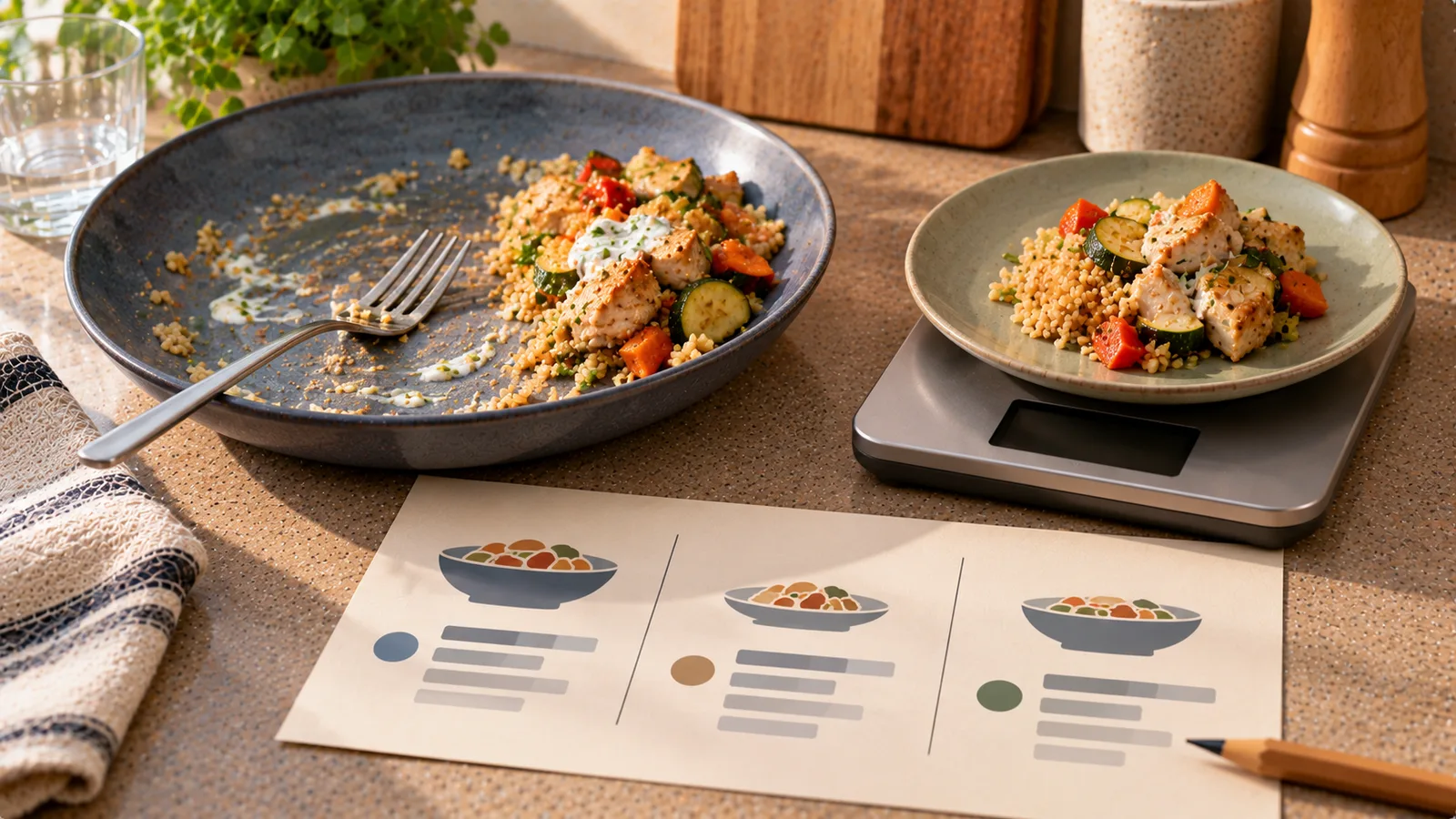
You planned to eat the whole meal, logged it, and then left part of it on the plate.
How many calories did you actually eat?
The most practical answer is to log the amount consumed rather than automatically keeping the original full portion.
If you can weigh the food before and after eating, the calculation is straightforward:
Amount eaten = starting edible weight − remaining edible weight
You can then scale the calories and nutrients to the amount you actually consumed.
The simplest example
Suppose you serve:
500 g of a meal
The entire portion contains:
750 kcal
After eating, 120 g remains.
Amount eaten:
500 − 120 = 380 g
Fraction eaten:
380 ÷ 500 = 0.76
Calories eaten:
750 × 0.76 = 570 kcal
Instead of keeping the original 750 kcal entry, you would log approximately 570 kcal.
Method 1: weigh what is left
When possible, weighing the remaining food is usually the easiest method.
You need:
- the original edible portion weight;
- the remaining edible food weight.
Then calculate:
Eaten weight = original weight − remaining weight
If the original serving was 420 g and 95 g remains:
420 − 95 = 325 g eaten
If the food contains 160 kcal per 100 g:
325 ÷ 100 × 160 = 520 kcal
This approach works especially well for relatively uniform foods such as:
- pasta dishes;
- rice dishes;
- porridge;
- yogurt;
- soup;
- casseroles;
- mashed potatoes;
- mixed bowls.
Method 2: edit the serving directly
If your food diary stores the food by weight, you may not need to calculate calories manually.
Suppose you initially logged:
300 g pasta
After eating, you estimate that you consumed only 225 g.
Edit the entry from 300 g to:
225 g
The app or database can then recalculate calories and macros from the revised weight.
This is often simpler than manually changing calories.
Method 3: estimate the fraction eaten
Sometimes weighing is not possible.
For example, you may be eating:
- at a restaurant;
- at work;
- while traveling;
- from shared dishes.
In that situation, estimate the fraction you consumed.
Useful practical estimates include:
- one-quarter eaten = 25%;
- one-third eaten ≈ 33%;
- half eaten = 50%;
- two-thirds eaten ≈ 67%;
- three-quarters eaten = 75%;
- almost all eaten ≈ 85–95%.
If a meal is estimated at 800 kcal and you ate roughly three-quarters:
800 × 0.75 = 600 kcal
The result is an estimate, but it is usually more realistic than logging the entire meal when a substantial portion was left.
Start with edible weight
When using weight, distinguish between total plate weight and edible food weight.
Do not accidentally include:
- the plate;
- bowl;
- container;
- bones;
- shells;
- large inedible peels;
- packaging.
The goal is to compare edible food before eating with edible food remaining afterward.
Example: homemade pasta
You serve 450 g of homemade pasta with sauce.
Your saved recipe contains:
170 kcal per 100 g
After eating, 80 g remains.
Amount eaten:
450 − 80 = 370 g
Calories:
370 × 170 ÷ 100 = 629 kcal
If the recipe also contains 7 g protein per 100 g:
370 × 7 ÷ 100 = 25.9 g protein
The same scaling method can be applied to carbohydrates, fat, fiber and other nutrients.
Example: soup
You serve:
550 g soup
The soup contains:
65 kcal per 100 g
You leave:
150 g
Amount eaten:
550 − 150 = 400 g
Calories eaten:
400 × 65 ÷ 100 = 260 kcal
If you had logged the entire 550 g serving, the entry would have been:
550 × 65 ÷ 100 = 357.5 kcal
Editing the portion therefore changes the estimate by almost 100 kcal.
Example: packaged yogurt
A container contains:
400 g
The label states:
75 kcal per 100 g
You eat some and leave 140 g.
Amount eaten:
400 − 140 = 260 g
Calories:
260 × 75 ÷ 100 = 195 kcal
If you later eat the remaining 140 g, you can log that amount separately.
Mixed meals require judgment
A mixed meal is not always perfectly uniform.
Suppose your plate contains:
- chicken;
- rice;
- vegetables;
- sauce.
You leave 100 g, but almost all of the leftovers are rice.
Simply subtracting 100 g from a combined meal assumes the leftovers have the same nutritional composition as the original plate.
That may not be true.
When the components are visibly different, it can be more accurate to adjust them separately.
For example, if you ate:
- all the chicken;
- most of the vegetables;
- half the rice;
- most of the sauce;
edit those components individually when practical.
When one combined estimate is good enough
You do not need to reconstruct every bite.
A combined percentage estimate can be reasonable when:
- the meal is well mixed;
- the remaining portion resembles the original portion;
- precise ingredient separation is impossible;
- the difference is unlikely to meaningfully affect your analysis.
Nutrition tracking is already based on measurements and estimates with some uncertainty.
The goal is a useful record, not laboratory reconstruction.
Restaurant example
Suppose you estimate a restaurant pasta dish at:
900 kcal
You eat approximately two-thirds.
Estimated intake:
900 × 0.67 ≈ 603 kcal
Logging approximately 600 kcal is a reasonable representation based on your estimate.
But if you ate all the meat and sauce while leaving mostly pasta, a simple two-thirds calculation may not reflect the composition as well.
Use the best information available rather than pretending the estimate is exact.
What if you already logged the whole meal?
Edit the original entry instead of adding a negative food entry when your app allows it.
For example:
Original:
600 g meal
Actual eaten amount:
440 g
Change the existing entry to 440 g.
This keeps the diary easier to understand later.
If you cannot edit the original entry, use whatever correction method your tracking system supports, but avoid leaving both the incorrect full portion and a second full replacement entry.
Do not subtract the leftovers twice
A common tracking mistake is:
- reduce the original meal entry;
- also create a separate negative adjustment for the leftovers.
That subtracts the same food twice.
Choose one correction method.
Usually the cleanest approach is simply to change the original serving to the amount actually eaten.
What if you weighed the plate?
A useful technique is to weigh the plate with food before and after eating.
Suppose:
Plate + food before eating:
820 g
Empty plate weight:
350 g
Starting food:
820 − 350 = 470 g
Plate + leftovers:
470 g
Remaining food:
470 − 350 = 120 g
Food eaten:
470 − 120 = 350 g
If the meal contains 180 kcal per 100 g:
350 × 180 ÷ 100 = 630 kcal
This method avoids moving the food into another container.
Tare the plate before serving
If you are preparing the meal yourself, an even easier approach is:
- put the empty plate on the scale;
- tare the scale to zero;
- add the food;
- record the starting weight.
After eating, you can weigh the leftovers on the same plate.
If the scale was tared only at the beginning and has since turned off, you still need to know the plate weight or have recorded the original food weight.
Sauces left on the plate
Sauces create additional uncertainty.
If you leave a small smear of sauce, attempting to calculate every gram is usually unnecessary.
If a substantial amount remains, it may matter more.
For example, leaving 50 g of a calorie-dense creamy sauce can make a meaningful difference compared with leaving 50 g of a watery vegetable broth.
When components are easy to identify, adjust them separately.
When they are not, use a reasonable combined estimate.
Bones and other inedible material
If a meal contains bones, shells or other inedible parts, do not treat them as uneaten edible food.
Suppose you serve a bone-in chicken portion weighing 300 g.
After eating, 90 g of bones and other inedible material remains.
It would be incorrect to assume:
300 − 90 = 210 g edible chicken eaten
unless the original 300 g nutrition entry was also based on total bone-in weight.
Food database entries can use different weight bases.
For foods with bones, peels or shells, match your measurement to the basis of the database entry.
What if you planned a serving but never started eating it?
If you logged food in advance but did not eat it, remove the entry or change the consumed amount to zero.
A planned meal and an eaten meal are not the same thing.
Pre-logging can be useful for planning, but the diary should ultimately reflect what you actually consumed if you are using it to analyze intake.
What if you save the leftovers for later?
Split the food between the two eating occasions.
Example:
Original portion:
500 g
Lunch consumption:
320 g
Saved leftovers:
180 g
Log 320 g at lunch.
If you eat the remaining 180 g at dinner, log 180 g at dinner.
The entire 500 g is eventually accounted for without assigning it all to the first meal.
What if someone else eats the leftovers?
Only log the portion you personally consumed.
If you served 600 g, ate 400 g and another person ate the remaining 200 g, your entry should represent approximately 400 g.
The fact that all the food was eventually eaten does not mean all of it belongs in your diary.
Shared dishes
Shared meals can make exact tracking difficult because you may not know your starting portion.
For example, several people may eat from the same serving bowl.
Possible approaches include:
- weigh your plate after serving yourself;
- estimate your share of the total recipe;
- track identifiable components;
- use a visual fraction when nothing else is available.
If you estimate that you consumed about one-quarter of a 2,000 kcal shared dish:
2,000 × 0.25 = 500 kcal
Treat this as an estimate rather than an exact measurement.
Buffet meals
At a buffet, it may be impractical to weigh everything before and after.
A practical approach is to:
- identify the main foods;
- estimate the portions initially taken;
- adjust for any substantial amount left uneaten;
- avoid spending effort correcting tiny remnants.
If you took an estimated 200 g serving but clearly ate only half, reducing the logged amount is worthwhile.
If only a small bite remains, the difference may be smaller than the uncertainty in the original estimate.
How precise should you be?
Precision should match the quality of the available information.
If you weighed:
- 480 g before eating;
- 135 g after eating;
using 345 g as the amount eaten is reasonable.
If you visually estimated a restaurant meal as 700 g, recording that you ate exactly 483 g would imply a level of precision you do not actually have.
In that case, an estimate such as two-thirds or three-quarters is more appropriate.
Small leftovers usually do not require complex correction
Suppose you leave:
- one small piece of lettuce;
- a teaspoon of sauce;
- two grains of rice.
Trying to reconstruct these amounts can add more complexity than useful accuracy.
The correction becomes more valuable when the leftover amount is substantial or particularly calorie-dense.
Calorie density matters
Leaving 30 g of different foods can have very different effects.
For example, 30 g of:
- cucumber;
- cooked rice;
- cheese;
- nuts;
- oil-based sauce
do not contain similar amounts of energy.
If the leftovers are calorie-dense, even a relatively small weight can matter more.
If they are mostly low-calorie vegetables or broth, the impact may be smaller.
Example: leaving part of a burger meal
Suppose you logged:
- burger: 650 kcal;
- fries: 400 kcal.
You eat the whole burger but only half the fries.
Do not reduce the entire meal by 25% just because approximately one-quarter of the total food volume remains.
Instead:
Burger:
650 kcal
Fries eaten:
400 × 0.5 = 200 kcal
Estimated total:
650 + 200 = 850 kcal
This is more representative than treating all components as equally unfinished.
Example: pizza
You log four slices at:
280 kcal each
You eat three slices and half of the fourth.
Amount eaten:
3.5 slices
Calories:
3.5 × 280 = 980 kcal
There is no need to calculate the remaining food by weight if the slices provide a convenient unit.
Example: sandwich
A sandwich is estimated at:
600 kcal
You eat approximately 75%.
Estimated calories:
600 × 0.75 = 450 kcal
If you left mostly bread but ate all the cheese, meat and sauce, the true value may be somewhat different.
When possible, component-level tracking improves the estimate.
Example: meal with separate components
Your plate contains:
- chicken: 250 kcal;
- potatoes: 300 kcal;
- vegetables: 100 kcal;
- sauce: 150 kcal.
You eat:
- 100% of the chicken;
- 50% of the potatoes;
- 80% of the vegetables;
- about 50% of the sauce.
Estimated intake:
Chicken:
250 × 1.00 = 250 kcal
Potatoes:
300 × 0.50 = 150 kcal
Vegetables:
100 × 0.80 = 80 kcal
Sauce:
150 × 0.50 = 75 kcal
Total:
250 + 150 + 80 + 75 = 555 kcal
The original full plate contained 800 kcal, so leaving food reduced the estimated intake by 245 kcal.
What about macros?
Use the same proportion when the meal is uniform.
Suppose a prepared meal contains:
- 800 kcal;
- 50 g protein;
- 90 g carbohydrates;
- 25 g fat.
You eat 75%.
Estimated intake:
Calories:
800 × 0.75 = 600 kcal
Protein:
50 × 0.75 = 37.5 g
Carbohydrates:
90 × 0.75 = 67.5 g
Fat:
25 × 0.75 = 18.75 g
If the leftovers consist mostly of one component, scaling every nutrient by the same percentage becomes less accurate.
Do not reconstruct food you cannot reasonably identify
Sometimes you simply do not know.
You may remember that you left some food but not how much.
In that case, choose a reasonable estimate based on what you remember.
For example:
- almost everything eaten: perhaps 90%;
- roughly one-quarter left: about 75% eaten;
- about half left: around 50% eaten.
Do not invent an exact weight you never measured.
Correcting yesterday's unfinished meal
If you later realize that a previous entry included food you did not finish, correcting it can improve your historical record when the difference is meaningful.
However, you do not need to reconstruct tiny leftovers from every past meal.
Prioritize corrections that materially change the day's estimated intake.
Avoid false accuracy
Food tracking contains uncertainty even before leftovers are considered.
Nutrition databases, labels, recipe calculations and restaurant estimates are not perfect measurements.
The goal is therefore not to produce a diary that looks mathematically exact.
The goal is to make the entry reasonably represent what you consumed.
A good estimate based on actual leftovers is usually more useful than an exact-looking number based on an incorrect full portion.
A practical decision tree
If you did not finish a meal:
Can you weigh the leftovers?
If yes:
- determine the original edible weight;
- weigh the edible amount remaining;
- subtract;
- log the amount eaten.
If no:
Can you identify separate components?
If yes:
Adjust the components individually.
If no:
Can you estimate the fraction eaten?
Use a reasonable percentage such as half, two-thirds or three-quarters.
If none of these is possible:
Use your best conservative estimate and accept the uncertainty.
The practical rule
Your food diary should represent the food you ate, not simply the food that was originally served.
When a substantial amount remains:
Amount eaten = original edible amount − edible amount left
Then scale calories and nutrients to that amount.
If weighing is impossible, use a sensible fraction or adjust visible components separately.
Do not spend excessive effort on tiny remnants, and do not create false precision from uncertain estimates.
The objective is a useful representation of your actual intake.