
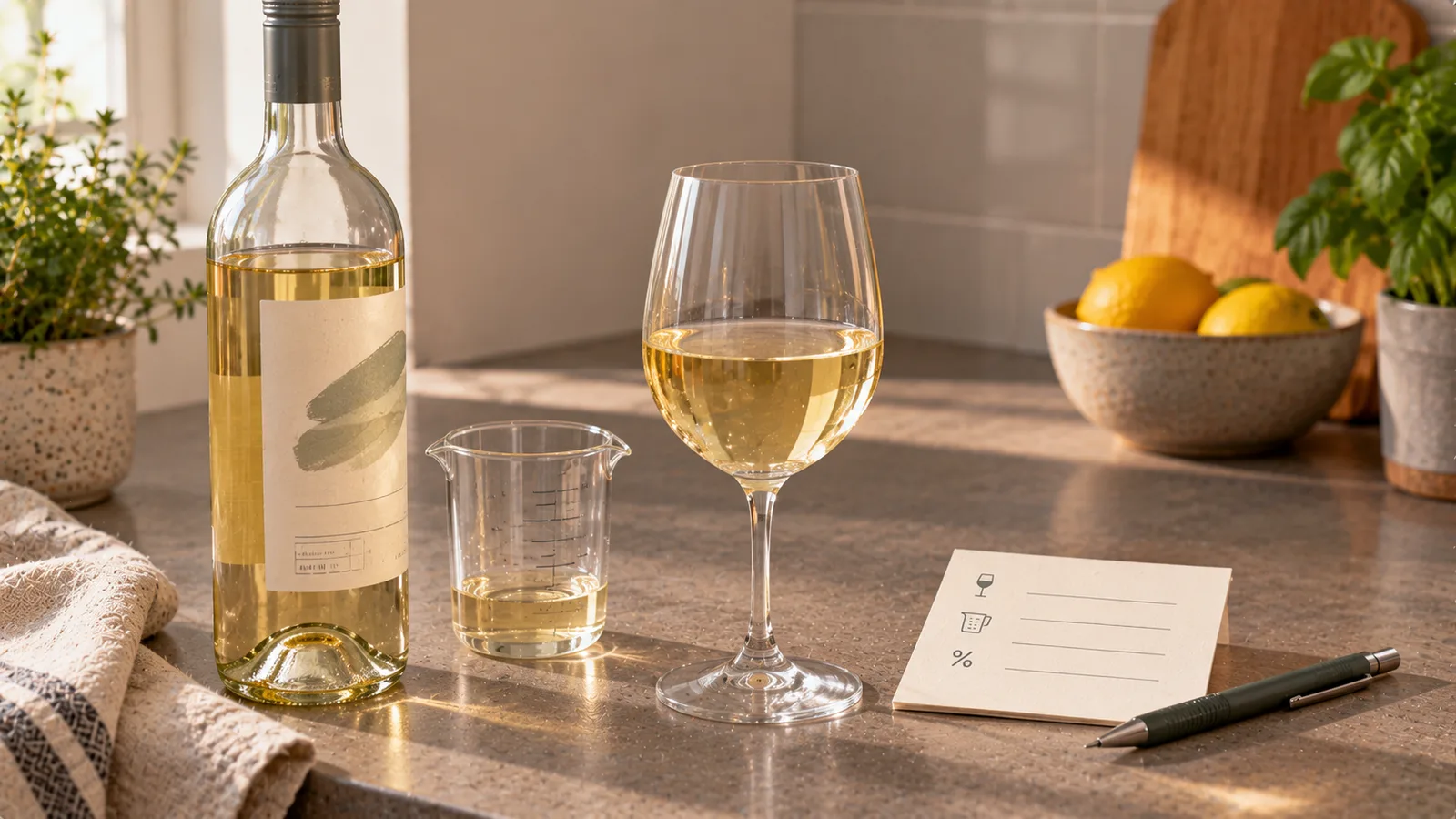
Alcohol can be more difficult to log than many ordinary foods.
A packaged yogurt or loaf of bread often gives you calories and nutrients per 100 g and per serving. Alcoholic drinks may instead emphasize bottle volume and alcohol by volume, while calorie information may be missing or incomplete.
Mixed drinks add another complication because the alcohol is only one part of the final drink.
The practical goal is not to estimate every drink perfectly. It is to identify the actual serving, use the best available information and avoid forgetting calories from mixers or additional servings.
Start with the amount you actually drank
Before looking at calories, identify the serving.
For example:
- 330 ml bottle of beer;
- 500 ml can of beer;
- 150 ml glass of wine;
- 100 ml glass of wine;
- 40 ml spirit measure;
- 250 ml mixed drink.
A calorie value is only useful when you know what quantity it refers to.
If a database entry says a beer contains 45 kcal per 100 ml and you drank 500 ml:
45 × 5 = 225 kcal
You would log approximately 225 kcal for that serving.
Per 100 ml and per serving are not the same thing
This is one of the easiest mistakes to make.
Suppose a drink lists:
50 kcal per 100 ml
but the bottle contains:
330 ml
The whole bottle contains approximately:
50 × 3.3 = 165 kcal
Logging 50 kcal would represent only 100 ml, not the entire bottle.
Always compare the nutrition basis with the amount consumed.
What does ABV mean?
ABV means alcohol by volume.
A drink labeled 5% ABV contains about 5 ml of pure alcohol per 100 ml of beverage by volume.
ABV is not a calorie number.
However, it provides useful information when calorie data are unavailable because ethanol itself contributes energy.
Alcohol provides approximately:
7 kcal per gram
This is different from the commonly used energy values for the three main macronutrients:
- protein: about 4 kcal/g;
- carbohydrate: about 4 kcal/g;
- fat: about 9 kcal/g.
Estimating calories from alcohol content
If no reliable calorie value is available, the alcohol portion can be estimated from drink volume and ABV.
A practical approximation uses the density of ethanol, about 0.789 g/ml.
For a 500 ml beer at 5% ABV:
Step 1: estimate pure alcohol volume
500 ml × 0.05 = 25 ml ethanol
Step 2: convert ethanol volume to grams
25 × 0.789 ≈ 19.7 g alcohol
Step 3: estimate calories from ethanol
19.7 × 7 ≈ 138 kcal
This is only the energy from alcohol.
The beer may also contain carbohydrate and therefore have a higher total calorie value.
That is why a verified product calorie value is preferable when available.
Example: 150 ml wine at 13% ABV
First calculate the alcohol volume:
150 × 0.13 = 19.5 ml ethanol
Convert to grams:
19.5 × 0.789 ≈ 15.4 g alcohol
Energy from alcohol:
15.4 × 7 ≈ 108 kcal
Again, this is not necessarily the complete calorie value of the wine because residual carbohydrate can contribute additional energy.
Use an actual product value when you have one.
Example: 40 ml spirit at 40% ABV
Pure alcohol volume:
40 × 0.40 = 16 ml
Alcohol mass:
16 × 0.789 ≈ 12.6 g
Energy from alcohol:
12.6 × 7 ≈ 88 kcal
A plain spirit may therefore obtain much of its energy from alcohol itself.
But once juice, tonic, cola, syrup, cream or another ingredient is added, the complete drink must include those calories too.
Do not log only the spirit in a mixed drink
Suppose a drink contains:
- 40 ml spirit;
- 150 ml regular tonic;
- lime;
- ice.
If you log only the 40 ml spirit, you omit the energy from the tonic.
A better approach is to log:
- the spirit;
- the caloric mixer;
- any meaningful syrup, juice, cream or other ingredient.
Ice and water do not add calories.
Small garnishes may contribute very little, but ingredients such as fruit juice or sugar syrup can be significant.
Regular and sugar-free mixers can be very different
Two visually similar mixed drinks can have different calorie totals depending on the mixer.
For example:
spirit + regular cola
and:
spirit + sugar-free cola
contain the same spirit serving but not necessarily the same total energy.
When possible, identify the exact mixer rather than selecting a generic cocktail entry.
Cocktails are harder to estimate
Cocktails can contain several calorie sources:
- one or more spirits;
- liqueurs;
- juice;
- syrup;
- sugar;
- cream;
- coconut products;
- soft drinks.
The glass size alone does not reveal the calorie content.
A 250 ml cocktail can contain fewer or more calories than another 250 ml cocktail depending on the recipe.
If the recipe is known, logging the major ingredients separately usually gives a more transparent estimate.
What if you are drinking at a restaurant or bar?
You may not know the exact recipe.
In that case, use the best reasonable estimate rather than pretending to know the exact number.
A practical hierarchy is:
- use official nutrition information from the venue if available;
- use the stated recipe or ingredient list;
- use a close database match with a similar serving size;
- use a reasonable generic estimate when no better information exists.
The uncertainty should influence how precisely you interpret the result.
An estimate of 184 kcal should not be treated as exact if the actual recipe and pour size are unknown.
Bottle size matters
Alcohol is often consumed directly from a bottle or can, which makes volume relatively easy to identify.
Common examples include:
- 330 ml;
- 355 ml;
- 440 ml;
- 500 ml;
- 750 ml.
Do not assume that one database “serving” equals your container.
If an entry uses 330 ml and you drank 500 ml, scale it.
For example, if 330 ml contains 150 kcal:
150 ÷ 330 × 500 ≈ 227 kcal
Poured wine is less predictable
A glass of wine is not a universal measurement.
One person may pour 100 ml while another pours 180 ml.
If accurate logging matters, measuring the serving occasionally can help you learn what your usual glass looks like.
For a bottle shared between people, you can also estimate your share.
If a 750 ml bottle is divided equally among five glasses:
750 ÷ 5 = 150 ml per glass
If the pours are unequal, this remains only an approximation.
Logging a shared bottle
Suppose two people share a 750 ml bottle equally.
Each person drinks approximately:
375 ml
If the wine provides 80 kcal per 100 ml:
80 × 3.75 = 300 kcal
Each person would log approximately 300 kcal.
The same method works for beer, cider and other drinks when you know the total volume and calorie density.
What if the label gives kilojoules instead of calories?
Some labels emphasize kilojoules.
A useful conversion is:
1 kcal ≈ 4.184 kJ
So if a serving contains 600 kJ:
600 ÷ 4.184 ≈ 143 kcal
If the label already provides both kJ and kcal, use the stated calorie value rather than recalculating it.
Why alcohol calories may not match macros
You may see a drink with calories that cannot be explained by carbohydrate, protein and fat alone.
That is expected.
Alcohol contributes energy independently.
For example, a drink can contain:
- little fat;
- little protein;
- relatively little carbohydrate;
and still contain substantial calories because ethanol provides approximately 7 kcal per gram.
Do not assume the calorie label is wrong simply because a standard 4-4-9 macro calculation does not reproduce it.
Should alcohol be entered as carbohydrate?
Not automatically.
Alcohol is not simply another carbohydrate macro.
If your food-tracking system has a verified alcoholic beverage entry, use the product or beverage entry rather than manually converting alcohol grams into carbohydrate grams.
This keeps the logged calories closer to the actual nutritional basis of the drink.
A practical logging hierarchy
When you have several possible data sources, use the most specific reliable one.
Best option: exact product information
If the manufacturer provides calories for the exact drink and serving, use that.
Next: exact drink with a different serving size
Scale the calories to the amount you consumed.
Next: a close equivalent
Use a similar drink with similar ABV, style and serving size.
Last resort: estimate from ABV
Estimate the energy from ethanol and recognize that carbohydrates or other ingredients may add more.
Example: beer with incomplete information
You have:
- 500 ml beer;
- 5% ABV;
- no calorie information.
The ethanol estimate gives approximately:
138 kcal from alcohol
But the beer also contains carbohydrate.
Therefore, logging exactly 138 kcal as the complete drink would likely underestimate the total.
A generic database entry for a similar 5% beer may provide a more useful total estimate.
The ABV calculation is best treated as a cross-check or fallback, not automatically as the complete calorie count.
Example: spirit with diet mixer
Suppose you have:
- 40 ml vodka at 40% ABV;
- 200 ml zero-sugar mixer.
The ethanol portion contributes roughly 88 kcal.
If the mixer has negligible energy, the complete drink may be relatively close to the spirit's energy value.
Check the exact product if available.
Example: spirit with juice
Now use:
- 40 ml spirit;
- 200 ml orange juice.
The alcohol still contributes its energy.
But the juice also contributes carbohydrate and calories.
Both components should be included.
Logging only the spirit would underestimate the drink.
Multiple drinks should be logged as multiple servings
If you drink three 330 ml bottles, do not log one bottle simply because the product entry is correct.
If one bottle contains 145 kcal:
145 × 3 = 435 kcal
The same principle applies to glasses of wine and spirit measures.
Serving count is often a larger source of tracking error than the calorie value of the individual serving.
Avoid false precision
Alcohol serving sizes are often estimated.
Restaurant pours may vary.
Cocktail recipes may vary.
Food databases may use generic averages.
If the available information is approximate, your interpretation should also be approximate.
There is little benefit in debating whether an unknown cocktail contained 218 or 226 kcal when the bartender's actual pour is unknown.
Choose a defensible entry and remain consistent.
Do not compensate for a drink by deleting food from the log
If the goal is an accurate food diary, record what was actually consumed.
Do not change or remove food entries simply to make the day's total fit a target.
The diary is more useful when it represents the real day.
If the total is higher than planned, that information can remain in the record without requiring punitive compensation.
Alcohol and nutrition goals
Alcoholic drinks can contribute energy without providing the same combination of protein, fiber, vitamins and minerals as many foods.
That can matter when planning a day's intake.
However, calorie tracking should not be turned into a recommendation to consume alcohol.
If you do not drink alcohol, there is no nutrition-tracking reason to start.
When alcohol should be avoided
Individual circumstances matter.
Alcohol may be inappropriate or unsafe in situations including pregnancy, driving, certain medical conditions, interactions with medications, recovery from alcohol-use problems and other circumstances.
If you are unsure whether alcohol is safe for you, seek individualized medical advice.
Quick logging checklist
Before saving an alcoholic drink in your diary, check:
- What volume did I actually drink?
- Is the nutrition value per 100 ml or per serving?
- Does the entry match the drink's ABV and type?
- Is there a caloric mixer?
- Did I have more than one serving?
- Am I using a verified product value or an estimate?
- If it is an estimate, am I avoiding false precision?
The key idea
Alcohol tracking becomes easier when you separate three questions:
How much did I drink?
How strong was it?
What else was in the drink?
Use exact product calories when they are available.
When they are not, serving size, ABV and a comparable database entry can provide a reasonable estimate.
For mixed drinks, remember to include caloric mixers and other meaningful ingredients.
The goal is not perfect precision. It is a consistent record that reflects the drink you actually consumed.