
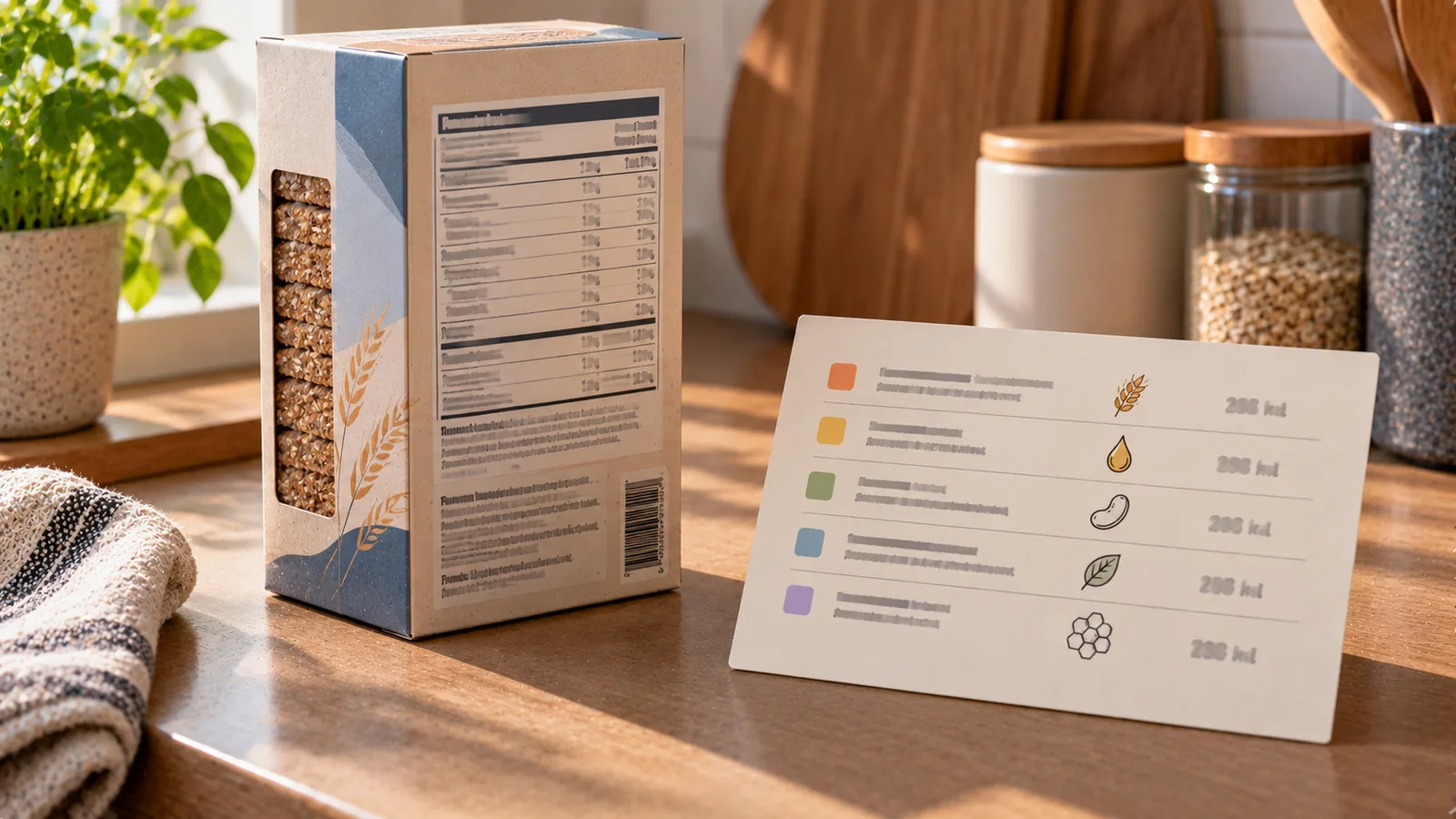
The calorie number on a food label is not always produced by simply multiplying protein and carbohydrate by 4 and fat by 9.
Those familiar numbers are useful approximations, but food-label energy calculations can be more detailed.
Depending on the product and the labeling system, the calculation may also account for fiber, polyols, alcohol, organic acids and other energy-providing components. Manufacturers may use permitted calculation methods, established conversion factors and analytical data, and the values displayed on the package are also subject to rounding.
This is why the calories printed on a label do not always match a quick calculation from the three main macronutrients.
What does "calories" on a food label mean?
Food energy describes the amount of usable energy supplied by a food.
Depending on the country, a nutrition label may show energy as:
- kilocalories, written as kcal;
- kilojoules, written as kJ;
- or both.
In everyday nutrition language, one dietary "Calorie" is one kilocalorie.
So when a label says 200 kcal, people commonly describe the food as containing 200 calories.
In the European Union, energy is normally declared in both kilojoules and kilocalories.
Where does the energy value come from?
Food contains components that can contribute different amounts of metabolizable energy.
The best-known approximate factors are:
| Nutrient | Common approximate energy value |
|---|---|
| Protein | 4 kcal/g |
| Available carbohydrate | 4 kcal/g |
| Fat | 9 kcal/g |
| Alcohol | 7 kcal/g |
But a real label calculation can include more than these four values.
For example, EU nutrition labeling rules specify energy conversion factors for several components, including fiber, polyols and organic acids.
That matters because not every gram listed outside protein, carbohydrate and fat is energetically equivalent.
Why 4-4-9 is useful but incomplete
The familiar 4-4-9 rule means:
- protein: approximately 4 kcal per gram;
- carbohydrate: approximately 4 kcal per gram;
- fat: approximately 9 kcal per gram.
For a simple food containing:
- 10 g protein;
- 20 g carbohydrate;
- 5 g fat;
a rough calculation would be:
10 × 4 = 40 kcal from protein
20 × 4 = 80 kcal from carbohydrate
5 × 9 = 45 kcal from fat
Total:
165 kcal
This is useful for understanding the basic relationship between macronutrients and energy.
However, it should not be treated as a rule that must reproduce every printed label exactly.
Fiber can contribute energy
Fiber is one reason a label may not fit a simple protein + carbohydrate + fat calculation.
Dietary fiber is not necessarily treated as providing zero energy.
In EU food labeling calculations, fiber has an assigned energy conversion factor of:
2 kcal per gram, or 8 kJ per gram. (EU Regulation (EU) No 1169/2011, Annex XIV)
Therefore, a product with a meaningful amount of fiber can have energy that is not fully explained by applying only 4-4-9 to the headline protein, carbohydrate and fat values.
This is especially relevant for foods such as:
- high-fiber cereals;
- fiber-enriched products;
- legumes;
- some breads;
- bars containing added fibers.
The exact label calculation should follow the applicable labeling rules rather than an informal three-macro calculation.
Polyols do not necessarily behave like ordinary carbohydrate
Polyols, also called sugar alcohols, are used in some reduced-sugar or sugar-free products.
Examples include ingredients such as:
- sorbitol;
- xylitol;
- maltitol;
- erythritol.
They should not automatically be treated as ordinary carbohydrate at 4 kcal per gram.
Under EU rules, most polyols use a different energy conversion factor, while erythritol has its own factor.
This is one reason products containing substantial amounts of polyols can look unusual if you try to reconstruct their calories using only the standard carbohydrate number.
Alcohol supplies energy too
Alcohol contributes energy even though it is not one of the three macronutrients people usually track.
A commonly used energy factor is approximately:
7 kcal per gram of alcohol.
That means the energy in an alcoholic drink cannot be understood solely from its protein, carbohydrate and fat values.
For a food or beverage containing alcohol, alcohol can be an important part of the total energy calculation.
Other components can matter
Depending on the food and regulatory system, additional components may have specified energy factors.
EU rules, for example, include conversion factors for substances such as:
- organic acids;
- salatrims;
- certain forms of fiber;
- polyols.
Most consumers do not need to calculate these manually.
The important point is that the regulatory calculation behind the energy declaration can contain more components than the three macronutrients visible in a basic 4-4-9 calculation.
Are calories measured directly in a laboratory?
Not necessarily in the way consumers sometimes imagine.
A manufacturer does not have to determine the energy value of every individual package by physically burning that package and measuring the heat.
Nutrition declarations can be based on permitted methods such as:
- analysis of the food;
- calculations from known or actual average values of the ingredients;
- calculations from generally established and accepted data.
The precise rules depend on the jurisdiction.
This means a nutrition label is an evidence-based declaration of typical values, not a measurement of every individual unit leaving the factory.
Why labels use average values
Natural and manufactured foods are not perfectly identical.
Small differences can arise from:
- raw-material variation;
- moisture;
- agricultural variation;
- recipe tolerances;
- manufacturing;
- storage;
- analytical uncertainty.
Nutrition labels therefore generally represent average values under the applicable rules.
A tomato, yogurt or loaf of bread is not chemically identical to every other unit of the same product.
The label is designed to provide a useful standardized value, not to claim molecular precision for every bite.
Why calculated calories may differ from the printed value
Imagine a label showing per 100 g:
- protein: 8 g;
- carbohydrate: 20 g;
- fat: 10 g.
Using basic 4-4-9 arithmetic:
8 × 4 = 32
20 × 4 = 80
10 × 9 = 90
Total = 202 kcal
Suppose the package displays a slightly different value.
That does not automatically mean the label is wrong.
Possible reasons include:
- rounded macronutrient values;
- fiber contributing energy;
- polyols;
- alcohol;
- other components with applicable energy factors;
- more precise underlying nutrient values than the rounded numbers printed on the package;
- permitted calculation methods.
The numbers you see on the label may therefore not contain enough precision to reconstruct the manufacturer's energy calculation exactly.
Rounding can create apparent inconsistencies
A label has limited space and nutrition values are normally displayed with practical precision.
Suppose an underlying value is not exactly 10 g but is rounded for display.
If several nutrients are rounded independently, multiplying the displayed numbers can produce a total that differs from a calculation using the more precise underlying data.
A small discrepancy can therefore be a mathematical consequence of rounding rather than an error.
A simplified rounding example
Imagine the actual underlying values were:
- protein: 7.6 g;
- carbohydrate: 19.6 g;
- fat: 9.6 g.
But the displayed values were rounded to:
- protein: 8 g;
- carbohydrate: 20 g;
- fat: 10 g.
A calculation using the displayed numbers will not be identical to one using the unrounded values.
Once several components are involved, the difference can become visible in the final calorie number.
This is why reverse-engineering label calories from rounded nutrient declarations has limits.
EU labels: energy conversion factors
In the European Union, Regulation (EU) No 1169/2011 provides energy conversion factors used for nutrition declarations.
Examples include:
| Component | EU energy factor |
|---|---|
| Carbohydrate | 4 kcal/g |
| Protein | 4 kcal/g |
| Fat | 9 kcal/g |
| Fiber | 2 kcal/g |
| Alcohol (ethanol) | 7 kcal/g |
| Organic acids | 3 kcal/g |
| Polyols, except erythritol | 2.4 kcal/g |
| Erythritol | 0 kcal/g |
The regulation also expresses the factors in kilojoules.
These factors explain why simply applying 4-4-9 to every product is not equivalent to the complete regulatory method.
What about the United States?
US nutrition labeling also uses established methods and energy factors, but the detailed rules and presentation are not identical to EU labeling.
The US system may use general or specific Atwater factors and applicable rules for components such as dietary fiber and sugar alcohols.
For consumers, the practical lesson is simple:
Do not assume that a calculation designed around one labeling system can be transferred perfectly to another.
This is particularly important when comparing EU and US products or databases.
What are Atwater factors?
Atwater factors are energy conversion factors used to estimate the metabolizable energy supplied by nutrients.
The general factors are commonly summarized as approximately:
- 4 kcal/g protein;
- 4 kcal/g carbohydrate;
- 9 kcal/g fat;
- 7 kcal/g alcohol.
More specific factors can be used because different foods and nutrients are not metabolized identically.
The familiar 4-4-9 rule is therefore a simplified expression of a broader energy-calculation system.
Calories are not calculated from serving size first
The energy density of a food is normally established for a reference quantity.
For example, EU labels commonly declare nutrition per 100 g or 100 ml.
A portion value can then be derived from that reference.
If a food contains 250 kcal per 100 g and the portion is 40 g:
250 × 40 / 100 = 100 kcal
The serving size changes the amount consumed, but it does not change the underlying energy density of the product.
Per 100 g and per serving answer different questions
Per 100 g values are useful for comparing products on a standardized basis.
Per serving values are useful for estimating what you actually consume.
For example:
| Product | Energy per 100 g | Portion | Energy per portion |
|---|---|---|---|
| Food A | 200 kcal | 30 g | 60 kcal |
| Food B | 150 kcal | 60 g | 90 kcal |
Food B has fewer calories per 100 g but more calories in the stated portion.
Both numbers can be correct because they answer different questions.
Does cooking change the label calculation?
For a packaged product, use the basis stated on the label.
Some products provide nutrition information:
- as sold;
- as prepared;
- or both.
Adding water can substantially change calories per 100 g of the prepared food without changing the total energy in the dry product.
Adding milk, oil or other ingredients can increase the total energy.
Always check whether the declaration refers to the product as sold or after preparation.
Why dry and prepared foods can look very different
Suppose 100 g of a dry product contains 350 kcal.
After adding water, the prepared food may weigh 300 g.
If water is the only addition, the total 350 kcal has not disappeared.
It is simply distributed across a larger weight.
The prepared food would therefore have a much lower calorie value per 100 g.
This is a concentration effect caused by water.
It is not evidence that cooking destroyed most of the calories.
Why labels and food databases can disagree
A generic food database entry may differ from a branded package because:
- the recipe is different;
- moisture differs;
- the database uses a generic food;
- the manufacturer reformulated the product;
- one value refers to cooked food and another to raw food;
- serving assumptions differ;
- data come from different regions.
For a specific packaged food, the current package label is often the most directly relevant source for that exact product, provided you use the correct serving and preparation state.
Should you manually replace the label calories with 4-4-9 math?
Usually, no.
The purpose of 4-4-9 arithmetic is to understand where food energy broadly comes from.
It is not a reason to automatically overwrite the declared energy value every time your calculator produces a slightly different result.
A separate practical question arises when a food diary or database forces you to choose between conflicting values. That requires checking the product, units, preparation state and data source rather than assuming one simple formula is always superior.
When is a discrepancy worth investigating?
A difference of a few calories can easily arise from rounding and does not normally justify extensive investigation.
A large discrepancy deserves a closer look.
Check whether:
- you used per-serving values for one nutrient and per-100-g values for another;
- the label refers to prepared rather than dry food;
- you confused kJ and kcal;
- the portion size was entered incorrectly;
- alcohol or polyols are present;
- fiber is handled differently;
- the database entry belongs to another product;
- the package has been reformulated.
Large inconsistencies are more often useful as a signal to check the data than as proof that the printed label is wrong.
Kilojoules and kilocalories
Energy can be expressed in either kilojoules or kilocalories.
The approximate relationship is:
1 kcal = 4.184 kJ
and:
1 kJ ≈ 0.239 kcal
EU labels normally show both.
If a package says:
840 kJ / 200 kcal
those are two units describing approximately the same amount of energy.
They should not be added together.
Why this matters for food tracking
Understanding how labels calculate energy helps prevent unnecessary corrections.
When logging packaged food:
- identify the correct product;
- check whether the values are per 100 g, 100 ml or serving;
- check whether they refer to the product as sold or prepared;
- enter the amount actually consumed;
- use the declared energy value rather than expecting simple macro arithmetic to reproduce it exactly.
If the discrepancy is unusually large, investigate the entry rather than immediately changing the label value.
What the calorie number does not tell you
Two foods can contain the same calories while differing substantially in:
- protein;
- fiber;
- vitamins and minerals;
- sodium;
- fat composition;
- portion volume;
- ingredients.
Energy is an important property of food, but it is not a complete measure of nutritional quality.
A 200-kcal value answers an energy question.
It does not tell you everything about the food.
A practical way to read the label
When you look at a nutrition declaration, use this sequence:
1. Find the energy value
Check both the unit and reference quantity.
2. Check the basis
Is it per 100 g, per 100 ml or per serving?
3. Check preparation state
Is the product dry, as sold or prepared?
4. Review the macronutrients
Protein, carbohydrate and fat explain much of the energy.
5. Notice relevant additional components
Fiber, polyols and alcohol can help explain why basic macro arithmetic does not match perfectly.
6. Expect some rounding
Printed nutrient values are not infinitely precise.
The main takeaway
Food-label calories are based on established energy calculations, not simply on three rounded numbers printed next to protein, carbohydrate and fat.
The familiar 4-4-9 rule is a useful foundation:
- protein ≈ 4 kcal/g;
- carbohydrate ≈ 4 kcal/g;
- fat ≈ 9 kcal/g.
But complete label calculations can also account for fiber, polyols, alcohol and other components according to the applicable rules.
Manufacturers may calculate declared values from analyses, ingredient data and established reference information, and the numbers displayed to consumers are rounded.
That is why a reasonable manual calculation may differ slightly from the energy printed on the package.
The printed calorie value and the macro values are related—but they are not always a perfectly reversible equation.
Sources
- European Parliament and Council, Regulation (EU) No 1169/2011 on the provision of food information to consumers, including Annex XIV energy conversion factors.
- European Commission, guidance on nutrition labelling and food information.
- U.S. Food and Drug Administration, Food Labeling Guide and nutrition labeling guidance.
- USDA, FoodData Central and documentation on food energy values.