
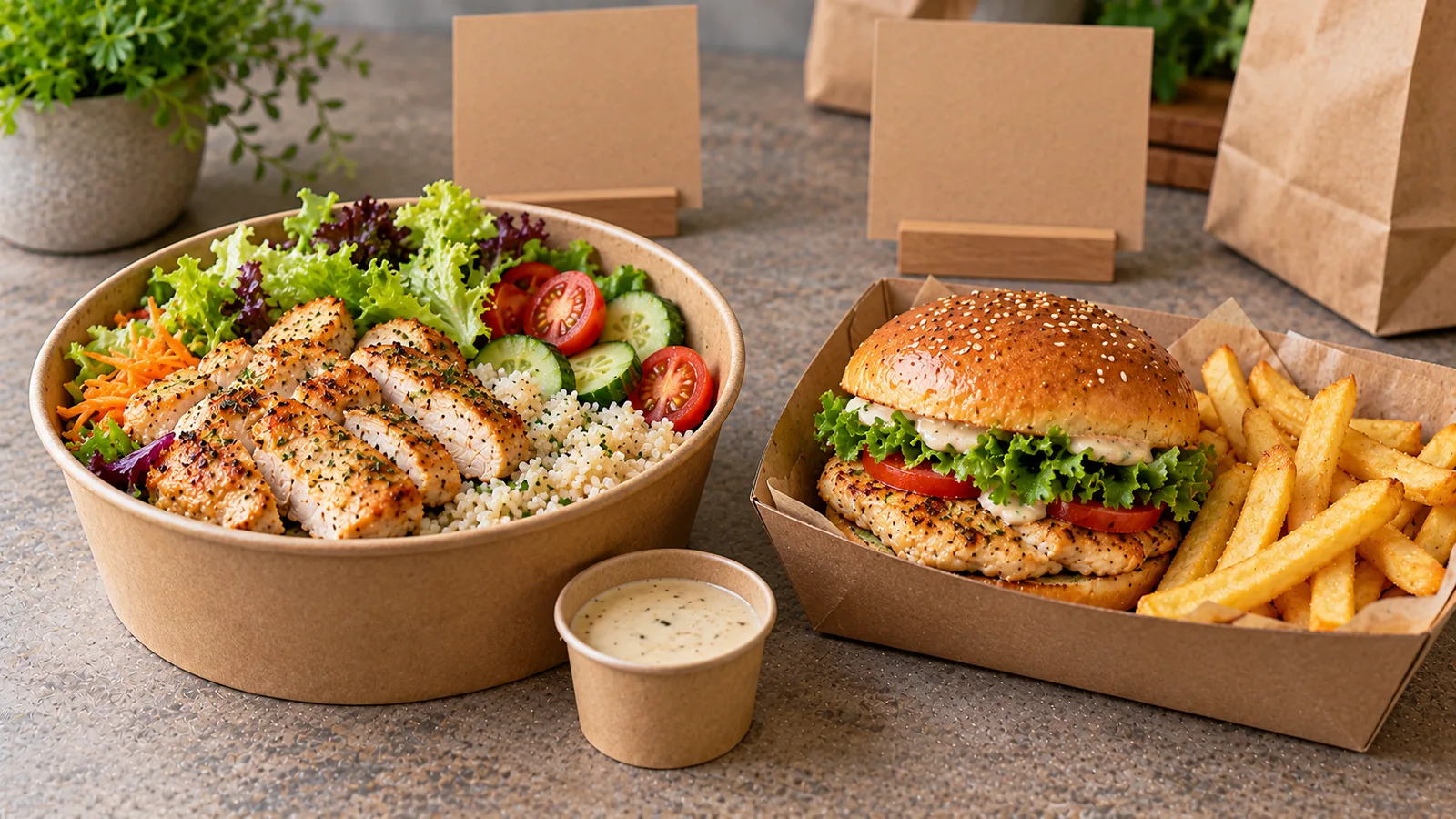
The label is a starting point, not a calculation
A fast-food menu may describe a sandwich as healthy, a bowl as lighter or a salad as a better choice. Those words can draw attention to a dish, but they cannot tell you its final calories, protein, salt or portion size on their own. A useful comparison asks what is actually in the order and which product or portion is being compared. It also separates informal menu language from legally defined claims on packaged foods.
The practical question is not whether a word sounds positive. It is whether the named meal meets your needs once you include the dressing, side, drink and substitutions. This guide is about interpreting menus, not diagnosing illness or prescribing a diet.
Healthy and lighter answer different questions
Healthy may describe an overall perception of a meal: perhaps vegetables, whole grains or a balance of ingredients. It does not give a numerical energy ceiling. Lighter usually suggests something has been reduced relative to another choice, but you need to know what changed. Was the portion smaller? Was fat reduced? Was the sauce omitted? A lower-fat version need not automatically have fewer calories, and a lower-calorie meal can still have a high salt content.
The phrase better for you is particularly context-dependent: better for what, compared with what? Read the nutrition table, not just the category heading. Menu wording in one country may also be subject to different advertising and food-claim rules from another country.
EU rules: the word light is not an unrestricted nutrition claim
In the EU, Regulation (EC) No 1924/2006 governs applicable nutrition and health claims on foods, including in commercial communication. The authorised nutrition claim light/lite follows the conditions for reduced and needs to indicate the characteristic that makes the food light. For common reduced-energy or reduced-nutrient claims, the general comparison threshold is at least 30% against a similar food, though there are specific exceptions and conditions, including for sodium or salt. An energy-reduced claim also needs to identify the characteristic behind the energy reduction.
That does not mean every casual English adjective on every menu has one universal interpretation. The exact wording, context, type of claim and national enforcement matter. Nor does calling a dish healthy automatically establish an authorised specific health claim. The safest consumer method is to request the underlying nutrition and portion information rather than treating the phrase as a certificate. See the European Commission's nutrition-claims guidance and Regulation (EC) No 1924/2006.
United States: a defined packaged-food claim is not a universal menu badge
The FDA updated criteria for the voluntary healthy nutrient-content claim on food labels, effective in 2025. The criteria address recommended food groups together with limits on saturated fat, sodium and added sugars; they differ across product types. This is not a rule that every restaurant promotion reading “healthy bowl” automatically carries an FDA seal. Products sold in retail packaging and restaurant menu descriptions can involve different requirements.
For US chain restaurants covered by federal menu-labeling rules—generally chains with 20 or more locations under the same name offering substantially the same items—calories must appear for standard menu items and additional nutrition information must be available on request. Smaller restaurants are not necessarily subject to that federal rule. Details: FDA on the healthy claim and FDA menu-labeling requirements.
Compare a whole order, not one headline number
Use the same scope when comparing choices. One burger alone is not the same unit as a burger-plus-fries meal. A salad without its dressing is not the same as a dressed salad. The following figures are fictional arithmetic examples, not verified restaurant products or nutrient declarations:
| Example order | Itemised fictional energy | Total |
|---|---|---|
| A: sandwich + fries + drink | 420 + 310 + 150 kcal | 880 kcal |
| B: wrap + side salad + dressing + water | 470 + 90 + 160 + 0 kcal | 720 kcal |
In this scenario B is 160 kcal lower than A. The calculation does not prove B is more nutritious: its ingredients, sodium and portion sizes have not been supplied. An extra sauce can change the apparent advantage. If the menu only gives calories for a base item, add each priced or optional component separately.
A lighter item can become a heavier combination
Suppose the menu highlights a lighter sandwich but the checkout automatically pairs it with a large drink and fries. The promotional adjective applies to the item or comparison specified, not automatically to the complete order. Equally, a full-sized standard sandwich with water and vegetables might have less total energy than a small sandwich with high-energy extras.
For example, imagine a salad listed at 120 kcal before dressing and a dressing portion adding 180 kcal. The served salad would then provide 300 kcal, not 120. These are invented numbers to demonstrate the arithmetic. Look for whether sauces are included in the restaurant's displayed values and whether the portion is per item, per 100 g or for the entire meal.
Four details more useful than a marketing label
First, compare calories for the amount you will eat. A “per serving” figure is meaningful only if you know how many servings are in the package or on the tray. Second, check protein and fibre when those help you select a satisfying meal; a low-calorie label alone does not describe either. Third, compare sodium or salt, especially when the main item, condiment and side all contribute. Fourth, note added drinks, dressings and toppings. The final energy can depend as much on extras as on the base sandwich.
All numbers should come from the restaurant's actual nutrition information where available. If values differ between countries or product versions, use the listing for the place where you order. For allergy questions, contact the restaurant about ingredients and cross-contact instead of inferring safety from a nutrition label.
Questions to ask at a counter or in an ordering app
Ask whether the calories refer to the sandwich alone or a meal deal. Check if displayed values already include cheese, sauces, oil or the default dressing. When two menu options have different stated serving sizes, compare the whole edible portions, not only 100 g figures. If the chain publishes a detailed PDF or nutrition page, search for the exact local product name and serving.
Where no nutrition figures are available, a careful estimate can be useful, but it remains an estimate. Note the uncertainty and avoid claiming an exact calorie saving. For example, asking for sauce on the side lets you observe how much you use; it does not guarantee any specific number of calories saved unless the sauce amount is known.
How to choose without turning eating out into a test
A practical order might include a protein source, vegetables, a portion of starch and a drink that suits you. A different choice can also fit an overall eating pattern. You do not need to select the lowest-calorie option every time, and labels cannot establish the value of a whole diet or the suitability of a meal for an individual's medical needs.
Use “healthy” as an invitation to read further and “lighter” as a prompt to ask lighter than what, and in which measure? Then compare complete portions. That method is more dependable than choosing by menu typography.
For another useful perspective, see the guide to reading nutrition labels · how to correct a food calorie estimate.
Sources
- European Commission: authorised nutrition claims — light/lite and reduced conditions.
- Regulation (EC) No 1924/2006 — EU nutrition and health claims framework.
- FDA: use of “healthy” on food labeling — updated packaged-food criteria.
- FDA: menu-labeling requirements — covered restaurant chains and nutrition access.