
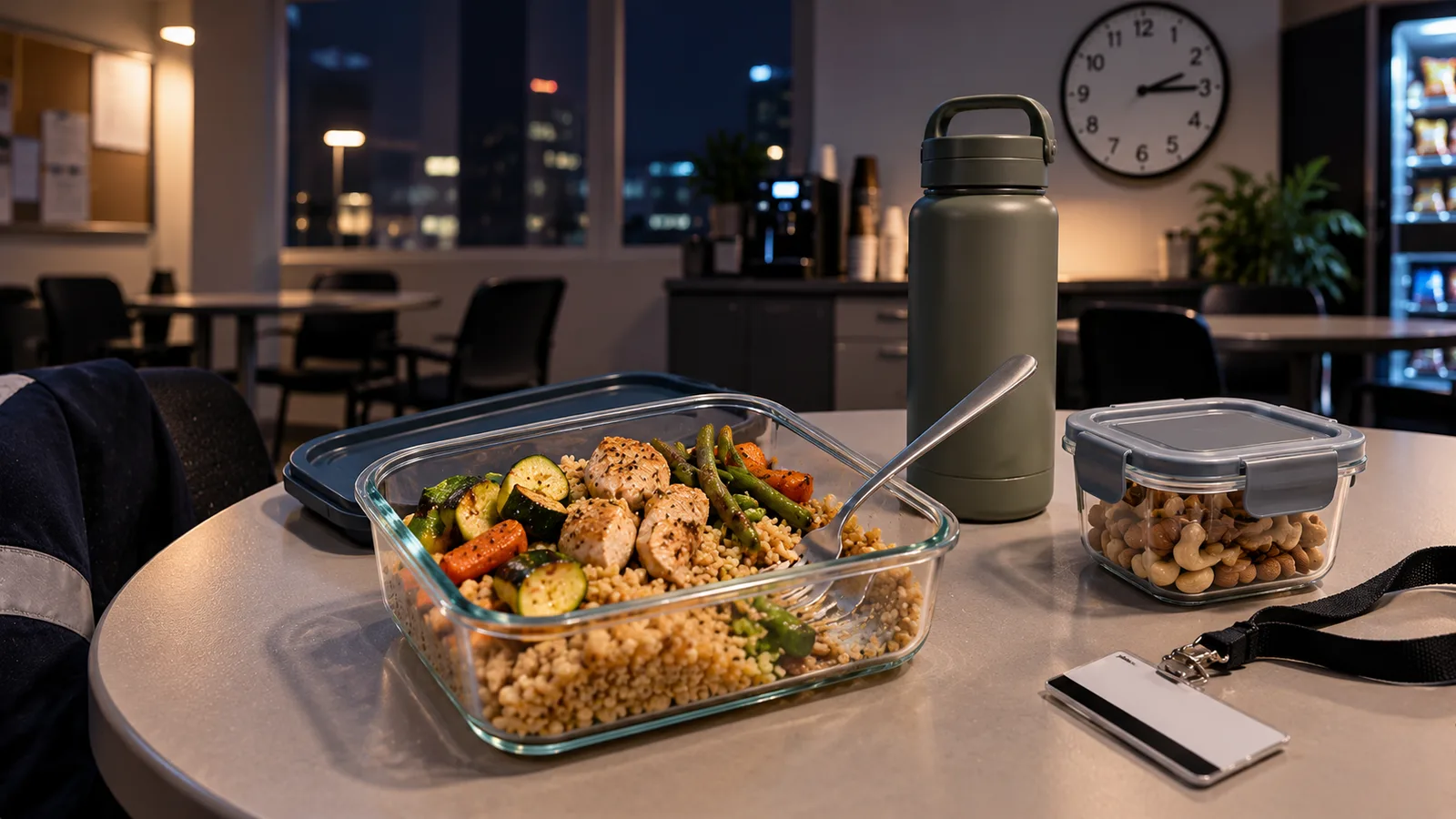
Night-shift eating is not simply daytime eating moved several hours later.
An overnight work schedule changes when you are awake, when food is available, when breaks happen and when you need to sleep. A useful eating plan therefore needs to fit the shift rather than forcing a conventional breakfast-lunch-dinner schedule onto it.
The goal is not to find one perfect time to eat at night. It is to create a repeatable structure that helps you arrive at work prepared, avoid depending entirely on vending machines or takeaway food, and finish the shift without making sleep unnecessarily difficult.
Start with the actual shift
Before planning food, write down the real schedule.
For example:
- wake: 15:30;
- main meal: 18:30;
- shift starts: 21:00;
- first break: 00:30;
- second break: 04:00;
- shift ends: 07:00;
- sleep: 09:00.
This immediately gives you more useful information than labels such as breakfast or dinner.
For shift workers, it can be easier to think in terms of:
- meal after waking;
- pre-shift meal;
- food during the shift;
- post-shift food.
Build the largest meal around practicality
For many people, a substantial meal before work is easier to control than a large meal in the middle of the night.
A pre-shift meal might contain:
- a protein source;
- rice, potatoes, pasta, bread or another carbohydrate source;
- vegetables;
- an appropriate amount of fat.
Examples include:
- chicken, potatoes and vegetables;
- lentil curry with rice;
- pasta with a tomato and meat or lentil sauce;
- tofu, rice and vegetables;
- beans, grains and salad.
This does not mean everyone must make the pre-shift meal the largest meal. It is simply a practical starting point because food preparation and access are often easier before work.
Plan the shift before hunger decides for you
If the workplace has limited food options, decide what you will take before leaving home.
A simple night-shift kit can include:
- one prepared meal;
- one protein-containing snack;
- fruit or vegetables;
- water;
- an optional additional snack for a longer or unusually demanding shift.
This gives you choices without requiring a large collection of snacks.
Use meal components that travel well
Useful work meals are usually foods that can be portioned, transported and eaten during the break time actually available.
Examples include:
- rice with chicken or tofu and vegetables;
- couscous with chickpeas and vegetables;
- pasta salad with beans, tuna or another protein source;
- lentil or bean dishes;
- sandwiches or wraps with a substantial filling;
- yogurt or skyr with oats and fruit when refrigeration is available.
Choose foods according to the storage and reheating facilities at your workplace.
If there is no refrigerator, do not assume a perishable meal can safely remain at room temperature for an entire shift.
What makes a useful night-shift snack?
A snack does not need to be a miniature meal.
Useful combinations can include:
- yogurt and fruit;
- fruit and a measured portion of nuts;
- bread or crispbread with cottage cheese;
- hummus with vegetables and bread;
- skyr with berries;
- a simple sandwich;
- an appropriate ready-to-eat protein food with fruit.
The best option is the one that fits your hunger, storage facilities and overall intake.
Avoid the all-or-nothing pattern
One common pattern is:
- eat very little before work;
- become extremely hungry overnight;
- buy whatever is easiest;
- eat a very large amount near the end of the shift;
- go to bed shortly afterwards.
Planning even one meal and one snack can make the night more predictable.
You do not need a perfect meal-prep system for planning to be useful.
What if you are not hungry at night?
Do not force a large meal simply because the clock says it is time to eat.
Some people prefer:
- a substantial meal before work;
- a smaller snack or light meal during the night;
- a small meal after the shift.
Others need more food during physically demanding work.
Use hunger, workload and your overall intake to adjust the structure.
What if you become very hungry during the shift?
First check whether the meals surrounding the shift are substantial enough.
A pre-shift meal consisting only of a small snack may not support a long overnight work period.
A meal with protein, carbohydrate, vegetables and some fat is generally more substantial than relying on coffee and a pastry.
It can also help to bring an additional planned snack rather than assuming you will not need one.
A sample structure for a 21:00–07:00 shift
Here is one possible pattern.
16:00 — meal after waking
Oats with yogurt, fruit and nuts, or another normal meal you enjoy.
19:30 — pre-shift meal
Rice with chicken or tofu, vegetables and a sauce.
00:30 — work break
A prepared sandwich, wrap or smaller portion of a main meal.
04:00 — optional snack
Fruit with yogurt, skyr or another convenient protein-containing food.
07:30 — after work
A smaller meal if hungry, such as oats, yogurt, bread with a topping or another simple option.
09:00 — sleep
This is an example, not a required schedule.
A person working 18:00–02:00 will need a different structure from someone working 23:00–08:00.
A sample structure for a 23:00–08:00 shift
Another possible arrangement:
| Time | Eating occasion | Example |
|---|---|---|
| 16:30 | Meal after waking | Eggs, bread, vegetables and fruit |
| 21:30 | Main pre-shift meal | Pasta with meat or lentil tomato sauce |
| 02:00 | Break meal | Couscous, chickpeas and vegetables |
| 05:30 | Snack if needed | Yogurt and fruit |
| 08:30 | Light post-shift food | Oats or toast with a simple topping |
The times should follow the real break schedule rather than an idealized plan.
Overnight access changes the plan
A hospital worker with a refrigerator and microwave has different options from a security worker with no kitchen access.
Before planning meals, identify:
- refrigerator availability;
- microwave or other reheating facilities;
- break duration;
- access to drinking water;
- vending machines;
- nearby shops or cafeterias;
- whether breaks happen at predictable times.
Meal planning becomes much easier when it is based on the environment you actually work in.
No microwave? Use cold meals intentionally
A cold meal does not have to be an emergency substitute.
Options include:
- pasta salad;
- couscous salad;
- bean salad;
- sandwiches;
- wraps;
- overnight oats;
- yogurt with oats and fruit;
- bread with hummus and vegetables.
If the meal requires refrigeration, it still needs to be kept safely cold.
Limited refrigerator space
If workplace refrigerator space is unreliable, an insulated lunch bag with appropriate cold packs may be useful for foods that need refrigeration.
Follow local food-safety guidance and product storage instructions.
Do not use smell or appearance alone to decide whether improperly stored perishable food is safe.
Convenience foods can be part of the plan
Night-shift eating does not need to consist entirely of homemade meals.
Useful convenience foods can include:
- canned pulses;
- ready-to-eat grain products;
- plain yogurt or skyr;
- prepared salads;
- pre-cut vegetables;
- canned fish;
- whole-grain bread;
- simple ready meals.
Compare labels and portions rather than assuming all convenience foods are nutritionally identical.
Convenience can be valuable when it prevents the plan from collapsing during a demanding work week.
Caffeine needs its own plan
Coffee, tea and other caffeinated drinks are common during night work.
Caffeine can increase alertness, but consuming it close to the intended sleep period may interfere with sleep for some people.
Instead of drinking caffeine automatically throughout the entire shift, consider:
- when you most need alertness;
- when you intend to sleep;
- how strongly caffeine affects you;
- whether the drink also contains substantial sugar or calories.
Caffeine sensitivity varies considerably between people.
Do not forget liquid calories
Sweetened coffee, energy drinks, soft drinks and other beverages can contribute substantial energy during a long shift.
This can be easy to miss when drinks are consumed gradually.
If you track calories, log:
- milk added to coffee;
- sugar or syrup;
- sweetened energy drinks;
- soft drinks;
- smoothies and other caloric beverages.
Water, unsweetened tea and similar drinks can also help maintain fluid intake without adding significant calories.
Hydration should be practical
You do not need a complicated hydration schedule.
A reusable bottle can make drinking easier when breaks are irregular.
Fluid needs vary with:
- body size;
- physical activity;
- workplace temperature;
- clothing and protective equipment;
- diet;
- individual factors.
Drink according to your needs rather than forcing a fixed universal amount.
The post-shift meal
After a night shift, some people are hungry while others want to sleep immediately.
If you are hungry, a simple smaller meal may be easier than preparing a large dinner at 08:00.
Examples include:
- oats and yogurt;
- bread with cottage cheese;
- yogurt with fruit;
- a small portion of leftovers;
- a simple sandwich.
If you are not hungry and your overall intake is adequate, there is no requirement to eat a large meal immediately before sleep.
Meal size before sleep
Large or personally uncomfortable meals immediately before lying down may make sleep less comfortable for some people.
If this happens to you, experiment with moving more of your food earlier in the shift and keeping the post-shift meal smaller.
This is a practical adjustment, not a universal rule.
Night shifts and weight management
Working at night does not create a special requirement for a "night-shift weight-loss diet."
For weight management, overall energy intake still matters.
The practical challenge is that night work can change:
- food availability;
- sleep opportunities;
- appetite;
- routine;
- reliance on convenience foods;
- frequency of unplanned snacks.
A structured plan can help make intake more predictable, but it does not guarantee weight loss.
Avoid judging a food as automatically fattening simply because it was eaten at night.
Protein across the waking period
Rather than saving nearly all protein for one meal, include useful protein sources across the meals you actually eat.
For example:
- yogurt after waking;
- chicken, tofu or legumes before work;
- tuna, beans or another protein source during the shift;
- a dairy or other suitable protein food after work if desired.
The exact amount depends on individual needs and total diet.
Fiber and produce during night work
Shift meals can become low in fruit, vegetables and fiber when the easiest available options are vending-machine snacks and takeaway food.
Simple additions can help:
- fruit that travels well;
- chopped vegetables;
- beans or lentils in a prepared meal;
- whole-grain bread;
- oats;
- nuts and seeds.
Increase fiber gradually if your usual intake is low, and maintain appropriate fluid intake.
Planning around rotating shifts
Rotating schedules are harder because the eating pattern changes from week to week.
Instead of creating a completely new diet for every rotation, keep several reusable meal templates.
For example:
Early shift template
Meal after waking → work meal → meal after work.
Late shift template
Meal after waking → main meal before work → work snack → meal after work.
Night shift template
Meal after waking → pre-shift meal → overnight meal/snack → optional post-shift food.
This keeps the foods familiar while changing their timing.
Transitioning into a night shift
On the day before the first night shift, your waking and sleeping schedule may be unusual.
Do not worry about forcing traditional meal names.
Track eating occasions according to the actual waking period.
For example, a meal at 18:00 can function as your main pre-shift meal even if it would normally be called dinner.
Transitioning back to days
After the final night shift, the waking period may be shorter or irregular while you return to daytime sleep.
A single unusual day does not require a complicated nutrition strategy.
Use simple meals, maintain hydration and return to your usual structure as your sleep schedule changes.
Meal preparation for several shifts
Preparing a few components can reduce work without requiring seven identical meals.
For example, prepare:
- a grain such as rice or couscous;
- one protein source;
- roasted or otherwise prepared vegetables;
- a sauce;
- washed fruit;
- one or two snack options.
Then combine them differently across shifts.
Another approach is to freeze individual portions and rotate them.
Keep food safety separate from convenience
Food being convenient does not make unsafe storage acceptable.
For perishable foods:
- follow refrigeration instructions;
- use clean containers;
- keep cold foods appropriately cold;
- reheat foods according to official safety guidance and product instructions;
- avoid repeatedly warming and cooling the same meal;
- discard food when safe storage requirements have not been met.
Workplace conditions should influence what you pack.
Tracking night-shift meals in a food diary
A calendar day can become confusing when you eat across midnight.
For example:
- meal at 19:30;
- snack at 00:30;
- meal at 04:00;
- food at 08:00.
Depending on the app, the foods after midnight may appear on the next calendar date even though you consider them part of the same work shift.
For analysis, consistency matters more than forcing a particular convention.
You might review:
- total intake across each 24-hour period;
- intake across your waking period;
- patterns across several shifts.
Do not accidentally omit food simply because the shift crosses midnight.
A simple preparation checklist
Before leaving for a night shift, ask:
- Have I eaten or packed a substantial meal?
- Do I have something to eat if the shift becomes more demanding than expected?
- Does my food need refrigeration?
- Can I reheat it safely at work?
- Do I have water available?
- Am I relying entirely on caffeine or vending-machine food?
- What will I eat after the shift if I am hungry?
These questions are often more useful than trying to follow an idealized meal schedule.
Build a routine you can repeat
Healthy eating on night shifts is mainly a planning problem.
The most useful structure is usually one that matches:
- your actual waking hours;
- your break times;
- your hunger;
- your workload;
- available food storage;
- available reheating facilities;
- your intended sleep period.
Start with a substantial meal before work, pack food for the hours when options are limited, and adjust meal size and timing based on how you feel.
There is no single meal schedule that works for every night-shift worker.
A repeatable, practical structure is more useful than trying to make an overnight schedule look exactly like a daytime one.
Sources
- European Food Safety Authority (EFSA), scientific and consumer information on nutrition and caffeine.
- German Nutrition Society (DGE), evidence-based nutrition guidance.
- Bundeszentrum für Ernährung (BZfE), practical guidance on balanced eating and food handling.
- Bundesinstitut für Risikobewertung (BfR), consumer information on food hygiene and safe food handling.
- U.S. Centers for Disease Control and Prevention / NIOSH, information on shift work and sleep.