
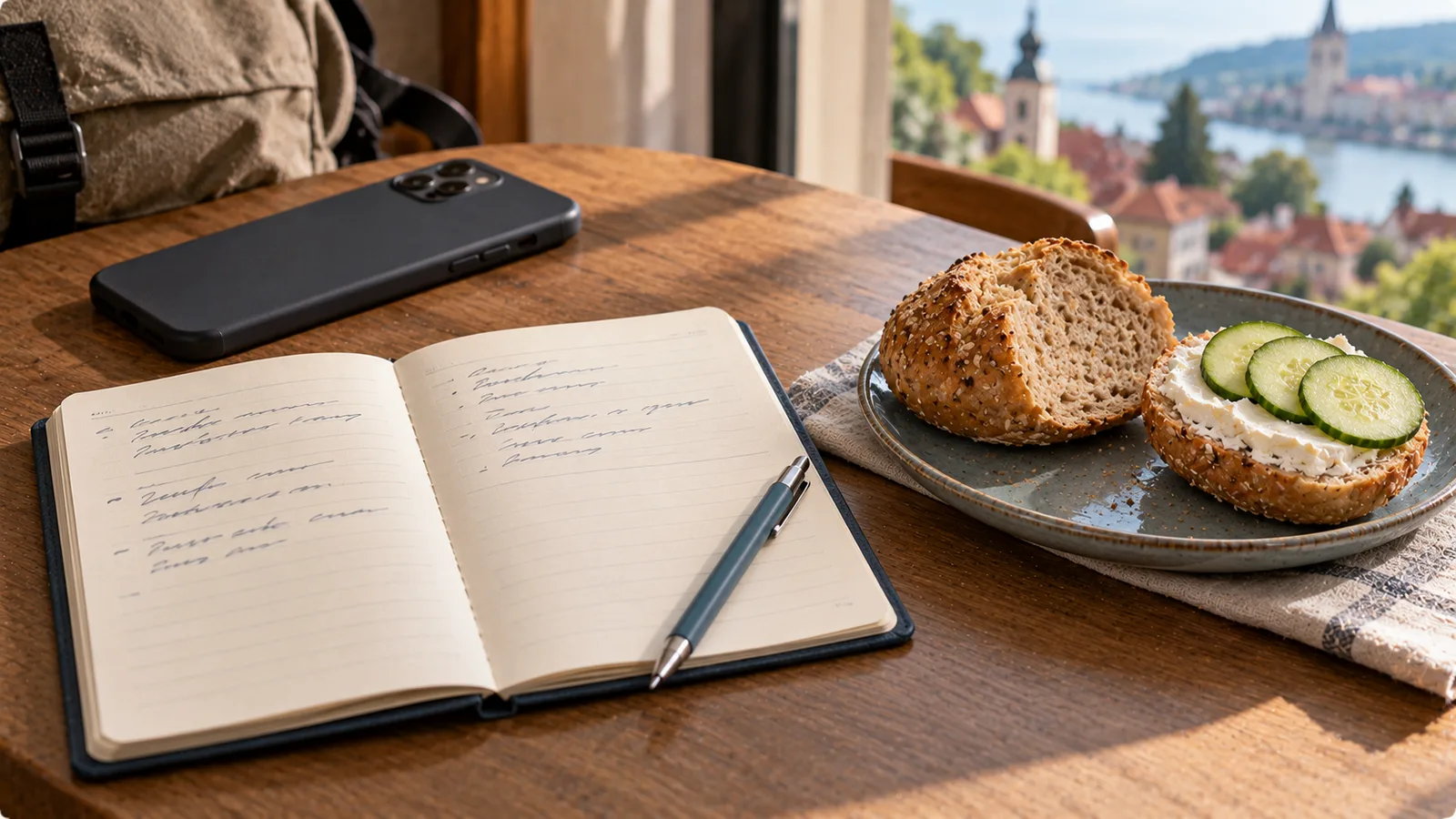
You do not need an internet connection at every meal to keep a useful food diary.
When travelling, mobile data may be unavailable, Wi-Fi may be unreliable, or a nutrition app may need an online connection to identify foods. The simplest solution is to capture a small amount of information at the time of eating and complete the detailed entry later.
This guide explains how to do that without losing track of portions, ingredients or the order of your meals.
The simplest offline food diary
For each meal, record five things:
- Time: When you ate.
- Food: What you ate and drank.
- Amount: Weight, package quantity or approximate portion.
- Preparation: Any important oil, sauce, dressing or cooking method.
- Reference: A photo, package label or receipt if useful.
You can keep this information in a phone's local notes app, an offline-capable document or a paper notebook.
You do not need to calculate calories while disconnected.
The goal is to preserve enough detail to make a reasonable entry later.
A 30-second meal note
A useful entry might look like this:
13:20 — Lunch
- Chicken sandwich, one large.
- Wholegrain bread, two thick slices.
- Chicken, approximately 100 g.
- Cheese, one slice.
- Mayonnaise, approximately one tablespoon.
- Apple, one medium.
- Water, 500 ml.
- Photo taken.
This is more useful than writing only “sandwich and apple.”
The extra details identify ingredients that can meaningfully affect the calorie estimate.
You can use the same structure for restaurant meals, packed lunches and food purchased during travel.
Three ways to capture meals offline
1. Local notes
A phone note is often the fastest option.
Use one note for each day and add meals in chronological order.
Example:
| Time | Food | Amount | Extra detail |
|---|---|---|---|
| 08:10 | Coffee with milk | 250 ml coffee, 80 ml milk | No sugar |
| 10:45 | Banana | 1 medium | — |
| 13:20 | Chicken sandwich | 1 large | Mayonnaise and cheese |
| 16:30 | Yogurt | 150 g | Package photographed |
| 20:15 | Pasta with tomato sauce | 1 restaurant plate | Parmesan added |
Check that your notes application actually saves information locally. Some services rely on cloud synchronization, even when their interface looks like a normal notes app.
2. Photos
Photographs help you remember:
- What was on the plate.
- Whether there was a sauce or topping.
- The size of a serving.
- A product's name and packaging.
- Nutrition information printed on a label.
Take the photo before eating whenever possible.
For packaged food, photograph the product name, nutrition table and net weight if they are relevant.
A photo alone cannot reliably establish the exact weight of a meal, especially when ingredients are hidden.
Add a short text note when the image does not capture important details.
3. Paper notebook
Paper works when your phone battery is low or you prefer not to use a device.
Use a consistent shorthand:
- B = breakfast.
- L = lunch.
- D = dinner.
- S = snack.
For example:
L 12:40 — rice 1 cup cooked, chicken 1 palm, vegetables 2 handfuls, oil unknown.
Mark uncertain quantities as estimates instead of treating them as measured facts.
How to estimate portions without a scale
When no kitchen scale is available, use the most reliable information you have.
A practical priority order is:
- Printed package weight.
- Measured amount, such as a 200 ml carton.
- Known serving count, such as two slices from a labelled package.
- Household measure, such as a cup or tablespoon.
- Visual estimate, such as a palm-sized portion.
Visual estimates are less precise than measured weights.
They can still be useful if you record them consistently and acknowledge the uncertainty.
Example: a bowl of rice
You eat a bowl that appears to contain approximately 180 g of cooked rice.
Write:
Cooked rice — estimated 180 g, not weighed.
Do not enter 180 g as though it were an exact measurement.
When you later use a food database, choose an entry for cooked rice, not dry rice.
Example: a bakery pastry
You buy an unlabelled pastry.
Record:
- Name or description.
- Number of pieces.
- Approximate size.
- Any visible filling or topping.
- A photo if convenient.
A bakery pastry's calories can vary substantially with butter, cream, chocolate and portion size.
If the exact product cannot be identified later, use a comparable entry and keep the result approximate.
Recording restaurant meals
Restaurant food is often the hardest category to reconstruct later.
The most useful information is usually:
- The menu name.
- Main ingredients.
- Cooking method.
- Sauces and dressings.
- Side dishes.
- Whether the entire portion was eaten.
Example:
Dinner — grilled salmon, roasted potatoes, green beans, lemon-butter sauce; ate all salmon, about half the potatoes and all beans.
This gives you a better basis for estimating the meal than a photograph of an empty plate.
If the menu lists a portion weight, note whether it refers to the raw or cooked ingredient.
Do not assume the menu's stated weight describes the final edible serving.
Drinks are easy to forget
When travelling, drinks may be consumed between meals and omitted from a diary.
Record drinks with meaningful energy content, including:
- Coffee with milk or sugar.
- Juice.
- Sweetened tea.
- Smoothies.
- Soft drinks.
- Alcoholic beverages.
For example:
Coffee, 240 ml + whole milk, approximately 90 ml + sugar, 10 g.
That is more useful than simply writing “coffee.”
Plain water can also be recorded if hydration tracking is one of your goals.
What if you cannot identify the food?
Do not invent an exact food name.
Record what you can observe:
- Main ingredient.
- Preparation.
- Approximate amount.
- Visible oil, cream, cheese or sauce.
- Possible ingredients you are uncertain about.
Example:
Unknown vegetable stew, about one bowl; appears to contain beans, potatoes and tomato; oil amount unknown.
Later, choose a comparable recipe or build a rough estimate from ingredients.
If you have an allergy or medically necessary dietary restriction, a food diary estimate is not a substitute for verifying ingredients before eating.
How to transfer offline notes into a nutrition app
When internet access returns, process the notes in chronological order.
Step 1: Start with the oldest meal
Open your notes or photo gallery and find the first meal that has not yet been entered.
Record its original date and time if the app supports historical entries.
Do not accidentally place all delayed entries on the current day.
Step 2: Match the food to the correct form
Distinguish:
- Raw versus cooked.
- Dry versus prepared.
- Whole package versus portion eaten.
- Product weight versus drained weight.
- Plain food versus a prepared dish with oil or sauce.
These distinctions often matter more than small differences between similar database entries.
Step 3: Add ingredients that are easy to miss
Check for:
- Cooking oil.
- Butter.
- Dressings.
- Milk in coffee.
- Sugar.
- Sauces.
- Cheese.
- Snacks between meals.
Avoid adding the same ingredient twice if a prepared-dish entry already includes it.
Step 4: Mark uncertainty
If the portion was estimated, preserve that fact.
You might use a note such as:
Restaurant pasta, estimated 350–450 g; sauce quantity uncertain.
A plausible range is more informative than false precision.
Step 5: Check for duplicates
Before finishing, compare the final diary against your original notes.
Make sure that:
- Every meal appears once.
- Snacks are included.
- Drinks are included.
- The dates are correct.
- Photos and manually entered items have not created duplicate entries.
A complete example: one day without mobile data
Imagine a day spent travelling by train.
You record the following offline:
| Time | Quick note |
|---|---|
| 07:30 | Two eggs, two slices of toast, coffee with milk |
| 10:20 | Banana and 30 g nuts |
| 13:40 | Chicken wrap, lettuce, tomato, creamy sauce |
| 16:10 | 250 ml sweetened iced coffee |
| 20:00 | Lentil soup, about 450 g, bread roll |
| 21:15 | Two squares of chocolate |
At night, you connect to Wi-Fi.
You can now:
- Find matching entries for the foods.
- Use package labels where available.
- Estimate the restaurant wrap from its components.
- Add the soup using a cooked-food or recipe entry.
- Check that the coffee, nuts and chocolate are included.
The result will not be perfectly precise, but it can preserve a useful picture of the day.
How much detail is enough?
The answer depends on your goal.
General eating awareness
If you want to understand meal timing and food variety, food names and approximate portions may be enough.
Calorie tracking
Record portion sizes and energy-dense additions more carefully.
Oil, butter, nuts, dressings and sweetened drinks can make a meaningful difference.
Protein tracking
Pay closer attention to the amounts of meat, fish, eggs, dairy, legumes and other protein sources.
Medical or allergy-related records
Use the format recommended by your healthcare professional.
Do not rely on visual guesses to establish allergen safety or clinically important nutrient amounts.
Preparing before a trip
A short setup can make offline tracking easier.
Before leaving:
- Check whether your notes app works without a connection.
- Keep enough storage space for photos.
- Save relevant product information locally if needed.
- Charge your phone or bring a power bank.
- Decide how you will label uncertain portions.
- Keep one note per day to avoid mixing dates.
If your nutrition app advertises an offline mode, test its specific features before relying on them.
Do not assume that barcode scanning, AI photo analysis, cloud food databases or automatic synchronization will work offline. These functions may require an internet connection even when other parts of the app remain accessible.
Privacy considerations
Food photos may reveal more than the meal itself.
They can include:
- People in the background.
- Restaurant locations.
- Receipts or payment details.
- Location metadata, depending on camera settings.
- Personal routines inferred from timestamps.
Review your camera, backup and sharing settings if privacy matters to you.
Avoid photographing other people or sensitive documents unnecessarily.
When transferring photos to an app, check its privacy policy and permissions.
Common problems and practical fixes
| Problem | Practical fix |
|---|---|
| You forget what you ate | Write a short note immediately after the meal |
| You forget portion size | Photograph the food before eating and add a size estimate |
| Product label is unavailable later | Photograph the nutrition table and package weight |
| Meals appear on the wrong date | Record the original time and date |
| Restaurant dishes are difficult to identify | Record menu name, ingredients and sauces |
| Entries are duplicated | Reconcile the final diary against the original note |
| Your phone runs out of battery | Keep a small paper backup |
| You cannot estimate a portion reliably | Record uncertainty rather than inventing precision |
The practical rule
When you cannot track a meal online, capture first and calculate later.
A useful offline record does not need a perfect calorie number. It needs enough information to reconstruct the meal reasonably:
Time + food + amount + preparation + optional photo.
With that information, you can complete your food diary when connectivity returns without relying entirely on memory.