
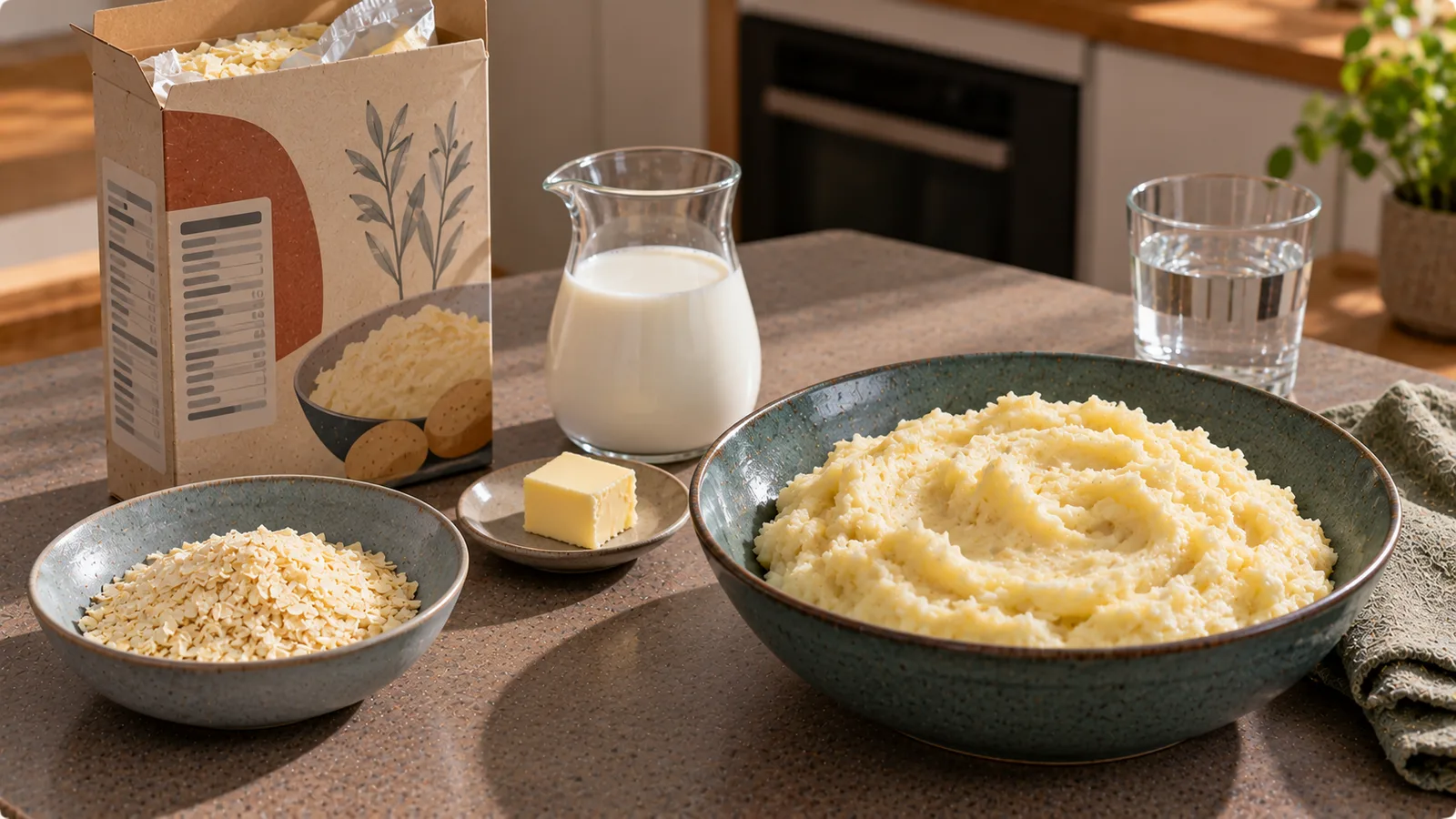
A packet of instant porridge, powdered soup or cake mix may show two sets of nutrition values: as sold and as prepared.
The numbers can be quite different. One table may describe the dry product inside the package, while another describes the food after adding water, milk, oil or other ingredients.
Which values should you use when tracking calories?
Use the values that correspond to the food and quantity you actually consumed. If you change the preparation instructions, you may need to calculate the added ingredients separately.
The distinction matters most when a product changes weight during preparation or when you add ingredients that contribute calories.
What does “as sold” mean?
“As sold” describes the product in the form in which it is purchased, before the preparation steps specified on the packaging.
Examples include:
- Dry instant porridge powder.
- Uncooked rice or pasta.
- A packet of powdered soup.
- Dry pancake or cake mix.
- A dehydrated meal.
- Concentrated drink powder.
For a dry soup mix, the as-sold values may refer to 100 g of dry powder, not 100 g of finished soup.
The weight of the powder and the weight of the prepared dish are not interchangeable.
What does “as prepared” mean?
“As prepared” describes the product after it has been made according to a stated preparation method.
Examples:
- Porridge prepared with a specified amount of milk.
- Soup powder mixed with water.
- Cake mix prepared with eggs and oil.
- Instant noodles cooked with the seasoning supplied.
- A powdered drink prepared with milk.
The important detail is which preparation instructions the nutrition values assume.
A table showing porridge prepared with semi-skimmed milk does not necessarily describe porridge made with water or a different milk.
Why can the numbers differ so much?
Three factors explain most differences.
| Factor | What changes | Effect on nutrition values |
|---|---|---|
| Added water | Finished food becomes heavier | Calories per 100 g often decrease |
| Added milk, oil or other food | Both weight and nutrients increase | Total calories and macros change |
| Cooking or evaporation | Water content changes | Calories per 100 g may rise or fall |
Water contributes weight but no calories.
Milk, oil, eggs and other ingredients contribute nutrients and energy.
Cooking does not automatically create calories, but it can change the concentration of nutrients per 100 g through water gain or loss.
Example 1: instant soup prepared with water
Imagine a fictional soup powder with these values:
| Item | Amount |
|---|---|
| Dry soup powder | 50 g |
| Energy of dry powder | 360 kcal per 100 g |
| Water added | 450 g |
| Finished soup weight | 500 g |
The dry powder contributes:
50 × 360 ÷ 100 = 180 kcal.
Water adds no calories.
Therefore, assuming no loss of ingredients, the finished 500 g soup contains 180 kcal.
Per 100 g of prepared soup:
180 ÷ 500 × 100 = 36 kcal per 100 g.
Both of these statements can be correct:
- Dry powder: 360 kcal per 100 g.
- Prepared soup: 36 kcal per 100 g.
The large difference comes from dilution with water, not from the disappearance of energy.
What if you eat only 300 g?
If the soup is evenly mixed:
300 ÷ 500 = 60% of the batch.
180 × 0.60 = 108 kcal.
Do not log 300 g of prepared soup using the dry powder's 360 kcal per 100 g.
That would greatly overestimate the energy consumed.
Example 2: porridge made with milk
Consider a fictional instant porridge serving:
- 50 g dry porridge mix.
- 380 kcal per 100 g dry mix.
- 200 ml milk.
- Milk containing 47 kcal per 100 ml.
The dry mix contributes:
50 × 380 ÷ 100 = 190 kcal.
The milk contributes:
200 × 47 ÷ 100 = 94 kcal.
Total energy:
190 + 94 = 284 kcal.
If the prepared porridge weighs approximately 250 g:
284 ÷ 250 × 100 = 114 kcal per 100 g, rounded.
This assumes the milk's volume is approximately equivalent to 200 g for this simplified example, and that there is no meaningful evaporation or ingredient loss.
If you use water instead of milk, the total is approximately 190 kcal, not 284 kcal.
The as-prepared values printed on a packet apply only to the preparation method they describe.
Example 3: cake mix with eggs and oil
Suppose a dry cake mix contains 1,500 kcal for the whole packet.
The instructions require:
- 2 eggs.
- 80 g vegetable oil.
- 150 ml water.
For this hypothetical calculation, assume:
- Eggs contribute 145 kcal in total.
- Oil contributes 720 kcal.
- Water contributes 0 kcal.
The prepared batter contains:
1,500 + 145 + 720 = 2,365 kcal.
If the finished cake is divided into 10 equal portions, each portion contains approximately:
2,365 ÷ 10 = 237 kcal.
This calculation assumes all batter is used and no meaningful energy-containing material is discarded.
The finished cake may weigh less than the batter because water evaporates during baking.
That changes calories per 100 g, but not automatically the total energy of the cake.
If you replace the oil with a different ingredient, the packet's as-prepared nutrition may no longer apply.
How to calculate nutrition when you change the recipe
The general method is:
Total prepared nutrition = nutrition of product as sold + nutrition of added ingredients − nutrients actually discarded
For most simple home recipes, the practical steps are:
- Record the amount of packaged product used.
- Calculate its nutrition using the as-sold values.
- Add the nutrition of milk, oil, eggs or other ingredients.
- Do not add calories for plain water.
- Account for any meaningful ingredients or fat discarded, if reliably measurable.
- Weigh the finished batch if you want values per 100 g.
- Divide by the actual portion consumed.
For protein, fat, carbohydrates and salt, use the same approach nutrient by nutrient.
Ingredient nutrition can be taken from product labels or suitable food-composition records such as USDA FoodData Central.
How to calculate calories per 100 g after cooking
Once you know the total calories of the prepared recipe, use its final edible weight.
Calories per 100 g prepared = total recipe calories ÷ finished edible weight × 100
For example:
- Total recipe energy: 600 kcal.
- Finished edible weight: 750 g.
600 ÷ 750 × 100 = 80 kcal per 100 g.
If you eat 250 g:
80 × 250 ÷ 100 = 200 kcal.
This method is especially useful for soups, sauces, porridge and other foods whose water content changes during preparation.
It assumes that the ingredients are distributed reasonably evenly throughout the portion.
Dry pasta versus cooked pasta
Dry pasta absorbs water during cooking.
A hypothetical 100 g portion of dry pasta may contain around 350 kcal.
After boiling, it might weigh approximately 240 g, depending on the type and cooking time.
If no meaningful energy-containing material is lost, the whole cooked portion still contains approximately 350 kcal.
The equivalent per-100-g cooked value would be:
350 ÷ 240 × 100 = 146 kcal per 100 g cooked, rounded.
The important distinction:
- 100 g dry pasta is not the same portion as 100 g cooked pasta.
- A larger cooked weight does not mean additional calories appeared.
- Sauce, oil and cheese must be counted separately.
The exact cooking yield varies, so use your own measurements or an appropriate cooked-food database entry.
Does adding water always lower calories?
It generally lowers calories per 100 g when water increases the food's weight without adding energy.
It does not lower the total calories of the original ingredients.
For example, adding more water to a soup can make the soup less energy-dense by weight.
But if you eat the entire pot, you still consume the calories from all the ingredients.
The same principle applies to drinks prepared from concentrates.
What if the packet gives values per serving?
A serving can be defined as:
- A specified dry weight.
- A prepared portion made with exact ingredients.
- A fraction of the package.
- A particular finished volume.
Always read the serving description.
Suppose the label says:
Per serving: 220 kcal, prepared with 200 ml semi-skimmed milk.
That number may not apply if you use:
- Water.
- Whole milk.
- A plant-based drink.
- More or less milk.
- Additional sugar or toppings.
For reliable tracking, calculate the actual preparation rather than assuming the printed serving matches yours.
Which nutrition declaration is required in the EU?
EU food information rules generally require nutrition declarations to refer to the food as sold.
Where appropriate, nutrition information may also refer to the food after preparation, provided sufficiently detailed preparation instructions are given and the information relates to the food as prepared for consumption.
This framework is set out in Regulation (EU) No 1169/2011, Article 31(3).
The European Commission also explains the general rules for nutrition labelling. European Commission — Nutrition labelling.
This does not mean every packaged food must display both sets of values.
The exact presentation depends on the product and applicable requirements.
What if the package shows only as-prepared values?
First check whether the information is presented per 100 g, per portion or both, and whether the preparation method is specified.
For an EU product, the mandatory nutrition declaration is generally based on the food as sold, subject to the rules and exceptions that apply to the product.
If the label is unclear or you cannot find a value that matches your preparation:
- Read the preparation instructions carefully.
- Check the complete nutrition table.
- Look for a manufacturer's official product page.
- Use the as-sold information and calculate added ingredients when possible.
- Avoid inventing missing values.
For food tracking, a precise calculation from known ingredients is preferable to selecting an unrelated prepared-food entry.
Common mistakes when tracking prepared foods
Applying dry values to cooked weight. Water changes the finished weight.
Ignoring milk or oil. These ingredients can substantially change total calories.
Counting water as calories. Plain water contributes no energy.
Using packet values for a different preparation. The stated recipe may not match yours.
Confusing total calories with calories per 100 g. Dilution changes concentration, not necessarily the total.
Forgetting toppings and sauces. Added ingredients belong in the calculation.
Assuming every cooked food has the same yield. Evaporation and water absorption vary.
A quick decision guide
| What you actually ate | Best starting point |
|---|---|
| Dry product weighed before cooking | As-sold values for the dry weight |
| Product prepared exactly as instructed | As-prepared values for that stated method and portion |
| Product prepared with different milk or oil | As-sold values plus your actual ingredients |
| Soup diluted with extra water | Total recipe nutrition divided by finished weight |
| Cooked pasta weighed after boiling | Suitable cooked entry or raw amount converted using actual yield |
| Only part of a prepared batch | Total batch nutrition multiplied by portion fraction |
The rule to remember
“As sold” and “as prepared” are not competing answers. They describe different states of the same product.
For accurate nutrition tracking:
- Identify the state described by the label.
- Match it to your actual preparation.
- Include any ingredients you added.
- Use the finished weight when calculating nutrition per 100 g of the prepared food.
That prevents both overcounting dry ingredients and overlooking the calories added during cooking.