
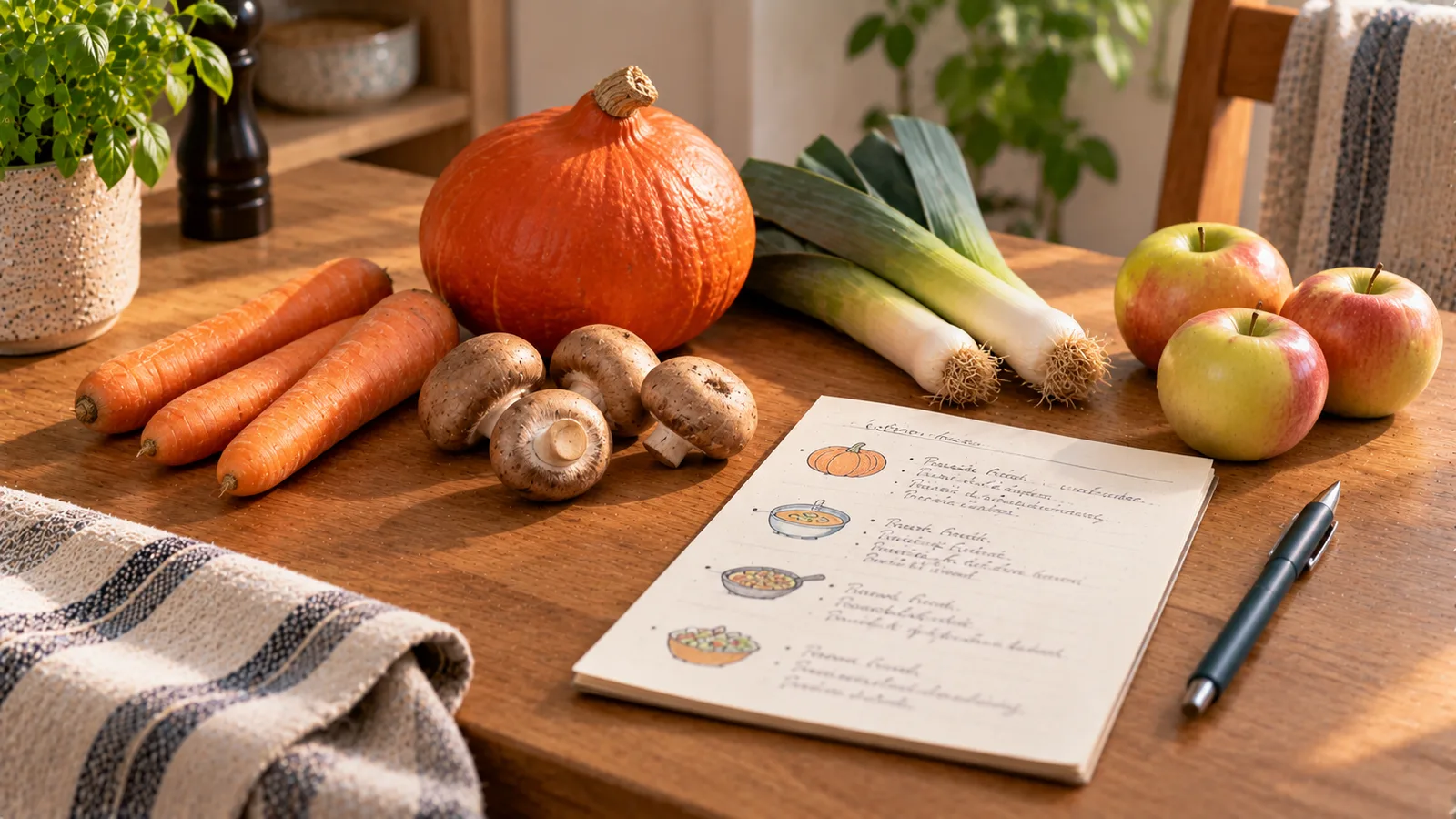
Seasonal meal planning does not require rebuilding your diet every few months or eating only foods that are locally harvested at that moment.
A simpler approach is to let a few foods that are currently abundant, appealing or practical become the starting point for several meals.
Instead of asking:
"What completely different meals should I cook this week?"
you can ask:
"Which seasonal ingredients could give me a few useful meal directions?"
That small change can make planning easier while still leaving room for pantry staples, frozen foods, favorite recipes and foods that are available throughout the year.
What seasonal meal planning actually means
Seasonal meal planning uses foods associated with the current season as one input when deciding what to cook.
It does not mean every ingredient in every meal must be seasonal.
A realistic meal might combine:
- a seasonal vegetable;
- rice or pasta from the pantry;
- beans, eggs, fish, meat or another protein source;
- frozen vegetables;
- a sauce or seasoning you use year-round.
The seasonal ingredient provides direction rather than a rigid rule.
For example, an autumn group of pumpkin, carrots, leeks, mushrooms and apples could inspire several meals without requiring an "autumn diet."
Start with a small seasonal group
Trying to plan around every seasonal ingredient available can make the process unnecessarily complicated.
Choose three to five foods instead.
For example:
- pumpkin;
- carrots;
- leeks;
- mushrooms;
- apples.
The exact foods depend on your location, time of year, availability and preferences.
Seasonality also varies by climate and supply chain, so a generic online calendar should be treated as a guide rather than a guarantee of what is locally in season.
Turn ingredients into meal directions
Do not immediately search for a separate recipe for every ingredient.
First convert the ingredient group into broad meal directions.
Using the example above:
| Seasonal ingredient | Possible meal direction |
|---|---|
| Pumpkin | soup, curry or roasted side |
| Carrots | tray bake, soup or grain dish |
| Leeks | soup, egg dish or pasta |
| Mushrooms | pasta, omelet, rice dish or stew |
| Apples | breakfast, snack or simple dessert |
These are not five fixed recipes.
They are options.
That distinction makes the plan easier to adapt.
Build meals around what you already have
Before buying additional ingredients, check:
- refrigerator;
- freezer;
- pantry;
- opened packages;
- foods that should be used soon.
Suppose you have:
- rice;
- red lentils;
- eggs;
- canned tomatoes;
- yogurt;
- frozen spinach.
Combined with a few seasonal foods, these could become:
- pumpkin and lentil curry with rice;
- mushroom and leek egg dish with a side salad;
- carrot and tomato lentil soup;
- apple oatmeal with yogurt.
The seasonal ingredients generate ideas, while existing food helps determine the actual meals.
Use a simple four-step workflow
A practical seasonal planning process can be reduced to four steps.
Step 1: Choose a few seasonal foods
Pick foods you genuinely like and can realistically use.
Do not buy an ingredient simply because a seasonal list says you should.
Step 2: Check what you already have
Look for foods that pair naturally with those ingredients.
This reduces unnecessary duplicate purchases.
Step 3: Choose meal directions
Decide whether the ingredients are likely to become:
- soup;
- pasta;
- curry;
- grain dish;
- egg-based meal;
- tray bake;
- breakfast;
- snack.
You do not need every recipe finalized yet.
Step 4: Complete the grocery list
Only after the meal directions are clear should you add missing ingredients.
This keeps the grocery list connected to actual meals.
Example: a simple autumn plan
Imagine you choose:
- one small pumpkin;
- carrots;
- leeks;
- mushrooms;
- apples.
You already have rice, oats, lentils, eggs, canned tomatoes and basic seasonings.
A simple set of meal directions could be:
Pumpkin-lentil curry
Use pumpkin, lentils, tomato, spices and rice.
Mushroom and leek omelet
Use mushrooms, leek and eggs, with bread or potatoes if desired.
Carrot and lentil soup
Use carrots, lentils, onion and stock.
Apple oatmeal
Use oats, apple, milk or yogurt and cinnamon.
Several ingredients can appear in more than one meal.
That is useful rather than repetitive when the final dishes are different.
Seasonal planning is not the same as planning around sales
A discounted ingredient and a seasonal ingredient can sometimes be the same food, but the planning logic is different.
Planning around grocery-store sales starts with a temporary price opportunity:
"Chicken and cauliflower are discounted this week. Should I adjust my existing plan?"
Seasonal planning starts with food availability and seasonal context:
"Pumpkin, leeks and mushrooms are useful at this time of year. What meals could they inspire?"
Do not assume that seasonal automatically means cheaper.
Prices depend on location, retailer, weather, supply, promotions and other factors.
If saving money is the goal, compare actual current prices rather than relying on the word "seasonal."
Do not force every meal into the seasonal theme
A common planning mistake is trying to make breakfast, lunch, dinner and snacks all match the season.
There is no nutritional or practical requirement to do that.
Your week can contain:
- seasonal meals;
- favorite year-round meals;
- leftovers;
- frozen foods;
- restaurant meals;
- quick emergency meals.
Seasonality is one planning tool, not the entire system.
Use seasonal ingredients across different meal formats
One ingredient becomes more useful when it can fit several types of meals.
Take mushrooms.
They could be used in:
- scrambled eggs;
- pasta;
- soup;
- rice;
- a sandwich;
- a stew.
Carrots could appear in:
- soup;
- roasted vegetables;
- curry;
- grain dishes;
- snacks.
This flexibility reduces the risk of buying an ingredient for one specific recipe and leaving the remainder unused.
Plan ingredient overlap deliberately
Ingredient overlap can make a meal plan more efficient.
Suppose one recipe requires half a leek.
Instead of leaving the other half without a purpose, plan another meal that can use it.
For example:
Meal 1: mushroom and leek omelet
Meal 2: carrot, leek and lentil soup
The meals are different, but the ingredient is used efficiently.
This is different from meal repetition.
You are repeating an ingredient, not necessarily the finished meal.
Keep quantities connected to actual meals
A seasonal display at a store can encourage buying more produce than you can realistically use.
Before buying, estimate how each ingredient will be used.
If pumpkin is planned for one curry and one soup, buying one appropriate pumpkin may be enough.
If mushrooms appear in only one two-person meal, you probably do not need several large packages.
The objective is not to maximize the amount of seasonal produce purchased.
It is to buy quantities that fit the plan.
Use the most perishable foods first
Not every ingredient has the same storage life.
When organizing the week, consider using more perishable foods earlier and longer-lasting foods later.
The exact storage life depends on the food, its condition and storage environment.
A practical approach is:
- identify foods that deteriorate quickly;
- assign them to earlier meals;
- keep more durable ingredients for later;
- freeze suitable foods if plans change.
This works especially well when seasonal produce is bought in several forms at once.
Leave one or two meals flexible
A meal plan does not need every slot fixed.
Leaving some flexibility helps when:
- leftovers are larger than expected;
- plans change;
- an ingredient needs to be used sooner;
- you decide you do not want the planned meal;
- another food becomes available.
For example, you might plan four dinners and leave a fifth as:
"Use remaining vegetables + protein + grain."
That gives the plan somewhere to absorb leftovers.
A seasonal meal does not need a special recipe
Sometimes the easiest approach is to substitute one component in a familiar meal.
Examples:
- add roasted pumpkin to a grain bowl;
- use mushrooms in your usual pasta;
- add leeks to an egg dish;
- use apples instead of another fruit with oatmeal;
- add carrots to a familiar soup.
This keeps seasonal planning practical.
You do not need a completely new recipe collection every season.
Keep nutritional balance separate from seasonality
A food being seasonal does not automatically make a meal balanced.
When building the final meal, still consider the components that matter for your needs.
Depending on the meal, that may include:
- a protein source;
- vegetables or fruit;
- a grain or other carbohydrate source;
- a source of fat.
For example, roasted pumpkin alone is not necessarily a complete dinner.
Pumpkin with lentils, rice and an appropriate sauce creates a more substantial meal.
Seasonality helps choose ingredients.
It does not replace the rest of meal planning.
Seasonal planning for breakfast
Seasonal planning can be very light at breakfast.
You might keep the same basic breakfast and change one component.
For example:
Base: oats + yogurt
Seasonal addition: apple
or:
Base: eggs + bread
Seasonal addition: mushrooms
This is often easier than creating an entirely new breakfast schedule for every season.
Seasonal planning for lunch and dinner
Lunch and dinner usually provide more room for seasonal vegetables.
A useful method is to choose one meal format first:
- soup;
- pasta;
- rice dish;
- curry;
- tray bake;
- egg-based meal.
Then ask which seasonal ingredient fits naturally.
For example:
Meal format: pasta
Seasonal ingredient: mushrooms
Protein: beans, fish, meat, cheese or another preferred source
Additional vegetable: spinach
Flavor: garlic and herbs
Now you have a meal structure without needing to start from a blank page.
What if seasonal produce is expensive?
Do not buy it simply because it is seasonal.
Use:
- frozen vegetables;
- canned foods;
- cheaper fresh alternatives;
- produce that is available year-round;
- whatever fits your budget.
Seasonal meal planning should make planning easier, not create a financial rule.
If budget is the priority, current unit prices are more useful than assumptions about seasonality.
What if you do not know what is in season?
Use reliable local sources when possible.
Depending on where you live, useful sources may include:
- government agriculture information;
- regional seasonal calendars;
- agricultural organizations;
- reputable consumer information services.
Then compare that information with what is actually available where you shop.
A calendar can suggest possibilities.
Your real grocery environment determines what you can use.
Avoid buying a "seasonal basket" without a plan
A collection of attractive produce is not yet a meal plan.
Before checkout, each major ingredient should ideally have at least one likely use.
A simple note can be enough:
- pumpkin → curry;
- mushrooms + leek → egg meal;
- carrots → soup;
- apples → breakfast/snacks.
This takes less time than choosing detailed recipes in the store and makes unused food less likely.
A simple seasonal planning template
Use this compact structure:
1. Seasonal starting foods
Choose 3–5.
2. Foods already at home
List useful refrigerator, freezer and pantry items.
3. Meal directions
Create 3–5 broad ideas.
4. Ingredient overlap
Identify foods that can be used in more than one meal.
5. Missing groceries
Buy only what is required to complete the meals.
6. Use-first order
Schedule the more perishable ingredients earlier.
7. Flexible meal
Keep at least one opportunity to use leftovers or respond to changed plans.
That is enough for seasonal meal planning to be useful without becoming a separate planning project.
Example planning card
A short planning note could look like this:
Seasonal foods
- pumpkin
- carrots
- leeks
- mushrooms
- apples
Already have
- lentils
- rice
- eggs
- oats
- canned tomatoes
Meal directions
- pumpkin lentil curry
- mushroom-leek egg meal
- carrot lentil soup
- apple oatmeal
Need to buy
- yogurt
- one additional protein option
- any missing seasonings
This is deliberately simple.
The goal is to turn seasonal ingredients into realistic meal directions.
Adapt the system across the year
The same workflow works in different seasons.
You change the ingredient group, not the entire planning method.
A different season might suggest:
- different vegetables;
- different fruits;
- different soups or salads;
- different cooking methods.
Your pantry staples, favorite proteins and basic meal structures can remain largely the same.
This reduces the amount of planning required.
Seasonal meal planning and food waste
Seasonal planning does not automatically reduce food waste.
It can help only when purchases are connected to realistic uses.
The most useful habits are practical:
- check food already at home;
- avoid duplicate purchases;
- assign ingredients to meals;
- plan overlap;
- use perishable foods first;
- adapt the plan when circumstances change.
The planning method matters more than simply buying seasonal produce.
The simplest version
If you want the shortest possible system, use this:
- Pick three seasonal foods you like.
- Check your kitchen.
- Create three meal ideas that combine the two.
- Buy only the missing ingredients.
- Use the most perishable foods first.
- Keep one meal flexible.
Seasonal meal planning does not need to become a strict seasonal menu.
Its main value is providing a useful starting point when you would otherwise be asking, "What should I cook?"
Sources
- European Food Information Council (EUFIC), information on sustainable and varied food choices.
- Deutsche Gesellschaft für Ernährung (DGE), recommendations for a varied diet with vegetables, fruit, legumes and other food groups.
- Bundeszentrum für Ernährung (BZfE), seasonal calendars and consumer guidance on fruit and vegetables.
- World Health Organization (WHO), Healthy Diet.