
A weekly meal plan can look perfectly organised until one ingredient becomes unavailable.
The supermarket is out of chicken thighs. The spinach has spoiled. Someone in the household no longer wants the planned fish dinner. Or a product costs considerably more than expected.
The usual reaction is to replace the entire meal, adjust the shopping list and then reconsider several other meals that depended on the same ingredients.
That is often unnecessary.
A more efficient approach is to replace the ingredient while preserving the role it plays in the recipe and the rest of the week.
The goal is not to find an identical food. It is to make the smallest useful change without creating new problems with cooking, nutrition, leftovers or spending.
Start with the ingredient's job, not its name
Ingredients serve different purposes in a meal.
Some are the main source of protein. Others provide starch, vegetables, fat, moisture, acidity, flavour or structure.
Before selecting a substitute, identify which function matters most.
| Ingredient role | Examples | What the replacement should preserve |
|---|---|---|
| Main protein | Chicken, tofu, beans, fish | Suitable portion and cooking method |
| Starchy base | Rice, pasta, potatoes | Meal structure and adequate quantity |
| Vegetable | Broccoli, spinach, courgette | Volume, texture and cooking compatibility |
| Cooking fat | Olive oil, butter | Appropriate cooking properties |
| Liquid or sauce | Stock, yogurt, tomato sauce | Moisture, consistency and flavour |
| Flavour component | Lemon, herbs, spices | Balance without changing the whole dish |
| Binding ingredient | Egg, flour, starch | The recipe's structure |
A substitute can work in one role and fail in another.
For example, yogurt may replace some cream in a sauce, but it may split under prolonged high heat.
Similarly, cooked lentils can replace some minced meat in a tomato sauce, but they do not behave like minced meat in every burger or meatball recipe.
The five-question substitution test
Before changing an ingredient, ask:
- Function: What does the ingredient contribute?
- Quantity: How much replacement is actually needed?
- Cooking: Does it require a different preparation or cooking time?
- Nutrition: Does the swap materially change protein, energy or other relevant nutrients?
- Weekly impact: Will it affect another planned meal, the shopping list or leftovers?
A replacement is especially convenient when the first four answers are manageable and the fifth creates little additional work.
If the replacement introduces several new ingredients, special equipment or another shopping trip, it may be simpler to change the entire meal instead.
Which ingredients are easiest to replace?
Vegetables used as side dishes are often relatively flexible.
Broccoli can sometimes be replaced with green beans, cauliflower or another vegetable that works with the same seasoning and cooking method.
Starchy sides can also be flexible, provided the preparation is adjusted.
Rice and couscous may serve a similar role in a bowl, but their water requirements and cooking times differ.
Protein substitutions usually need more attention because foods vary in nutrient composition, moisture and cooking behaviour.
Baking substitutions require particular care. Replacing flour, eggs or leavening agents can change the structure of the entire recipe.
The more structurally important an ingredient is, the less useful a casual one-for-one replacement becomes.
Practical swaps for common weekly meals
The following examples are starting points rather than exact nutritional equivalents.
| Original ingredient | Possible replacement | Important adjustment |
|---|---|---|
| Chicken breast in a stir-fry | Firm tofu | Press if needed; season and cook separately |
| Chicken thighs in a tray bake | Turkey thigh pieces | Check safe cooking and moisture |
| Minced beef in tomato sauce | Cooked lentils | Reduce liquid if necessary |
| Spinach in pasta | Chard or kale | Adjust cooking time |
| Broccoli as a side | Cauliflower or green beans | Check tenderness |
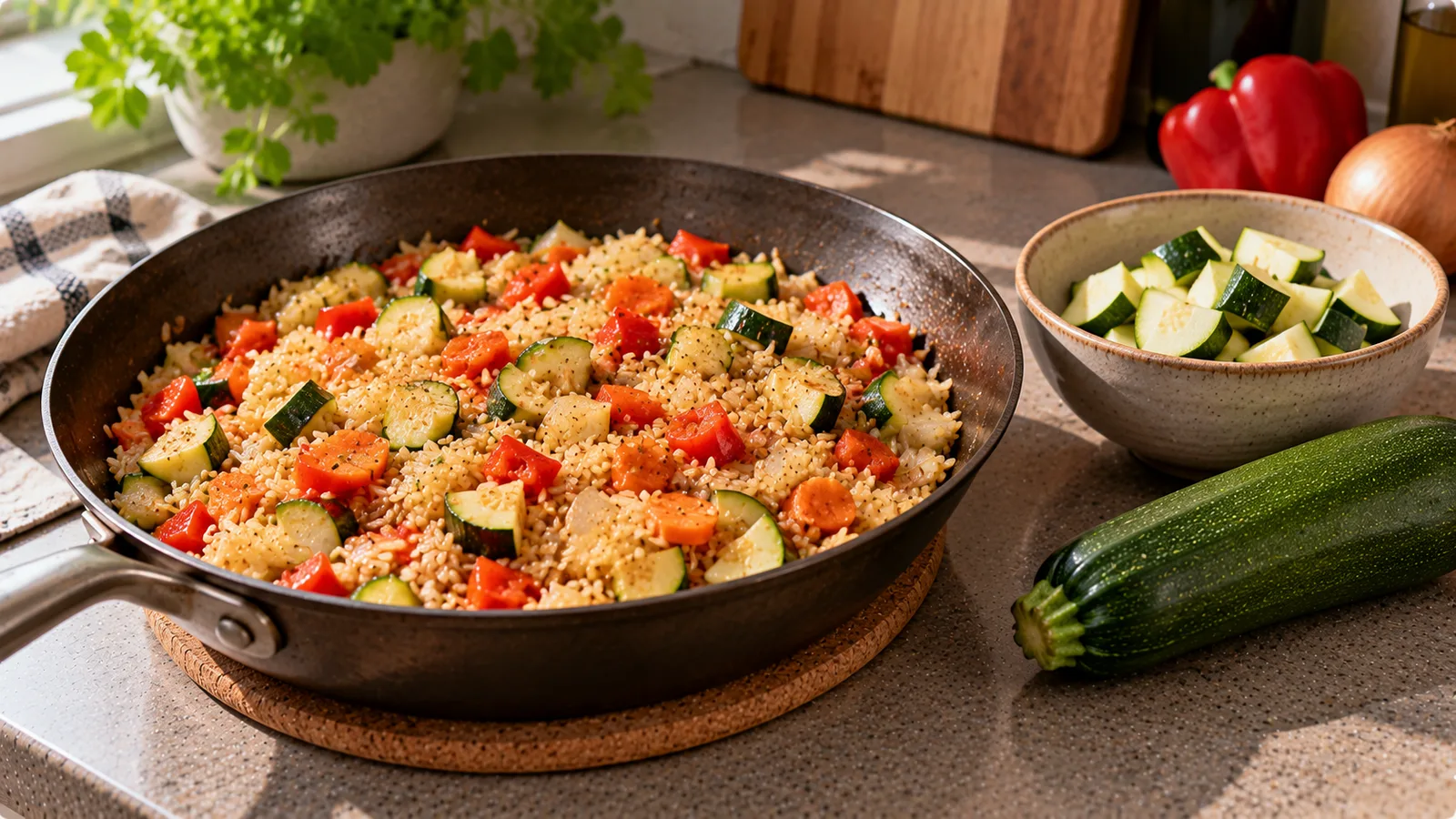
| Courgette in a skillet | Mushrooms or aubergine | Account for different water absorption |
| Rice in a grain bowl | Couscous or bulgur | Use the correct cooking instructions |
| Potatoes as a side | Sweet potatoes | Adjust cooking time and flavour |
| Cream in a sauce | Suitable cooking cream alternative | Check heat stability |
| Lemon juice in dressing | Mild vinegar | Start with less and taste |
These substitutions are culinary options, not guarantees of equivalent calories, protein, allergens or micronutrients.
For medically necessary restrictions, verify the ingredients and cross-contact risks rather than relying on the general category.
A real-world example: chicken is unavailable
Imagine a four-person dinner originally planned as:
- 600 g chicken breast.
- 300 g dry rice.
- 500 g mixed vegetables.
- A simple sauce.
At the shop, chicken breast is unavailable.
You find firm tofu instead.
Rather than redesigning dinner, keep the rice, vegetables and general sauce concept.
Then adjust only the protein component.
Step 1: Check the intended portions
The original recipe uses 150 g raw chicken per person.
Do not assume that 150 g tofu provides the same protein or energy.
Check the specific tofu label and decide whether to increase the tofu portion or add another food.
Step 2: Adjust preparation
Chicken and tofu do not require identical cooking.
Tofu may benefit from draining, pressing, seasoning and browning separately.
Step 3: Keep shared ingredients unchanged
The rice and vegetables remain in the plan.
You do not need to rewrite other meals simply because the main protein changed.
Step 4: Update the shopping list
Remove the chicken.
Add the actual quantity of tofu required.
Avoid leaving both products on the list.
Step 5: Recalculate only the affected dinner
If you track nutrition or spending, update that recipe rather than rebuilding all seven days.
This is the basic principle of a local substitution.
Why gram-for-gram swaps can be misleading
Two foods can have similar culinary roles but different nutrient profiles.
For example, replacing 200 g of one protein food with 200 g of another does not automatically preserve the protein target.
The same applies to carbohydrates and fats.
Cooked rice and dry rice are especially easy to confuse because water changes their weight.
If a recipe specifies 100 g dry rice, replacing it with 100 g cooked couscous would substantially change the quantity of food.
Always identify whether the recipe uses raw, dry, cooked or drained weights.
For accurate nutrient comparisons, use product labels or a food-composition resource such as USDA FoodData Central.
How to replace ingredients without disrupting the budget
A substitution should be evaluated by the cost of the amount you will actually use.
Suppose the planned recipe needs 600 g of an ingredient priced at €8 per kilogram.
The planned cost is:
600 / 1000 × €8 = €4.80.
The replacement costs €6.50 per kilogram, but the recipe requires 750 g.
Its cost is:
750 / 1000 × €6.50 = €4.88.
The difference is only €0.08.
These are illustrative prices.
Comparing only the shelf price per kilogram would miss the different quantities required.
Also consider whether the replacement is sold in a package larger than necessary.
A cheaper ingredient can create a higher actual checkout cost if you must buy much more than the recipe uses.
The hidden problem: ingredients shared across meals
Many weekly plans deliberately reuse ingredients.
A bag of spinach may be intended for Monday's pasta and Thursday's omelette.
A pot of yogurt may be used in breakfast bowls and two sauces.
Replacing an ingredient in one recipe can therefore affect several meals.
Before removing a product from the shopping list, check whether another recipe still needs it.
A useful method is to maintain a simple ingredient-use map.
| Ingredient | Planned uses | What happens if replaced? |
|---|---|---|
| Spinach | Pasta, omelette | Both meals need checking |
| Yogurt | Breakfast, dressing | Keep the breakfast quantity |
| Rice | Two dinners | Only adjust if total required changes |
| Chickpeas | Salad, curry | Do not remove if one meal still uses them |
The aim is to prevent a local change from accidentally creating a shortage elsewhere.
A substitution that uses existing leftovers
The best replacement may already be in your refrigerator.
Suppose Wednesday's meal calls for 300 g cooked beans.
You have 250 g cooked lentils left from Monday.
You may be able to adapt the meal around those lentils instead of buying a new package of beans.
Check whether the lentils suit the recipe's texture and seasoning.
Also verify that the leftovers were stored safely and remain suitable to eat.
Do not assume that leftover food is safe simply because it appears normal.
Using existing ingredients can reduce spending and food waste, but food safety takes priority.
How to update a weekly shopping list
After a substitution, update the list in this order:
- Remove the quantity of the original ingredient no longer required.
- Keep any quantity still needed for other meals.
- Add the replacement in its actual purchase unit.
- Recalculate package quantities.
- Check whether the swap creates new leftovers.
- Update the estimated cost.
For example, replacing 400 g spinach in one meal does not justify deleting the full 600 g on the list if another meal still needs 200 g.
Similarly, a replacement sold only in 500 g packs may require buying two packs even when the recipe needs 700 g.
The shopping list should represent what you need to purchase, not merely the theoretical ingredient weight.
Preserve the week with a minimal-change rule
When a substitution is needed, change as few components as possible.
Consider a planned meal:
Salmon + potatoes + green beans + lemon dressing.
If salmon is unavailable, choose a suitable alternative protein.
Keep potatoes, beans and dressing if they still work.
Do not automatically replace the vegetables, starch and sauce as well.
A useful decision hierarchy is:
- First choice: replace only the unavailable ingredient.
- Second choice: replace the ingredient and one dependent component.
- Third choice: replace the complete meal if the original structure no longer works.
This keeps planning manageable.
When a substitution should trigger a bigger change
Some changes cannot be handled locally.
Examples include:
- A severe allergy that affects multiple ingredients or cross-contact.
- A replacement that requires equipment you do not have.
- A food that changes cooking time beyond your available schedule.
- A protein replacement that materially undermines an important dietary target.
- A substitution that creates several unused ingredients.
- A recipe where the missing ingredient is structurally essential.
In these cases, replacing the whole recipe may be the more practical choice.
The goal is not to preserve the original plan at any cost.
It is to preserve the parts that still work.
Handling substitutions in batch cooking
Batch cooking introduces an additional constraint: a change may affect several portions at once.
Suppose you planned six portions of a lentil soup but only have enough lentils for four.
You could:
- Make four portions and reduce the other ingredients proportionally.
- Add another suitable legume and adjust liquid and cooking.
- Prepare the original soup for four portions and use a different meal for the remaining two.
Do not automatically add uncooked beans directly to a recipe designed for quick-cooking lentils.
Different legumes can have substantially different soaking, cooking and food-safety requirements.
Check the preparation instructions for the specific product.
What about allergies and intolerances?
A culinary substitute is not automatically a safe substitute.
For example, replacing dairy cream with a plant-based alternative may introduce soy, nuts or other allergens.
Replacing wheat pasta with another grain product does not guarantee suitability for someone with coeliac disease.
Check packaged ingredient lists and allergen information.
In the EU, food allergen declarations are covered by Regulation (EU) No 1169/2011.
For a diagnosed allergy, follow the relevant medical advice and take cross-contact into account.
A quick substitution decision table
| Situation | Usually the most efficient action |
|---|---|
| One vegetable is unavailable | Replace the vegetable |
| Protein is unavailable | Replace protein and reassess portions |
| Sauce ingredient is missing | Adapt seasoning or sauce |
| Several core ingredients are missing | Consider a different recipe |
| A shared ingredient is replaced | Check all affected meals |
| Replacement costs much more | Compare other options or change the meal |
| Leftovers can replace an ingredient | Check safety and suitability |
| Allergy makes the recipe unsuitable | Use a verified safe recipe |
This approach avoids unnecessary changes while recognising that some substitutions require more planning.
A reusable weekly substitution checklist
When something changes, record five details:
Original ingredient: What was planned?
Replacement: What will be used instead?
Quantity: How much is required for the actual number of servings?
Affected meals: Does the ingredient appear anywhere else this week?
Shopping-list change: What should be removed, added or reduced?
If you track nutrition, add one final step: recalculate the affected recipe using the replacement's actual nutritional information.
You do not need to recalculate meals that have not changed.
Keep the plan flexible, not fragile
A useful meal plan is not a fixed script.
It is a structure that can accommodate unavailable products, price changes, leftovers and shifting preferences.
By identifying the ingredient's function, checking quantities and updating only the affected recipes, you can preserve most of the week without starting again.
The best substitution is not necessarily the most similar ingredient.
It is the one that keeps the meal practical, the shopping list accurate and the rest of the week intact.