
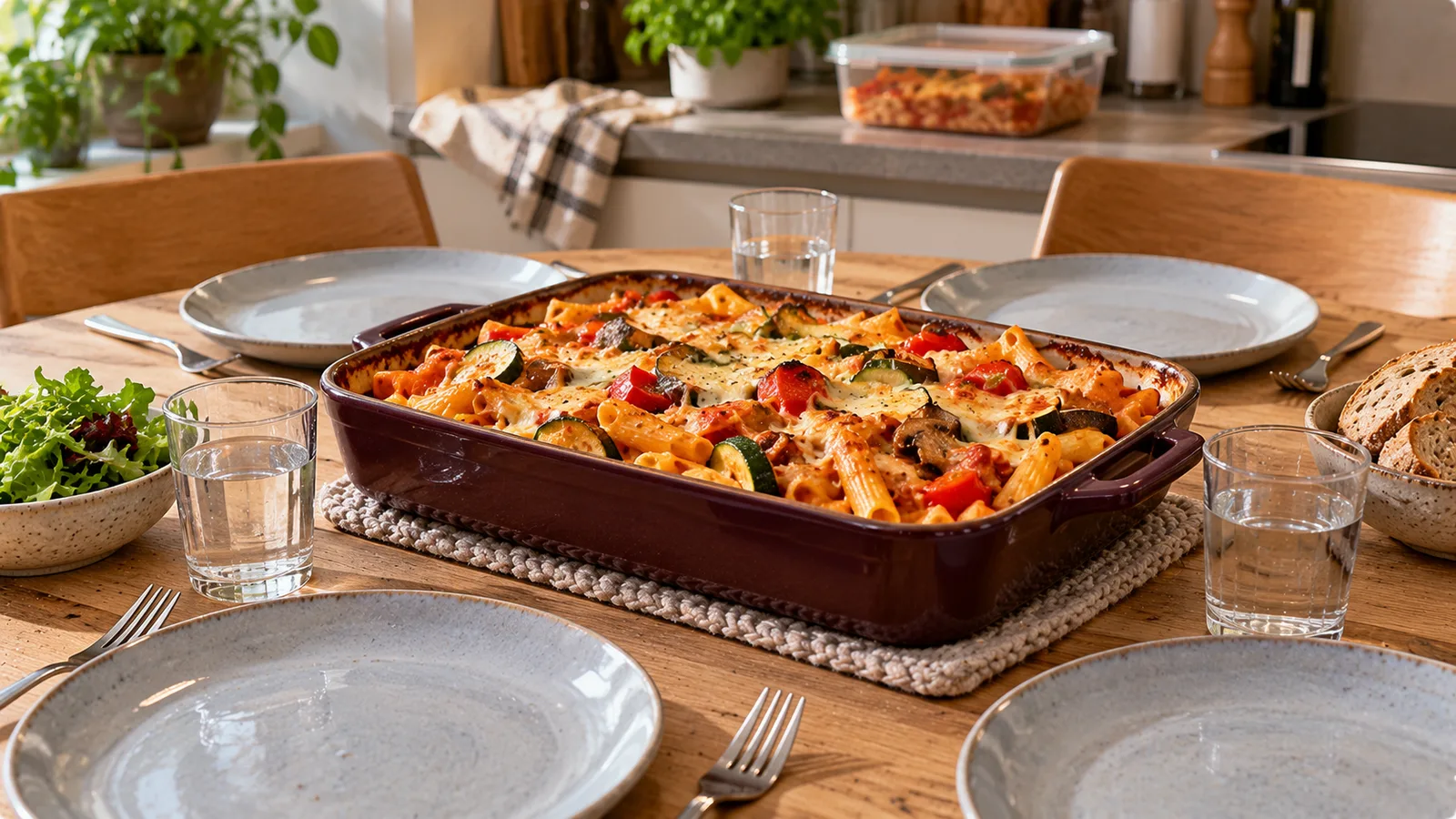
Planning meals for a normal week is relatively straightforward when the same people eat at home every day. It becomes more complicated when a friend visits for dinner, relatives stay for two nights or someone joins only for weekend breakfasts.
The mistake is to increase the entire week's shopping list just because the household will temporarily be larger.
A better approach is to plan around the number of people attending each individual meal.
That way, you can buy enough food for your guests without turning a short visit into several days of unnecessary leftovers.
Start with meals, not guest numbers
Imagine a household with two regular members.
Two guests will arrive on Friday evening and leave on Sunday after breakfast.
The household does not need food for four people throughout the entire week.
It needs additional portions only for the meals the guests will actually attend.
| Day | Meal | People eating |
|---|---|---|
| Thursday | Dinner | 2 |
| Friday | Breakfast | 2 |
| Friday | Dinner | 4 |
| Saturday | Breakfast | 4 |
| Saturday | Lunch | 4 |
| Saturday | Dinner | 4 |
| Sunday | Breakfast | 4 |
| Sunday | Dinner | 2 |
This small attendance table is the foundation of the shopping calculation.
It also reveals which meals need larger recipes and which can remain unchanged.
The portion calculation
For each meal, calculate:
Total portions = regular household portions + guest portions.
Suppose a pasta recipe normally serves two people.
On Friday, two guests join dinner.
You need four portions, so the scaling factor is:
4 ÷ 2 = 2.
The original recipe quantities can usually be doubled.
But doubling is not always necessary for every ingredient.
Seasonings, cooking oil, sauces and garnishes may need adjustment by taste rather than a perfectly linear multiplication.
The most important quantities to scale accurately are the main ingredients.
Example: adapting a pasta dinner
Consider a simple pasta dish for two people.
| Ingredient | For 2 people | For 4 people |
|---|---|---|
| Dry pasta | 180 g | 360 g |
| Tomato sauce | 250 g | 500 g |
| Mushrooms | 200 g | 400 g |
| Spinach | 100 g | 200 g |
| Olive oil | 15 ml | Approximately 25–30 ml |
| Grated cheese or alternative | 30 g | 60 g |
These are illustrative recipe quantities, not nutritional recommendations.
The oil quantity is adjusted slightly rather than doubled automatically.
If your guests have different appetites, the final amounts may need to change.
Separate fixed meals from flexible meals
Some meals are difficult to change at the last minute.
Others can easily accommodate an extra person.
A practical weekly plan uses both.
| Meal type | Examples | Flexibility |
|---|---|---|
| Fixed portions | Individual pies, filled wraps, plated meals | Lower |
| Easily scalable | Pasta, rice bowls, soup, chili | Higher |
| Self-service | Sandwiches, breakfast buffet, tacos | Very high |
| Leftover-friendly | Stew, curry, baked vegetables | High |
When guest numbers are uncertain, choose a meal that can be expanded without changing the entire recipe.
For example, a pot of bean chili can be served with extra rice or bread.
An individually portioned dish is harder to adapt after preparation.
Build a guest-aware weekly plan
The simplest structure is to keep the normal plan intact and modify only the affected meals.
Here is a fictional example for two residents and two weekend guests.
| Day | Dinner plan | Portions |
|---|---|---|
| Monday | Lentil soup | 2 |
| Tuesday | Chicken and potatoes | 2 |
| Wednesday | Vegetable stir-fry | 2 |
| Thursday | Rice with beans | 2 |
| Friday | Tomato and mushroom pasta | 4 |
| Saturday | Vegetable chili with rice | 4 |
| Sunday | Leftover-based dinner | 2 |
The Friday and Saturday dinners are deliberately easy to scale.
The Sunday meal uses ingredients that remain after the visit.
This avoids creating an entirely separate meal plan for the guests.
Count guest meals before buying groceries
A useful measure is the number of additional meal portions, not merely the number of visitors.
Suppose two guests attend:
- Friday dinner
- Saturday breakfast
- Saturday lunch
- Saturday dinner
- Sunday breakfast
That equals five meals per guest.
Two guests × five meals = 10 additional meal portions.
Those portions will not all cost the same.
Breakfast may require oats, eggs or bread, while dinner may include several cooked ingredients.
Still, the count helps you see the true scale of the visit.
Convert the extra portions into ingredients
Do not simply multiply the entire grocery basket by the number of guests.
Instead, identify the recipes that change.
Example:
| Meal | Extra portions | Additional ingredients |
|---|---|---|
| Friday pasta | 2 | Pasta, sauce, mushrooms |
| Saturday breakfast | 2 | Bread, eggs, fruit |
| Saturday lunch | 2 | Soup ingredients or sandwich fillings |
| Saturday chili | 2 | Beans, tomatoes, rice |
| Sunday breakfast | 2 | Oats, yogurt or alternatives |
Combine repeated ingredients into one shopping list.
If Friday pasta and Saturday chili both require onions, buy the total amount needed rather than treating them as unrelated purchases.
Check the pantry before increasing quantities
Guest visits often lead to duplicate purchases.
Before shopping, inspect:
- Dry pasta and rice
- Beans and lentils
- Cooking oil
- Spices
- Frozen vegetables
- Bread and breakfast ingredients
- Sauces and condiments
Suppose your plan requires 600 g of rice and you already have 350 g.
The additional amount needed is:
600 − 350 = 250 g.
You may still need to buy a larger package, but the remaining rice becomes pantry inventory for future meals.
The amount purchased and the amount consumed should not be confused.
Account for package sizes
Recipes are measured in grams, but groceries are sold in packages.
Imagine you need 650 g of yogurt for the guest breakfasts.
Your shop sells 500 g and 1 kg containers.
You could buy two 500 g containers or one 1 kg container.
The better choice depends on:
- Total price
- Price per kilogram
- Remaining shelf life
- Whether the household will use the surplus
- Storage space
A larger package is not automatically cheaper in practice if the excess is discarded.
Plan around dietary requirements
Guests may have allergies, intolerances or dietary preferences that differ from the household's usual meals.
Ask about these requirements before finalizing the menu.
When possible, choose meals that can be adapted without cooking completely separate dishes.
For example:
- Serve cheese separately for a dairy-free guest.
- Offer a suitable plant-based protein with a shared vegetable base.
- Keep sauces or toppings separate when appropriate.
- Use verified allergen-safe ingredients for guests with allergies.
For serious food allergies, ingredient substitution alone may not be enough. Cross-contact during preparation also matters.
Never assume that removing a visible ingredient makes the meal safe.
Make breakfast flexible
Breakfast is often the easiest meal to accommodate.
Rather than preparing four identical plates, create a small selection from ingredients that can be used later.
For example:
- Whole-grain bread
- Eggs
- Fruit
- Oats
- Yogurt or a suitable alternative
- Coffee and tea
People can choose portions according to their preferences.
This also reduces the risk of preparing more food than everyone wants.
If guests have specific dietary requirements, make sure suitable options are clearly available.
Avoid overplanning snacks
Hosts sometimes buy snacks for every possible situation.
That can increase costs and leave many opened packages.
Instead, estimate whether guests will actually be home between meals.
For a weekend visit, a modest selection of fruit, nuts where appropriate, crackers or another shared snack may be sufficient.
If guests will spend most of Saturday outside, there may be little need for an elaborate afternoon snack plan.
Build flexibility into one meal
Not every meal needs to be decided precisely in advance.
A flexible meal can absorb:
- Unexpected guests
- Changed arrival times
- Leftovers from dinner
- Ingredients that need using
- A cancelled restaurant visit
Examples include soup, grain bowls, omelets, sandwiches or a simple pasta dish.
Keep the flexible meal based on ingredients you already use regularly.
Buying an entirely separate emergency grocery basket can defeat the purpose.
What if guests arrive late?
Arrival times can change.
If a dinner may be delayed, choose a dish that is easy to finish or reheat safely.
For example, you might prepare a vegetable sauce in advance and cook pasta closer to serving time.
Avoid leaving perishable food at room temperature for extended periods.
Use appropriate refrigeration and reheating practices.
A meal that tolerates a schedule change is usually a better choice than a dish requiring everyone to eat at an exact minute.
What if one guest cancels?
A cancellation changes the required portions, but it does not mean every ingredient must be discarded.
Prioritize the foods that are most perishable.
Possible adjustments include:
- Reduce the amount of pasta or rice cooked.
- Save unopened ingredients for later.
- Refrigerate suitable leftovers promptly.
- Freeze portions when appropriate and safe.
- Use remaining vegetables in the next day's meal.
It is often easier to reduce dry grains before cooking than to manage a large quantity of prepared food afterward.
A realistic guest-food budget
You can estimate the extra grocery cost meal by meal.
Example:
| Guest meal | Additional ingredient cost |
|---|---|
| Friday dinner | €5.00 |
| Saturday breakfast | €3.50 |
| Saturday lunch | €4.00 |
| Saturday dinner | €6.00 |
| Sunday breakfast | €3.50 |
| Total additional cost | €22.00 |
These are fictional prices used to demonstrate budgeting.
They do not represent current supermarket prices.
The calculation includes only the extra ingredients needed for the guests, not the full cost of meals already planned for the regular household.
You may also want a small reserve for drinks or changes in appetite.
Leftovers after the guests leave
The best time to plan leftovers is before shopping.
Choose one or two post-visit meals that can use remaining ingredients.
Examples:
| Leftover ingredient | Possible next meal |
|---|---|
| Cooked rice | Rice bowl with vegetables |
| Raw mushrooms | Omelet or pasta |
| Extra spinach | Soup or egg dish |
| Remaining beans | Bean salad |
| Bread | Toast or sandwiches |
| Opened yogurt | Breakfast with fruit |
Food safety depends on how ingredients were stored and handled.
Do not use leftovers that have been kept under unsafe conditions simply to avoid waste.
A reusable guest-planning worksheet
Before the visit, fill in the following table.
| Question | Your answer |
|---|---|
| Regular household members | |
| Additional guests | |
| Arrival day and time | |
| Departure day and time | |
| Meals guests will attend | |
| Dietary requirements | |
| Meals requiring extra portions | |
| Pantry ingredients available | |
| Additional groceries needed | |
| Planned use of leftovers |
This takes only a few minutes and prevents many unnecessary purchases.
A practical planning sequence
Use this order whenever guests join for part of the week:
- Confirm arrival and departure times.
- Mark the meals guests will actually attend.
- Check allergies and dietary needs.
- Keep unaffected meals unchanged.
- Choose scalable dishes for shared meals.
- Calculate portions separately for each meal.
- Subtract ingredients already in the kitchen.
- Compare package sizes and prices.
- Leave one meal flexible.
- Plan how to use remaining ingredients afterward.
The result is a normal weekly meal plan with a few deliberate adjustments, not a completely new menu.
The key principle
When guests join for only part of the week, scale the meals they attend rather than the entire week.
Count extra portions, select flexible recipes, check your pantry and think about leftovers before shopping.
This approach makes it easier to welcome guests without losing control of food quantities, spending or the rest of your meal plan.