
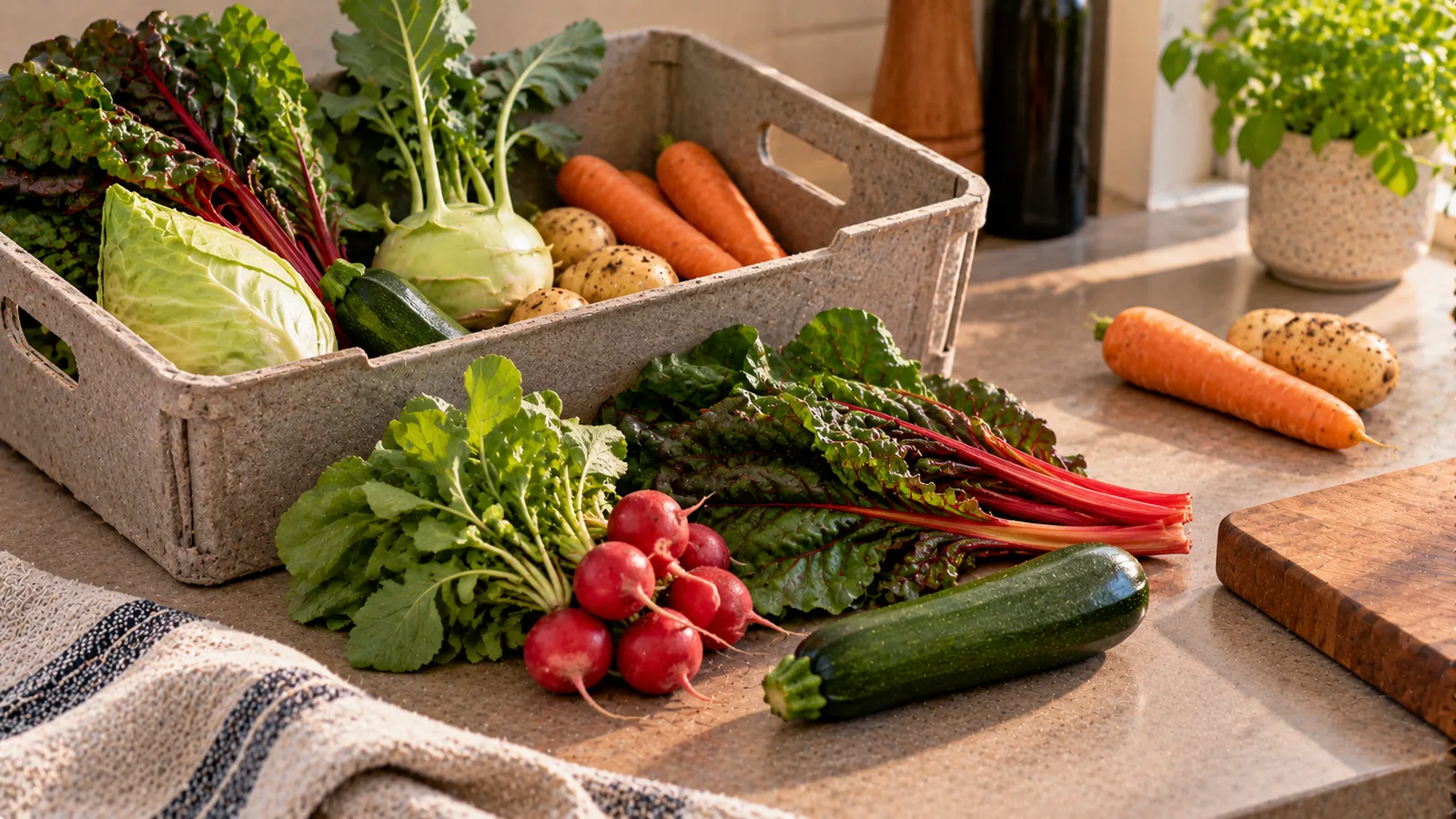
A CSA or seasonal vegetable box changes the usual meal-planning process.
Instead of deciding what you want to cook and then buying the ingredients, you often receive the ingredients first.
One week the box might contain lettuce, tomatoes, zucchini and herbs. Another week it may be full of cabbage, carrots, potatoes, beetroot and squash.
The challenge is not simply finding recipes for every vegetable. It is turning a changing box into a realistic plan before the most perishable produce is forgotten at the back of the refrigerator.
A useful system starts with three questions:
- What needs to be eaten first?
- Which vegetables can form the base of several meals?
- What proteins, grains and pantry ingredients are needed to turn the produce into complete meals?
Step 1: Empty the box and make a quick inventory
Do not start by searching for recipes.
First, see exactly what you have.
Imagine your box contains:
- 1 head of lettuce;
- 500 g tomatoes;
- 3 zucchini;
- 1 bunch of spinach;
- 1 bunch of carrots;
- 1 cauliflower;
- 1 kg potatoes;
- 2 onions;
- fresh parsley.
Write the items down or add them to your food inventory.
This takes only a few minutes and prevents the common problem of planning around the vegetables you remember while forgetting the ones hidden underneath them.
Step 2: Sort vegetables by urgency
Not everything in the box needs to be eaten immediately.
A simple use-first system makes the rest of the plan easier.
Use first
These are foods that may deteriorate relatively quickly.
Depending on freshness and storage, examples can include:
- leafy greens;
- delicate herbs;
- ripe tomatoes;
- soft berries if included;
- very ripe vegetables.
Use next
These usually provide a little more flexibility.
Examples can include:
- zucchini;
- broccoli;
- cauliflower;
- peppers;
- green beans.
Use later
More durable produce can often wait until later in the week when stored appropriately.
Examples include:
- carrots;
- cabbage;
- potatoes;
- onions;
- beetroot;
- winter squash.
The exact storage life varies, so inspect the actual produce rather than relying only on the category.
The purpose is simply to give your meal plan an order.
Step 3: Plan the fragile ingredients before the durable ones
If spinach needs attention before potatoes, place the spinach meal earlier in the week.
For example:
| Day | Vegetable priority | Meal idea |
|---|---|---|
| Monday | Spinach + tomatoes | Spinach omelet with tomato salad |
| Tuesday | Lettuce + tomatoes | Bean and grain salad |
| Wednesday | Zucchini | Zucchini pasta with protein |
| Thursday | Cauliflower | Roasted cauliflower bowl |
| Friday | Carrots | Lentil and carrot soup |
| Saturday | Potatoes + onions | Potato tray bake |
| Sunday | Remaining vegetables | Flexible leftover meal |
This is more useful than assigning recipes randomly across the week.
The order reflects what is likely to need using first.
Step 4: Choose meal formats before exact recipes
A changing vegetable box works well with flexible meal formats.
Instead of searching for a highly specific recipe for every item, think in structures such as:
- soup;
- pasta;
- curry;
- stir-fry;
- grain bowl;
- tray bake;
- omelet or frittata;
- salad;
- tacos or wraps.
These formats can absorb different combinations of vegetables.
For example, a grain bowl might use:
grain + protein + 2–3 vegetables + sauce
A soup might use:
aromatic vegetables + main vegetables + beans or lentils + stock + seasoning
A tray bake might use:
vegetables + protein + oil + seasoning + optional starch
This makes the plan resilient when the contents of the next box change.
Step 5: Add protein deliberately
A vegetable box provides vegetables. It does not automatically provide complete meals.
Once the produce has been assigned to meal formats, check what protein sources you need.
Depending on your preferences, these might include:
- eggs;
- beans;
- lentils;
- chickpeas;
- tofu;
- tempeh;
- yogurt or skyr;
- cottage cheese;
- cheese;
- fish;
- chicken;
- other meat.
Suppose you plan:
- spinach omelet;
- zucchini pasta;
- roasted cauliflower bowl;
- carrot soup.
You could complete them with:
- eggs for the omelet;
- white beans or turkey for the pasta;
- chickpeas for the cauliflower bowl;
- lentils for the soup.
Now the plan is based on the vegetable box without becoming a week of vegetables with no meal structure.
Step 6: Add a small set of flexible carbohydrates
Next, check which carbohydrate sources can work across several meals.
Examples include:
- potatoes from the box;
- rice;
- pasta;
- bread;
- couscous;
- bulgur;
- oats;
- tortillas.
You do not need a different starch for every dinner.
A small set of flexible staples reduces both shopping and leftover ingredients.
For example:
- rice can accompany a curry and become the base of a bowl;
- bread can accompany soup and be used for lunch;
- potatoes can be roasted once and reused in another meal.
Step 7: Build the grocery list around the gaps
Only after planning the box should you create the grocery list.
If the vegetables are already at home, your shopping list might be surprisingly short.
For the example box, you might need:
Protein
- eggs;
- canned beans;
- lentils;
- Greek yogurt.
Staples
- pasta;
- rice;
- bread.
Flavor
- garlic;
- lemon;
- canned tomatoes;
- stock;
- a sauce or condiment you regularly use.
The vegetable box becomes the starting inventory.
The grocery store fills the gaps rather than determining the entire plan.
Step 8: Give one ingredient more than one possible destination
Rigid plans can fail when schedules change.
Suppose you planned to use zucchini in pasta on Wednesday but end up eating away from home.
If zucchini has only one assigned recipe, the plan suddenly has a problem.
Instead, know two or three ways it could be used:
Zucchini
- pasta;
- omelet;
- soup;
- tray bake.
Carrots
- soup;
- roasted side;
- salad;
- curry.
Spinach
- omelet;
- pasta;
- soup;
- grain bowl.
This is not the same as planning several extra meals.
It simply gives ingredients backup destinations.
Step 9: Use one meal as the flexibility slot
Do not allocate every vegetable down to the last gram before the week begins.
Leave one meal flexible.
A useful end-of-week meal might be:
- soup;
- frittata;
- stir-fry;
- curry;
- tray bake;
- grain bowl.
Its purpose is to absorb:
- unused vegetables;
- partial onions;
- remaining herbs;
- leftover cooked grains;
- opened beans;
- other small amounts.
This creates a built-in recovery mechanism for the plan.
Example: turning one box into five dinners
Suppose the box contains:
- spinach;
- zucchini;
- cauliflower;
- carrots;
- potatoes;
- tomatoes;
- onions.
Here is one possible plan.
Dinner 1: Spinach and tomato frittata
Uses the most delicate leafy vegetable early.
Add:
- eggs;
- bread or potatoes;
- optional cheese.
Dinner 2: Zucchini and white bean pasta
Uses:
- zucchini;
- onion;
- tomatoes.
Add:
- pasta;
- white beans;
- garlic;
- herbs.
Dinner 3: Roasted cauliflower and chickpea bowl
Uses:
- cauliflower;
- carrots;
- onion.
Add:
- chickpeas;
- rice or another grain;
- yogurt or tahini-style sauce.
Dinner 4: Lentil and carrot soup
Uses:
- carrots;
- onion;
- remaining tomatoes if appropriate.
Add:
- lentils;
- stock;
- bread.
Dinner 5: Potato and leftover-vegetable tray bake
Uses:
- potatoes;
- any remaining zucchini, carrots, cauliflower or onions.
Add a protein source according to preference.
This plan does not require a unique specialized recipe for every vegetable.
Several meals intentionally share supporting ingredients.
What if the box contains a vegetable you have never cooked?
Do not let one unfamiliar ingredient derail the entire week.
Use a simple process:
- identify the vegetable;
- check which parts are edible;
- find basic storage guidance;
- choose one straightforward cooking method;
- pair it with familiar ingredients.
If you receive kohlrabi for the first time, for example, you do not need to design the week's most ambitious recipe around it.
You might simply:
- roast it with other vegetables;
- add it to soup;
- slice it into a salad if appropriate;
- cook it as a side dish.
The goal is to use the ingredient, not prove culinary creativity.
What if there is too much of one vegetable?
CSA boxes sometimes contain large quantities of a seasonal item.
If you receive far more zucchini, cabbage or tomatoes than you can reasonably use in one meal, divide the quantity into different roles.
For example, a large zucchini supply could become:
- pasta on Tuesday;
- a side dish on Thursday;
- part of a frittata on Saturday.
You can also consider appropriate freezing, preserving or batch cooking when suitable for the specific food.
The important point is to recognize the surplus early rather than discovering it when the produce is already deteriorating.
Storage is part of meal planning
A good plan can still fail if the produce is stored badly.
After unpacking the box:
- refrigerate foods that require refrigeration;
- keep suitable produce in appropriate cool, dry storage;
- separate damaged items from good ones;
- avoid washing produce far in advance when excess moisture would shorten storage life;
- use visibly damaged or very ripe items first.
Storage recommendations vary by food, so follow appropriate guidance for the specific produce.
Meal planning begins when the box arrives, not when cooking starts.
Do not force every vegetable into dinner
Some produce may be easier to use outside the main evening meal.
Examples:
- tomatoes in sandwiches;
- cucumber with lunch;
- carrots as a snack or side;
- fruit with breakfast;
- herbs in sauces;
- greens in eggs.
This reduces pressure on dinner recipes and helps use smaller quantities naturally.
Reuse ingredients without repeating the same meal
Using the same vegetable twice does not require eating the same dish twice.
For example:
Carrots
- Monday: raw in salad;
- Thursday: roasted in a grain bowl;
- Saturday: cooked into soup.
Spinach
- Monday: omelet;
- Tuesday: small amount stirred into pasta.
This is ingredient reuse, not necessarily meal repetition.
Keep a small pantry that supports variable boxes
A flexible pantry makes unpredictable produce much easier to use.
Useful staples may include:
- canned beans;
- lentils;
- canned tomatoes;
- rice;
- pasta;
- grains;
- stock;
- onions and garlic;
- oils;
- vinegar;
- herbs and spices;
- a few versatile sauces.
You do not need every possible ingredient.
The goal is to have enough building blocks to turn changing vegetables into meals without a major shopping trip every time.
What not to do
Do not choose seven recipes before opening the box
That reverses the process and can leave the actual produce unused.
Do not treat every ingredient as equally urgent
Spinach and potatoes should not automatically receive the same position in the schedule.
Do not buy another full basket of vegetables
Start with what the box already provides and shop mainly for the missing meal components.
Do not create a plan with no flexibility
Schedules and produce condition change.
Leave at least one meal capable of absorbing leftovers.
Do not wait until the end of the week to inspect the box again
A quick midweek check can reveal ingredients that need to move forward in the schedule.
A 10-minute vegetable-box planning routine
When the box arrives:
Minutes 1–2: unpack and list everything.
Minutes 3–4: sort into use first, use next and use later.
Minutes 5–6: choose flexible meal formats for the most urgent produce.
Minutes 7–8: add proteins and carbohydrate staples.
Minute 9: create a grocery list for missing ingredients.
Minute 10: choose one flexible leftover meal.
You now have a working weekly plan without searching for a separate recipe for every item.
The core principle
Meal planning from a CSA or vegetable box works best when you reverse the usual planning sequence.
Instead of:
choose meals → buy ingredients
you use:
inventory vegetables → rank by urgency → choose meal formats → add protein and staples → shop for the gaps
This keeps the changing contents of the box at the center of the plan while still producing complete, practical meals.
The goal is not to predict exactly what every future box will contain.
It is to build a planning system that still works when the ingredients change.