
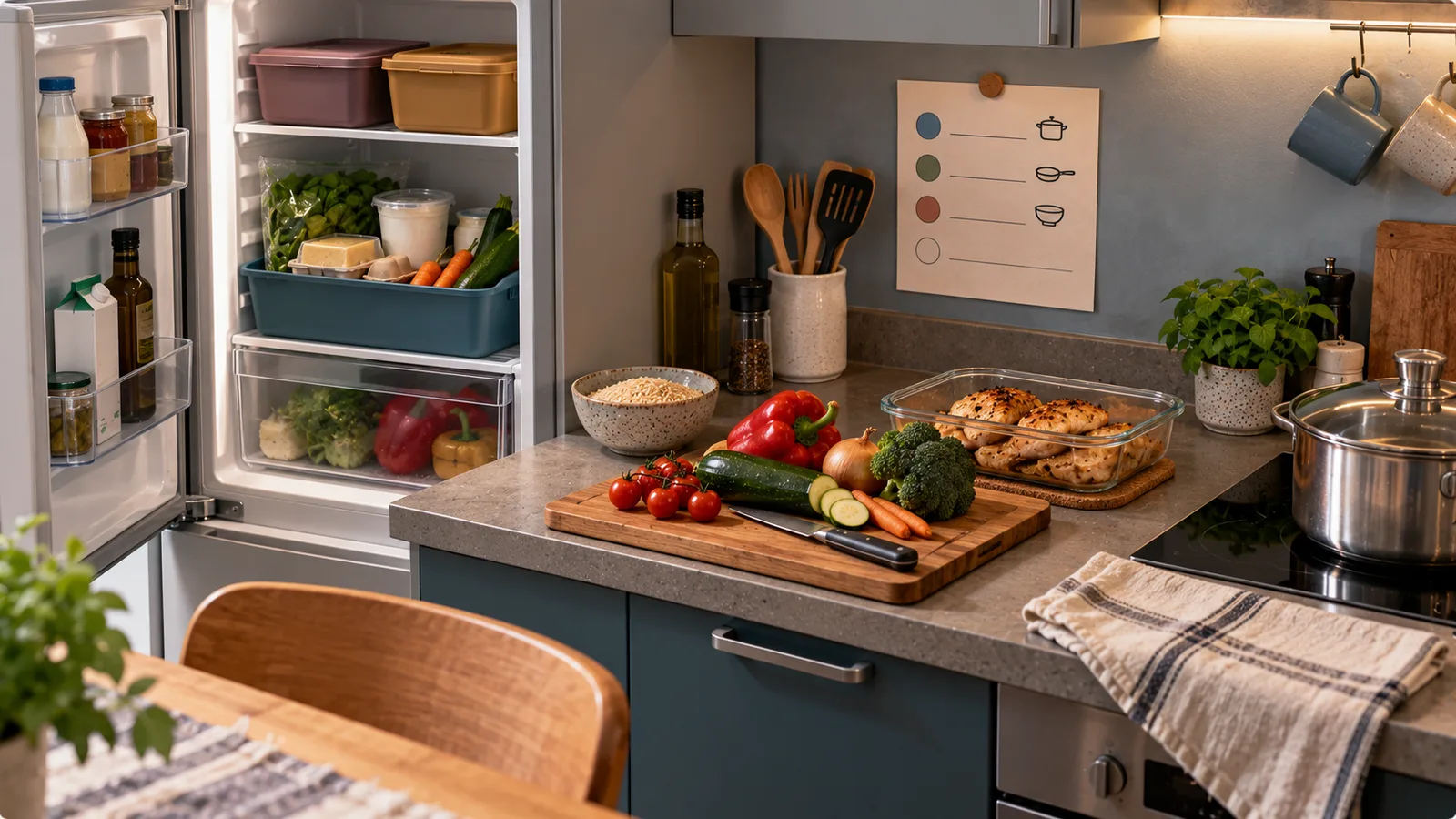
Cooking in a shared student kitchen has constraints that do not exist in a private kitchen.
Fridge shelves are limited. Someone may already be using the stove when you want to cook. Ingredients can be confused with someone else's groceries. Large batches can occupy too much shared storage, and an elaborate recipe can become impractical when several people need the kitchen at the same time.
A useful meal plan for a shared kitchen should therefore optimize more than nutrition.
It should also minimize:
- kitchen time;
- refrigerator space;
- cookware;
- food waste;
- ingredient confusion;
- dependence on a specific cooking time.
The goal is not to create seven completely different dinners. It is to build a small system of meals that works in a shared space.
Start with the kitchen, not the recipes
Before planning meals, check what you can realistically use.
A student kitchen may have:
- one or two refrigerator shelves;
- a small freezer compartment;
- one oven;
- two or four stove burners;
- a microwave;
- limited counter space;
- shared pots and pans;
- little dry-storage space.
Your meal plan should fit those limits.
If you have only half a refrigerator shelf, preparing seven large containers at once is probably a poor strategy even if the recipes themselves are inexpensive.
Use three types of food storage
A simple system is to divide your groceries into three groups.
1. Personal dry storage
Keep foods such as:
- oats;
- rice;
- pasta;
- lentils;
- canned beans;
- canned tomatoes;
- tuna;
- spices;
- unopened sauces.
A labeled box or cupboard section prevents confusion and reduces the amount of food occupying shared surfaces.
2. Personal refrigerator space
Reserve this for foods that genuinely need refrigeration:
- yogurt;
- eggs where refrigeration is appropriate locally;
- cheese;
- cooked leftovers;
- opened products;
- fresh vegetables that require chilling.
3. Shared ingredients
Only treat an ingredient as shared when everyone involved has explicitly agreed.
Oil, salt, milk and spices are often assumed to be communal even when nobody has actually decided that.
A clear rule is easier:
If it has not been agreed as shared, treat it as personal.
This article focuses on planning your own food within a shared kitchen. Splitting the grocery bill among housemates is a separate problem.
A practical weekly structure
Instead of cooking every meal from scratch, use a few reusable components.
For one student, a simple week could use:
- one pot of lentil-tomato sauce;
- one batch of cooked rice;
- one tray of roasted vegetables;
- eggs;
- yogurt and oats;
- canned beans;
- tuna;
- pasta;
- fresh fruit.
These ingredients can create different meals without requiring a refrigerator full of seven separate prepared dishes.
Example 5-day plan
This example covers five typical study days for one person.
Day 1
Breakfast:
- oats;
- yogurt;
- banana.
Lunch:
- rice;
- lentil-tomato mixture;
- roasted vegetables.
Dinner:
- pasta with lentil-tomato sauce;
- side salad.
Day 2
Breakfast:
- two eggs;
- bread;
- fruit.
Lunch:
- leftover pasta;
- vegetables.
Dinner:
- rice bowl with beans, vegetables and yogurt-based sauce.
Day 3
Breakfast:
- oats;
- yogurt;
- apple.
Lunch:
- tuna and bean salad;
- bread.
Dinner:
- vegetable omelet;
- potatoes or bread.
Day 4
Breakfast:
- eggs on toast;
- fruit.
Lunch:
- rice with beans and leftover vegetables.
Dinner:
- pasta with tuna, tomatoes and spinach.
Day 5
Breakfast:
- oats;
- yogurt;
- banana.
Lunch:
- lentil bowl with rice and vegetables.
Dinner:
- flexible meal using remaining ingredients.
The fifth dinner is deliberately flexible. It gives you a place to use food that would otherwise remain in the refrigerator over the weekend.
Example grocery list for one student
A reasonable five-day grocery basket might include:
Grains and starches
- 300 g oats;
- 400 g dry rice;
- 400–500 g dry pasta;
- one loaf of bread;
- 1 kg potatoes.
Protein foods
- 8–10 eggs;
- 500 g plain yogurt;
- 2 cans beans;
- 1–2 cans tuna;
- 250–300 g dry lentils or equivalent cooked amount.
Vegetables
- 3 onions;
- 3 carrots;
- 2 bell peppers;
- 1 zucchini;
- 300–400 g spinach or another leafy vegetable;
- salad vegetables;
- 2 cans chopped tomatoes.
Fruit
- 3 bananas;
- 3 apples;
- another seasonal fruit if needed.
Other ingredients
- cooking oil;
- garlic;
- basic spices;
- mustard or another simple sauce;
- optional grated cheese.
Quantities should be adjusted to appetite, calorie needs and how often you eat outside the home.
Why a component system works better than seven complete meals
Imagine preparing five different cooked dishes on Sunday.
Each dish requires a container.
If every container occupies roughly 1 liter, you may need around 5 liters of refrigerator space just for your main meals.
Now compare that with:
- one container of cooked rice;
- one container of lentil sauce;
- one container of roasted vegetables.
Those three components can be combined into several meals and usually require less storage.
They also give you flexibility if your schedule changes.
Plan around cooking slots
Shared kitchens often have unofficial rush hours.
For example:
- 07:30–09:00 before classes;
- 18:00–20:00 in the evening.
If four people regularly cook at 19:00, planning a 45-minute stovetop meal at exactly that time creates unnecessary friction.
Instead, identify two or three quieter cooking windows.
For example:
Sunday 16:00–17:00: batch preparation.
Wednesday 15:30–16:00: small midweek refill.
This can be more practical than trying to cook extensively every evening.
A 60-minute Sunday preparation session
A compact preparation session could look like this.
Minute 0–10
Start rice.
Start lentils in a second pot.
Preheat the oven.
Minute 10–20
Chop vegetables.
Place them on one tray with a measured amount of oil.
Minute 20–40
Roast vegetables.
Turn cooked lentils into a tomato-based sauce using onion, garlic, canned tomatoes and seasonings.
Minute 40–50
Cool the cooked rice and sauce appropriately.
Prepare a simple yogurt sauce if desired.
Minute 50–60
Portion the foods into a small number of containers.
Wash cookware and clear the shared surfaces.
The exact timing depends on the equipment available, but the principle is to overlap cooking processes instead of preparing every component separately.
Do not occupy every burner
In a shared kitchen, efficient cooking is partly social.
If four burners exist, using all four for an hour may prevent anyone else from cooking.
Whenever possible, design your preparation around:
- one or two burners;
- one oven tray;
- one chopping board;
- one main pot.
This also reduces cleanup.
One-pot meals are especially useful
Shared kitchens are well suited to meals such as:
- lentil stew;
- bean chili;
- tomato pasta;
- curry;
- soup;
- rice-and-bean dishes.
A one-pot meal requires less cookware and leaves fewer items waiting around the sink.
That matters when the kitchen is shared by several people.
Keep breakfasts almost kitchen-free
Morning kitchen congestion is easy to avoid.
Breakfasts that require little equipment include:
- overnight oats;
- yogurt with oats and fruit;
- bread with cheese;
- fruit and yogurt;
- pre-boiled eggs.
If you prefer cooked eggs, they can still work, but having several no-cook alternatives makes the plan more resilient.
Use shelf-stable foods strategically
Shelf-stable ingredients reduce pressure on refrigerator space.
Useful examples include:
- canned beans;
- canned lentils;
- canned tuna;
- dry pasta;
- rice;
- oats;
- canned tomatoes;
- shelf-stable milk before opening, where available.
A small room-temperature pantry can therefore be more valuable than filling your limited refrigerator space with prepared meals.
Refrigerator space is a planning constraint
Suppose your usable refrigerator area fits four medium containers.
Do not create a plan requiring eight.
A better system might reserve the space for:
- one container of cooked grain;
- one container of cooked sauce or stew;
- one container of vegetables;
- one container for leftovers or an opened product.
Other ingredients remain dry or are purchased later in the week.
Shop twice if storage is very limited
One large weekly grocery trip is not always optimal.
If you have almost no refrigerator space, divide the shop.
First shop
Buy:
- dry staples;
- canned foods;
- first half of fresh vegetables;
- yogurt;
- eggs;
- fruit.
Midweek top-up
Buy:
- additional fresh vegetables;
- another yogurt or dairy product;
- bread;
- fruit.
This reduces overcrowding and spoilage.
Label your food
A simple label can prevent many shared-kitchen problems.
Use:
- your name;
- initials;
- a colored sticker;
- a dedicated container style.
For cooked food, adding the preparation date is also useful.
Example:
AK — Lentil sauce — Monday
This makes it clear who owns the food and how long it has been stored.
Avoid storing food in the cooking pot
A large pot can occupy a disproportionate amount of refrigerator space.
After cooling food safely, move it into appropriately sized containers.
A rectangular container usually uses shared refrigerator space more efficiently than a large round saucepan.
It also frees the pot for other people.
Build meals from overlapping ingredients
Ingredient overlap reduces storage and waste.
For example, spinach can be used in:
- omelets;
- pasta;
- rice bowls.
Tomatoes can be used in:
- lentil sauce;
- pasta;
- bean dishes.
Yogurt can be used for:
- breakfast;
- a savory sauce;
- a topping for a rice bowl.
The goal is not to make every meal identical.
It is to make sure ingredients have more than one planned use.
Keep one emergency meal
Student schedules change.
Classes run late. Libraries stay open longer than expected. Someone may occupy the kitchen.
Keep at least one meal that can be prepared with almost no kitchen access.
For example:
- canned tuna;
- canned beans;
- bread or wraps;
- shelf-stable vegetables or an available fresh vegetable.
Another option is a frozen individual portion if you have freezer space.
The emergency meal prevents a disrupted kitchen schedule from breaking the entire plan.
Plan leftovers intentionally
Leftovers should have a destination before you cook.
If Monday dinner creates two portions, decide that the second portion is Tuesday lunch.
This is better than putting an anonymous container in the refrigerator and hoping someone remembers it later.
A simple rule is:
Cook once, assign the leftover immediately.
Example: pasta portions
Suppose you cook 240 g dry pasta and plan three servings.
After cooking, divide the finished pasta into three roughly equal portions.
Use:
- one for dinner;
- one for tomorrow's lunch;
- one with a different sauce later.
If you do not need the third portion, cook less pasta.
Shared kitchens reward smaller, intentional batches.
Keep personal ingredients compact
Bulky packaging can consume valuable space.
Where practical, use compact containers for dry staples.
For example:
- rice in a sealed container;
- oats in a container;
- spices in a small box.
Do not decant products if doing so would make allergen identification, cooking instructions or expiry information difficult to retain.
Shared equipment needs a backup plan
Do not build your entire meal plan around one appliance that may be occupied.
If the oven is unavailable, can dinner be made on the stove?
If the microwave is busy, can the meal be eaten cold or reheated later?
If the large pan is missing, can you use a pot?
A resilient plan has simple alternatives.
Example substitution system
Instead of planning:
Wednesday: exact chicken-and-rice recipe requiring the oven
plan:
Wednesday: grain + protein + vegetables
Then choose from what is available:
Grain:
- rice;
- pasta;
- potatoes;
- bread.
Protein:
- eggs;
- beans;
- lentils;
- tuna;
- tofu.
Vegetables:
- roasted;
- sautéed;
- raw;
- frozen.
This structure survives changes in equipment and schedule.
Frozen vegetables can save space and time
If freezer space is available, frozen vegetables can reduce:
- chopping;
- spoilage;
- shopping frequency.
They are especially useful for:
- stir-fries;
- soups;
- pasta;
- rice dishes.
But a tiny shared freezer can become overcrowded even faster than the refrigerator, so only buy quantities you can actually store.
Food safety still matters
A shared kitchen does not change basic food-safety principles.
Refrigerate perishable cooked food promptly rather than leaving it on a shared counter for hours.
Keep the refrigerator sufficiently cold, generally around 4°C or below where practical guidance recommends it.
Avoid cross-contamination between raw animal foods and ready-to-eat foods.
Reheat leftovers appropriately.
Discard food that is no longer safe rather than relying only on whether it looks acceptable.
Clean as part of the cooking plan
In a private kitchen, dishes can sometimes wait.
In a shared kitchen, leaving them can block the next person's meal.
Include cleanup in your cooking time.
A 30-minute recipe that creates another 25 minutes of washing up is effectively a 55-minute kitchen session.
This is another reason to favor:
- one-pot meals;
- one-pan meals;
- reusable components;
- simple breakfasts.
A simple midweek reset
On Wednesday or Thursday, check:
- what cooked food remains;
- which vegetables need to be used soon;
- whether bread or fruit needs replacing;
- whether another batch is actually necessary.
Do not automatically cook more food just because the original plan said so.
The plan should respond to what remains.
Example midweek adjustment
Suppose Wednesday evening you still have:
- two portions of rice;
- one portion of lentil sauce;
- half a bag of spinach;
- four eggs.
Instead of cooking another large batch, Thursday can become:
Lunch:
- rice + lentil sauce + spinach.
Dinner:
- egg and spinach rice bowl.
This uses existing food before buying or cooking more.
Meal planning around study days
Not every day needs the same type of meal.
For a day with lectures from morning to late afternoon, prioritize:
- portable lunch;
- simple breakfast;
- quick dinner.
For a study-at-home day, you can use a meal requiring slightly more preparation.
Match the cooking demand to the day rather than distributing complicated recipes evenly across the week.
Example schedule-based week
Monday: long campus day
Portable lunch and reheatable dinner.
Tuesday: shorter day
Cook one fresh meal and make an extra portion.
Wednesday: long campus day
Eat Tuesday's extra portion.
Thursday: home study day
Use remaining vegetables in a one-pot meal.
Friday: flexible
Use leftovers and ingredients that need to be finished.
This is often more realistic than assigning a completely new recipe to every evening.
If several people want to cook together
Occasional shared meals can reduce costs and kitchen congestion, but only if expectations are clear.
Agree beforehand on:
- who is eating;
- who buys ingredients;
- who pays;
- who cooks;
- who cleans;
- what happens to leftovers.
Do not assume that every shared-kitchen meal should become a shared grocery system.
You can share a meal while keeping most weekly groceries personal.
A compact system that works
For many students, the most practical shared-kitchen routine is:
- Keep dry groceries in one personal box or cupboard area.
- Limit refrigerated meal prep to a few reusable components.
- Cook one larger batch once or twice per week.
- Reserve quieter kitchen times when possible.
- Use overlapping ingredients across several meals.
- Assign leftovers before storing them.
- Keep one low-effort backup meal.
- Do a midweek inventory before buying more food.
- Clean the cooking area immediately after use.
A successful student meal plan does not require a large kitchen or seven perfectly prepared dinners.
It needs to fit the space, equipment and people you actually share the kitchen with.