
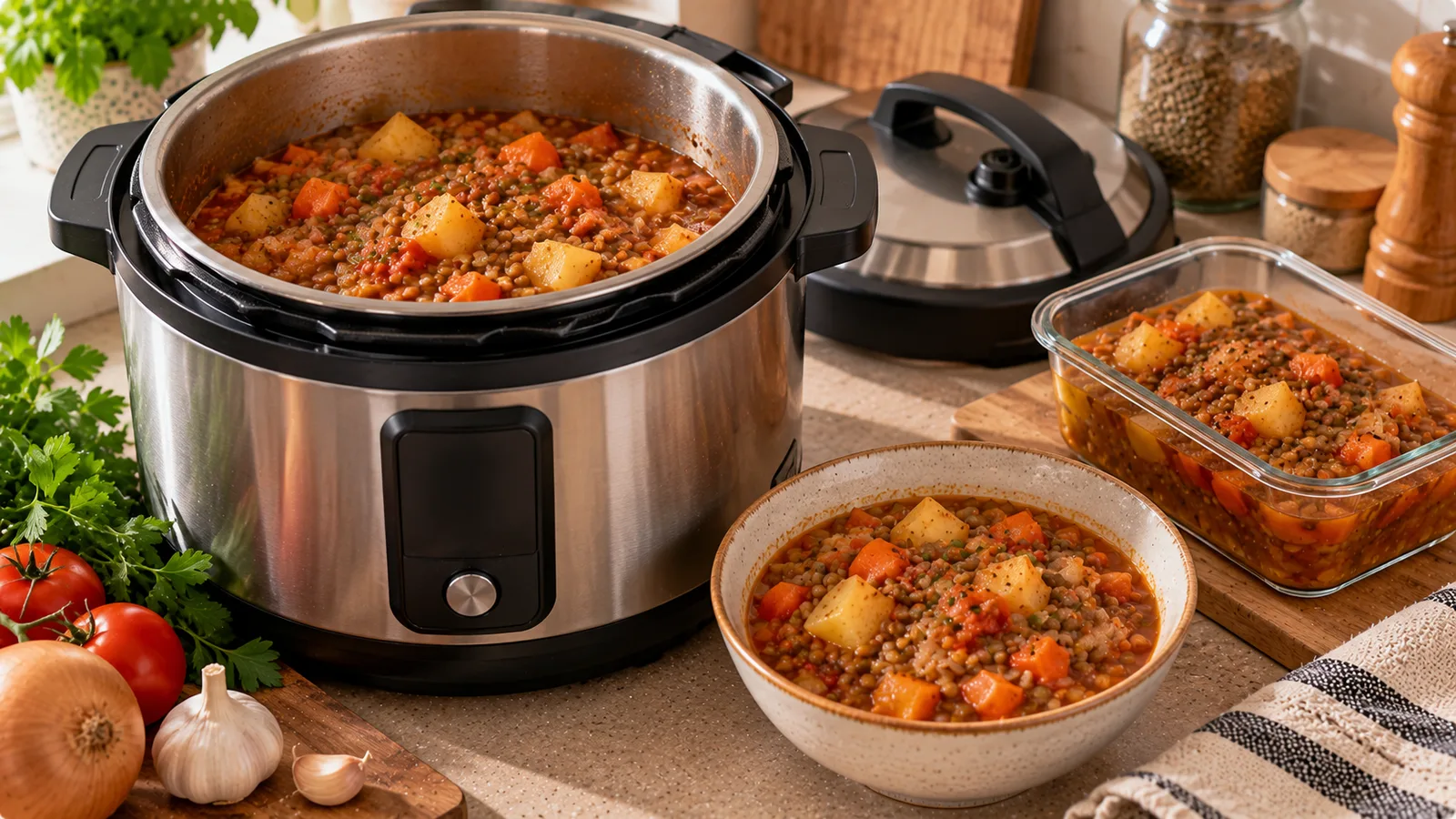
A pressure cooker can make weekly meal planning easier, especially when your meals regularly include beans, lentils, grains, soups and slow-cooking cuts of meat.
The advantage is not simply faster cooking. It is the ability to prepare versatile ingredients in batches and turn them into different meals throughout the week.
However, pressure-cooker meal planning works best when you account for appliance capacity, pressure-building time, release methods, food safety and storage.
This guide focuses on the workflow rather than providing a collection of unrelated pressure-cooker recipes.
Start with ingredients, not seven separate recipes
A useful approach is to prepare a small number of ingredients that can be combined in different ways.
For example:
| Batch ingredient | Possible meals |
|---|---|
| Cooked chickpeas | Grain bowls, salads, soups, wraps |
| Cooked lentils | Tomato stew, soup, vegetable filling |
| Cooked rice | Rice bowls, side dishes, vegetable meals |
| Shredded chicken | Wraps, soups, rice bowls |
| Cooked beans | Chili, salads, bean bowls |
You do not need to prepare every ingredient in one session.
Choose two or three components that match your planned meals, household size and storage space.
What should you cook first?
Pressure cookers work well for some ingredients, but not all foods benefit equally.
Dry beans, tougher cuts of meat and certain soups are often good candidates.
Quick-cooking vegetables, delicate fish and foods that require a crisp surface may be easier to prepare separately.
Plan the cooking order according to:
- Foods requiring soaking or other advance preparation.
- Foods with longer total cooking and pressure-release times.
- Ingredients that need cooling before refrigeration.
- Components that can be prepared on the stovetop while the cooker is occupied.
- Ingredients intended for freezing rather than immediate consumption.
This prevents a common problem: scheduling several pressure-cooker batches as if they could cook simultaneously.
Pressure-cooker time is not just the timer setting
A recipe may specify 15 minutes at pressure, but that does not mean the entire process takes 15 minutes.
Total time may include:
- Ingredient preparation.
- Heating and reaching pressure.
- Cooking at pressure.
- Natural or controlled pressure release.
- Final seasoning or reduction.
- Cooling and storage.
A realistic plan reserves time for the full process.
For example, a batch that cooks for 20 minutes at pressure may occupy the appliance much longer.
Exact times depend on the appliance, ingredient quantity, starting temperature and release method.
Always follow the manufacturer's instructions and a validated recipe for your particular model.
Build a three-batch cooking session
Here is an illustrative workflow for a household that wants several flexible meals.
Batch 1: Chickpeas
Cook chickpeas using an appliance-approved method appropriate for their soaking status and quantity.
Drain or reserve the cooking liquid according to the recipe.
Use the chickpeas in salads, bowls and a tomato-based stew.
Batch 2: Chicken
Prepare chicken using a validated pressure-cooker recipe.
Check that it reaches a safe internal temperature with a food thermometer.
Shred the cooked chicken and divide it into meal-sized portions.
Use it in wraps, rice bowls or soup.
Batch 3: Lentil soup
Prepare a vegetable and lentil soup using a recipe suitable for pressure cooking.
Follow the appliance's fill limits and release instructions, especially for thick or foamy mixtures.
Portion the soup into shallow containers for prompt cooling.
Meanwhile, prepare quick vegetables or other side dishes outside the pressure cooker.
The three batches create several combinations without requiring three entirely separate meals every day.
Example five-day meal plan
The following plan is an organizational example. Portions should be adjusted to individual energy and nutrient needs.
| Day | Lunch | Dinner |
|---|---|---|
| Monday | Chickpea and vegetable bowl | Chicken with rice and vegetables |
| Tuesday | Lentil soup with bread | Chicken wraps with salad |
| Wednesday | Chickpea tomato stew | Rice bowl with vegetables and chicken |
| Thursday | Lentil soup with yogurt | Chickpea salad with eggs |
| Friday | Frozen chicken-and-rice portion | Lentil and vegetable bowl |
This does not mean every Monday batch should remain refrigerated until Friday.
Meals intended for later in the week should be frozen promptly and thawed safely when needed.
The schedule can also be split into two smaller cooking sessions.
One session or two cooking days?
A single cooking session can reduce daily preparation, but it creates storage demands.
Two shorter sessions can provide fresher meals and reduce the quantity that must be frozen.
A practical pattern is:
First session: Cook legumes and one protein. Refrigerate near-term portions and freeze later portions.
Second session: Prepare another protein, soup or grain component and replenish fresh vegetables.
This approach is especially useful when your pressure cooker is small or your refrigerator has limited space.
How much should you cook?
Start with the number of portions you actually expect to eat.
For example, if three planned meals each require 150 g of cooked chickpeas:
3 × 150 g = 450 g cooked chickpeas.
Allow for the fact that dry legumes absorb water and increase in weight during cooking.
The yield varies by ingredient and preparation method.
Do not use a single universal dry-to-cooked conversion for every bean or grain.
For accurate nutrition tracking, record whether your measured quantity refers to dry or cooked food.
If you are tracking a recipe, weigh the finished batch and calculate portions from the final yield.
Respect the appliance's fill limits
Pressure cookers are not ordinary stockpots.
Overfilling can interfere with safe operation.
Foods that expand or foam, including beans and some grains, often require a lower maximum fill level than other preparations.
The exact limits depend on the appliance.
Follow the manufacturer's maximum-fill markings and instructions for expanding foods.
Never assume that a batch designed for a larger model can be prepared unchanged in a smaller cooker.
If the quantity exceeds the safe capacity, divide it into separate batches.
Beans need special attention
Dry beans differ in their cooking requirements.
Soaking may be recommended for some recipes, and cooking times vary considerably between varieties.
Kidney beans require particular care because inadequately cooked beans can contain harmful levels of phytohaemagglutinin.
Use reliable, validated instructions that explicitly address the bean variety and cooking method.
Do not assume that every slow-cooker or stovetop bean recipe can be transferred directly to a pressure cooker.
If your appliance manual does not provide suitable instructions, use a trusted pressure-cooker recipe or another validated cooking method.
Cook proteins safely
Pressure cooking does not eliminate the need to check whether food is properly cooked.
For poultry and other temperature-sensitive foods, use a food thermometer and follow applicable food-safety guidance.
Do not rely solely on appearance, texture or the pressure-cooker timer.
Frozen ingredients may require different procedures from refrigerated ingredients.
Only use frozen-food methods that are suitable for your appliance and recipe.
For meat-based batches, divide cooked food into portions before storage.
Cooling, refrigerating and freezing
Batch cooking only saves time when the food is stored safely.
Large containers of hot food can cool slowly.
Divide cooked food into smaller, shallow containers and refrigerate promptly.
As a practical rule, refrigerate perishable cooked food within two hours, or within one hour in very hot conditions.
Keep the refrigerator at a safe temperature, commonly 4°C or below.
Use refrigerated leftovers within the recommended period for the food and local guidance; freezing is a better option for meals intended much later.
Rice deserves particular care because improperly cooled or stored cooked rice can allow Bacillus cereus to grow.
Cool rice quickly, refrigerate it promptly and follow local guidance on storage and reheating.
Freezing portions early is generally safer than keeping a week's worth of cooked food in the refrigerator.
Reheat only what you need
Take out the number of portions required for the meal.
Thaw frozen food safely, preferably in the refrigerator, or use an approved method that allows immediate cooking or reheating.
Reheat leftovers thoroughly according to food-safety guidance.
Avoid repeatedly warming and cooling the same large batch.
When possible, store grains, proteins and sauces separately to preserve texture and allow flexible portion sizes.
Make the meals taste different
Batch ingredients do not have to produce repetitive meals.
A cooked chickpea batch can become:
- A lemon-herb salad.
- A tomato and spinach stew.
- A spiced grain bowl.
- A filling for a wrap.
Cooked chicken can be paired with different vegetables, sauces and starches.
Keep seasonings flexible when cooking the main batch.
For example, a lightly seasoned protein can be finished with different sauces after reheating.
This is often more versatile than preparing a large quantity of one fully assembled dish.
Plan around nutrition, not just convenience
Pressure cooking is a cooking method, not a guarantee that every meal will be balanced.
When building a meal, consider:
- A suitable protein source.
- Vegetables or fruit.
- A carbohydrate source appropriate to the meal.
- Dietary fiber.
- Fat sources and portion sizes.
- Sodium from sauces, stock and packaged ingredients.
The pressure cooker may prepare the protein or grain component while vegetables and other ingredients are added separately.
A complete meal plan should reflect the actual foods and portions consumed.
Common planning problems and solutions
| Problem | Practical adjustment |
|---|---|
| Too many batches for one appliance | Use two cooking sessions |
| Meals taste repetitive | Keep base ingredients simply seasoned |
| Refrigerator becomes overcrowded | Freeze later-week portions immediately |
| Cooking takes longer than expected | Include pressure-building and release time |
| Beans cook unevenly | Use variety-specific validated instructions |
| Portions are inconsistent | Weigh finished batches and divide by planned servings |
| Vegetables become too soft | Prepare delicate vegetables separately |
A reusable weekly workflow
Before shopping, choose a small number of meals that share ingredients.
Write down the number of portions needed.
Check which components genuinely benefit from pressure cooking.
Review the appliance's capacity and the cooking instructions for each recipe.
Prepare ingredients that require soaking or advance handling.
Cook batches sequentially, allowing enough time for pressure release.
Cool and store the finished food safely.
Freeze meals intended for later in the week.
During the week, combine the prepared components with fresh vegetables, seasonings and suitable sides.
The result is a flexible system rather than a rigid schedule of identical meals.
Sources and safety guidance
- USDA Food Safety and Inspection Service — safe cooking temperatures and leftovers.
- USDA FoodKeeper — food storage guidance.
- UK Food Standards Agency — cooking, chilling and reheating advice.
- FDA: Bad Bug Book — information on foodborne hazards, including those associated with beans.
For appliance-specific limits, pressure release and cooking procedures, the manufacturer's manual and validated recipes take priority.
The main principle
Plan around the pressure cooker's strengths: batch legumes, grains, soups and suitable proteins.
Allow for the entire cooking process, respect capacity limits and store food safely.
A few versatile batches, combined with fresh ingredients and thoughtful freezing, can support varied meals throughout the week without requiring daily pressure cooking.