
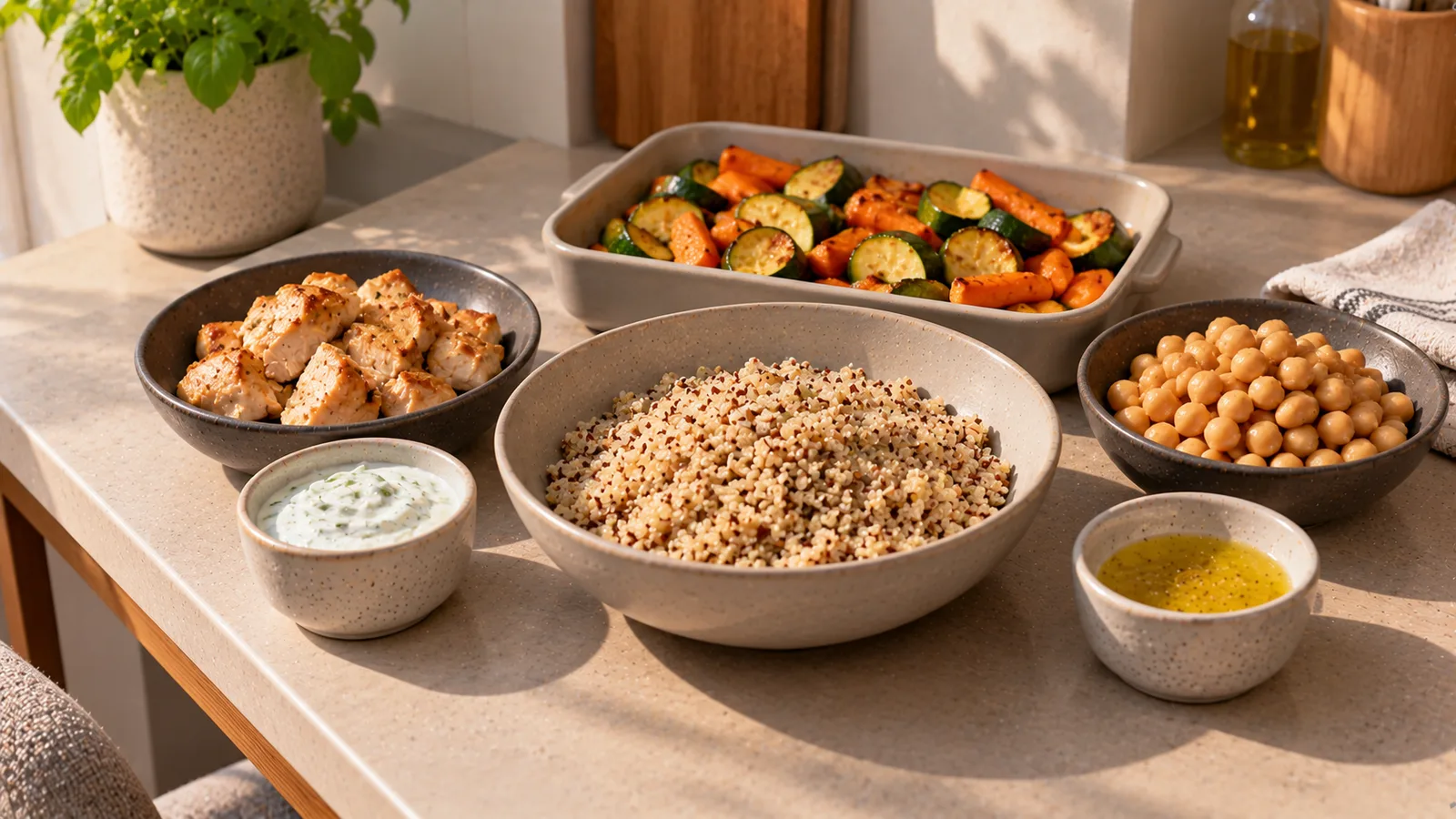
Meal planning becomes more complicated when certain foods cannot or should not be included.
A household may need to account for food allergies, intolerances, vegetarian or vegan preferences, religious or cultural requirements, medical instructions, or simply several people who eat differently.
The solution is usually not to create a completely separate menu for every restriction.
A more practical system is to build meals from compatible components, identify the restrictions that actually require separation, and plan substitutions before shopping.
Start by defining the restriction precisely
“Can't eat dairy” can mean very different things.
One person may avoid lactose but tolerate lactose-free dairy. Another may have a milk allergy and need to avoid milk proteins entirely.
Likewise, “gluten-free,” “vegetarian,” “low-sodium” and other descriptions can have different practical requirements.
Before planning meals, write down exactly what must be:
- excluded completely;
- limited;
- substituted;
- checked on labels;
- kept separate during preparation.
This prevents vague restrictions from making the entire meal plan unnecessarily complicated.
If a restriction is related to an allergy, diagnosed medical condition or prescribed diet, follow the guidance provided by the relevant healthcare professional rather than treating a general meal-planning guide as medical advice.
Separate non-negotiable restrictions from preferences
This distinction matters.
A severe food allergy is not equivalent to someone simply disliking mushrooms.
Create two categories:
Must avoid
Foods or ingredients that cannot be used because of allergy, intolerance, medical guidance, religious requirements or another firm restriction.
Prefer to avoid
Foods someone dislikes or generally chooses not to eat but that do not create the same safety issue.
This helps you prioritize the restrictions that genuinely determine how food must be purchased, stored and prepared.
Find the common base first
When several people have different requirements, start with foods everyone can eat.
For example, imagine a household where:
- one person is vegetarian;
- one person avoids lactose;
- everyone else eats without those restrictions.
Instead of planning two completely different dinners, choose a common base:
- rice;
- roasted vegetables;
- beans;
- salad.
Then add separate components:
- tofu or beans for the vegetarian option;
- chicken for those who want it;
- lactose-free or dairy-free sauce where needed;
- regular cheese as an optional topping for others.
Most of the meal stays shared.
Only the components that need to differ are separated.
Use a component-based meal structure
A flexible meal can often be built from five parts:
| Component | Examples |
|---|---|
| Protein | chicken, fish, eggs, tofu, tempeh, beans, lentils |
| Carbohydrate base | rice, potatoes, quinoa, pasta, bread |
| Vegetables | fresh, frozen, roasted, steamed |
| Fat or sauce | olive oil, tahini, yogurt sauce, avocado |
| Optional extras | cheese, nuts, herbs, toppings |
You do not need all five categories at every meal.
The value of the structure is flexibility.
If one component conflicts with a dietary restriction, you can often replace that component without redesigning the entire meal.
Build a substitution map
Do not wait until cooking time to discover that a key ingredient cannot be used.
Create a small substitution list for foods that appear regularly in your meals.
For example:
| If the plan uses | Possible alternative |
|---|---|
| Cow's milk | lactose-free milk or suitable plant drink |
| Regular yogurt | lactose-free or plant-based yogurt |
| Wheat pasta | suitable gluten-free pasta |
| Chicken | tofu, tempeh, beans or another suitable protein |
| Cheese | suitable dairy-free alternative or omit |
| Nuts | seeds, when appropriate and safe |
These are examples, not universal substitutions.
For allergies in particular, an alternative must be checked for the specific allergen and for any cross-contact considerations relevant to the person.
Choose meals that are easy to modify
Some meals are naturally easier to adapt than others.
Useful formats include:
- grain bowls;
- tacos or wraps with separate fillings;
- baked potatoes with separate toppings;
- salads assembled from components;
- rice or noodle bowls;
- soups with optional additions;
- breakfast bowls;
- build-your-own sandwiches.
A meal with six separate components can often accommodate several diets more easily than a casserole where every ingredient is mixed together.
Example: one dinner, three variations
Suppose the base dinner is a rice bowl.
Shared components:
- cooked rice;
- roasted peppers and zucchini;
- cucumber;
- herbs.
Then prepare different additions.
Standard version
Chicken + yogurt sauce.
Vegetarian version
Tofu + yogurt sauce.
Dairy-free vegetarian version
Tofu + tahini-lemon sauce.
You are not cooking three completely different dinners.
Most ingredients and preparation are shared.
Plan the week around adaptable meals
A weekly plan does not need seven highly specialized recipes.
You can deliberately choose meals that tolerate substitutions.
For example:
| Day | Meal | Adaptation strategy |
|---|---|---|
| Monday | Rice bowls | Choose protein and sauce separately |
| Tuesday | Baked potatoes | Keep toppings separate |
| Wednesday | Pasta | Use alternative pasta if required |
| Thursday | Soup + bread | Match soup and bread to restrictions |
| Friday | Tacos | Assemble individual fillings |
| Saturday | Stir-fry | Cook restricted component separately |
| Sunday | Leftover bowls | Combine compatible remaining ingredients |
This creates variety without requiring seven entirely different planning systems.
Check labels before adding a product to the routine
Packaged foods can contain ingredients that are not obvious from the product name.
When a restriction requires ingredient avoidance, check the current package rather than relying only on memory.
This can matter for products such as:
- sauces;
- stocks and broths;
- spice blends;
- bread;
- plant-based products;
- processed meat alternatives;
- desserts;
- snack foods.
Recipes and formulations can change.
For medically important restrictions or allergies, follow the label and safety guidance relevant to your country and situation.
Create a list of reliable staples
Meal planning becomes faster when you already know which products work.
Your personal list might include:
- a suitable bread;
- a safe pasta;
- a preferred milk alternative;
- two or three protein options;
- frozen vegetables;
- canned beans;
- a few sauces or seasonings;
- breakfast staples;
- reliable snacks.
You do not need to research every product every week.
Once suitable staples are identified, they can form the default structure of the grocery list.
Keep a backup meal that fits the restriction
Plans change.
A useful backup meal should be:
- quick;
- made from ingredients you normally keep;
- compatible with the relevant restrictions;
- easy enough that you will actually prepare it.
Examples could include:
- rice + beans + frozen vegetables;
- suitable pasta + tomato sauce + protein;
- eggs + potatoes + vegetables, when appropriate;
- tofu + frozen vegetables + rice;
- a suitable soup with bread.
The exact backup depends on the restriction.
The important part is deciding on it before a busy evening occurs.
Dietary restrictions and grocery shopping
Organize the grocery list around the meal components rather than around isolated recipes.
For example:
Proteins
- tofu;
- beans;
- chicken.
Carbohydrate bases
- rice;
- potatoes;
- suitable pasta.
Vegetables
- peppers;
- zucchini;
- tomatoes;
- frozen mixed vegetables.
Sauces and extras
- tahini;
- suitable yogurt;
- herbs.
This makes it easier to see whether each person has enough usable options for the week.
Check the plan before shopping
Before finalizing the grocery list, review each planned meal.
Ask:
- Can everyone eat the base?
- Which components need substitution?
- Do any ingredients require a label check?
- Does anything need separate preparation?
- Is there at least one backup meal?
- Can leftover ingredients be used elsewhere?
This short check can prevent discovering a problem after the groceries are already purchased.
Avoid buying a separate specialty product for everything
Dietary restrictions can increase grocery costs, especially if every standard product is replaced with a specialized packaged alternative.
Sometimes a naturally compatible food is simpler and cheaper.
For example, depending on the restriction:
- rice instead of specialty bread;
- potatoes instead of a specialty side;
- beans or lentils instead of a highly processed substitute;
- naturally dairy-free sauces instead of specialty replacements.
This is not always possible or appropriate, but it is worth checking before assuming every ingredient requires a specialty version.
Use ingredient overlap carefully
Ingredient overlap can reduce waste and simplify shopping.
For example, one week might use:
- rice in two meals;
- peppers in three meals;
- beans in two meals;
- tofu in two meals;
- herbs across several dishes.
But overlap should not remove variety completely.
The goal is to reuse ingredients, not necessarily repeat identical meals.
A batch of roasted vegetables might appear in a rice bowl one day and a wrap the next.
Plan leftovers intentionally
Leftovers can be especially useful when suitable meals require additional preparation.
Instead of accidentally cooking too much, decide which meal should create another portion.
For example:
Monday: cook four portions of suitable chili.
Tuesday lunch: use two leftover portions.
Now the leftovers have a job.
This reduces the risk of both food waste and last-minute meals that do not fit the dietary requirements.
When cross-contact matters
Some dietary restrictions require more than simply leaving an ingredient off one plate.
With food allergies or conditions requiring strict avoidance, cross-contact during storage and preparation may matter.
Depending on the situation, that can affect:
- cutting boards;
- knives and utensils;
- cooking surfaces;
- shared fryers;
- storage containers;
- spreads or condiments used with shared utensils.
The necessary precautions depend on the specific restriction.
For serious allergies or medically required avoidance, follow professional and official food-safety guidance appropriate to that condition.
Meal planning for one restricted eater in a household
If only one person has a restriction, avoid automatically creating an entirely separate weekly menu.
Look for meals where one component can change.
For example:
Pasta night
Same tomato sauce and vegetables.
Use regular pasta for some people and a suitable alternative for the restricted eater.
Taco night
Same vegetables and several toppings.
Each person assembles the combination that works for them.
Bowl night
Same rice and vegetables.
Different proteins or sauces are added individually.
This reduces duplicate cooking.
Meal planning when everyone eats differently
When several restrictions overlap, begin with the narrowest common set of foods.
Then add optional components.
Suppose one person is vegetarian, another avoids gluten and a third avoids dairy.
A shared meal might start with:
- rice;
- beans;
- vegetables;
- salsa;
- herbs.
Optional additions can then include:
- tofu;
- chicken;
- cheese for those who eat it;
- dairy-free sauce.
This is usually simpler than starting with a recipe containing meat, wheat and dairy and trying to rebuild it three times.
Restaurants and takeout nights still need a plan
Meal planning does not require cooking every meal.
If you regularly order food on Friday, include that in the weekly plan.
For dietary restrictions, identify a few restaurants or dishes that reliably provide suitable options.
This prevents takeout nights from becoming an emergency search every week.
For serious allergies, communicate the allergy directly to the food provider and follow appropriate safety guidance rather than assuming menu wording guarantees absence of cross-contact.
Keep nutrition in view
Removing a food group can sometimes remove nutrients or convenient sources of protein, fiber or other nutrients from the diet.
A substitution should therefore do more than simply remove the restricted ingredient when possible.
For example, if a usual protein source is removed, make sure the replacement meal still contains an appropriate protein source.
If several food groups are restricted or the diet is medically prescribed, individualized advice from a qualified healthcare professional or dietitian may be useful.
A 15-minute weekly planning workflow
A simple routine can look like this:
Step 1: Check the week
Identify busy evenings, meals away from home and days when cooking time is limited.
Step 2: Choose five or six compatible meal bases
Favor meals that can be adapted through components.
Step 3: Mark substitutions
Write the alternative directly next to the meal instead of relying on memory.
Step 4: Assign leftovers
Decide which dinner will provide lunch or another meal.
Step 5: Add one backup
Make sure the ingredients are actually available.
Step 6: Build the grocery list
Group shared ingredients and restriction-specific products.
Step 7: Review labels where necessary
Check unfamiliar or changed products before relying on them.
Example three-day plan
Day 1
Breakfast:
oats with fruit and a suitable milk or yogurt.
Lunch:
rice, beans, vegetables and avocado.
Dinner:
build-your-own tacos with separate proteins and toppings.
Day 2
Breakfast:
eggs with potatoes and vegetables, or an appropriate alternative.
Lunch:
leftover taco bowl using compatible ingredients.
Dinner:
pasta with tomato and vegetable sauce, using the required pasta variation.
Day 3
Breakfast:
suitable yogurt with fruit and oats.
Lunch:
bean and vegetable soup with suitable bread.
Dinner:
rice bowl with roasted vegetables, separate proteins and separate sauces.
Notice that the system relies on reusable components rather than three days of completely unrelated specialty recipes.
When the restriction changes
Dietary needs are not always permanent or static.
A product may be reintroduced, a medical recommendation may change, or someone in the household may adopt a new dietary preference.
When that happens, update:
- the must-avoid list;
- the substitution map;
- reliable staples;
- backup meals;
- saved meal templates.
Do not keep following an outdated restriction simply because it is embedded in the old meal plan.
The practical takeaway
Meal planning with dietary restrictions is easier when you design the system around flexibility.
Start with the foods everyone can eat, separate genuine safety requirements from preferences, choose adaptable meals, plan substitutions before shopping and keep reliable backup options available.
The goal is not to create a different menu for every person.
It is to build a shared weekly structure that can accommodate the necessary differences without turning every meal into a separate project.