
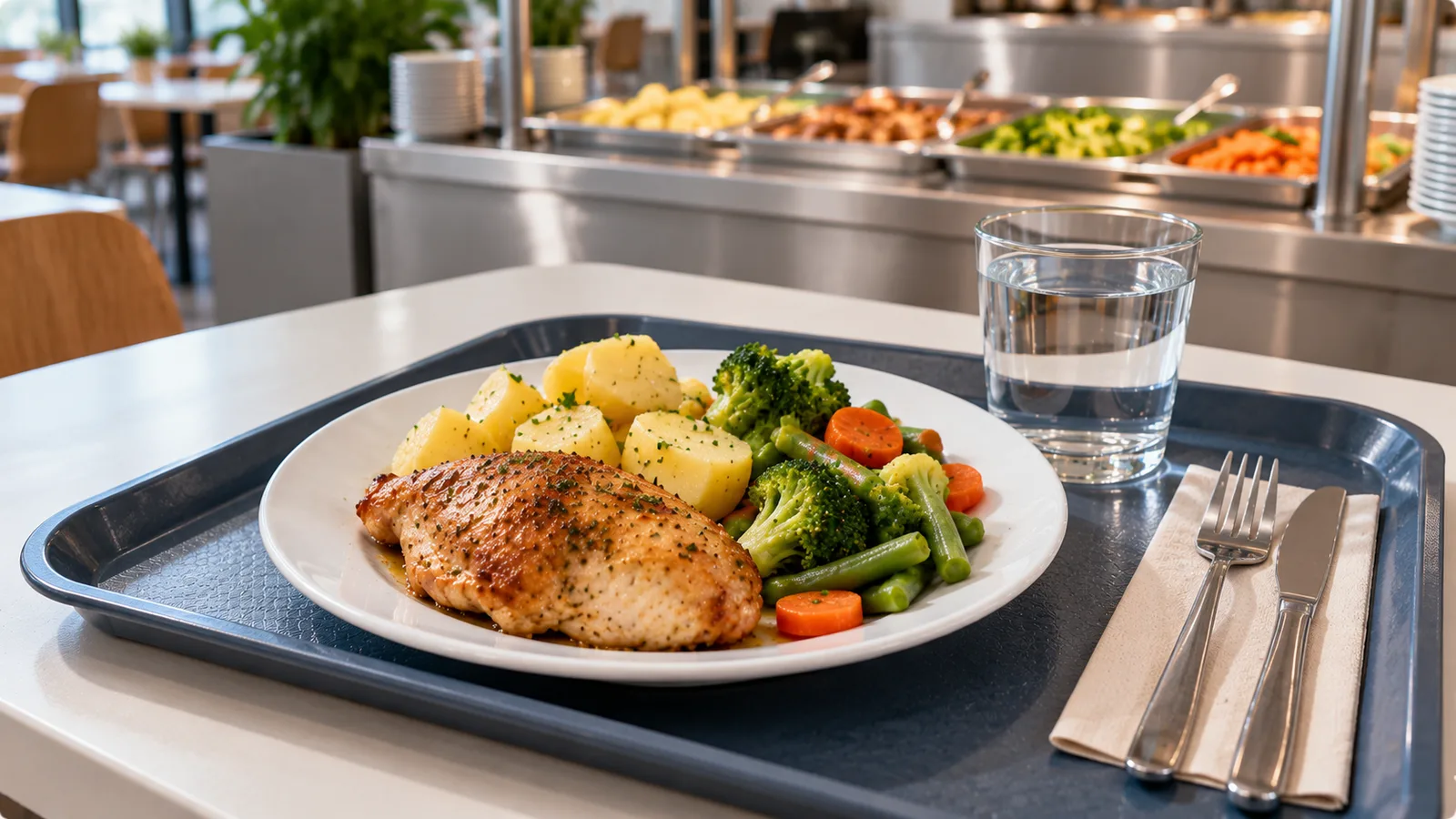
A workplace cafeteria can make weekday lunches convenient, but it also introduces uncertainty into meal planning.
You may not know the menu until the morning. Portions may vary. Some days offer several balanced choices; others offer mainly pizza, pasta or fried dishes.
The solution is not to prepare a second lunch at home or predict every cafeteria meal.
Plan the meals you control, leave room for the cafeteria lunch, and adjust the rest of the day using what you actually eat.
This approach can reduce unnecessary grocery purchases while keeping your meal plan useful even when the cafeteria menu changes.
Start with the meal you do not control
Traditional weekly meal planning often begins with seven breakfasts, seven lunches and seven dinners.
That approach creates unnecessary work if you eat lunch at work most weekdays.
Instead, identify which lunches are normally covered by the cafeteria.
For example:
| Day | Expected lunch | Home cooking required? |
|---|---|---|
| Monday | Workplace cafeteria | No |
| Tuesday | Workplace cafeteria | No |
| Wednesday | Workplace cafeteria | No |
| Thursday | Workplace cafeteria | No |
| Friday | Workplace cafeteria | No |
| Saturday | At home | Yes |
| Sunday | At home | Yes |
In this example, you only need ingredients for two home lunches, not seven.
That difference matters for grocery quantities, cooking time and food waste.
If you work remotely on some days, mark those days separately.
Build a weekly plan around fixed and flexible meals
Treat the cafeteria as a flexible lunch slot rather than a specific recipe.
Your weekly structure might be:
- Breakfast: planned at home.
- Lunch: cafeteria on working days.
- Dinner: planned at home.
- Snacks: optional, depending on hunger and daily needs.
- Weekend lunches: planned separately.
You do not need to assign an exact cafeteria dish before you know the menu.
A placeholder such as "cafeteria lunch" is sufficient for the initial plan.
The important part is leaving enough flexibility to respond to the actual meal.
A practical five-day example
Here is a sample plan for someone who eats lunch in the cafeteria Monday through Friday.
| Day | Breakfast | Lunch | Dinner |
|---|---|---|---|
| Monday | Skyr, oats and berries | Cafeteria | Chicken, potatoes and vegetables |
| Tuesday | Eggs and whole-grain toast | Cafeteria | Lentil and tomato soup |
| Wednesday | Yogurt, banana and nuts | Cafeteria | Salmon, rice and broccoli |
| Thursday | Overnight oats | Cafeteria | Bean and vegetable wraps |
| Friday | Eggs, bread and fruit | Cafeteria | Pasta with tomato sauce and turkey |
The meals are examples, not a personalized prescription.
Portion sizes and additional snacks should reflect individual energy needs, preferences and activity.
The purpose is to show how five uncertain lunches can coexist with a predictable home meal plan.
How to choose lunch when the menu changes
Instead of ranking every cafeteria dish as good or bad, evaluate the available choices using a few practical questions.
- Is there a meaningful source of protein?
- Does the meal include vegetables, fruit or another source of fibre?
- How large is the portion relative to your hunger?
- Are sauces, dressings or extras served separately?
- Does the meal fit your dietary restrictions and preferences?
You will not always find a dish that satisfies every preference.
A cafeteria lunch does not need to be nutritionally perfect for the entire day to be balanced.
For example, if lunch contains few vegetables, dinner can include a larger vegetable portion.
If lunch is low in protein, another meal can contain more protein-rich foods.
This is a planning adjustment, not a requirement to compensate for eating something considered unhealthy.
Use three cafeteria lunch categories
A simple classification can reduce decision-making.
Category A: A relatively complete meal
Examples include chicken with potatoes and vegetables, a bean-based bowl with grains, or fish with rice and salad.
These meals contain several food groups.
You can usually keep your planned dinner without major changes.
Category B: A meal missing a component
Examples include plain pasta with sauce, vegetable soup without a substantial protein source, or a large salad with very little accompanying food.
You may choose to add an appropriate side at lunch or include the missing component elsewhere in the day.
Category C: A larger or richer meal
Examples include a substantial burger meal, creamy pasta or a large serving of fried food.
There is no need to skip dinner automatically.
Instead, consider your appetite and whether a lighter, simpler dinner would be more comfortable.
These categories are practical descriptions, not clinical nutrition ratings.
How to estimate cafeteria calories without exact recipes
Cafeteria food often comes without detailed ingredient weights.
Even when calories are displayed, recipes and serving sizes may differ from what ends up on your plate.
Use the most reliable information available.
A reasonable priority is:
- Official nutrition information from the cafeteria.
- The cafeteria's published recipe or ingredient list.
- A comparable meal entry with an appropriate portion.
- A rough estimate based on the visible components.
Avoid presenting an estimate as an exact measurement.
For example, a plate containing chicken, rice, vegetables and sauce can be broken into four components.
Estimate the chicken, rice, vegetables and sauce separately when possible.
Cooking oil and creamy sauces can meaningfully change energy content, so ignoring them can distort the estimate.
If the uncertainty is large, record a reasonable range rather than inventing precision.
Do not let an uncertain lunch distort the entire day
Suppose your planned dinner contains a measured serving of rice, vegetables and chicken.
At lunch, you unexpectedly choose a pasta dish.
You do not necessarily need to remove all carbohydrates from dinner.
Instead, look at the day as a whole.
Consider hunger, meal size, protein, vegetables and your overall nutritional goals.
A single cafeteria choice rarely provides enough information to justify drastic changes.
The aim is to maintain a practical routine, not to force every day into an identical nutrient pattern.
Plan protein across the day
Cafeteria lunches vary in protein content.
Some provide substantial portions of meat, fish, eggs, tofu or legumes.
Others contain relatively little.
If protein is an important part of your nutrition plan, distribute dependable sources across the meals you control.
For example:
| Meal | Possible protein source |
|---|---|
| Breakfast | Skyr, eggs or soy yogurt with added protein |
| Cafeteria lunch | Fish, chicken, tofu, beans or lentils when available |
| Dinner | Legumes, poultry, fish, eggs or another suitable source |
| Snack, if needed | Yogurt, cottage cheese or another suitable food |
The appropriate daily protein amount depends on the individual.
Do not assume that every cafeteria meal contains the same protein quantity.
Plan vegetables without relying on the cafeteria
Some workplace cafeterias provide generous vegetable portions.
Others offer only small garnishes.
Rather than assuming that lunch will always supply enough vegetables, make your home meals flexible.
Useful options include frozen vegetables, salad ingredients, carrots, tomatoes and other produce that fits your preferences.
Frozen vegetables are especially convenient because they can be used in small quantities without requiring a new shopping trip.
If lunch already includes plenty of vegetables, your planned dinner can remain unchanged.
If lunch contains very few, you have easy options available at home.
Avoid buying groceries for lunches you will not cook
One of the biggest financial advantages of cafeteria-based planning is purchasing fewer ingredients for unused meals.
Suppose a home lunch normally requires:
- One protein ingredient.
- One grain or starchy food.
- Vegetables.
- A sauce or seasoning.
If you buy these components for five lunches but eat at the cafeteria all week, some ingredients may remain unused.
That can lead to extra spending or spoilage.
Instead, calculate your home lunch count before shopping.
For example:
Five workdays at the cafeteria + two weekend lunches = ingredients for two home lunches.
Add an emergency lunch only if you realistically need one.
Keep one backup lunch at home
Cafeteria availability can change.
The cafeteria may close unexpectedly, the menu may not suit your dietary needs, or you may work from home.
A backup meal can prevent unnecessary takeaway purchases.
Good options use shelf-stable or frozen ingredients.
Examples include:
- Lentils and canned tomatoes with rice.
- Frozen vegetables with eggs and bread.
- Pasta with beans and tomato sauce.
- A frozen homemade portion of soup.
The backup should not require a large collection of highly perishable ingredients.
It is more useful to maintain one dependable option than to buy five additional lunches "just in case."
How to handle remote-work days
Hybrid schedules can make cafeteria planning more complicated.
A simple method is to separate confirmed office days from uncertain days.
For confirmed office days, reserve the cafeteria lunch slot.
For confirmed home days, plan a home lunch.
For uncertain days, choose a meal that can be prepared from existing pantry or freezer ingredients.
Avoid buying fresh ingredients for both alternatives.
Once your schedule is confirmed, update the plan.
Cafeteria spending versus grocery spending
A cafeteria lunch is a food expense, even though it does not appear on your supermarket receipt.
Track it separately from groceries if you want a realistic view of your food budget.
For example:
| Expense | Weekly amount |
|---|---|
| Five cafeteria lunches at €6.50 | €32.50 |
| Groceries for breakfasts, dinners and weekend meals | €58.00 |
| Total food spending | €90.50 |
These are illustrative prices, not current market averages.
The calculation is:
5 × €6.50 + €58.00 = €90.50.
If you only track supermarket purchases, your food spending will appear lower than it really is.
For budgeting, consider both categories.
Compare cafeteria meals fairly with packed lunches
A cafeteria meal may cost more than the ingredients for a homemade lunch.
However, the comparison is not always straightforward.
A packed lunch can involve ingredients, preparation time, storage and sometimes food that goes unused.
The cafeteria may also be subsidized by your employer.
To compare the options, use actual prices rather than assumptions.
For example:
| Option | Illustrative direct cost |
|---|---|
| Cafeteria lunch | €6.50 |
| Homemade lunch ingredients | €3.80 |
| Difference | €2.70 |
The difference is €13.50 across five lunches.
This does not automatically mean that packing lunch is the better choice.
Convenience, available time, portion size and food waste also matter.
A weekly grocery list for cafeteria users
For the five-day example above, a shopping list can focus on breakfast and dinner ingredients.
Breakfast ingredients
- Skyr or yogurt.
- Eggs.
- Rolled oats.
- Whole-grain bread.
- Bananas and berries.
- A measured quantity of nuts.
Dinner ingredients
- Chicken or another suitable protein.
- Lentils and beans.
- Fish or a suitable alternative.
- Potatoes, rice and pasta.
- Fresh or frozen vegetables.
- Tomato sauce and seasonings.
Adjust quantities to the number of people and actual portions.
Check the refrigerator and pantry before buying more.
The important difference is that the list does not include five additional weekday lunches.
Make dinners flexible rather than reactive
It can be tempting to decide dinner entirely based on how healthy lunch felt.
That creates unnecessary complexity.
A more useful system is to prepare two or three adaptable dinner templates.
For example:
Protein + vegetables + starch: adjust portions and ingredients according to appetite.
Soup or stew: use legumes, vegetables and an optional protein source.
Wrap or bowl: combine available ingredients without needing a new recipe.
These templates allow small adjustments while preserving the grocery plan.
What if the cafeteria menu is published weekly?
If your workplace releases a menu in advance, use it to improve the plan.
Identify days when a suitable lunch is likely to be available.
Check for allergens or dietary restrictions.
You can also anticipate days when a packed lunch may be more convenient.
However, menus can change.
Do not build a rigid home meal plan that depends on every cafeteria dish being available exactly as advertised.
Treat the published menu as useful information rather than a guarantee.
What if the cafeteria has limited vegan options?
For vegan or vegetarian eaters, the cafeteria may not always provide a satisfying combination of protein, vegetables and energy.
Review menus in advance when possible.
Ask about ingredients and preparation where necessary.
Consider keeping a backup meal or suitable snack available.
Do not assume that a vegetable side dish is automatically a complete meal.
For strict vegan diets, dependable vitamin B12 intake also requires separate planning through appropriate supplementation or fortified foods.
Food allergies and intolerances
When a cafeteria meal contains ingredients you cannot safely consume, convenience should not override safety.
Check the cafeteria's allergen information and ask staff when details are unclear.
Do not rely solely on visual inspection.
Cross-contact may matter for some allergies.
If the cafeteria cannot provide reliable information or a suitable meal, use a planned alternative.
The same applies to medically necessary dietary restrictions.
What to do after an unexpectedly large lunch
Suppose lunch is more filling than expected.
You can keep dinner flexible.
Possible adjustments include eating later, choosing a smaller portion or saving part of a prepared dinner for another day.
There is no need to impose a rigid compensation rule.
Similarly, an unexpectedly small lunch may mean you need a more substantial dinner or snack.
Respond to actual hunger and your overall nutritional needs.
A ten-minute weekly planning routine
You do not need to rebuild the entire plan every evening.
Try this sequence:
- Mark office and remote-work days.
- Reserve cafeteria slots for expected office lunches.
- Plan breakfasts and dinners.
- Count home lunches and choose one backup.
- Check existing groceries.
- Create a shopping list for the missing ingredients.
- Review the cafeteria menu if available.
- Update only the meals that actually change.
This process keeps meal planning manageable.
It also prevents buying food for meals you are unlikely to prepare.
The main principle
A workplace cafeteria does not need to disrupt weekly meal planning.
Treat cafeteria lunches as flexible meals, plan the meals you control and record actual spending.
Use nutrition information when available, but avoid false precision when portions and recipes are uncertain.
A good plan should reduce effort, prevent unnecessary purchases and remain useful even when lunch changes at the last minute.