
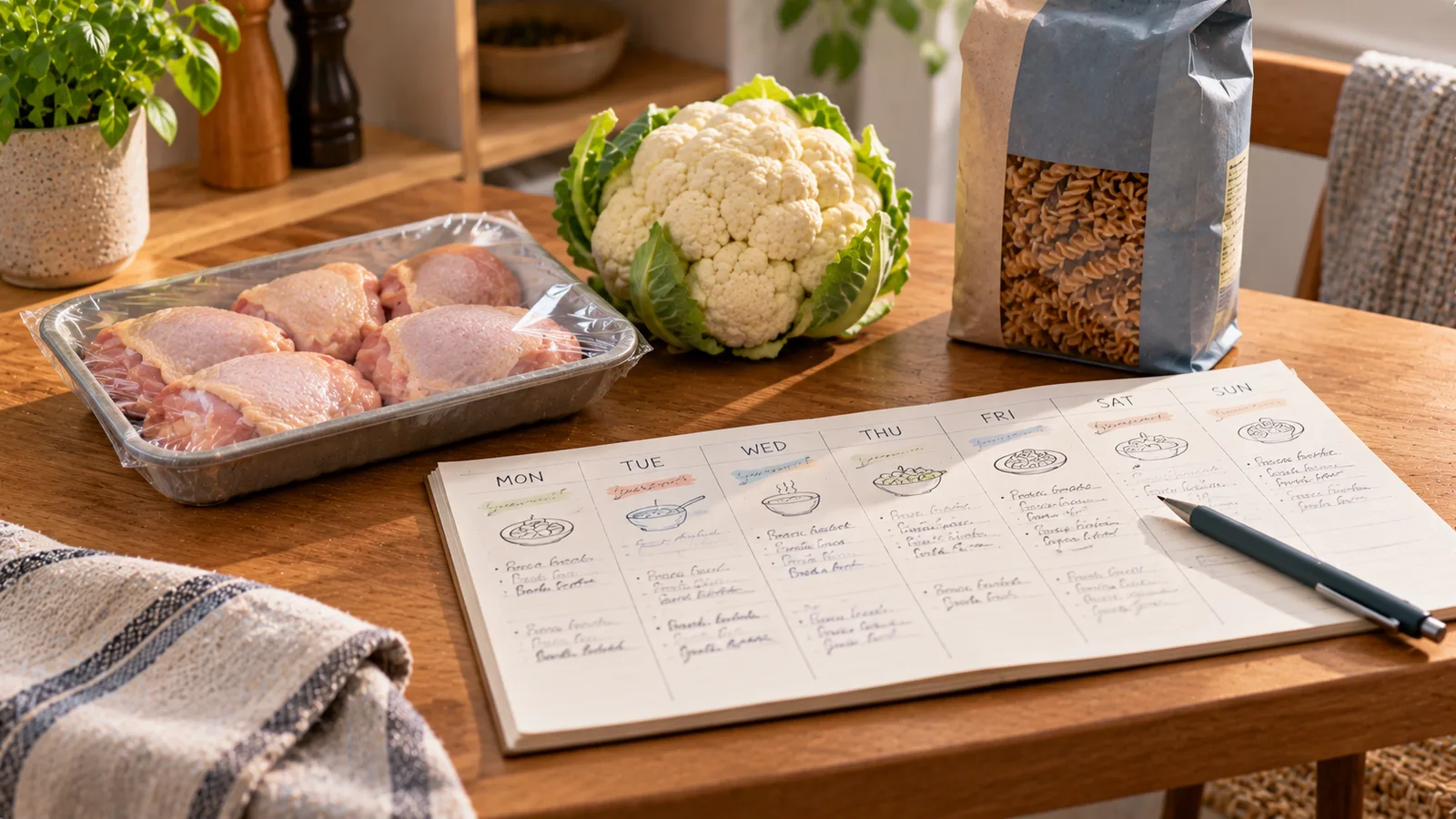
Grocery store sales can reduce the cost of a weekly food shop, but only when the discounted ingredients fit into meals you will actually eat.
Buying something simply because it is 30% cheaper does not necessarily save money. If part of it is wasted, requires several extra ingredients or replaces a cheaper food you would normally buy, the apparent saving can disappear.
A better approach is to let useful sales influence part of your meal plan without allowing the supermarket flyer to determine everything you eat.
This is sale-led meal planning: start with relevant discounts, match them to flexible meals, check what you already have and buy only quantities your household can realistically use.
Start with your normal week, not the sale flyer
Before looking at discounts, identify the basic shape of the coming week.
Ask:
- How many breakfasts will you eat at home?
- How many lunches need to be packed?
- How many dinners do you realistically need?
- Are there evenings when you will eat out?
- Which days have little time for cooking?
- Do you need leftovers for work or school?
- Is anything already in the fridge that should be used first?
This prevents a common problem: planning seven elaborate discounted dinners when you only need four.
A sale should modify a realistic week, not create an unrealistic one.
Step 1: Check what you already have
Look briefly through your:
- fridge;
- freezer;
- pantry;
- opened packages;
- vegetables and fruit that need using soon.
Write down the foods that should be used first.
For example:
- half a bag of spinach;
- two carrots;
- opened yogurt;
- cooked rice;
- frozen peas;
- half a pack of tortillas.
These foods are already paid for.
Using them is often more valuable than chasing another small discount.
Step 2: Review sales for useful anchor ingredients
Now check the current offers.
Do not treat every discount as an opportunity.
Look primarily for foods that can become the anchor ingredient of meals you already know how to make.
Useful anchors might include:
- chicken thighs;
- fish;
- tofu;
- eggs;
- beans or lentils;
- yogurt;
- pasta;
- rice;
- potatoes;
- seasonal vegetables;
- frozen vegetables.
Suppose this week's offers include:
- chicken thighs;
- broccoli;
- canned tomatoes;
- Greek-style yogurt;
- whole-grain wraps.
That is already enough information to influence several meals.
You do not need to build a plan around every discounted product in the store.
Step 3: Separate real opportunities from tempting discounts
For each sale item, ask four questions.
Would I normally buy something similar?
A discount on a familiar staple is usually easier to use than a discount on an unfamiliar specialty product.
Can I use the quantity?
A family-size package is not a saving if half of it spoils.
Does it require expensive extras?
A cheap main ingredient can become an expensive meal if you need five additional products solely for one recipe.
Can it work in more than one meal?
Flexible ingredients are particularly useful for sale-led planning.
For example, discounted chicken can potentially become:
- tray-baked chicken and vegetables;
- chicken wraps;
- a rice bowl;
- soup;
- leftovers for lunch.
That flexibility reduces the risk of waste.
Step 4: Build meals from sale ingredient + food you already own
The strongest combinations often connect a discounted item with something already in your kitchen.
Imagine you have:
- rice;
- frozen peas;
- tortillas;
- onions;
- oats.
The store has discounted:
- chicken thighs;
- broccoli;
- yogurt.
Possible meals include:
| Sale ingredient | Food already at home | Meal |
|---|---|---|
| Chicken thighs | Rice + peas | Chicken rice bowls |
| Broccoli | Rice + onions | Vegetable fried rice |
| Chicken | Tortillas + onions | Chicken wraps |
| Yogurt | Oats | Yogurt oat breakfast |
| Broccoli | Eggs already planned | Broccoli omelet |
This is usually more economical than selecting a sale item first and then buying an entirely new recipe around it.
Step 5: Use flexible meal formats
Sale-led meal planning works best when you plan some meals as formats rather than rigid recipes.
Examples include:
Grain bowls
Combine:
- rice, couscous, bulgur or another grain;
- a protein;
- vegetables;
- a sauce or seasoning.
If broccoli is discounted this week and courgettes next week, the structure still works.
Pasta meals
Use:
- pasta;
- tomato-based, vegetable or protein-rich sauce;
- available vegetables;
- optional cheese or another topping.
Wraps
Combine:
- wraps;
- protein;
- vegetables;
- sauce or yogurt-based dressing.
Soups and stews
These are useful for:
- discounted vegetables;
- beans;
- lentils;
- leftover cooked ingredients.
Tray meals
A simple combination of:
- protein;
- potatoes or another carbohydrate;
- one or two vegetables
can adapt easily to weekly offers.
The goal is not to eat identical meals every week. It is to use structures that tolerate ingredient changes.
Step 6: Plan the most perishable sale foods first
A discount is not useful if the food spoils before you reach it.
After selecting your meals, order them by perishability.
For example:
Monday: fresh fish + vegetables
Tuesday: chicken + broccoli
Wednesday: chicken wraps using leftovers
Thursday: lentil pasta
Friday: freezer meal
This sequence makes more sense than saving the most perishable food until Friday.
Use-first planning is particularly important for:
- fresh fish;
- delicate leafy vegetables;
- berries;
- ripe fruit;
- opened dairy products;
- fresh herbs.
Step 7: Decide whether a larger discounted package is actually useful
Sales often encourage larger purchases.
Calculate the useful amount rather than focusing only on the package price.
Suppose:
- normal chicken pack: 600 g for €5.40;
- sale pack: 1.2 kg for €8.40.
The sale pack has a lower price per kilogram.
But ask what happens to all 1.2 kg.
If you can:
- cook 600 g this week;
- freeze 600 g safely for later;
the larger pack may make sense.
If you only need 500–600 g and cannot store the remainder, the cheaper unit price may not produce a real saving.
Step 8: Compare unit prices when package sizes differ
A large discount label can be misleading when products come in different sizes.
Use the price per kilogram, liter or another comparable unit where appropriate.
Example:
Product A
500 g for €2.49
€2.49 ÷ 0.5 kg = €4.98/kg
Product B
750 g sale pack for €3.29
€3.29 ÷ 0.75 kg = €4.39/kg
Product B is cheaper per kilogram.
But it is only the better purchase if you can use the additional 250 g.
Unit price answers:
Which product is cheaper for the same quantity?
Meal planning answers:
Which quantity actually makes sense this week?
You need both questions.
Step 9: Give each discounted ingredient more than one possible job
You do not necessarily need to schedule every use in advance.
Instead, give flexible ingredients a primary and backup use.
Example:
Broccoli
Primary:
- chicken and broccoli rice bowls.
Backup:
- omelet;
- soup;
- pasta.
Yogurt
Primary:
- breakfast.
Backup:
- dressing for wraps;
- snack;
- sauce.
Chicken
Primary:
- tray dinner.
Backup:
- lunch wraps;
- rice bowl.
This makes the plan more resilient if your week changes.
Step 10: Do not force a sale into the plan
Imagine salmon is heavily discounted.
That does not automatically mean you should buy it.
Skip the offer if:
- nobody in the household wants it;
- you already have enough protein;
- it does not fit the week's schedule;
- the package is too large;
- you would need several additional ingredients;
- you cannot store it appropriately.
The cheapest unnecessary purchase is still an unnecessary purchase.
A worked example
Suppose one adult needs:
- 7 breakfasts;
- 5 lunches at home or work;
- 5 dinners at home;
- 2 dinners elsewhere.
Food already available
- oats;
- rice;
- pasta;
- canned beans;
- frozen peas;
- onions;
- eggs;
- spices.
This week's useful sales
- chicken thighs;
- broccoli;
- yogurt;
- apples;
- canned tomatoes.
Instead of creating five unrelated sale recipes, build a compact plan.
Breakfasts
4 days: oats + yogurt + apple
3 days: eggs + toast or another available carbohydrate
Lunches
2 days: leftover chicken rice bowls
2 days: bean and rice bowls
1 day: leftover pasta
Dinners
Monday: chicken, rice and broccoli
Tuesday: tomato-bean pasta
Wednesday: chicken wraps or bowls using remaining chicken
Thursday: vegetable omelet
Friday: rice and beans with remaining vegetables
This plan uses the discounts without requiring every meal to depend on them.
Build the grocery list only after the meal structure exists
Once the meals are selected, create the shopping list.
Start with what the plan actually requires.
For the example above, the list might include:
Sale items
- chicken thighs;
- broccoli;
- yogurt;
- apples;
- canned tomatoes.
Missing supporting ingredients
- wraps or bread;
- one additional vegetable;
- optional cheese;
- milk if needed.
This is different from walking through the supermarket collecting discounted products and deciding what to do with them later.
Keep a small pantry base
A flexible pantry makes sales easier to use.
Useful staples depend on your preferences, but may include:
- rice;
- pasta;
- oats;
- couscous;
- canned tomatoes;
- beans;
- lentils;
- frozen vegetables;
- herbs and spices;
- cooking oil.
Then a discounted fresh ingredient does not require an entirely new shopping basket.
For example:
discounted chicken + rice + frozen vegetables + spices
can already become a complete meal structure.
Sales do not need to determine every meal
Trying to optimize every meal around discounts can make meal planning unnecessarily complicated.
A practical approach is to let sales influence:
- one or two proteins;
- several vegetables or fruits;
- selected staples you genuinely need.
The rest of the plan can remain based on normal household foods.
This gives you flexibility without turning grocery shopping into a constant optimization exercise.
What about stocking up?
Some discounts are useful beyond the current week.
Shelf-stable or freezable foods may be worth buying in larger quantities when:
- the unit price is genuinely lower;
- you regularly use the food;
- you have storage space;
- buying more does not interfere with the current food budget;
- the product will realistically be used.
Potential examples include:
- canned beans;
- canned tomatoes;
- pasta;
- rice;
- oats;
- frozen vegetables.
But stocking up and weekly meal planning are different decisions.
A pantry purchase does not need to become part of this week's meals immediately.
Be careful with multi-buy offers
Offers such as:
- buy two, get one free;
- three for €5;
- second package 50% off
can reduce unit cost.
But only if you need the extra quantity.
Ask:
Would I buy this amount without the promotion?
If the answer is no, calculate whether the additional quantity has a realistic use.
For perishable food, storage time matters as much as price.
Use sales to substitute, not simply add
One of the easiest ways to benefit from discounts is substitution.
Suppose your original plan contains:
chicken + potatoes + green beans
but broccoli is discounted and green beans are not.
If the vegetables serve a similar role in the meal, substitute broccoli.
Or perhaps turkey mince is on sale while your plan called for beef mince.
If the recipe works with turkey and you enjoy it, the substitution can reduce cost without changing the whole week.
This is often more effective than adding extra sale products to an already complete grocery list.
Preserve nutritional balance
Price matters, but a low-cost plan still needs to function as a real eating plan.
Across the week, aim for a reasonable variety of:
- protein sources;
- vegetables;
- fruit;
- carbohydrate-rich foods;
- sources of dietary fat.
A supermarket promotion can influence which specific foods you choose within these groups.
For example:
- broccoli instead of cauliflower;
- lentils instead of another legume;
- discounted chicken instead of a different meat;
- seasonal apples instead of another fruit.
The sale changes the ingredient, not the basic structure of the diet.
Do not ignore food preferences
A heavily discounted ingredient has little value if your household does not enjoy eating it.
Repeatedly buying "healthy" or inexpensive sale foods that remain unused creates waste.
Your plan should reflect:
- foods people actually like;
- realistic cooking skills;
- available equipment;
- time;
- storage;
- portion needs.
Savings only count when the food is eaten.
When the sale changes after you planned
Sometimes an advertised product is unavailable.
Build a simple fallback rule.
For example:
Protein: discounted chicken → regular chicken if reasonably priced → beans or eggs as backup.
Vegetable: discounted broccoli → cauliflower → frozen mixed vegetables.
Fruit: discounted berries → apples → another seasonal fruit.
This avoids rebuilding the entire plan in the store.
A 10-minute sale-led planning routine
You do not need a complicated spreadsheet.
Minute 1–2
Check your calendar and count meals at home.
Minute 3–4
Check fridge, freezer and pantry.
Minute 5–6
Review relevant supermarket offers.
Minute 7–8
Choose several meals using sale ingredients plus foods already available.
Minute 9
Put perishable foods earlier in the week.
Minute 10
Create the final grocery list and quantities.
The goal is not a mathematically perfect grocery basket.
It is a realistic plan that makes useful discounts easier to capture.
A simple decision rule for every sale
Before adding a discounted product to your cart, ask:
- Will we eat it?
- Does it fit a planned meal?
- Can we use or store the quantity?
- Is the unit price actually better?
- Does buying it replace another purchase rather than simply add spending?
If most answers are yes, the sale may be useful.
If several answers are no, the discount probably should not control your meal plan.
The practical takeaway
Meal planning around grocery store sales works best when discounts are treated as inputs, not instructions.
Start with:
- the number of meals you actually need;
- food already at home;
- useful current discounts;
- flexible meal structures;
- realistic quantities;
- use-first ordering for perishable foods.
Then create the grocery list.
This keeps the main benefit of shopping sales — lower prices on foods you can genuinely use — while reducing the risk of buying discounted products that never become meals.
Sources
- USDA, guidance on meal planning, food storage and reducing household food waste.
- U.S. Food and Drug Administration, food storage and food safety guidance.
- Bundeszentrum für Ernährung (BZfE), consumer guidance on food planning, shopping and food waste.
- Verbraucherzentrale, consumer information on supermarket pricing, package sizes and special offers.
- European Commission, consumer information and EU food information rules.