
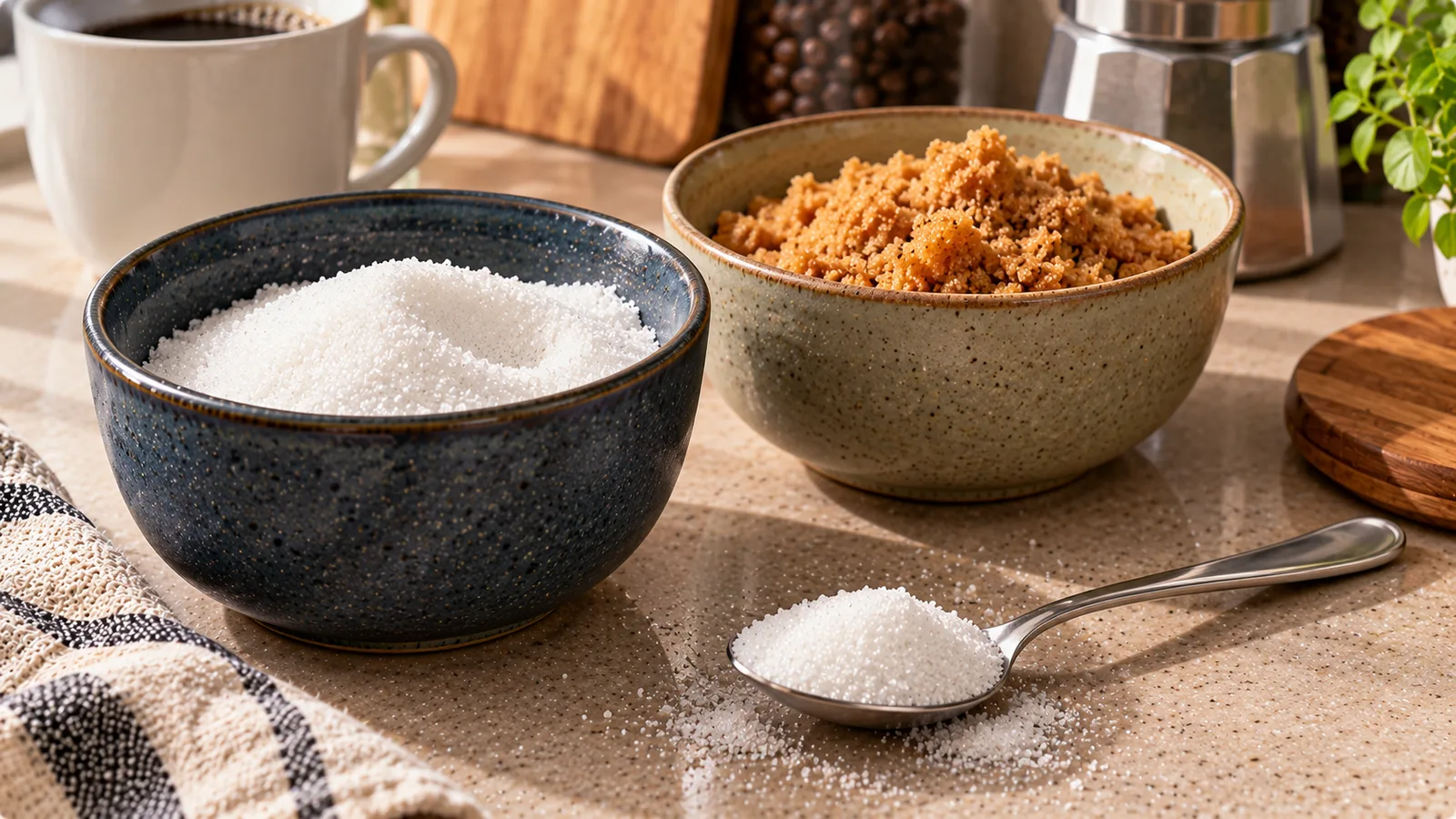
White granulated sugar provides approximately 387 calories per 100 grams, according to USDA food-composition data. Brown sugar has a similar energy value, although its molasses and moisture content can make the figures slightly different.
For everyday food tracking, the more useful question is often how many calories are in the amount you actually use: one teaspoon in coffee, a tablespoon in a recipe or a measured quantity added to a homemade dessert.
This guide covers white and brown sugar together because they serve the same basic calorie-and-portion search intent.
Sugar nutrition per 100 grams
These are rounded reference values, not guaranteed specifications for every brand.
| Nutrient | White granulated sugar | Brown sugar |
|---|---|---|
| Calories per 100 g | 387 kcal | Approximately 380 kcal |
| Carbohydrates | 100 g | Approximately 98 g |
| Total sugars | Approximately 100 g | Approximately 97 g |
| Protein | 0 g | Negligible |
| Fat | 0 g | Negligible |
| Fiber | 0 g | Negligible |
White sugar consists almost entirely of sucrose. Brown sugar contains sucrose together with varying amounts of molasses and moisture.
The small differences in composition do not make brown sugar a substantially lower-calorie alternative.
For precise tracking, use the nutrition information on the actual product.
How many calories are in a teaspoon of sugar?
A level measuring teaspoon of granulated white sugar is commonly estimated to weigh about 4 grams.
At 387 calories per 100 grams:
4 × 387 ÷ 100 = 15.48 kcal.
That means one level teaspoon contains approximately 15–16 calories.
A heaped teaspoon can contain more sugar. An ordinary household teaspoon is also not necessarily the same volume as a standardized measuring spoon.
| Amount of white sugar | Approximate weight | Calories |
|---|---|---|
| 1 level teaspoon | 4 g | 15 kcal |
| 2 level teaspoons | 8 g | 31 kcal |
| 3 level teaspoons | 12 g | 46 kcal |
| 1 level tablespoon | 12 g | 46 kcal |
| 20 g | 20 g | 77 kcal |
| 25 g | 25 g | 97 kcal |
| 50 g | 50 g | 194 kcal |
| 100 g | 100 g | 387 kcal |
The spoon conversions are approximate and apply to level measuring spoons filled with white granulated sugar.
A kitchen scale provides a more dependable measurement.
White sugar versus brown sugar
Brown sugar usually contains some molasses, giving it a different color, texture and flavor.
The amount of moisture varies between products.
That matters when measuring by volume.
A tablespoon of firmly packed brown sugar may weigh more than a loosely filled tablespoon of white granulated sugar.
Therefore, comparing one spoon of each does not necessarily mean comparing equal amounts.
If both portions weigh 10 grams, their calorie values will generally be very similar.
The main distinction is usually flavor and texture rather than a meaningful difference in energy density.
Calories in sugar by weight
For any sugar product, the basic calculation is:
Calories = weight in grams × calories per 100 g ÷ 100
Using 387 kcal per 100 g for white granulated sugar:
| Weight | Approximate calories |
|---|---|
| 5 g | 19 kcal |
| 6 g | 23 kcal |
| 10 g | 39 kcal |
| 15 g | 58 kcal |
| 20 g | 77 kcal |
| 30 g | 116 kcal |
| 40 g | 155 kcal |
| 60 g | 232 kcal |
For brown sugar or another sugar product, substitute the calorie value printed on its label.
This approach avoids relying on potentially inconsistent spoon measurements.
Example: sugar in coffee or tea
Suppose a cup of coffee contains two level teaspoons of white sugar.
Estimated sugar weight:
2 × 4 g = 8 g.
Estimated calories:
8 × 3.87 = approximately 31 kcal.
If you drink two such coffees, the sugar contributes approximately 62 calories in total.
Milk, cream or other additions contribute their own nutrients and calories.
For accurate tracking, include those ingredients separately or calculate the entire beverage.
The example illustrates calorie accounting, not a recommended daily sugar allowance.
Example: sugar in homemade cake
Imagine a cake recipe containing 120 grams of white sugar and producing 12 equal slices.
Calories contributed by the sugar:
120 × 3.87 = approximately 464 kcal.
Sugar calories per slice:
464 ÷ 12 = approximately 39 kcal.
This is not the total calorie content of a cake slice.
Flour, butter, eggs, milk and other ingredients must also be included.
If slices are unequal, use the actual weight of the finished cake and each portion rather than assuming identical servings.
The same principle applies to biscuits, sauces, pancakes and other homemade foods.
Sugar calories versus carbohydrates
Sugar is classified as carbohydrate.
White granulated sugar contains approximately 100 grams of carbohydrate per 100 grams.
A 10-gram portion therefore provides approximately 10 grams of carbohydrate.
Food labels may show energy values that do not correspond exactly to a simple calculation of four calories per gram.
Differences can result from rounding, energy-conversion conventions and the underlying food-composition data.
For consistency, use the energy and carbohydrate values from the same product label or database entry.
Do not combine unrelated figures from different sources as though they describe one exact product.
Total sugars and added sugars are not identical
Total sugars include sugars naturally present in foods and sugars added during manufacturing or preparation.
Milk contains naturally occurring lactose, while fruit contains naturally occurring sugars.
A sweetened yogurt can contain both naturally occurring and added sugars.
Plain table sugar is itself essentially all sugar.
In the European Union, the nutrition declaration generally includes carbohydrates and the amount 'of which sugars'.
In the United States, the Nutrition Facts label also identifies added sugars.
These labeling systems should not be treated as interchangeable.
For packaged foods, examine the nutrition declaration and ingredient list together.
Does brown sugar have fewer calories?
Brown sugar can contain slightly fewer calories per 100 grams because of its moisture content.
However, the difference is usually small.
Replacing white sugar with an equal weight of brown sugar does not normally produce a substantial reduction in calories.
A person might use less brown sugar because of its stronger flavor, but that is a change in the amount used, not proof that brown sugar is inherently a low-calorie ingredient.
How to log sugar accurately
When recording sugar in a food diary:
- Identify the specific sugar product.
- Check its nutrition label where available.
- Weigh the quantity in grams if possible.
- Calculate calories using the corresponding value per 100 grams.
- Include sugar added to drinks, sauces and homemade recipes.
- Avoid counting sugar twice if it is already included in a logged prepared food.
For homemade recipes, calculate nutrition from all ingredients and the final recipe yield.
A teaspoon estimate is useful when a scale is unavailable, but it should remain an estimate.
Sources and data limitations
- USDA FoodData Central — reference food-composition data for granulated and brown sugar.
- USDA FoodData Central documentation — information about the database and its data types.
- European Commission: Food information to consumers — EU food-labeling framework.
- US FDA: Added Sugars on the Nutrition Facts Label — explanation of total and added sugars.
The figures in this article are rounded reference estimates. Sugar composition, measuring-spoon weights and label rounding can vary. Product-specific nutrition labels and weighed portions should take priority when greater precision is needed.