
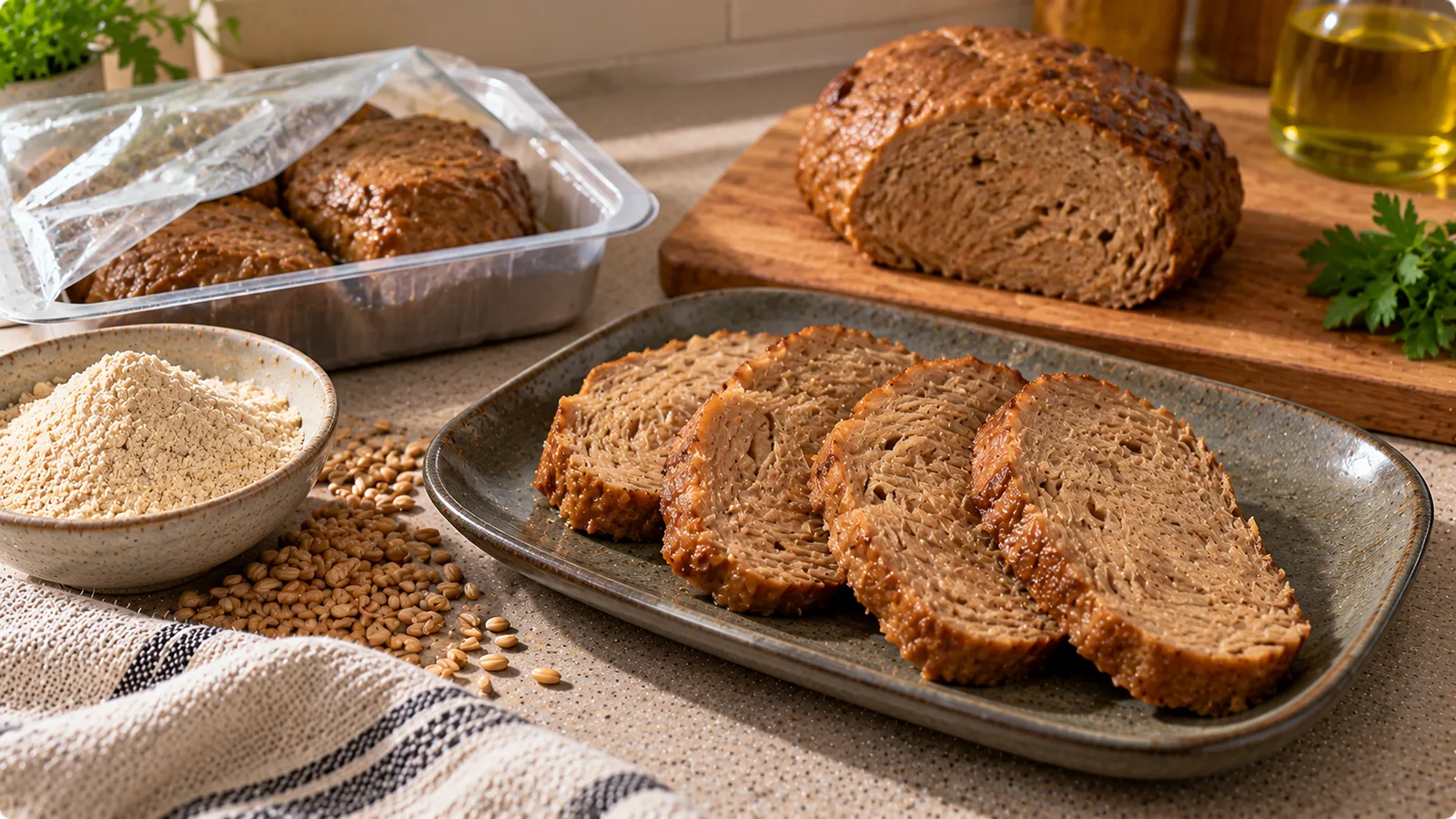
Seitan is a wheat-based protein food commonly used as a meat alternative. Its main ingredient is vital wheat gluten, the protein-rich component of wheat flour.
Because seitan contains a large amount of protein relative to its weight, it can be a useful ingredient in vegetarian and vegan meals. However, its calories and macronutrients vary considerably depending on how it is prepared.
A plain, water-rich seitan product is not nutritionally identical to dry vital wheat gluten, a marinated supermarket product or breaded fried seitan.
The most useful starting point is the nutritional information for the exact product you eat.
How many calories are in seitan?
For orientation, plain cooked seitan commonly provides approximately 110–170 calories per 100 g.
This is an illustrative range, not a universal nutritional specification. Commercial products can fall outside it, especially when they contain added oil, starch, sauces or breading.
| Food | Approximate calories |
|---|---|
| Plain cooked seitan, 50 g | 55–85 kcal |
| Plain cooked seitan, 100 g | 110–170 kcal |
| Plain cooked seitan, 150 g | 165–255 kcal |
| Plain cooked seitan, 200 g | 220–340 kcal |
These estimates assume the same plain cooked product across all serving sizes.
For packaged seitan, use the label rather than applying the range automatically.
Seitan nutrition per 100 g
The following table gives a broad illustration of the nutritional composition of plain, hydrated seitan.
| Nutrient | Approximate amount per 100 g |
|---|---|
| Calories | 110–170 kcal |
| Protein | 20–30 g |
| Carbohydrates | 2–10 g |
| Fat | 0.5–5 g |
| Fiber | Varies by recipe |
| Sodium | Highly variable |
The ranges are not a single matched food-database entry. They describe possible differences among preparations, and the upper or lower ends should not be combined to calculate an exact calorie total.
Plain seitan is generally protein-rich, but the actual nutritional profile depends on the ratio of gluten to water and on any added ingredients.
Some packaged products contain relatively large amounts of salt. Check sodium or salt separately when that matters to your diet.
Why does seitan's calorie content vary?
Three factors explain much of the variation.
1. Water content
Dry vital wheat gluten is much more concentrated than cooked seitan.
During preparation, gluten dough absorbs water and is usually simmered, steamed or baked.
Water increases the food's weight without adding calories.
Consequently, 100 g of cooked seitan can contain substantially fewer calories than 100 g of dry gluten flour.
2. Added ingredients
Homemade seitan may include:
- Chickpea flour.
- Nutritional yeast.
- Soy sauce.
- Vegetable stock.
- Oil.
- Starch.
- Spices and seasonings.
These ingredients change the total calories, protein, carbohydrates and fat.
3. Cooking method
Steaming or simmering generally adds little energy unless the cooking liquid contributes meaningful calories.
Frying in oil, adding a glaze or coating seitan in breadcrumbs can substantially increase its calorie density.
Homemade seitan versus store-bought seitan
Neither homemade nor commercial seitan has one fixed nutritional value.
| Factor | Homemade | Packaged |
|---|---|---|
| Ingredients | Controlled by the cook | Defined by manufacturer |
| Water content | Depends on recipe and cooking | Depends on product |
| Oil and sauces | Optional | May already be included |
| Nutrition information | Must be calculated | Usually available on label |
| Portion tracking | Weigh ingredients and finished yield | Use label and portion weight |
For homemade seitan, the most reliable calculation starts with the complete recipe.
For packaged seitan, check the nutrition declaration and whether it refers to 100 g, one serving or the drained product.
How to calculate calories in homemade seitan
Suppose a recipe uses:
| Ingredient | Quantity | Illustrative calories |
|---|---|---|
| Vital wheat gluten | 200 g | 740 kcal |
| Chickpea flour | 30 g | 115 kcal |
| Olive oil | 10 g | 90 kcal |
| Seasonings and broth | Variable | 15 kcal |
| Total | 960 kcal |
These values are illustrative. Use the labels of your actual ingredients for an accurate calculation.
Imagine that the cooked recipe weighs 650 g.
Calories per 100 g:
960 ÷ 650 × 100 = approximately 148 kcal.
A 150 g portion would contain:
148 × 1.5 = approximately 222 kcal.
The finished weight matters because recipes absorb and lose different amounts of water.
If the same ingredients produce only 550 g of cooked seitan, calories per 100 g will be higher even though the total recipe calories remain the same.
How much protein is in seitan?
Protein is the nutrient for which seitan is particularly well known.
A plain cooked serving of 100 g may provide approximately 20–30 g of protein, although the exact amount varies.
| Portion | Approximate protein |
|---|---|
| 50 g | 10–15 g |
| 100 g | 20–30 g |
| 150 g | 30–45 g |
| 200 g | 40–60 g |
Seitan can help increase protein intake without adding a large amount of fat.
However, wheat gluten has a different amino acid profile from animal proteins and soy. In particular, it is relatively low in lysine.
Combining seitan with legumes, soy foods or other protein sources over the course of the day can improve overall amino acid variety.
There is no need to assume that every individual meal must contain perfectly matched proteins.
Is seitan low in carbohydrates?
Plain seitan often contains fewer carbohydrates than foods such as bread, pasta or cooked rice, but it is not necessarily carbohydrate-free.
Carbohydrate content depends on whether the recipe includes flour, starch or sweetened sauces.
For example:
- Plain seitan may contain only a small amount of carbohydrates.
- Seitan made with chickpea flour may contain more.
- Breaded seitan can contain substantially more.
- Sweet barbecue-style marinades can add sugar.
Check the complete product rather than assuming all seitan is suitable for a particular low-carbohydrate target.
Seitan versus tofu and tempeh
These foods can all serve as plant-based protein sources, but they are not nutritionally identical.
| Food | Main ingredient | Typical characteristic |
|---|---|---|
| Seitan | Wheat gluten | Often high in protein and relatively low in fat |
| Firm tofu | Soybeans | Protein-rich; fat and calcium vary |
| Tempeh | Fermented soybeans | Provides protein, fat and fiber |
Their calories per 100 g vary by brand, moisture content and preparation.
A comparison using one supermarket product from each category may be more useful than relying on generalized figures.
Seitan is not a substitute for tofu when a gluten-free diet is required.
How many calories are in fried seitan?
Fried seitan contains the calories of the seitan itself plus any absorbed oil, batter, breadcrumbs and sauce.
Consider a hypothetical meal containing:
- 150 g plain seitan at 140 kcal per 100 g: 210 kcal.
- 10 g oil retained in the dish: 90 kcal.
- 20 g breadcrumbs: approximately 70 kcal.
Total before sauces and side dishes: approximately 370 kcal.
The actual amount of absorbed oil can be difficult to measure.
For home cooking, record the oil used and estimate how much remains in the finished dish.
For restaurant meals, calorie estimates may be substantially less precise.
Is seitan suitable for weight management?
Seitan can fit into many eating patterns, including diets designed for weight maintenance or weight loss.
Its relatively high protein content may help build protein-rich meals.
However, whether a meal supports your goals depends on:
- Total energy intake.
- Portion size.
- Cooking method.
- Added oil and sauces.
- Vegetables, grains and other accompaniments.
- Overall dietary quality.
A 150 g serving of plain seitan with vegetables is different from the same quantity deep-fried and served with a rich sauce.
No single ingredient determines whether a diet leads to weight loss.
Does seitan contain gluten?
Yes. Seitan is made primarily from wheat gluten.
It is unsuitable for people with celiac disease, wheat allergy or other conditions requiring avoidance of wheat gluten.
Cooking does not make seitan gluten-free.
People with celiac disease should avoid seitan even if it is labeled vegan, organic or high-protein.
For further information, consult the Celiac Disease Foundation.
How to log seitan accurately in a nutrition app
To avoid significant tracking errors:
- Identify whether the food is dry vital wheat gluten or cooked seitan.
- Check the nutrition label for packaged products.
- Weigh the portion you actually eat.
- Record added oils, sauces and breading separately if not included in the database entry.
- For homemade seitan, calculate the full recipe and weigh its finished yield.
- Use consistent raw or cooked measurements.
A frequent mistake is entering the nutritional values of dry gluten flour for a much heavier portion of hydrated seitan.
That can greatly overestimate calories and protein.
Another mistake is treating a seasoned ready-to-eat seitan product as identical to plain homemade seitan.
Practical serving examples
| Meal | Seitan quantity | What else affects calories |
|---|---|---|
| Seitan and vegetable stir-fry | 120–150 g | Oil, rice, sauce |
| Seitan sandwich | 80–120 g | Bread, spreads, cheese |
| Seitan salad | 100–150 g | Dressing, nuts, grains |
| Seitan curry | 120–180 g | Coconut milk, oil, rice |
| Grilled seitan with potatoes | 150–200 g | Potatoes, cooking fat |
The amounts are examples rather than recommended serving sizes for every individual.
Choose portions according to your appetite, energy needs and the composition of the entire meal.
Sources and data interpretation
- USDA FoodData Central — food composition data and ingredient lookup.
- USDA Dietary Guidelines resources — context for balanced dietary patterns.
- Celiac Disease Foundation — What Is Gluten? — information about gluten and gluten-containing foods.
- European Commission — Food Information to Consumers — nutrition labeling framework.
The calorie and macronutrient ranges in this article are approximate orientation values, not a standardized laboratory analysis of one seitan product.
The most accurate approach is to use the label of your specific seitan product or calculate a homemade recipe from its ingredients and final cooked weight.