
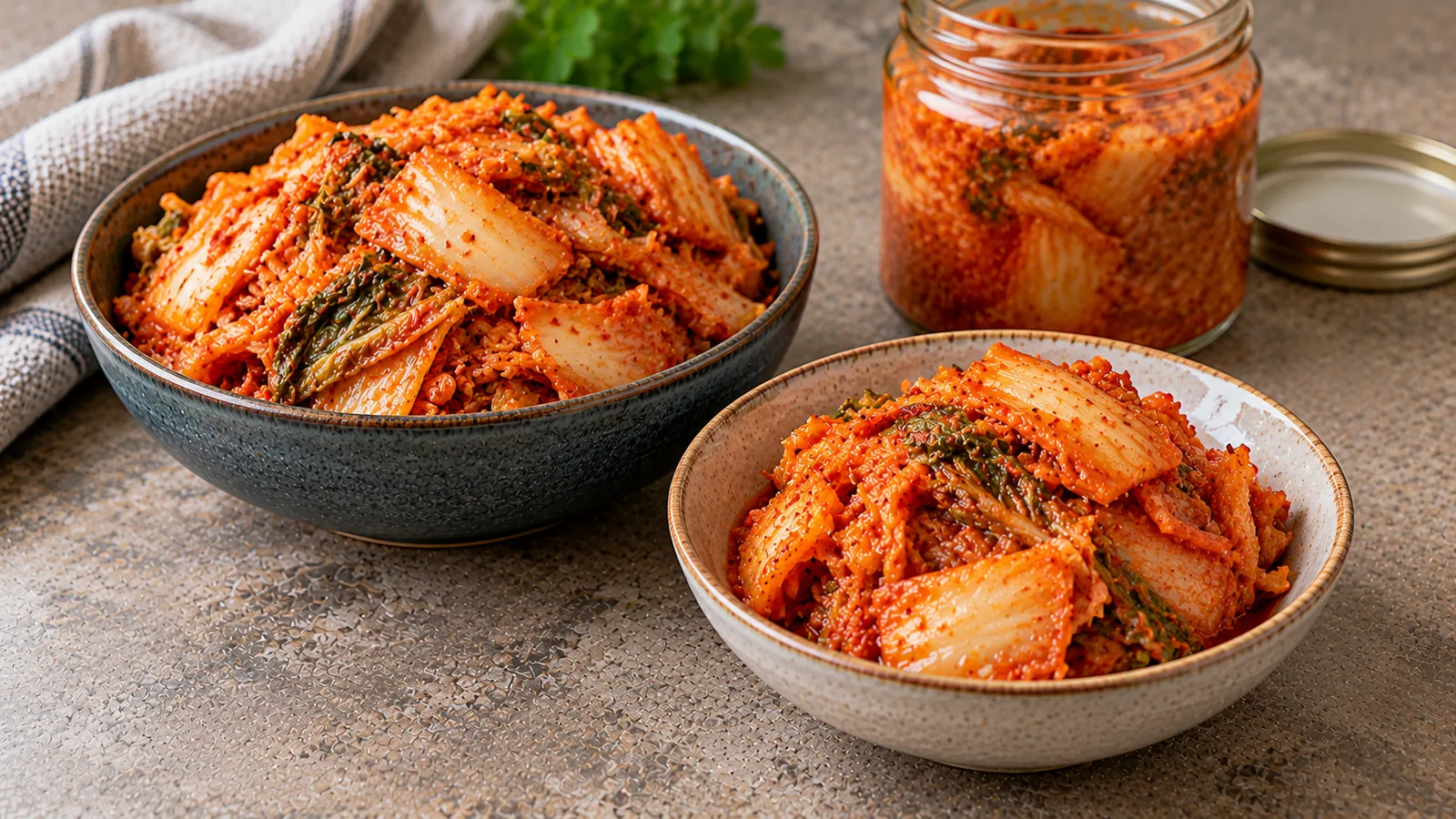
How many calories does kimchi contain?
Plain fermented cabbage kimchi is relatively low in energy but can supply a substantial amount of sodium. The identified USDA SR Legacy entry Cabbage, kimchi (FDC 170392) lists 15 kcal and 498 mg sodium per 100 g. This is a reference composition, not a promise about every supermarket jar, restaurant side dish or homemade batch. Kimchi may contain radish, other vegetables, different amounts of salt, fish sauce, sugar or added oil. Begin with the exact product and the weight you actually eat. The figures below apply to the specific reference food, without a separately added sauce or cooking oil.
Per 100 g: calories, macros and sodium
The same USDA entry reports 1.1 g protein, 2.4 g carbohydrate by difference, 0.5 g fat and 1.6 g dietary fibre per 100 g. Sugars are around 1.1 g; they are already part of the carbohydrate figure, not an extra quantity to add. In US data, carbohydrate by difference may include fibre; on European packaging, fibre is generally declared separately. The calorie figure is an independently reported database value, so do not rebuild it mechanically from rounded macronutrients and assume any small discrepancy is an error.
| Nutrient in reference cabbage kimchi | Per 100 g |
|---|---|
| Energy | 15 kcal |
| Protein | 1.1 g |
| Carbohydrate by difference | 2.4 g |
| Fat | 0.5 g |
| Dietary fibre | 1.6 g |
| Sodium | 498 mg |
| Salt equivalent, calculated | about 1.25 g |
How much is a side serving?
A small side dish could weigh 50 g, a more generous accompaniment 75 g, or a shared-sized bowl 150 g. These are examples, not universal official serving sizes. Weigh the kimchi after serving it, rather than guessing based on the bowl or treating one cup as a fixed weight. Portions with more liquid will differ from drained cabbage pieces. All table values below are calculated from the same 15 kcal and 498 mg sodium per 100 g reference; sodium and calories are rounded only for display.
| Weighed kimchi | Approximate calories | Approximate sodium |
|---|---|---|
| 30 g | 5 kcal | 149 mg |
| 50 g | 8 kcal | 249 mg |
| 75 g | 11 kcal | 374 mg |
| 100 g | 15 kcal | 498 mg |
| 150 g | 23 kcal | 747 mg |
For example, eating 50 g gives 15 × 0.5 = 7.5 kcal, shown as 8 kcal, and 498 × 0.5 = 249 mg sodium. A 150 g side gives 22.5 kcal, shown as 23 kcal, and 747 mg sodium. The weights and the food form must match; a restaurant may use a different recipe.
Sodium and salt are not the same label number
European nutrition labels typically display salt, whereas American labels report sodium. The European Commission explains that, for label conversion, salt equivalent is sodium multiplied by 2.5 after converting to the same unit. Thus 498 mg sodium = 0.498 g sodium × 2.5 ≈ 1.25 g salt equivalent per 100 g. At 50 g the equivalent is approximately 0.62 g salt; at 75 g it is approximately 0.93 g; at 150 g it is about 1.87 g. These are calculations from the USDA reference, not measurements of a particular brand. Do not add 498 mg sodium to 1.25 g salt: these describe related aspects of the same food, not two separate additions.
Kimchi recipes vary more than the reference suggests
Traditional napa-cabbage kimchi, radish kimchi and restaurant versions need not have identical nutritional profiles. Additional oil or a sweeter sauce can change calories. The amount of salt used in seasoning and fermentation can change sodium substantially. A small dish weighed with a lot of brine is not nutritionally identical to the same weight of mostly drained cabbage. Fermentation does not automatically remove sodium, and sourness cannot tell you an exact sodium amount. A labelled packaged product is the better source for that brand. For homemade kimchi, record the ingredients and the final usable yield, while recognising that its actual sodium distribution may be difficult to calculate precisely.
How to read a jar or packet correctly
Find whether the declaration says per 100 g or per serving. Check the listed serving mass before comparing two products. Multiply the value for 100 g by the fraction actually eaten; for 60 g use 0.6. If a European label shows 2.0 g salt per 100 g, a 60 g portion supplies about 1.2 g salt, corresponding to approximately 480 mg sodium. That example describes a hypothetical product label, not USDA kimchi. Check whether the product includes fish sauce, salted shrimp or other seasonings; kimchi is not automatically vegan, and fish, shellfish, soy or wheat ingredients can matter to people with allergies. The actual ingredients list controls.
To interpret your own packaging, see how low-sodium label claims work · reading the nutrition label · plain cabbage calorie profile.
Is kimchi different from sauerkraut?
Both are fermented vegetables, but the typical seasoning profiles and products differ. Kimchi commonly includes garlic, ginger and chilli, while plain sauerkraut has a different usual ingredient list. Neither shares a universal calorie or sodium value with the other. Do not copy a sauerkraut nutrition panel into a kimchi diary entry, or assume every jar named kimchi matches the USDA example. The upcoming separate sauerkraut food profile answers that product's own calorie question; this page remains the owner for kimchi servings and sodium.
Tracking kimchi with a complete meal
Record the weight of kimchi separately from rice, tofu, eggs, noodles or added oil. A bowl containing 75 g of the reference kimchi contributes about 11 kcal and 374 mg sodium before you count the rest of dinner. A sauce poured over the bowl or oil used to fry kimchi needs its own entry. If you heat kimchi, water can evaporate, changing calories per 100 g of the finished mixture without creating energy. The useful record is either the actual packaged composition and amount used or the sum of weighed ingredients with an observed cooked yield. Avoid assigning the same vegetables and sauce twice.
Fermentation, storage and nutrition claims
Kimchi is fermented, but a nutrition panel alone cannot prove that a particular jar contains live cultures. Processing, storage and recipe choices affect that question. Likewise, this calorie guide does not promise digestive or immune benefits. Follow the storage instructions and use a clean utensil when serving. For personalised sodium restrictions, follow appropriate professional advice rather than treating a low calorie count as a signal that unlimited amounts are suitable. A food can be low in calories and still worth checking for sodium.
A reliable three-step portion check
First, identify whether you have plain cabbage kimchi, a mixed-vegetable version or a prepared dish such as kimchi fried rice. Second, weigh the part you eat in grams, including only the brine or dressing actually consumed. Third, prefer your product's nutrition label; otherwise use the clearly labelled USDA reference 15 kcal and 498 mg sodium per 100 g, with the caveats above. For a quick side-portion estimate, 50 g ≈ 8 kcal / 249 mg sodium; 75 g ≈ 11 kcal / 374 mg; 150 g ≈ 23 kcal / 747 mg. These calculations are more reproducible than a picture-based guess.
Sources
- USDA FoodData Central — search for cabbage kimchi, FDC 170392. Reference nutrient amounts per 100 g; identify the specific SR Legacy food rather than an unrelated branded entry.
- European Commission Knowledge4Policy — dietary salt and sodium. Conversion between sodium and salt equivalent in nutrition labelling.