
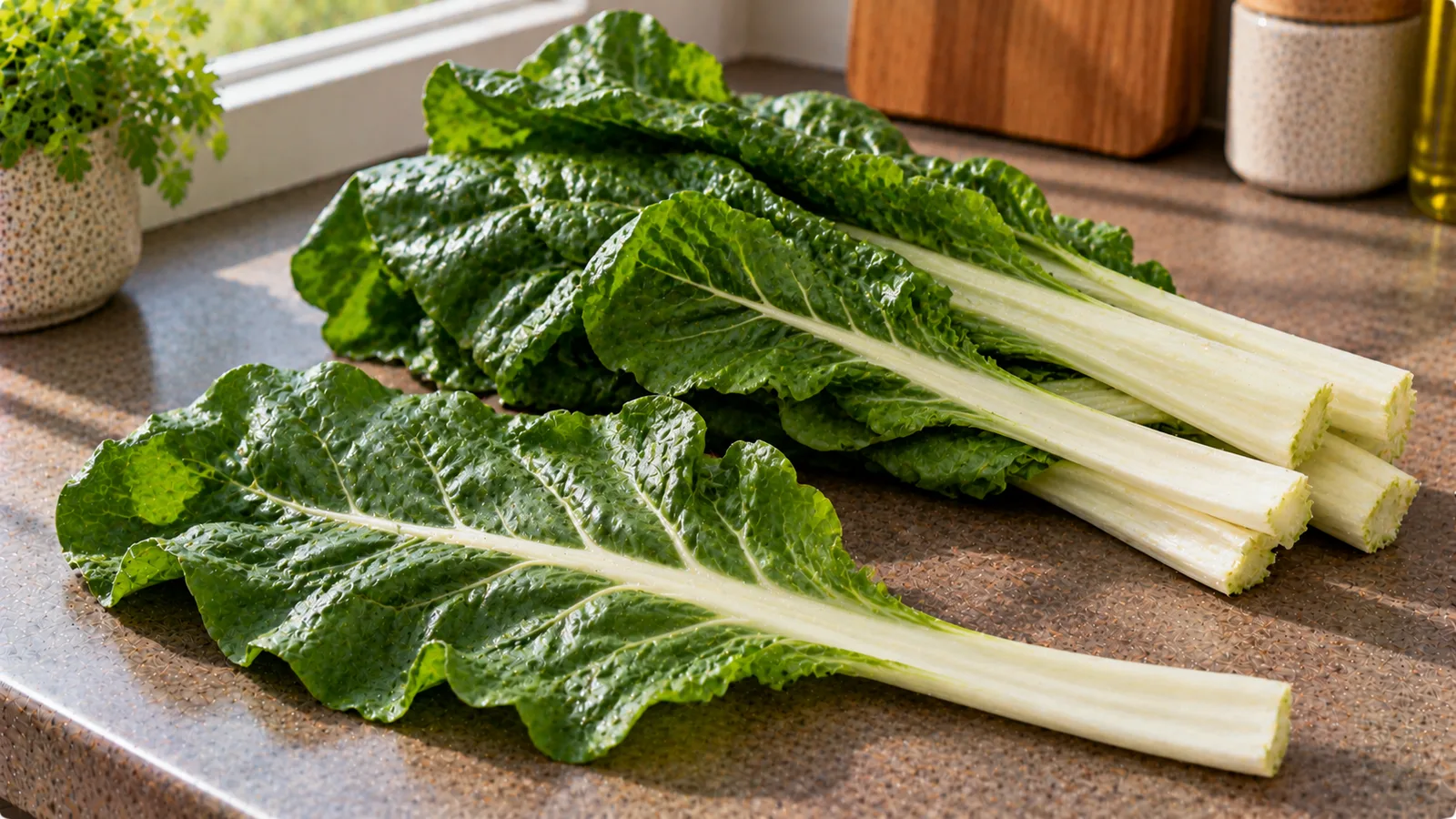
Swiss chard is a leafy vegetable with broad green leaves and edible stalks. It is commonly steamed, sautéed, added to soups or used in vegetable dishes.
Raw Swiss chard contains approximately 19 kcal per 100 g, according to commonly used USDA food composition data.
That makes it a relatively low-calorie vegetable when eaten without substantial amounts of oil, butter, cheese or sauce.
The calorie content of a finished chard dish, however, depends on both the quantity of chard and the other ingredients used.
Swiss chard calories by weight
The following estimates use 19 kcal per 100 g of raw Swiss chard.
| Raw Swiss chard | Approximate calories |
|---|---|
| 50 g | 10 kcal |
| 75 g | 14 kcal |
| 100 g | 19 kcal |
| 150 g | 29 kcal |
| 200 g | 38 kcal |
| 250 g | 48 kcal |
| 300 g | 57 kcal |
| 400 g | 76 kcal |
| 500 g | 95 kcal |
Values are rounded.
The calculation is:
Calories = raw edible weight in grams × 19 ÷ 100
For example, 350 g of raw Swiss chard provides approximately 67 kcal.
These estimates apply to the raw edible vegetable, not a recipe containing additional ingredients.
Source: USDA FoodData Central.
Nutrition facts per 100 g
A commonly used USDA reference for raw Swiss chard reports approximately the following values.
| Nutrient | Per 100 g raw |
|---|---|
| Energy | 19 kcal |
| Protein | 1.80 g |
| Fat | 0.20 g |
| Total carbohydrate, US definition | 3.74 g |
| Dietary fiber | 1.6 g |
| Total sugars | 1.10 g |
| Water | 92.7 g |
| Potassium | 379 mg |
| Magnesium | 81 mg |
| Vitamin C | 30 mg |
| Vitamin K | 830 µg |
| Vitamin A | 306 µg RAE |
These are approximate reference values, not measurements of every individual bunch.
Growing conditions, plant maturity, storage and cooking can influence nutritional composition.
Understanding the carbohydrate figure
US food composition data generally include fiber within total carbohydrate.
European nutrition labels normally present available carbohydrate and fiber separately.
A simplified calculation using the values above gives:
3.74 g total carbohydrate − 1.6 g fiber = approximately 2.14 g available carbohydrate per 100 g.
This is an illustration rather than a guaranteed conversion between analytical methods.
When comparing food databases, check how carbohydrate is defined.
References: USDA FoodData Central and Regulation (EU) No 1169/2011.
How many calories are in one cup of chard?
Volume measurements are less precise than weight measurements.
A cup of loosely packed chopped raw leaves weighs much less than a cup of cooked chard.
A commonly used reference weight for one cup of chopped raw Swiss chard is approximately 36 g.
At 19 kcal per 100 g, this corresponds to about 7 kcal.
| Chopped raw chard | Approximate weight | Calories |
|---|---|---|
| Half cup | 18 g | 3 kcal |
| One cup | 36 g | 7 kcal |
| Two cups | 72 g | 14 kcal |
| Three cups | 108 g | 21 kcal |
These figures are estimates. Cutting style, stems and packing density can change the weight.
For more accurate tracking, weigh the edible portion in grams.
Calories in a bunch of Swiss chard
A bunch is not a standardized weight.
The amount sold as one bunch varies between shops, growing seasons and countries.
Some bunches contain large leaves and thick stalks, while others are smaller.
Instead of assigning one calorie value to every bunch, calculate the edible weight.
| Edible raw chard | Approximate calories |
|---|---|
| 200 g | 38 kcal |
| 300 g | 57 kcal |
| 400 g | 76 kcal |
| 600 g | 114 kcal |
| 800 g | 152 kcal |
These are illustrative weights, not official bunch-size categories.
Remove only the parts you will not eat, then weigh the remaining leaves and stalks.
Raw versus cooked chard
Cooking changes the water content and physical volume of chard.
The leaves collapse dramatically when heated, so a large bowl of raw leaves may become a much smaller cooked portion.
That does not mean the vegetable suddenly gains calories.
For example, suppose 300 g of raw chard contains approximately 57 kcal.
If cooking without added fat reduces the finished weight to 180 g and energy-containing losses are small, the total remains close to 57 kcal.
The concentration becomes:
57 ÷ 180 × 100 = approximately 32 kcal per 100 g cooked.
This is a simplified example, not a universal nutritional value for cooked chard.
The actual result depends on the cooking method, water retention and any nutrients lost into cooking liquid.
Boiled Swiss chard
Boiling chard in water does not add calories.
However, some soluble compounds can move from the vegetable into the cooking water.
The final cooked weight may also differ substantially from the raw weight.
A commonly used USDA entry for boiled, drained Swiss chard reports approximately 20 kcal per 100 g, although values depend on the database entry and preparation.
| Boiled, drained chard | Approximate calories |
|---|---|
| 100 g | 20 kcal |
| 150 g | 30 kcal |
| 200 g | 40 kcal |
| 250 g | 50 kcal |
Use a matching cooked-food entry when weighing the cooked vegetable.
If you weigh raw ingredients before cooking, use the raw-food values instead.
Do not apply cooked values to raw weights without adjustment.
Steamed chard
Steaming generally does not require added fat.
Plain steamed chard therefore remains relatively low in calories.
The final calories depend on the original amount of vegetable and any changes during cooking.
For example, 250 g of raw chard provides approximately 48 kcal.
If steamed without oil or butter, the total energy will usually remain in a similar range, allowing for cooking losses.
The value per 100 g may change because the final weight changes.
For food tracking, use a consistent raw-ingredient or cooked-portion method.
Sautéed chard: why oil matters
Swiss chard is often sautéed with olive oil and garlic.
The oil can contribute more calories than the vegetable.
Using approximately 884 kcal per 100 g of olive oil:
300 g chard without oil
- Chard: approximately 57 kcal.
300 g chard with 10 g olive oil
- Chard: 57 kcal.
- Olive oil: approximately 88 kcal.
- Total: 145 kcal.
300 g chard with 20 g olive oil
- Chard: 57 kcal.
- Olive oil: approximately 177 kcal.
- Total: 234 kcal.
These calculations assume all the oil is consumed.
If some oil remains in the pan, the amount eaten may be lower.
For homemade meals, measuring oil is more reliable than estimating it from the appearance of the finished dish.
Example: Swiss chard with garlic and olive oil
Consider a simple recipe.
| Ingredient | Quantity | Approximate calories |
|---|---|---|
| Raw Swiss chard | 500 g | 95 kcal |
| Olive oil | 15 g | 133 kcal |
| Garlic | 10 g | 15 kcal |
| Lemon juice | 20 g | 4 kcal |
| Total | 247 kcal |
The values for the additional ingredients are rounded estimates.
If the recipe makes two equal servings:
247 ÷ 2 = approximately 124 kcal per serving.
If it makes three equal servings:
247 ÷ 3 = approximately 82 kcal per serving.
The final cooked weight may be much lower than the combined raw weight because of water loss.
That change in weight does not automatically change the total recipe calories.
Swiss chard in soups
Chard is commonly added to vegetable soups, bean soups and broths.
Its contribution to total energy is usually modest.
For example, 200 g of raw chard adds approximately 38 kcal to a soup before considering any cooking losses.
However, the complete soup may also contain potatoes, lentils, beans, meat, pasta, cream or oil.
There is no single calorie value for every chard soup.
To calculate a homemade soup:
- Weigh the calorie-containing ingredients.
- Determine the calories for each ingredient.
- Add the values for the complete recipe.
- Divide by the number of servings or the portion consumed.
Water adds volume but no calories.
For more accurate calculations per 100 g, weigh the finished soup after cooking.
Chard in pies, gratins and pasta
Chard is also used in dishes containing cheese, pastry, eggs, cream or pasta.
In these meals, the vegetable may contribute only a small fraction of total calories.
For example, a chard pie can contain a substantial amount of energy from pastry and cheese.
A creamy chard gratin may contain more calories from cream and butter than from the chard itself.
A pasta dish with chard must include the pasta, sauce and any oil in its calorie calculation.
Recording such dishes as plain chard would significantly underestimate the energy consumed.
Use the complete recipe or a product-specific nutrition label.
Leaves versus stems
Both the leaves and stalks of Swiss chard are edible.
The leaves cook quickly, while thick stems often need more time to soften.
The two parts differ in water content, texture and composition.
However, standard food databases frequently report values for the edible vegetable as a whole.
There is no reliable universal calorie value for every variety of chard stem or leaf.
If you separate the leaves and stalks, weigh what you actually eat.
For everyday tracking, a suitable whole-chard reference is usually a practical approximation unless more specific data are available.
Rainbow chard versus green chard
Rainbow chard is a name used for chard varieties with differently colored stalks.
It is not a single standardized nutritional formulation.
Different pigments and varieties can produce small compositional differences.
Nevertheless, there is no reason to assume that a colorful stalk automatically makes the vegetable substantially higher in calories.
For routine tracking, a Swiss chard reference is a reasonable starting point when variety-specific data are unavailable.
Cooking oil and other additions will often have a much larger effect on the finished meal's calories.
Protein, fiber and micronutrients
Swiss chard contains some protein and fiber, but it is not a concentrated protein source.
A 250 g raw portion provides approximately:
- Energy: 48 kcal.
- Protein: 4.5 g.
- Fat: 0.5 g.
- US total carbohydrate: 9.35 g.
- Fiber: 4.0 g.
Swiss chard is also notable for vitamin K and contains vitamin A-related carotenoids, vitamin C, magnesium and potassium.
Nutrient amounts may change with cooking.
Eating chard alongside beans, lentils, tofu, fish, eggs or another protein source can help create a more substantial meal.
The nutritional value of a meal depends on the complete combination of foods.
Vitamin K and blood-thinning medication
Swiss chard is particularly rich in vitamin K.
Vitamin K participates in normal blood clotting and other physiological processes.
People taking warfarin or other vitamin K-antagonist anticoagulants should discuss substantial dietary changes with their healthcare professional.
The general recommendation is usually to keep vitamin K intake reasonably consistent rather than abruptly eliminating vitamin K-rich vegetables.
This consideration does not apply identically to all anticoagulant medications.
See the NIH vitamin K fact sheet for background.
Oxalates in Swiss chard
Swiss chard contains oxalates.
Oxalate content varies with plant variety, growing conditions and preparation.
For people with certain types of kidney stones, dietary oxalate may be relevant.
However, that does not mean everyone needs to avoid chard.
Appropriate advice depends on stone type, medical history and overall dietary pattern.
People who have been advised to restrict oxalate should follow individualized clinical guidance.
The National Kidney Foundation provides educational information about kidney stone prevention.
Is Swiss chard useful for weight management?
Plain Swiss chard has a low energy density because it contains a high proportion of water and relatively little fat.
It can add volume, texture and micronutrients to meals without contributing many calories by itself.
However, chard does not directly cause weight loss.
Body-weight changes depend on overall energy balance, eating patterns, activity and individual factors.
A large portion of plain steamed chard may be low in calories, while chard cooked with substantial oil, cheese or cream can be much more energy-dense.
For calorie tracking, the full recipe matters more than the vegetable's name.
How to track chard calories accurately
The most consistent method depends on when the food is weighed.
For raw chard: Weigh the edible raw portion and use a raw Swiss chard entry.
For plain cooked chard: Weigh the cooked portion and use a suitable cooked chard entry.
For homemade recipes: Weigh all raw ingredients, including oil and sauces, add their calories and divide the total by the amount consumed.
For packaged dishes: Use the manufacturer's nutrition declaration when available.
Avoid mixing raw weights with cooked-food values.
Also avoid assuming that a cup of cooked chard weighs the same as a cup of raw leaves.
Quick answers
How many calories are in 100 g of Swiss chard?
Approximately 19 kcal when raw.
How many calories are in 200 g?
Approximately 38 kcal for raw Swiss chard.
How many calories are in one cup?
One reference cup of chopped raw chard weighing approximately 36 g contains about 7 kcal.
Does cooked chard have more calories?
Cooking without added fat does not create energy. Changes in water content and nutrient losses can affect the value per 100 g.
Does olive oil change the calories significantly?
Yes. Ten grams of olive oil adds approximately 88 kcal to a dish.
Is Swiss chard the same as spinach?
No. They are different leafy vegetables and have different reference nutrient values.
Sources
- USDA FoodData Central — raw and cooked Swiss chard composition and recipe ingredient values.
- NIH Office of Dietary Supplements: Vitamin K — vitamin K and anticoagulant considerations.
- National Kidney Foundation — kidney stone and oxalate information.
- Regulation (EU) No 1169/2011 — nutrition labeling definitions.
All calorie values are approximate and depend on the actual edible weight, preparation method and added ingredients.