
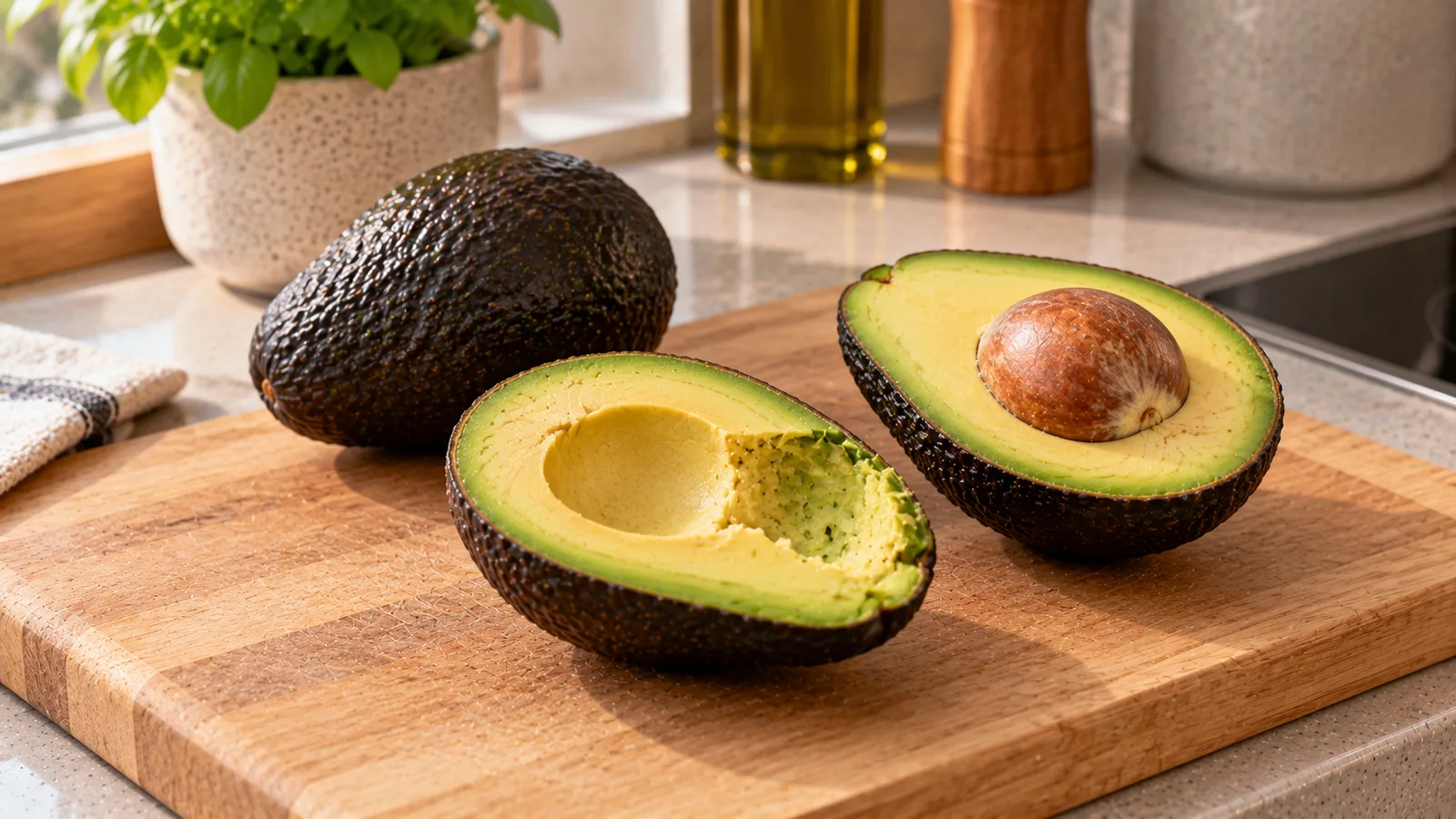
Avocado is more calorie-dense than many fruits because a substantial part of its energy comes from fat.
A useful reference for raw avocado is approximately 160 kcal per 100 g of edible flesh.
That makes portion size particularly important. A few slices, half an avocado and a whole large avocado can represent very different amounts of food.
Avocado calories at a glance
Using approximately 160 kcal per 100 g:
| Edible avocado | Approx. calories |
|---|---|
| 25 g | 40 kcal |
| 30 g | 48 kcal |
| 50 g | 80 kcal |
| 75 g | 120 kcal |
| 100 g | 160 kcal |
| 125 g | 200 kcal |
| 150 g | 240 kcal |
| 200 g | 320 kcal |
These are practical estimates. Avocados naturally vary, and nutrition databases can differ slightly.
How many calories are in half an avocado?
There is no fixed answer because avocados vary greatly in size and the skin and stone are not eaten.
If the edible half weighs:
- 50 g: about 80 kcal
- 70 g: about 112 kcal
- 80 g: about 128 kcal
- 100 g: about 160 kcal
So simply logging “half an avocado” can be less accurate than using grams.
For occasional tracking, a standard serving estimate may be sufficient. If avocado is something you eat frequently, weighing the edible portion a few times can show how large your usual serving actually is.
How many calories are in a whole avocado?
Again, the edible weight matters more than the number of fruits.
For example:
| Edible flesh | Approx. calories |
|---|---|
| 100 g | 160 kcal |
| 125 g | 200 kcal |
| 150 g | 240 kcal |
| 175 g | 280 kcal |
| 200 g | 320 kcal |
A whole avocado can therefore vary considerably in calories.
Do not use the total weight of the fruit as edible weight without accounting for the skin and stone.
How to calculate avocado calories from weight
If your nutrition entry lists 160 kcal per 100 g:
Calories = edible weight in grams × 160 ÷ 100
For 65 g:
65 × 160 ÷ 100 = 104 kcal
For 92 g:
92 × 160 ÷ 100 = 147.2 kcal
So a 92 g portion contains approximately 147 kcal using this reference.
Nutrition in avocado per 100 g
A typical reference for 100 g of raw avocado is approximately:
| Nutrient | Approx. amount |
|---|---|
| Energy | 160 kcal |
| Protein | 2.0 g |
| Carbohydrate | 8.5 g |
| Fiber | 6.7 g |
| Fat | 14.7 g |
The carbohydrate figure includes fiber, and exact database conventions and values can vary.
Avocado also provides micronutrients including potassium, folate, vitamin K and vitamin E.
For everyday tracking, however, the largest difference compared with many fruits is its relatively high fat content and therefore higher calorie density.
Why is avocado higher in calories than many fruits?
Most common fruits derive much of their energy from carbohydrate and contain very little fat.
Avocado is different.
A substantial share of its energy comes from fat, and fat provides more energy per gram than carbohydrate or protein.
That is why 100 g of avocado contains considerably more calories than 100 g of foods such as apple, berries or melon.
This does not make avocado an unhealthy food. It simply means that portion size has a larger effect on total calories.
What type of fat is in avocado?
Much of the fat in avocado is unsaturated, including monounsaturated fat.
The nutritional quality of a food is not determined by calorie content alone.
At the same time, unsaturated fat still provides energy. If you track calories, it should still be included in the total rather than treated as “free” because it comes from a nutrient-rich food.
Is 30 g of avocado a serving?
Some labels or databases use approximately 30 g as a reference serving.
At 160 kcal per 100 g:
30 × 160 ÷ 100 = 48 kcal
That can be a useful reference for a few slices or a small topping.
But it does not mean everyone should eat exactly 30 g.
A serving listed on a label is a reference quantity, not a universal personal requirement.
What does 50 g of avocado provide?
A 50 g portion is approximately:
- 80 kcal
- 1 g protein
- 4.3 g carbohydrate
- 3.4 g fiber
- 7.4 g fat
These are approximate values derived from a 100 g reference.
Fifty grams can work as a topping for toast, a bowl or a salad, but visual volume depends on how the avocado is sliced or mashed.
Slices are not a precise measurement
“Three slices of avocado” can mean very different amounts.
One person may cut thin slices from a small avocado. Another may cut thick slices from a much larger fruit.
If accuracy matters, weigh the edible portion rather than relying on slice count.
The same issue applies to tablespoons of mashed avocado.
How to weigh avocado accurately
The simplest method is to weigh only the flesh you plan to eat.
If that is inconvenient:
- weigh the whole avocado;
- eat or prepare it;
- weigh the skin and stone;
- subtract the discarded weight.
Example:
Whole avocado = 238 g
Skin and stone = 83 g
Edible amount:
238 − 83 = 155 g
Calories:
155 × 160 ÷ 100 = 248 kcal
This gives a much better estimate than entering 238 g as edible avocado.
Avocado size does not tell you the exact edible weight
Terms such as small, medium and large are convenient but imprecise.
Two avocados with similar external dimensions can differ in:
- stone size;
- skin weight;
- variety;
- water content;
- edible flesh.
For that reason, weight-based tracking is especially useful for avocado.
Mashed avocado vs sliced avocado
Mashing does not create calories.
If 70 g of avocado is sliced and another 70 g is mashed, both portions contain approximately the same amount of energy.
The problem is that mashed avocado is easier to measure inaccurately by volume.
A tablespoon can be level, rounded or packed.
If you need a consistent estimate, grams are more reliable.
Avocado toast calories
The total calories in avocado toast depend on more than the avocado.
For example:
- bread;
- avocado;
- oil or butter;
- eggs;
- cheese;
- seeds;
- sauces
all contribute to the total.
Suppose you use:
- 60 g avocado = about 96 kcal;
- one slice of bread = use the package value;
- one egg = use the value for the egg actually used.
The meal total is the sum of all components.
Do not log the entire meal as avocado alone.
Avocado in salads and bowls
Avocado can be easy to underestimate when it is mixed into a larger dish.
If possible, measure the amount before adding it.
For example:
A bowl contains 75 g avocado.
75 × 160 ÷ 100 = 120 kcal
Then track the remaining ingredients separately.
This is particularly useful when the bowl also contains other energy-dense ingredients such as oil, cheese, nuts or seeds.
Guacamole is not always equivalent to plain avocado
Guacamole usually contains avocado, but it may also contain:
- tomato;
- onion;
- lime;
- herbs;
- chili;
- salt;
- other ingredients depending on the recipe.
The calorie density may therefore differ from plain avocado.
For packaged guacamole, use the product label.
For homemade guacamole, calculate the recipe from the ingredients and final quantity.
If the recipe is almost entirely avocado, the value may be similar, but it should not automatically be assumed to be identical.
Does cooking avocado change the calories?
Heating avocado does not create energy, but changes in water content can alter the calories per 100 g.
Added ingredients matter more.
If avocado is cooked with oil, cheese, breading or another ingredient, those calories should be included separately.
For tracking foods whose weight changes during cooking, see Raw vs Cooked Food Weight: How to Track Calories Correctly.
Avocado oil is much more calorie-dense
Avocado and avocado oil are not interchangeable for calorie tracking.
Whole avocado contains a large amount of water, fiber and other components.
Avocado oil is almost entirely fat.
Therefore, avocado oil contains far more calories per 100 g than whole avocado.
If you cook with avocado oil, track the oil separately rather than treating it as a portion of avocado.
Is avocado good for weight loss?
No individual food causes weight loss on its own.
Avocado can fit into a weight-loss diet, just as it can fit into a weight-maintenance diet.
The relevant factors include:
- total energy intake;
- portion size;
- the rest of the meal;
- overall eating pattern.
Because avocado is relatively energy-dense, an unmeasured large portion can add more calories than expected.
That does not mean avocado needs to be avoided. It means portion awareness can be useful when calorie intake matters.
Example: the same meal with different avocado portions
Imagine a meal where everything except the avocado stays identical.
| Avocado portion | Approx. avocado calories |
|---|---|
| 30 g | 48 kcal |
| 50 g | 80 kcal |
| 75 g | 120 kcal |
| 100 g | 160 kcal |
| 150 g | 240 kcal |
Moving from 30 g to 150 g changes the meal by approximately 192 kcal.
Neither portion is automatically correct or incorrect. The example simply shows why the amount matters.
Common avocado tracking mistakes
Logging the whole fruit weight
Skin and stone are not normally eaten.
Use edible flesh weight when possible.
Assuming half an avocado is always the same
Half of a small avocado and half of a large avocado can be very different portions.
Estimating thick slices as a tiny serving
Avocado is calorie-dense enough that large visual estimation errors can noticeably change the calorie estimate.
Forgetting oil
Avocado may already contribute significant fat, but oil added to toast, salad or cooking is a separate ingredient.
Tracking guacamole as plain avocado
Use the actual recipe or package information when other ingredients are present.
Confusing avocado with avocado oil
They have very different calorie densities.
Do you need to weigh avocado every time?
Not necessarily.
If you regularly buy similar avocados and use similar portions, weighing them a few times can help you learn what your typical portion looks like.
For example, you may discover that the amount you normally add to toast is usually around 55–65 g.
You can then use that knowledge for faster estimates when weighing is inconvenient.
For greater precision, continue using grams.
Portion estimation when you cannot weigh it
If a scale is unavailable, you can estimate based on:
- fraction of the fruit;
- approximate number of slices;
- visual volume;
- a previously learned typical portion.
But these methods have more uncertainty than weighing.
A photo-based food tracker can also estimate the portion, although visual estimation should still be treated as an estimate rather than an exact measurement.
How to log avocado in Mealisa
A practical workflow is:
- identify the food as raw avocado;
- use edible weight when known;
- otherwise estimate the fraction or portion;
- distinguish plain avocado from guacamole;
- track oils, bread, eggs, cheese and other additions separately;
- use product-specific information for packaged avocado products.
This keeps the avocado entry focused on the food you actually consumed.
Quick reference
Using approximately 160 kcal per 100 g of raw edible avocado:
- 25 g ≈ 40 kcal
- 30 g ≈ 48 kcal
- 50 g ≈ 80 kcal
- 75 g ≈ 120 kcal
- 100 g ≈ 160 kcal
- 150 g ≈ 240 kcal
- 200 g ≈ 320 kcal
For the most consistent estimate, track the edible flesh in grams rather than relying only on “half” or “one avocado.”
Nutrition data sources and product differences
The records below describe only the named foods, fat levels and preparation states. USDA figures are per 100 g; manufacturer figures retain their stated unit. These sources do not independently prove every approximate figure in the article.
The 160 kcal per 100 g example refers to an average across commercial varieties. A specific Hass avocado can differ substantially.
USDA FoodData Central (search by FDC ID):
- FDC 171706 — Avocados, raw, California (167 kcal/100 g)
- FDC 171707 — Avocados, raw, Florida (120 kcal/100 g)
- FDC 2710824 — Avocado, Hass, peeled, raw (206.05 kcal/100 g)
- FDC 171705 — Avocados, raw, all commercial varieties (160 kcal/100 g)