
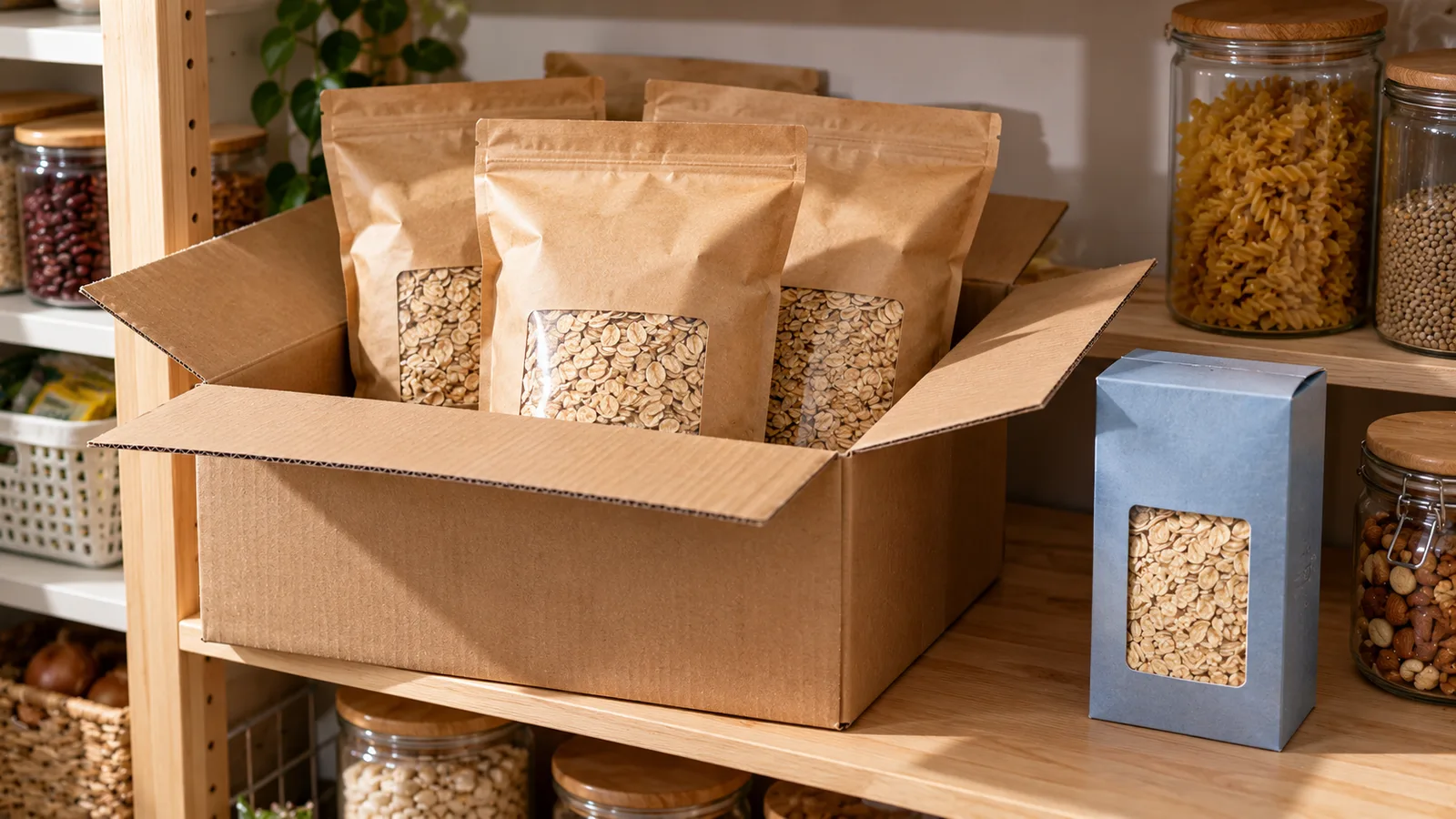
A bulk food subscription can look like an easy way to reduce grocery spending. Members may receive lower prices on larger packages of rice, oats, beans, coffee, nuts or other regularly purchased foods.
But a discounted unit price does not automatically mean a lower total bill.
Membership fees, delivery charges, minimum orders, storage limitations and unused food can erase the savings. Sometimes the cheapest option is simply buying a standard package from a nearby supermarket.
The important question is not whether a subscription offers discounts. It is whether your household saves enough on food it would actually buy and consume to cover every extra cost.
This guide shows how to calculate that break-even point, compare realistic scenarios and identify the types of households most likely to benefit.
The break-even formula
Start with the price difference for products you already purchase.
The basic calculation is:
Net savings = avoided regular-store cost − subscription food cost − membership fee − extra delivery costs − value of unusable food.
A subscription breaks even when net savings reach zero.
It becomes financially beneficial when net savings are positive.
If the subscription provides an average saving of 10% on comparable purchases, you need enough eligible spending to offset its fixed costs.
For a simple subscription with no extra delivery or waste costs:
Break-even eligible spending = membership fee ÷ discount rate.
For example:
- Annual membership fee: €60.
- Average saving on comparable products: 10%.
- Required annual eligible spending: €60 ÷ 0.10 = €600.
In this simplified scenario, you need to replace at least €600 of ordinary purchases with genuinely equivalent discounted products over the year.
That does not mean you need to spend €600 in addition to your normal grocery budget.
Example: three household scenarios
Assume a subscription costs €60 per year and saves 10% compared with the cheapest realistic alternative for products the household already buys.
| Annual comparable spending | Gross saving at 10% | Membership fee | Net result |
|---|---|---|---|
| €300 | €30 | €60 | −€30 |
| €600 | €60 | €60 | €0 |
| €1,200 | €120 | €60 | +€60 |
These figures assume that the household uses all purchased food and pays no additional delivery charges.
In reality, those conditions may not hold.
A more realistic formula
For a proper comparison, include all relevant costs.
Let:
- R = cost of the same usable food at your normal retailer.
- S = subscription product cost.
- F = membership fee allocated to the period.
- D = additional delivery or handling costs.
- W = value of food bought through the subscription but not consumed.
- O = other additional costs directly caused by the subscription.
Then:
Net savings = R − S − F − D − W − O.
The comparison must use the same time period and equivalent products.
If you compare one month's subscription purchases against an annual membership fee, allocate the fee consistently.
For example, a €60 annual membership costs €5 per month when spread evenly across twelve months.
Why unit price matters more than package price
A large package can cost more at checkout but less per kilogram.
Compare products using the same unit.
| Product | Regular store | Bulk subscription | Difference |
|---|---|---|---|
| Rice | €2.40/kg | €1.95/kg | €0.45/kg |
| Oats | €1.60/kg | €1.35/kg | €0.25/kg |
| Dried lentils | €3.20/kg | €2.70/kg | €0.50/kg |
| Coffee beans | €16.00/kg | €14.50/kg | €1.50/kg |
These are illustrative prices, not current market quotes.
For 10 kg of rice annually, the saving is:
10 × €0.45 = €4.50.
For 20 kg of oats annually:
20 × €0.25 = €5.
Even apparently attractive discounts may produce modest annual savings if consumption is low.
The most useful products are those with both a meaningful unit-price advantage and predictable consumption.
Calculate your own break-even point
Use this five-step method.
Step 1: List products you already buy
Review two or three months of grocery receipts.
Include foods that your household purchases regularly, such as:
- Rice and pasta.
- Oats and breakfast cereals.
- Dried beans and lentils.
- Coffee and tea.
- Nuts and seeds.
- Canned tomatoes and legumes.
- Shelf-stable cooking ingredients.
Do not include products merely because the subscription offers them at a discount.
A discount on an unnecessary purchase is not a saving.
Step 2: Record the realistic alternative price
Use the price you would actually pay without the subscription.
That might be:
- Your usual supermarket.
- A local discount retailer.
- An existing store loyalty offer.
- Another online shop with no membership fee.
Avoid comparing subscription prices only with unusually expensive branded products if you normally buy lower-cost alternatives.
Step 3: Estimate annual quantities
Estimate how much of each product you will genuinely consume.
For example:
| Product | Annual consumption | Saving per kg | Annual saving |
|---|---|---|---|
| Rice | 24 kg | €0.45 | €10.80 |
| Oats | 18 kg | €0.25 | €4.50 |
| Lentils | 12 kg | €0.50 | €6.00 |
| Coffee | 8 kg | €1.50 | €12.00 |
| Nuts | 10 kg | €2.00 | €20.00 |
| Total | €53.30 |
With a €60 annual membership fee, this basket would not break even, even before delivery charges or waste.
The household would need more genuinely beneficial purchases or a lower fee.
Step 4: Add delivery and membership costs
Check whether delivery is free only above a minimum order.
Suppose:
- Membership fee: €60 annually.
- Six orders per year.
- Delivery: €4 per order.
Annual fixed and delivery costs are:
€60 + (6 × €4) = €84.
If gross product savings total €100, net savings before waste are only €16.
Step 5: Adjust for unused food
If the subscription encourages purchases that are not consumed, subtract their cost.
Suppose the household saves €100 on unit prices but loses €25 of food through spoilage or unused purchases.
After €84 in fees and delivery:
€100 − €84 − €25 = −€9.
The subscription now costs more than the alternative.
Membership fees: monthly versus annual
A subscription may charge monthly, annually or per order.
Compare the effective cost over the same period.
| Membership model | Example fee | Annual equivalent |
|---|---|---|
| Monthly | €6/month | €72 |
| Annual | €60/year | €60 |
| Per order | €5 × 8 orders | €40 |
These are illustrative examples.
A cheaper annual fee is not necessarily the better choice if you may stop using the service after a few months.
Check cancellation rules, renewal dates and whether any prepaid fees are refundable.
Do not assume a subscription can be paused or canceled immediately without checking its terms.
How minimum order thresholds change the calculation
Some services require a minimum basket value to unlock lower prices or free delivery.
That can create two problems.
First, you may buy products earlier than needed.
Second, you may add unnecessary items simply to meet the threshold.
For example:
- You need €42 of groceries.
- Free delivery begins at €60.
- Delivery below the threshold costs €5.
- You add €18 of products you would not otherwise buy.
If the extra €18 is unnecessary, avoiding a €5 delivery charge has not saved money.
If those products are genuinely needed later and can be stored safely, the comparison may be different.
The relevant question is whether the additional purchases replace future spending rather than increase it.
The hidden cost of storage
Bulk purchases require space.
Before subscribing, consider:
- Dry pantry capacity.
- Airtight containers.
- Protection from moisture and pests.
- Refrigerator or freezer space where relevant.
- Whether packages can be used before quality deteriorates.
Buying an extra shelf or storage containers may be reasonable, but those costs should be included if they are necessary for the subscription.
There is also an opportunity cost to using limited kitchen space.
You do not need to assign an exact monetary value to every shelf, but storage limitations should influence the decision.
Shelf life: the difference between cheap and useful
Shelf-stable foods are often the strongest candidates for bulk buying.
Examples include dry rice, pasta, oats and some dried legumes, provided they are stored correctly.
Other products require more caution.
Nuts and seeds
Their fat content makes them susceptible to rancidity over time.
A large package may lose quality before it is finished.
Coffee
Whole beans and ground coffee can lose aroma and flavor after opening.
A lower price per kilogram is less valuable if you do not enjoy the product by the time you finish it.
Whole-grain flours
These may have shorter quality lifespans than highly refined flour because of their fat-containing components.
Oils
Large containers can be economical, but light, heat and oxygen may reduce quality over time.
Refrigerated and frozen foods
The savings depend on safe storage and available refrigerator or freezer space.
Always follow product-specific storage instructions and use-by dates.
Bulk subscriptions versus warehouse clubs
Bulk subscriptions and warehouse clubs may look similar, but their cost structures differ.
| Factor | Food subscription | Warehouse club |
|---|---|---|
| Membership fee | Often recurring | Often annual |
| Shopping method | Usually online or scheduled delivery | Often in-store |
| Delivery cost | May apply | Depends on retailer |
| Package sizes | Often large | Often large |
| Transport | Usually reduced | Travel may be required |
| Product availability | Depends on subscription catalog | Depends on store assortment |
Neither model is automatically cheaper.
A warehouse club may involve travel costs and impulse purchases.
A subscription may involve delivery charges and restricted product selection.
Compare total annual spending on products you would otherwise purchase.
Who is most likely to save?
A bulk food subscription is more promising when a household:
- Regularly consumes substantial quantities of eligible foods.
- Has reliable storage space.
- Can use larger packages before quality deteriorates.
- Orders enough to avoid excessive delivery fees.
- Already knows its preferred products.
- Has checked prices against realistic alternatives.
Larger households may reach the break-even point more easily because they consume more food.
However, household size alone is not enough. A smaller household with predictable consumption may also benefit.
Who should be cautious?
A subscription may be less attractive when:
- Grocery spending is relatively low.
- Storage space is limited.
- Eating habits change frequently.
- The service encourages extra purchases.
- Only a few products offer real savings.
- Delivery fees are high.
- Equivalent products are cheaper at a local discount store.
- The membership renews automatically and is easy to forget.
For these households, occasional bulk purchases without a membership may be more economical.
Does buying in bulk always reduce packaging waste?
Not necessarily.
Larger packages may reduce packaging per kilogram, but the result depends on packaging materials, delivery systems and whether food is wasted.
If bulk buying causes more food to be thrown away, its environmental benefit may be reduced or reversed.
The most practical priority is to purchase quantities that will actually be consumed.
A quick decision checklist
Before joining, answer these questions:
- What is the full annual membership cost?
- Which products do I already buy regularly?
- What is the price per kilogram or liter at my usual store?
- What is the subscription price for an equivalent product?
- How much will my household consume in a year?
- Are delivery charges or minimum orders involved?
- Can I store the products properly?
- How much food might remain unused?
- Can I cancel or pause the membership?
- Are the estimated net savings large enough to justify the effort?
If the savings are only a few euros per year, small price changes or wasted products could erase them.
A meaningful safety margin is preferable to a calculation that breaks even only under perfect conditions.
A simple spreadsheet formula
You can calculate annual savings with:
Annual net savings = SUMPRODUCT(annual quantities, regular unit prices − subscription unit prices) − annual membership fee − annual delivery costs − expected waste costs.
For each product, use the same measurement unit and a realistic annual quantity.
If the result is positive, the subscription may be financially worthwhile.
If it is negative, the conventional purchasing method is cheaper under your assumptions.
Repeat the calculation when prices, fees or household consumption change.
Final verdict
A bulk food subscription breaks even only when the money saved on products you actually use covers membership fees, delivery and avoidable waste.
The most reliable approach is to compare annual consumption and total annual cost, not advertised discounts or package sizes.
If the numbers show a clear saving and you have suitable storage, a subscription can be useful.
If they do not, buying ordinary quantities at competitive local prices may be the smarter budget choice.