
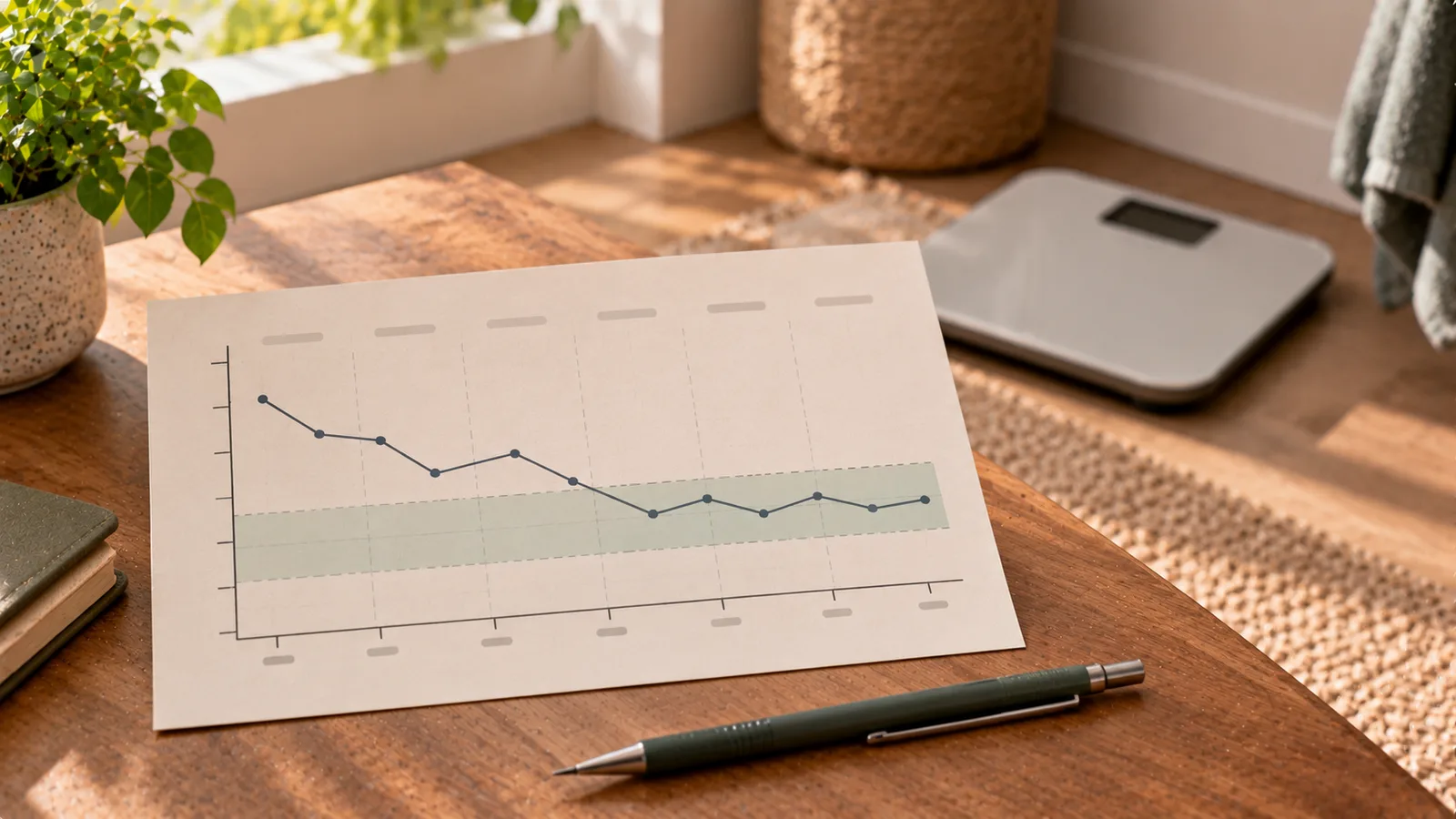
A weight goal is often expressed as one exact number: 70 kg, 65 kg, 80 kg.
That can be useful for simplicity, but body weight does not behave like a fixed number.
Even when body fat is essentially unchanged, scale weight can move from day to day because of water, food in the digestive system, carbohydrate storage, sodium intake and other normal factors.
For many people, a target weight range is therefore more practical than a single target weight.
Instead of saying:
“My goal is exactly 70.0 kg.”
you might eventually use a range such as:
“My maintenance range is roughly 69–72 kg.”
The appropriate range is individual. The purpose is not to find a universal three-kilogram rule, but to define a zone that is useful for your own situation.
Why one exact target can be misleading
Suppose your target is 70 kg.
You reach 70.0 kg on Monday.
On Tuesday the scale shows 70.8 kg.
On Wednesday it shows 71.2 kg.
That does not automatically mean you regained 1.2 kg of body fat.
Short-term scale changes can reflect:
- changes in body water;
- sodium intake;
- carbohydrate intake and glycogen storage;
- food and fluid still being digested;
- bowel contents;
- recent exercise;
- measurement timing.
A single target number can make these ordinary movements look like success or failure when they may simply be normal variation.
What is a target weight range?
A target weight range is a lower and upper boundary that you use as a practical zone rather than requiring the scale to remain at one exact number.
For example:
Single target: 70 kg
could become:
Working maintenance range: 69–72 kg
This does not mean every person with a 70 kg target should use those exact limits.
The range should reflect your own weight pattern, goals, health context and ability to maintain your routine.
Start with the reason for your goal
Before choosing numbers, ask what the target is supposed to achieve.
Possible reasons include:
- improving a health marker with professional guidance;
- reaching a weight that feels sustainable;
- maintaining weight after a period of weight loss;
- supporting sport or performance goals;
- moving away from a weight that is causing practical difficulties.
The reason matters because there is no single ideal body weight that can be calculated perfectly from height alone.
BMI can provide context, not a perfect personal target
Body mass index is calculated from weight relative to height.
It can be useful as a population-level screening measure and may provide one piece of context when discussing weight-related health.
But BMI does not directly measure:
- body fat percentage;
- muscle mass;
- fat distribution;
- fitness;
- metabolic health;
- individual medical circumstances.
Two people with the same BMI can have different body composition and health profiles.
For that reason, a BMI-derived number should not automatically become an exact personal target weight.
Step 1: identify a provisional center point
If you already have a target suggested by a clinician or dietitian, that may provide a useful starting point.
If not, you may have a provisional number based on:
- previous stable weight;
- current health goals;
- a realistic amount of weight change;
- a weight you have previously maintained comfortably.
Treat this number as a reference point rather than a finish line that must be hit to the nearest 100 grams.
For example:
Reference point: 75 kg
The next question is how much normal movement around that number makes sense.
Step 2: observe your normal fluctuations
Daily weighing is not required.
But if you already weigh regularly, your existing data can help show how much your weight naturally moves.
For example, after reaching a relatively stable period, your measurements might look like this:
| Day | Weight |
|---|---|
| Monday | 74.8 kg |
| Tuesday | 75.4 kg |
| Wednesday | 75.1 kg |
| Thursday | 74.6 kg |
| Friday | 75.7 kg |
| Saturday | 75.2 kg |
| Sunday | 74.9 kg |
Nothing here requires the conclusion that meaningful fat was gained and lost repeatedly during the week.
The useful information is that this person's scale weight naturally moves around the mid-75 kg area.
Step 3: choose a range wide enough for normal life
A range that is too narrow recreates the same problem as a single target.
For example:
74.9–75.1 kg
would be impractical for many people because ordinary fluid changes could move weight outside the range almost immediately.
A more useful range should tolerate normal variation while still being narrow enough to identify a sustained trend.
There is no universal width that works for everyone.
A smaller person with very stable routines may naturally fluctuate differently from a larger person, an athlete or someone whose sodium and carbohydrate intake varies considerably.
Example: turning 75 kg into a working range
Suppose:
- 75 kg is your provisional target;
- your stable daily weight commonly moves by around 0.5–1.0 kg;
- you want a maintenance zone that does not react to every daily fluctuation.
You might initially test a range such as:
74–77 kg
The word test matters.
You are not declaring that these numbers are medically ideal.
You are using them as a practical monitoring range and seeing whether they fit your actual maintenance pattern.
A range is not a license to ignore a trend
A target range should reduce overreaction to individual measurements.
It should not make long-term changes invisible.
Imagine your range is:
74–77 kg
and your measurements progress like this over several weeks:
75.0 → 75.6 → 76.1 → 76.5 → 77.0 → 77.6 → 78.1 kg.
The important information is not that one reading exceeded 77 kg.
The important information is the sustained upward trend.
Similarly, one morning at 77.3 kg after a salty restaurant meal may mean very little if your weight returns to its usual pattern over the following days.
Look at trends, not isolated readings
When weight is being monitored, a rolling average or weekly average can often provide more context than individual measurements.
For example:
| Week | Average weight |
|---|---|
| Week 1 | 75.2 kg |
| Week 2 | 75.1 kg |
| Week 3 | 75.4 kg |
| Week 4 | 75.3 kg |
This looks very different from focusing on a single 76.4 kg reading somewhere in Week 3.
The average suggests relative stability.
Your lower boundary matters too
People often think only about the upper end of a maintenance range.
But the lower boundary can also be useful.
If weight continues falling below the intended range after a weight-loss phase, it may indicate that the current intake or routine is still producing a deficit.
A maintenance range is a two-sided zone.
The goal is not automatically to remain as close as possible to the lower boundary.
Do not turn the range into another precision trap
A common mistake is replacing one rigid target with two rigid targets.
For example:
“My range is 70–72 kg, so 72.1 kg means I failed.”
That defeats the purpose.
The boundaries are decision aids.
They help you distinguish ordinary noise from a pattern worth reviewing.
They are not cliffs where your health or progress suddenly changes.
When should you react to being outside the range?
Usually, context matters more than a single measurement.
Before changing your diet because of one reading, consider:
- Was the measurement taken under comparable conditions?
- Was the previous day unusually high in sodium or carbohydrates?
- Was there a large restaurant meal?
- Has training changed?
- Is this one measurement or a multi-week pattern?
- Has your average weight changed?
A sustained trend is generally more informative than a single day.
Standardize measurements when possible
If you want weight data to be comparable, measure under reasonably consistent conditions.
For example, many people choose:
- the same scale;
- a similar time of day;
- similar clothing conditions;
- a consistent relationship to meals and drinks.
Perfect standardization is unnecessary.
The goal is simply to reduce avoidable measurement noise.
A target range can change
Your first range does not need to remain permanent.
You may discover that:
- normal fluctuations are larger than expected;
- the range is unnecessarily wide;
- your preferred maintenance weight has changed;
- your training or lifestyle has changed;
- a healthcare professional recommends a different goal.
Adjusting the range based on new information is not failure.
It is refinement.
Example: a range after weight loss
Imagine someone starts at 92 kg and eventually reaches approximately 78 kg.
Instead of continuing to chase a lower number simply because weight loss has been the routine for months, they decide to enter maintenance.
After several weeks, their weight commonly sits between about 77.5 and 79.5 kg.
A practical maintenance range might be built around that observed pattern rather than forcing exactly 78.0 kg every morning.
The next objective becomes maintaining habits and monitoring the trend, not repeatedly trying to produce a new lowest scale reading.
Goal weight and maintenance range are not always identical concepts
During active weight loss, you may still use a provisional goal as a planning reference.
Once you approach it, a maintenance range becomes more useful.
For example:
Weight-loss reference goal: about 75 kg
Later:
Observed sustainable maintenance range: approximately 74–77 kg
The second number is informed by what actually happens when the person lives at maintenance.
What if you have never been at the proposed target?
Then uncertainty is normal.
You do not need to predict the perfect maintenance range before reaching it.
A practical approach is:
- choose a provisional goal based on reasonable context;
- approach it gradually;
- reassess how you feel and function;
- observe weight during maintenance;
- define or refine the range from real data.
This is more realistic than assuming a formula can identify your exact lifelong body weight in advance.
Factors beyond the scale
A target weight should not be evaluated only by whether the number looks appealing.
Depending on your situation, useful context can include:
- energy levels;
- strength and physical performance;
- hunger and satiety;
- ability to maintain the eating pattern;
- relevant health markers;
- sleep;
- overall quality of life.
A weight that requires an unsustainable routine may not be a useful long-term target simply because it fits an arbitrary number.
When professional guidance is particularly useful
A clinician or registered dietitian can help individualize weight goals when there are factors such as:
- pregnancy or breastfeeding;
- adolescence or ongoing growth;
- significant medical conditions;
- medications affecting weight or appetite;
- a history of eating disorders or disordered eating;
- large or unexplained weight changes;
- sport-specific body composition requirements.
Generic online calculations are not substitutes for individualized medical assessment in these situations.
A simple framework
If you want to replace one exact target with a more flexible system:
- Identify why you want to change or maintain your weight.
- Choose a provisional reference point rather than a perfect number.
- Observe normal weight variability under reasonably consistent conditions.
- Establish a working lower and upper range.
- Judge trends over time rather than individual readings.
- Reassess the range once you have real maintenance data.
- Consider health, sustainability and daily functioning alongside body weight.
The purpose of a target weight range is not to make weight tracking more complicated.
It is to make the interpretation more realistic.
Your body does not need to weigh exactly the same amount every morning for your weight to be stable.