
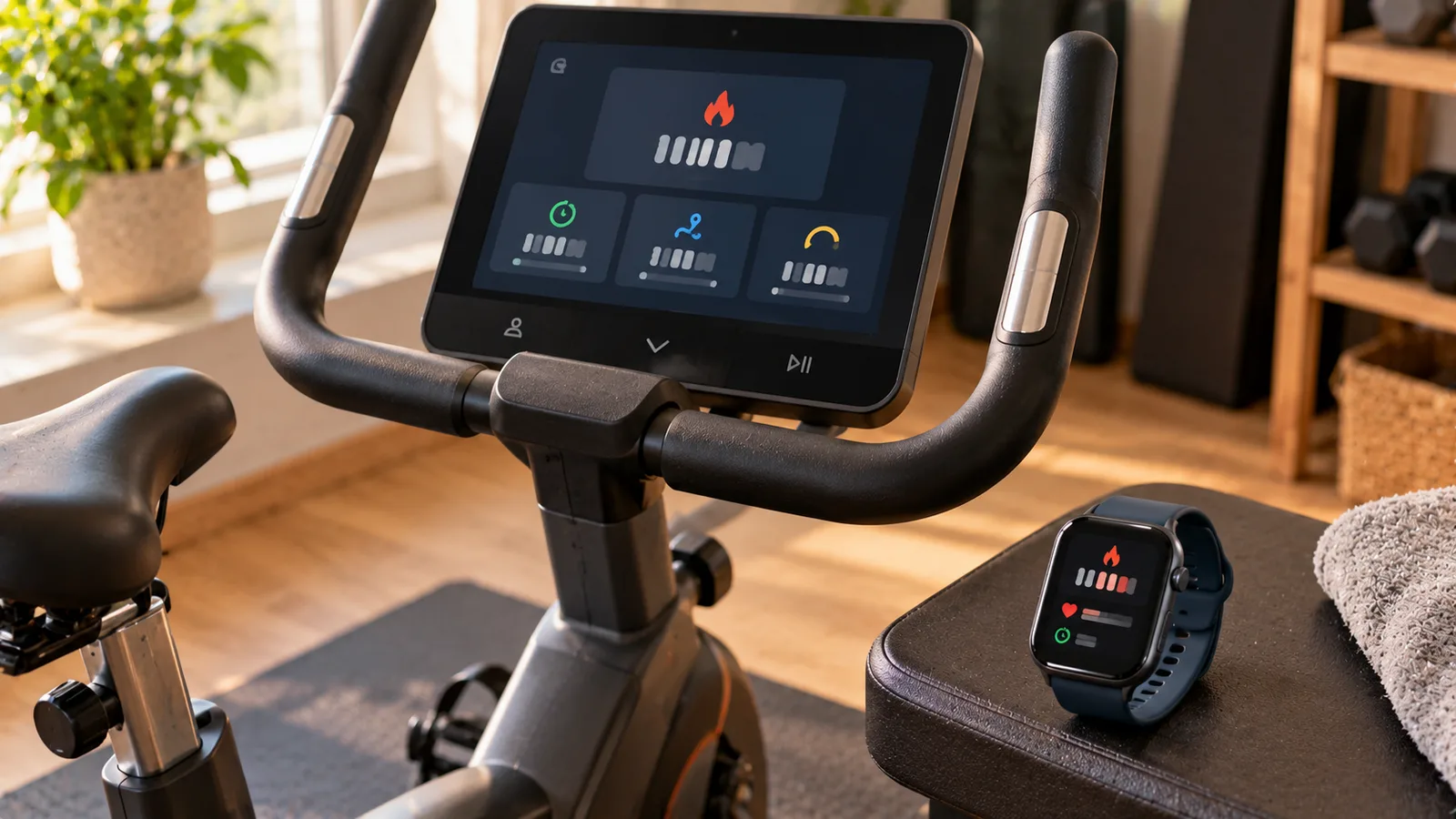
You finish a treadmill workout and the machine says you burned 420 calories. Your watch says 310.
Which one is correct?
Possibly neither — at least not exactly.
Exercise calorie numbers from watches, treadmills, exercise bikes and elliptical machines are estimates. Different devices use different inputs, formulas and definitions, so disagreement is normal.
The difference does not necessarily mean that one device is broken.
Why the numbers can be different
A fitness machine and a wearable may not be estimating exactly the same thing.
They can differ because of:
- the personal data available to the device;
- heart-rate information;
- exercise intensity measurements;
- whether resting energy is included;
- the algorithm used;
- how the activity is classified;
- whether you entered your weight and other information correctly.
Two devices can therefore observe the same workout and still produce different calorie estimates.
Watch vs fitness machine: what each device knows
A modern watch may have access to information such as:
- age;
- sex, depending on the device and profile;
- body weight;
- heart rate;
- movement data;
- workout type;
- duration;
- historical fitness information, depending on the platform.
A treadmill or stationary bike may know:
- workout duration;
- speed;
- incline or resistance;
- distance;
- machine workload;
- body weight, if you entered it;
- sometimes heart rate.
These are different datasets.
A machine can know its own workload very well while knowing relatively little about the person using it.
A watch knows more about the wearer but may have less direct information about the mechanical workload.
Active calories and total calories are not the same
One of the biggest reasons for apparent disagreement is that the two devices may be displaying different definitions of calories.
Active calories
These generally represent energy attributed to activity above a resting baseline.
Total calories
These may include both:
- energy associated with the activity;
- energy your body would have used during that time anyway.
Imagine that a device estimates:
- 300 active calories during a workout;
- 55 calories of resting energy during the same period.
A total-calorie estimate could therefore be around:
355 calories
while another screen might display only:
300 active calories
The two numbers can look inconsistent even though part of the difference is simply the definition being used.
Before comparing devices, check whether both are reporting active calories, total calories or another metric.
Why treadmills estimate calories differently
A treadmill has useful information about the workout itself.
It can measure or derive variables such as:
- speed;
- incline;
- duration;
- distance.
But it may have limited information about you.
If you start a treadmill without entering your weight, the machine may rely on a default value or generalized assumptions.
Even when weight is entered, the displayed calories are still an estimate rather than a direct measurement of your energy expenditure.
Running economy also differs between people. Two people of similar weight can perform the same treadmill workout without necessarily using exactly the same amount of energy.
Why stationary bikes can disagree with watches
Exercise bikes introduce another variable: workload.
Some machines can estimate or measure mechanical power more directly than others.
A watch, meanwhile, may rely more heavily on:
- heart rate;
- movement;
- personal profile information;
- the selected workout type.
This can create substantial differences.
For example, your wrist may move very little during indoor cycling even though your legs are working hard. A wearable designed to combine heart rate and workout classification may compensate for this, but the estimate still depends on its algorithm.
Why elliptical machines are especially difficult to compare
Elliptical training combines movement patterns that vary substantially by machine and user.
Calorie estimates may be influenced by:
- resistance;
- cadence;
- incline;
- use of moving handles;
- body weight;
- workout duration;
- machine-specific assumptions.
A watch may interpret the same workout differently depending on whether an elliptical workout was started manually or detected automatically.
Again, neither number should be treated as a laboratory measurement.
Heart rate helps, but it does not make the estimate exact
Heart rate can provide useful information about exercise intensity.
But heart rate is not a direct calorie meter.
It can vary because of factors including:
- fitness level;
- temperature;
- hydration;
- stress;
- caffeine;
- medications;
- fatigue;
- individual physiology.
Optical wrist heart-rate sensors also have measurement limitations, particularly during activities involving substantial wrist movement, gripping or rapidly changing intensity.
So a watch using heart rate may have more individualized information than a machine, but that does not guarantee an exact calorie result.
Personal data matter
A calorie estimate can change when a device uses different personal information.
Body weight is particularly important for many exercise calculations.
If your watch profile contains your current weight but the treadmill:
- uses a default weight;
- contains an old weight;
- was used without entering a profile;
the estimates may diverge substantially.
Check that relevant profile information is current before interpreting a large difference as a device error.
Example: one workout, three numbers
Imagine a 45-minute cardio session.
The devices show:
| Source | Calories displayed |
|---|---|
| Watch | 320 kcal |
| Treadmill | 390 kcal |
| Fitness app | 350 kcal |
It is tempting to ask which number is the true one.
A better first step is to ask:
- Does each number represent active or total calories?
- Did each device use the same body weight?
- Did the watch record heart rate reliably?
- Was the correct workout type selected?
- Did the machine know the user's profile?
- Is the app importing data from one of the other devices?
Without answering these questions, the three numbers are not necessarily directly comparable.
Exercise calories are estimates, not direct measurements
Consumer devices usually do not directly measure the heat produced by your body or perform laboratory-grade metabolic measurement during ordinary workouts.
Instead, they estimate energy expenditure using available signals and mathematical models.
That means the displayed result should not be interpreted as:
"I burned exactly 347 kcal."
A more appropriate interpretation is:
"This device estimates that this workout used approximately this amount of energy according to its model."
That distinction matters when two devices disagree.
Can a machine overestimate calories?
Yes, it can.
Possible reasons include:
- default body-weight assumptions;
- generalized equations;
- including resting energy;
- limited personalization;
- differences between the machine's assumed movement and how you actually performed the exercise.
But a watch can also overestimate.
There is no general rule that the lower number is always correct or that one device category is universally more accurate.
Can a watch underestimate calories?
Yes.
A wearable estimate can be affected by:
- inaccurate heart-rate readings;
- incorrect profile information;
- incorrect workout classification;
- limited movement detection;
- unusual exercise patterns;
- algorithmic assumptions.
Accuracy also varies by activity type and device.
Holding treadmill rails can affect the comparison
Suppose a treadmill is set to a steep incline, but you support part of your body weight by holding the rails.
The machine knows:
- the incline;
- the belt speed;
- the workout duration.
But it may not fully account for how much assistance you receive from the rails.
Its calculation can therefore represent a workload assumption that does not perfectly match what your body actually performed.
This is one example of why machine settings alone cannot determine exact energy expenditure.
What if the difference is very large?
Small or moderate disagreement is unsurprising.
If the difference is unusually large, check for simple causes first.
Check your profile
Confirm that your:
- weight;
- age;
- other relevant settings
are correct.
Check the workout type
Make sure the watch recorded the actual activity rather than a generic or incorrect workout.
Check heart-rate data
Look for obvious gaps or implausible readings.
Check the machine settings
If possible, confirm that body weight and other profile settings were entered correctly.
Check what the calorie number means
Determine whether the device is displaying:
- active calories;
- total calories;
- workout calories;
- another proprietary metric.
A definition mismatch can explain a surprisingly large difference.
Should you add the watch and machine calories together?
No.
If the watch and machine are both estimating the same workout, they are not two separate energy expenditures.
For example:
- watch: 300 kcal;
- treadmill: 380 kcal.
That does not mean the workout burned:
300 + 380 = 680 kcal
They are two estimates of the same event.
Adding them would double-count the workout.
Be careful with synced apps
Another source of confusion appears when multiple services sync activity.
For example:
- your watch records a workout;
- the fitness machine exports the same workout;
- both reach another health or nutrition app.
Depending on how the software handles duplicates, the workout can appear more than once.
If an activity total suddenly looks implausibly high, check whether the same session was imported from multiple sources.
Which number should you use consistently?
For tracking trends, consistency can be more useful than switching between whichever device reports the most appealing number.
If you regularly perform the same type of exercise using the same watch, its estimates can provide a consistent reference even though individual calorie values remain estimates.
For example, you might observe:
- easy session: approximately 220 active kcal;
- normal session: approximately 300 active kcal;
- longer session: approximately 410 active kcal.
The relative pattern may be useful even if none of those values should be treated as exact metabolic measurements.
Comparing workouts is different from measuring exact calories
Wearables and machines can be useful for questions such as:
- Was today's session longer?
- Was the intensity higher?
- Did I perform more work?
- How has my activity changed over several weeks?
Those questions do not require every calorie estimate to be perfectly accurate.
A device can still provide useful trend information while having meaningful error in absolute calorie expenditure.
Do not let one calorie estimate redefine your whole day
A workout calorie estimate is only one part of daily energy expenditure.
Your total daily energy use also includes energy required for:
- basic physiological functions;
- ordinary movement;
- digestion;
- exercise and other activity.
If you are trying to understand your overall calorie needs, concepts such as maintenance calories and total daily energy expenditure are more relevant than treating one exercise-machine number as a complete daily energy calculation.
Watch vs machine: a practical interpretation
When your watch and exercise machine disagree:
- Check whether both numbers use the same definition.
- Confirm your personal data are current.
- Check whether heart-rate data look reasonable.
- Make sure the correct workout was recorded.
- Do not add the two estimates together.
- Treat both as estimates rather than exact measurements.
- Use a consistent source when following trends over time.
The goal is not to find a device that can tell you the exact number of calories burned during every workout.
Consumer devices are better treated as tools for estimating activity and following patterns.
The main takeaway
A watch and a fitness machine can show different calorie numbers because they may use different data, algorithms and even different definitions of what the displayed calories represent.
A treadmill may know speed and incline but little about the user. A watch may know your profile and heart rate but estimate workload indirectly. One device may display active calories while another includes resting energy.
That is why a difference does not automatically mean that one device is wrong.
Treat exercise calories as estimates, compare equivalent metrics and focus more on consistent trends than on trying to identify one perfectly accurate number.
Sources
- U.S. National Institutes of Health and National Library of Medicine resources on energy expenditure and physical activity.
- American College of Sports Medicine, principles of exercise testing and energy expenditure estimation.
- Peer-reviewed research evaluating wearable-device estimates of energy expenditure.