
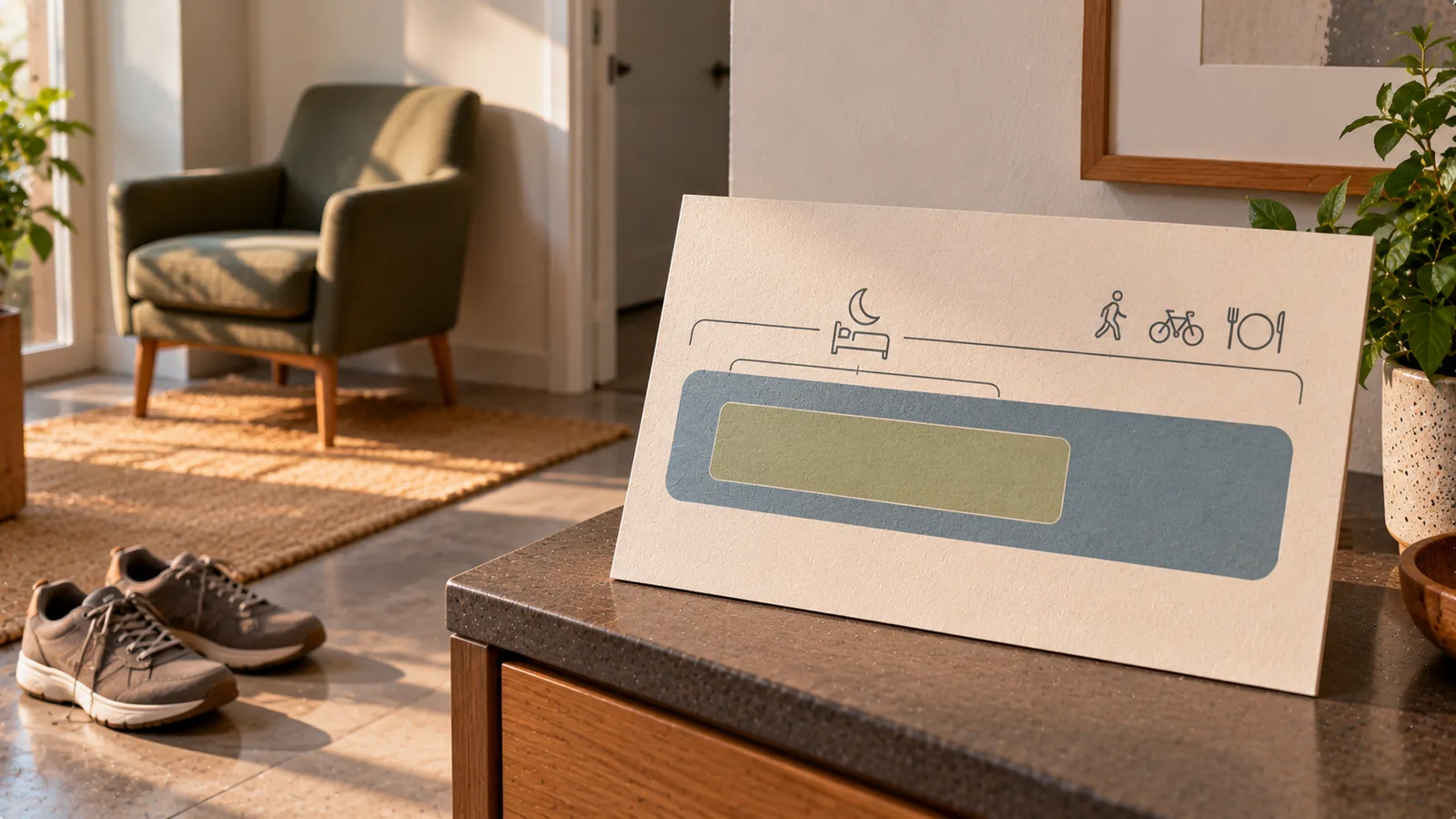
BMR and TDEE are both estimates of energy expenditure, but they answer different questions. (Frankenfield et al.)
BMR estimates the energy your body needs for basic functions at rest.
TDEE estimates the total energy you use across an entire day.
The simplest relationship is:
BMR is one component of TDEE.
If you are trying to understand your total daily calorie needs, TDEE is generally the more relevant number. BMR is useful for understanding the baseline on which that total is built.
TDEE vs BMR at a glance
| BMR | TDEE | |
|---|---|---|
| Full name | Basal Metabolic Rate | Total Daily Energy Expenditure |
| What it estimates | Baseline energy needs | Total daily energy use |
| Includes basic body functions | Yes | Yes |
| Includes ordinary movement | No | Yes |
| Includes exercise | No | Yes |
| Includes thermic effect of food | Not as part of BMR | Yes, conceptually |
| Usually lower or higher? | Lower | Higher |
| Most useful for | Understanding baseline energy needs | Estimating total daily calorie needs |
The two values are related, but they should not be used interchangeably.
What is BMR?
BMR stands for Basal Metabolic Rate.
It represents the energy required to maintain essential physiological functions under basal conditions.
Those functions include:
- breathing;
- circulation;
- organ function;
- nervous system activity;
- cellular processes;
- maintenance of body temperature.
Your body uses energy for these processes even when you are not deliberately moving.
That is why energy expenditure never falls to zero simply because you are resting.
What is TDEE?
TDEE stands for Total Daily Energy Expenditure.
It represents the total amount of energy used over a day.
Conceptually, TDEE includes:
- baseline or resting energy needs;
- ordinary daily movement;
- structured exercise;
- the thermic effect of food.
This makes TDEE a broader estimate than BMR.
The key relationship
A simplified way to think about the two is:
BMR = baseline
TDEE = baseline + the rest of your daily energy expenditure
For example, imagine someone has an estimated BMR of:
1,600 kcal/day
Their body still uses additional energy when they:
- walk;
- work;
- cook;
- clean;
- climb stairs;
- exercise;
- digest food.
Their TDEE might therefore be estimated at:
2,300 kcal/day
The difference between the two values reflects energy expenditure beyond basal conditions.
Why TDEE is always higher than BMR in practical daily life
BMR describes a tightly defined baseline state.
Real daily life involves more than that.
Even someone who spends much of the day sitting still needs to:
- get out of bed;
- walk around;
- prepare or obtain food;
- maintain posture;
- perform routine tasks;
- digest meals.
These activities require energy.
For that reason, estimated TDEE should normally be higher than estimated BMR.
Example: same BMR, different TDEE
Consider two people with the same estimated BMR:
BMR: 1,600 kcal/day
Person A has a desk-based routine and relatively little daily movement.
Their estimated TDEE might be:
about 1,950 kcal/day
Person B has an active job, walks frequently and exercises several times per week.
Their estimated TDEE might be:
about 2,600 kcal/day
The BMR can be similar while total daily energy needs differ substantially.
That is one reason BMR alone is not a complete daily calorie target.
How calculators move from BMR to TDEE
Many calorie calculators use a two-stage process.
Step 1: estimate BMR
A formula uses information such as:
- age;
- sex;
- body weight;
- height.
This produces an estimate of baseline energy requirements.
Step 2: account for activity
The estimated BMR is then combined with an activity assumption.
A simplified example:
Estimated BMR = 1,600 kcal
If an activity multiplier of 1.5 is used:
1,600 × 1.5 = 2,400 kcal
The resulting estimated TDEE is:
2,400 kcal/day
This is a model, not a direct measurement.
Why activity multipliers matter so much
Two calculators can start with a similar BMR estimate but produce different TDEE values if they use different activity assumptions.
Activity categories may be described as:
- sedentary;
- lightly active;
- moderately active;
- very active.
The difficulty is that these categories are broad.
Two people who both select “moderately active” may have very different:
- step counts;
- jobs;
- commuting patterns;
- training schedules;
- time spent sitting.
This creates uncertainty in the TDEE estimate even when the BMR estimate is similar.
Is BMR the number of calories you should eat?
Not generally.
BMR is not designed to represent your complete daily calorie requirement.
It estimates baseline energy needs under specific resting conditions.
Your real day includes movement, digestion and usually other activity.
Therefore, treating BMR as if it were automatically your maintenance-calorie target ignores important components of daily expenditure.
Is TDEE your maintenance calorie level?
TDEE is commonly used as an estimate of maintenance energy needs.
Conceptually:
average intake ≈ average TDEE
would be expected to support approximately stable body weight over time.
But this should not be interpreted as an exact equation for every individual day.
Both food intake and expenditure contain measurement uncertainty.
Body weight also fluctuates for reasons unrelated to changes in body fat.
TDEE is therefore best treated as a starting estimate that can be compared with longer-term real-world trends.
BMR and weight loss
BMR is sometimes incorrectly treated as a direct weight-loss target.
A more useful framework is to start with estimated total expenditure.
If average intake remains below average expenditure over time, an energy deficit exists.
For example:
Estimated BMR: 1,600 kcal/day
Estimated TDEE: 2,300 kcal/day
The energy balance of daily life relates more directly to the 2,300 kcal TDEE estimate than to the 1,600 kcal BMR estimate.
The appropriate intake depends on individual circumstances and should not be derived simply by eating at or below BMR.
BMR and exercise
Exercise does not become part of BMR.
Suppose you complete a cycling session.
Your energy expenditure from that activity contributes to your total daily expenditure.
It does not mean your BMR itself suddenly includes the workout.
This distinction helps keep the concepts clear:
BMR describes baseline needs.
TDEE describes the whole day.
TDEE can change even if BMR changes little
Imagine your body weight and body composition remain relatively stable, but you change jobs.
Previously:
- office work;
- car commute;
- little walking.
Now:
- active job;
- walking commute;
- much more time standing.
Your estimated baseline requirement may remain fairly similar.
Your total daily expenditure, however, can increase because your activity has changed.
This is primarily a TDEE difference.
Both BMR and TDEE can change over time
Neither number is permanently fixed.
BMR estimates can change with factors such as:
- body weight;
- body composition;
- age.
TDEE can additionally change with:
- daily movement;
- occupation;
- exercise frequency;
- training volume;
- commuting;
- lifestyle.
A calorie estimate calculated years ago may therefore no longer represent your current routine.
BMR vs resting metabolic rate
BMR is also sometimes confused with RMR, or resting metabolic rate. (RMR validation study)
The terms are related but not perfectly identical.
BMR is traditionally associated with stricter measurement conditions.
RMR can be measured under somewhat less restrictive resting conditions.
In everyday calorie calculators, the distinction may be blurred because equations estimate resting requirements rather than performing laboratory measurements.
For most people using an online calculator, the practical question remains whether the number represents baseline resting needs or total daily expenditure.
Which number should you use for calorie planning?
If your goal is to estimate how much energy you use in an ordinary day, TDEE is generally more relevant.
It incorporates the broader daily picture.
BMR can still be useful because it helps explain where much of your daily energy expenditure comes from.
A simple decision rule is:
Want to understand baseline energy needs? → BMR
Want an estimate of total daily calorie needs? → TDEE
Example: desk worker
Suppose a person has:
BMR: 1,500 kcal/day
Their routine includes:
- desk work;
- a short commute;
- approximately 5,000 steps;
- two workouts per week.
A calculator estimates:
TDEE: 1,950 kcal/day
The difference:
1,950 − 1,500 = 450 kcal
represents the calculator's estimate of energy expenditure beyond basal needs.
It should not be interpreted as an exact measurement of movement calories.
Example: active worker
Another person has:
BMR: 1,500 kcal/day
but works in a physically active job, walks frequently and trains several times per week.
Their estimated TDEE might be:
2,400 kcal/day
Now the difference is:
2,400 − 1,500 = 900 kcal
Again, this is an estimated total, not a precise measurement of every activity.
The comparison shows why similar BMR values can coexist with very different daily calorie needs.
Why your watch may show another number
A fitness watch may estimate daily energy expenditure using:
- heart rate;
- movement;
- steps;
- workouts;
- profile information.
Its result may differ from an online TDEE calculator.
For example:
Calculator TDEE: 2,350 kcal
Watch total expenditure: 2,520 kcal
This does not automatically mean one is correct and the other is wrong.
They use different inputs and models.
Both should be treated as estimates.
Do not add exercise twice
One practical mistake occurs when a person's TDEE already includes normal exercise through the selected activity level and they then add all exercise calories again.
For example:
- you choose “moderately active” because you train four times per week;
- the calculator produces a TDEE based partly on that activity;
- you then add every workout calorie from your watch on top.
Part of the activity may now be represented twice.
Whether exercise calories should be added separately depends on how the original calorie target was constructed.
BMR is not a minimum-eating rule
A common internet claim is that nobody should ever eat below their BMR.
BMR itself does not function as a universal intake threshold.
It is an estimate of basal energy expenditure, not a personalized prescription for minimum food intake.
Appropriate energy intake depends on the person's total requirements, goals, nutritional adequacy, health circumstances and the size and duration of any energy deficit.
The fact that an intake is above or below an estimated BMR does not by itself determine whether a diet is appropriate.
TDEE is not perfectly precise either
Moving from BMR to TDEE adds another layer of uncertainty.
A calculator has to estimate:
- baseline energy needs;
- activity level;
- sometimes exercise patterns.
Real-world movement changes from day to day.
For this reason, a result such as:
TDEE = 2,437 kcal/day
should not be interpreted as proof that exactly 2,437 kcal are used every day.
The true practical value is usually a range rather than a perfectly precise number.
How to test whether a TDEE estimate is reasonable
You cannot verify TDEE from one day of eating or one morning weigh-in.
A more useful approach is:
- start with a reasonable estimate;
- track intake consistently enough to interpret it;
- observe average body-weight trends over several weeks;
- consider meaningful changes in activity;
- adjust the working estimate when the trend consistently differs from expectations.
For example, if estimated TDEE is 2,300 kcal and average intake is close to that level while body weight remains broadly stable over time, the estimate may be reasonably close to maintenance.
Daily TDEE vs average TDEE
Actual daily expenditure is not constant.
One day might include:
- 3,000 steps;
- no exercise;
- mostly sitting.
Another might include:
- 15,000 steps;
- cycling;
- several hours on your feet.
Your actual expenditure will probably differ between those days.
For practical planning, an average daily estimate can still be useful.
This is why TDEE does not need to be interpreted as an identical calorie burn every 24 hours.
What if your goal changes?
The definitions of BMR and TDEE do not change when your goal changes.
Whether your goal is:
- weight maintenance;
- weight loss;
- weight gain;
BMR still describes baseline expenditure and TDEE still describes total daily expenditure.
What changes is how energy intake relates to the estimated TDEE.
A useful mental model
Think of BMR as the energy cost of keeping the body's essential systems running.
Then imagine adding:
- walking;
- standing;
- work;
- household activity;
- exercise;
- digestion.
The result moves toward total daily energy expenditure.
That is the fundamental distinction between BMR and TDEE.
Which number matters more?
Neither number is universally “better.”
They answer different questions.
BMR is useful for understanding baseline metabolism.
TDEE is more useful when the question is:
“Approximately how much energy do I use in a full day?”
For calorie planning, maintenance estimates and energy-balance calculations, that usually makes TDEE the more directly applicable figure.
The key difference
The distinction can be summarized in one line:
BMR estimates your baseline energy needs; TDEE estimates your total daily energy expenditure. (NIDDK)
BMR forms part of TDEE.
TDEE adds the energy associated with the rest of daily life.
Both are estimates, and neither should be treated as a perfectly measured personal constant.
Use BMR to understand the baseline. Use TDEE when you need a practical estimate of the whole day's energy needs.
Sources
Evidence and authoritative guidance used for the nutrition and health information in this article: