
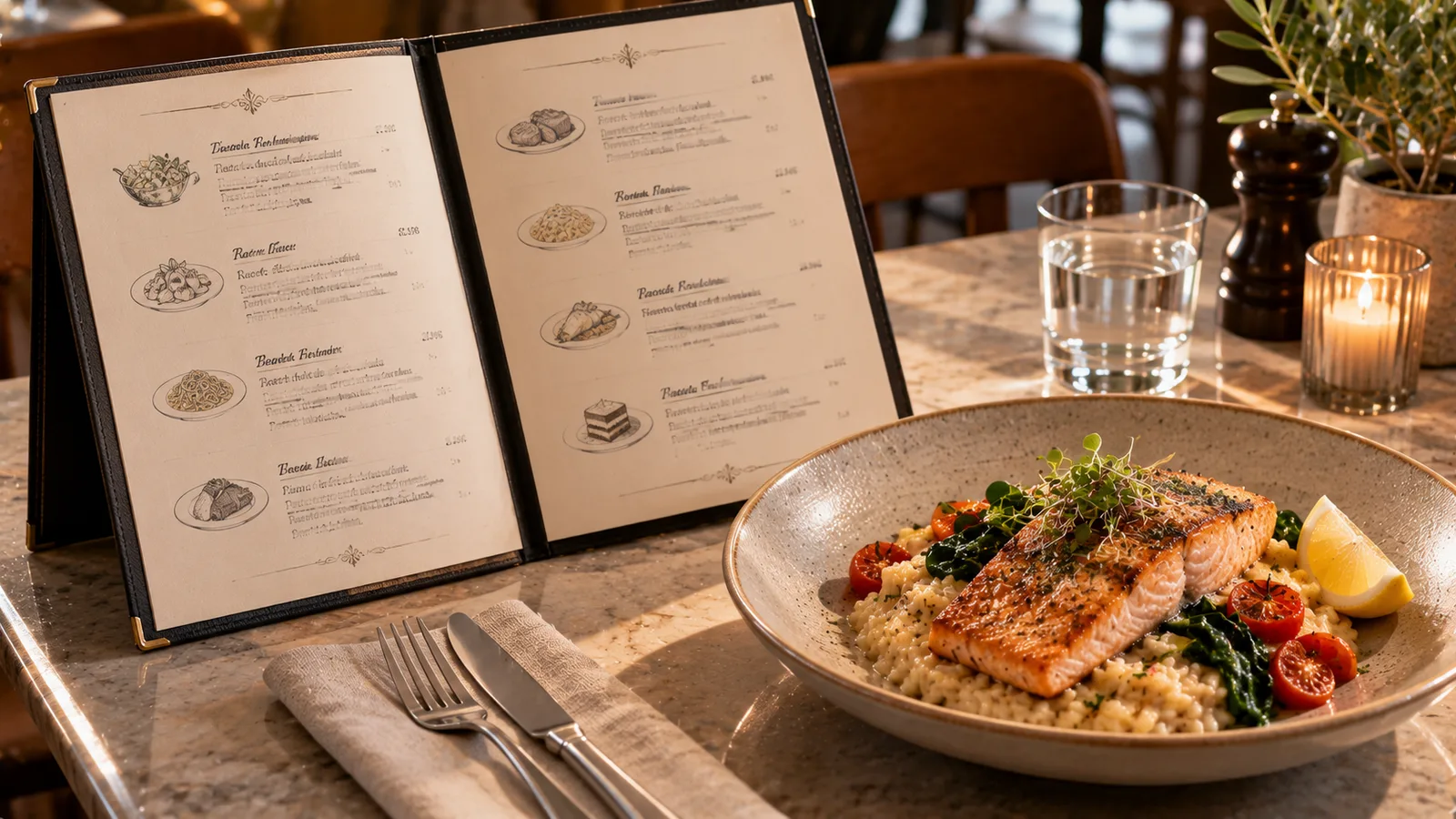
Feeling guilty after eating can happen after a large meal, dessert, takeaway, an unplanned snack or simply after eating something you have mentally classified as "bad."
The feeling can be uncomfortable, but guilt does not tell you how much damage a meal caused, whether you need to compensate for it or whether you have failed at healthy eating.
A useful next step is usually much simpler: avoid punishment, return to your ordinary eating pattern and look at the situation with enough distance to understand whether anything actually needs to change.
Food guilt is a feeling, not a nutritional measurement
Thoughts such as:
- "I ruined my diet";
- "I should not have eaten that";
- "I need to skip my next meal";
- "I have to burn this off";
- "I was good all week and now I failed";
can feel convincing immediately after eating.
But none of them is a nutritional calculation.
Feeling very guilty does not mean you consumed an extreme amount of energy.
Feeling no guilt does not tell you whether a meal matched your goals either.
Emotion and nutritional information are different things.
That distinction matters because decisions made purely to reduce guilt can become much more extreme than the meal itself warrants.
Why food guilt can become a cycle
A common pattern looks like this:
- You eat something that conflicts with a food rule.
- You interpret the event as failure.
- You feel guilty or anxious.
- You try to compensate by restricting food or exercising.
- You become unusually hungry, preoccupied with food or tired.
- Eating becomes harder to regulate.
- Another eating episode creates more guilt.
Not everyone experiences this cycle, but it explains why punishment is often an unhelpful response.
The attempt to "fix" one meal can create a larger problem around the meals that follow.
What to do immediately after a meal that triggers guilt
You do not need to solve your entire diet while the emotion is strongest.
A practical sequence is:
1. Describe what happened without judging it
Instead of:
"I was terrible and ate too much."
try:
"Dinner was larger than I planned and I also had dessert."
The second version describes an event.
It does not turn the event into a judgment about your character.
2. Avoid immediate compensation
Do not automatically respond by:
- skipping the next meal;
- fasting longer than planned;
- cutting the next day's food dramatically;
- adding punishing exercise;
- removing entire food groups.
There may be legitimate reasons to adjust food intake from day to day, but guilt alone is not a useful basis for an extreme correction.
3. Continue with your normal routine
If your next meal would normally be breakfast, lunch or dinner, return to that pattern when appropriate.
You may naturally feel more or less hungry after a larger meal. That is different from deliberately withholding food as punishment.
4. Review the event later
Once the emotional reaction is weaker, ask whether there is actually anything useful to learn.
Sometimes there is.
Sometimes there is not.
One meal rarely defines the overall pattern
Nutrition and weight-management outcomes develop from repeated patterns over time.
One restaurant dinner, dessert or celebration does not describe your entire diet.
Consider a simple example.
Suppose someone's usual intake is approximately 2,000 kcal per day.
Across seven days:
2,000 × 7 = 14,000 kcal
If one day is 500 kcal higher than usual while the other days remain unchanged, the weekly total becomes:
14,500 kcal
The average becomes about:
2,071 kcal per day
The purpose of this example is not to prescribe a calorie target.
It shows why a single event and a repeated pattern are mathematically different.
"This meal was different from my plan" is not the same statement as "everything is ruined."
Avoid turning the next day into punishment
After an unusually large meal, some people plan an extremely restrictive next day.
That can look like:
- skipping breakfast despite hunger;
- eating only very low-calorie foods;
- avoiding carbohydrates;
- trying to "save" calories until evening;
- doing extra exercise specifically to erase the meal.
This response can reinforce the idea that food has to be earned or repaid.
For many people, a more stable approach is to return to ordinary meals and allow normal appetite cues and routine to re-establish themselves.
You do not need to "earn" food
Food is not a reward that must be earned through exercise or dietary perfection.
Physical activity can support health, fitness, enjoyment and many personal goals.
Using it primarily as punishment for eating is a different relationship.
If you planned a normal workout, you do not necessarily need to cancel it.
The distinction is the purpose:
normal planned activity is different from exercise added specifically because you feel guilty for eating.
Be careful with "good" and "bad" food labels
Foods differ nutritionally.
That does not require dividing every food into moral categories.
A lentil meal and a piece of cake have different nutritional profiles and may play different roles in a diet.
That is useful information.
Calling one "good" and the other "bad" can add a moral judgment that makes ordinary eating decisions more emotionally charged.
More neutral descriptions are often more useful:
- higher in protein;
- lower in fiber;
- energy-dense;
- high in sodium;
- contains vegetables;
- dessert;
- everyday staple;
- occasional food.
These descriptions tell you something concrete.
A meal can be less balanced without being a failure
Suppose dinner contains:
- a burger;
- fries;
- a sweet drink.
You may decide that the meal was lower in vegetables or fiber than your usual dinner.
That is a nutritional observation.
You do not need to transform it into:
"I ate badly, so tomorrow I need to compensate."
Instead, the next meal can simply return to your usual pattern.
For example, it may contain foods you normally enjoy that also provide vegetables, protein, whole grains, fruit or other foods that fit your needs.
The goal is not to cancel the burger.
It is to continue eating normally.
Ask whether the guilt came from the food or from a rule
Sometimes the meal itself is not the main issue.
The guilt comes from an internal rule such as:
- "I must never eat after 8 p.m.";
- "Dessert is only allowed on weekends";
- "Carbohydrates at dinner are bad";
- "If I eat takeaway, the day is ruined";
- "I must stay below my calorie target every single day."
Ask:
What rule do I think I broke?
Then ask:
Is this rule actually necessary for my goal?
Some rules are useful practical structures.
Others are unnecessarily rigid.
A sustainable eating pattern generally needs enough flexibility to accommodate ordinary life.
Distinguish a preference from a rigid rule
There is a difference between:
"I usually prefer a lighter lunch because I feel better in the afternoon."
and:
"I am not allowed to eat a substantial lunch."
The first describes a preference based on experience.
The second creates a prohibition.
Rigid rules can make ordinary deviations feel like failures even when nothing dangerous or unusual happened.
What if you really did eat more than you intended?
A non-punitive approach does not require pretending that every eating decision was exactly what you wanted.
You can acknowledge:
"I ate more than I intended."
Then investigate the reason without attacking yourself.
Possible factors include:
- arriving at the meal extremely hungry;
- skipping an earlier meal;
- eating very quickly;
- distraction;
- unusually large portions;
- alcohol;
- social pressure;
- stress;
- eating directly from a large package;
- simply enjoying the food and deciding to continue.
Different causes suggest different practical responses.
Use the event as information, not evidence against yourself
Suppose you repeatedly arrive home extremely hungry and eat far more at dinner than you intended.
The useful question is not:
"Why do I have no self-control?"
A more actionable question is:
"What happens earlier in the day?"
Perhaps lunch is too small.
Perhaps there is a seven-hour gap between lunch and dinner.
Perhaps there is no convenient afternoon snack.
Those are practical variables that can be tested.
A simple reflection framework
After the guilt has settled, ask four questions:
What happened?
Describe the food and situation neutrally.
What was happening before it?
Consider hunger, meal timing, stress, environment and availability.
Did the event actually create a problem?
One unusual meal may require no intervention.
A repeated pattern that conflicts with your goals may deserve attention.
What is one practical change, if any?
Choose one adjustment rather than imposing a punishment.
For example:
"Next time I will eat my normal lunch instead of skipping it before the restaurant dinner."
That is more specific than:
"Tomorrow I will eat almost nothing."
When calorie tracking contributes to guilt
Tracking can be useful for some people.
For others, seeing a target turn red or exceed a number can trigger an emotional reaction that is much larger than the practical significance of the difference.
If you track calories, remember that an app target is a planning tool.
It is not a moral boundary.
Going above a target does not turn food into a mistake.
It may simply be data.
The useful question is whether the pattern over time supports your goal.
Do not repeatedly lower your target to compensate
If yesterday was higher than planned, repeatedly cutting today's target can create a moving cycle of restriction and compensation.
This can make normal variation feel unacceptable.
For weight management, consistency over time is generally more informative than trying to mathematically punish every higher-calorie meal immediately.
Individual energy needs and appropriate targets vary, so personalized targets should be discussed with an appropriate professional when needed.
Scale changes can intensify guilt
A larger restaurant meal may contain more:
- sodium;
- carbohydrate;
- food volume;
- fluid.
Body weight can therefore change temporarily because of water, glycogen and gastrointestinal contents.
A short-term increase on the scale does not directly measure body-fat change from one meal.
Reacting to a next-morning scale increase with severe food restriction can therefore compound an already emotional situation.
Food guilt and weight management are not the same problem
Someone can have a legitimate weight-management goal and still use a non-punitive approach to food.
These ideas are compatible:
- energy balance matters over time;
- portion size can matter;
- food choices can affect satiety and nutrition;
- habits can be adjusted;
- one meal does not require punishment;
- guilt is not a calorie-management strategy.
Weight management does not require treating every deviation from a plan as a failure.
Social meals are part of real eating patterns
Birthdays, holidays, restaurants, travel and meals with friends are normal parts of life for many people.
A sustainable nutrition strategy needs a way to include them.
If every social meal creates guilt, the issue may not be the frequency of the meals alone.
The plan itself may be too rigid to accommodate ordinary variation.
A useful plan should work not only on ideal weekdays but also across a realistic month.
What about dessert?
Dessert does not need to be justified by an otherwise perfect day.
You can decide whether and how often dessert fits your preferences and goals without assigning it moral value.
If dessert repeatedly leaves you physically uncomfortable or consistently displaces foods you want more of, that is useful practical information.
It still does not require shame.
If you want to make the next meal more balanced
You can choose a balanced next meal because that is how you normally want to eat—not because you need to erase the previous one.
For example, a normal meal might include:
- a protein source;
- vegetables or fruit;
- a carbohydrate source;
- a source of fat depending on the meal.
This is continuation, not compensation.
The difference is important.
Avoid "starting over Monday"
Food guilt often produces an all-or-nothing response:
"The day is ruined, so I might as well keep eating and start again tomorrow."
or:
"This week is ruined. I will restart Monday."
There is no nutritional requirement to wait for a new day or week.
Your next ordinary eating decision is simply the next decision.
Nothing needs to be reset.
When guilt follows eating foods you genuinely enjoy
Enjoyment is a legitimate part of eating.
Taste, culture, social connection and pleasure can coexist with nutrition goals.
A diet does not become nutritionally poor because every food is not selected for maximum nutrient density.
The overall pattern matters.
If guilt appears whenever you eat something primarily because you enjoy it, the underlying food rules may deserve more attention than the food itself.
When guilt is frequent
Occasional regret after a meal is different from persistent guilt around eating.
Pay attention if guilt regularly causes you to:
- skip meals;
- fast to compensate;
- exercise compulsively;
- avoid eating with other people;
- fear particular foods;
- repeatedly check your body or weight;
- experience episodes of loss of control around food;
- purge or use other compensatory behaviors;
- feel that thoughts about food dominate your day.
These patterns deserve support rather than stricter food rules.
When professional support may help
If guilt around food is frequent, intense or linked to restrictive, bingeing, purging or compulsive exercise behaviors, consider discussing it with an appropriate healthcare professional.
Depending on the situation, this may include a physician, registered dietitian with relevant expertise or mental-health professional.
Eating disorders and disordered eating are not diagnosed from a single behavior or an online checklist.
A professional can assess the broader pattern.
A practical response after food guilt
When guilt appears after eating, try this sequence:
- Pause the judgment. Describe what happened factually.
- Do not punish the next meal. Avoid automatic restriction or compensatory exercise.
- Return to your ordinary eating pattern.
- Wait until the emotion is less intense before analyzing the event.
- Look for a repeated pattern rather than treating one event as proof of failure.
- If a practical problem exists, choose one specific adjustment.
- Seek support if guilt and compensatory behaviors are becoming frequent or distressing.
Example: restaurant dinner
Imagine you planned a restaurant dinner and ate:
- a starter;
- a main course;
- dessert.
Afterward you think:
"That was far too much. Tomorrow I should skip breakfast and lunch."
A non-punitive response might be:
"Dinner was larger than my usual meal. I enjoyed some of it and now I feel very full. Tomorrow I will return to my normal meals and review later whether I want to change anything about restaurant portions."
The second response acknowledges reality without turning the meal into a debt.
Example: unplanned evening snack
Suppose you intended to stop eating after dinner but later ate several snacks while watching television.
Instead of:
"I have no discipline."
you could ask:
- Was dinner satisfying?
- Was I physically hungry?
- Was I eating automatically because food was beside me?
- Was I stressed or bored?
- Does this happen regularly or was tonight unusual?
If it is a repeated pattern, the answer might involve changing the environment, meal structure or evening routine.
If it was simply an unusual evening, no intervention may be necessary.
Example: exceeding an app target
Suppose your food diary shows that you exceeded a calorie target.
Before adjusting tomorrow, check:
- Was the target appropriate in the first place?
- Is the estimate accurate?
- Was today unusual?
- Is this happening repeatedly?
- Did you feel unusually hungry because earlier meals were too restrictive?
A number can help identify patterns.
It does not tell you how guilty you should feel.
A useful weekly perspective
Instead of asking:
"Was every day perfect?"
try asking:
- Were most meals reasonably aligned with my goals?
- Did I eat enough foods that support nutrition and satiety?
- Were there repeated situations that made eating difficult?
- Was the plan flexible enough for my real life?
- Is there one change that would make next week easier?
This turns reflection into planning rather than punishment.
The main takeaway
Food guilt after eating can feel urgent, but it does not require an urgent dietary correction.
One meal can be larger, less balanced or different from what you intended without turning the rest of the day or week into a failure.
A practical response is to:
- separate the feeling from the nutritional facts;
- avoid compensatory restriction or punishment;
- return to your normal eating pattern;
- examine repeated patterns rather than isolated events;
- make specific practical changes when they are actually needed.
Healthy eating can include structure and goals without requiring perfection.
If guilt around food becomes frequent, distressing or connected with restrictive, bingeing, purging or compulsive behaviors, professional support is more appropriate than adding stricter food rules.
Sources
- National Institute of Mental Health (NIMH), Eating Disorders.
- National Eating Disorders Association (NEDA), information on disordered eating and warning signs.
- NHS, Eating Disorders overview and support information.
- Academy of Nutrition and Dietetics, guidance on healthy eating patterns and registered dietitian nutritionists.
- World Health Organization, healthy diet guidance.