
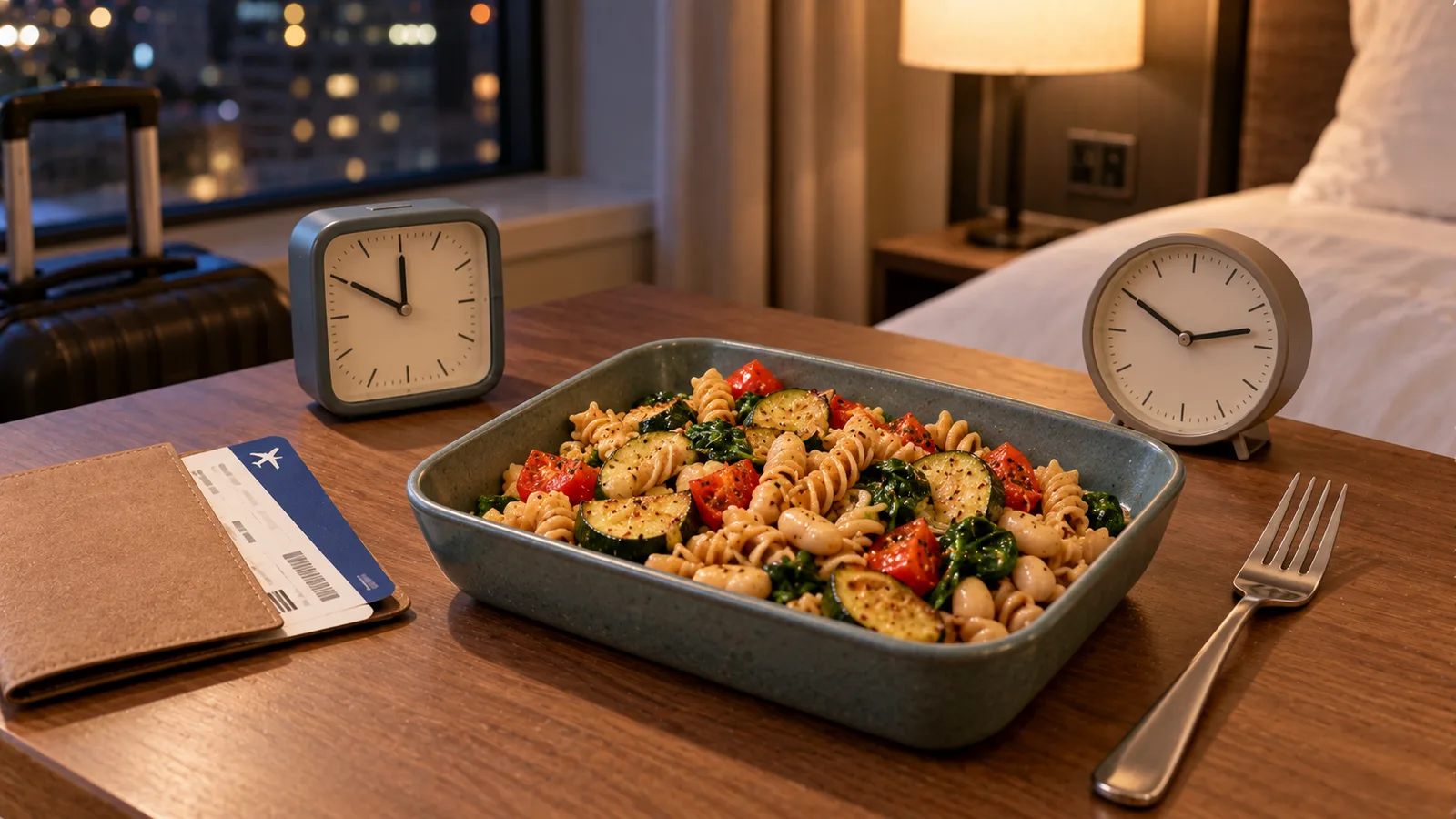
A meal at 12:15 a.m. creates a surprisingly practical food-tracking question:
Does it belong to yesterday or today?
Travel makes the problem harder. You can eat breakfast in Berlin, lunch during a flight and dinner in New York while your phone changes time zones during the same calendar day.
There is no universal rule requiring every food diary to organize meals in exactly the same way. For personal tracking, the most useful approach is usually to choose a consistent rule that preserves the context of your eating pattern without inventing or duplicating entries.
Calendar date and eating day are not always the same thing
A calendar day changes at midnight.
Your eating pattern does not necessarily do the same.
Imagine this schedule:
- breakfast: 09:00;
- lunch: 14:00;
- dinner: 20:30;
- snack after a late event: 00:20;
- sleep: 01:30.
Technically, the snack happened on the next calendar date.
Behaviorally, however, it may feel like the final eating occasion of the previous waking day.
Both interpretations are possible.
The important part is to decide what your diary is intended to show.
Two reasonable ways to handle meals after midnight
There are two common approaches.
1. Use the actual calendar date
Everything eaten after 00:00 goes on the new date.
Example:
| Time | Diary date |
|---|---|
| 20:30 Monday | Monday |
| 23:45 Monday | Monday |
| 00:20 Tuesday | Tuesday |
| 08:30 Tuesday | Tuesday |
This approach is simple and matches timestamps directly.
It can work especially well when:
- you want strict calendar-day totals;
- your app automatically assigns meals by timestamp;
- your schedule is relatively regular;
- you rarely eat after midnight.
2. Keep a late-night meal with the previous waking day
Some people prefer to treat a meal shortly after midnight but before sleep as part of the day that started when they woke up.
Example:
| Time | Eating day |
|---|---|
| 20:30 Monday | Monday |
| 23:45 Monday | Monday |
| 00:20 Tuesday before sleep | Monday eating day |
| 08:30 Tuesday after waking | Tuesday eating day |
This can make behavioral patterns easier to interpret for people who regularly stay awake past midnight.
Neither approach changes what you actually ate.
It only changes how the entries are grouped.
Which method should you choose?
Choose the method that best matches the question you are trying to answer.
If you mainly care about strict daily totals tied to calendar dates, use the actual date.
If you are examining your meals as part of a waking-and-sleeping cycle, grouping a shortly-after-midnight meal with the preceding waking day may sometimes be more intuitive.
The key is consistency.
If a 00:30 snack belongs to the previous eating day on Monday but to the new calendar day on Wednesday without a reason, comparisons become harder to interpret.
Do not move meals just to improve the numbers
Changing dates can become misleading if entries are moved simply because one day looks high.
Suppose Monday already contains 2,300 kcal and you eat a 300 kcal snack at 00:10 before going to bed.
Moving that snack to Tuesday solely to make Monday's total smaller does not improve the quality of the record.
Likewise, moving it back to Monday solely to keep Tuesday lower would not help.
Choose a rule based on timing and context, not on which daily total looks better.
What if you work night shifts?
Night shifts make midnight-based diary boundaries especially awkward.
Imagine:
- wake: 15:00;
- first meal: 16:00;
- start work: 20:00;
- meal break: 01:00;
- snack: 05:00;
- sleep: 08:00.
If every entry automatically changes day at midnight, one waking period is split across two calendar dates.
That may be completely acceptable if your goal is calendar-day reporting.
But if you are studying your eating pattern across each wake-work-sleep cycle, a waking-day approach may provide clearer context.
Whatever system you use, keep the original meal times whenever possible. The timestamps preserve information even if you later choose a different way to summarize the day.
What happens when you cross a time zone?
Travel introduces a different problem.
The clock itself changes.
Suppose you fly from Berlin to New York.
You eat:
- breakfast at 08:00 in Berlin;
- a meal during the flight;
- dinner at 19:00 in New York.
The travel day may be unusually long because you moved west.
Flying east can create the opposite situation: the local calendar advances quickly and your apparent day becomes shorter.
Trying to force such a travel day to resemble a normal 24-hour day can make the diary less useful.
Use local time for real-world context
For ordinary personal food tracking during travel, local time is often the easiest reference.
When you arrive in a new time zone, record meals according to the local time where you are eating them.
This keeps entries aligned with practical questions such as:
- Was this breakfast or dinner locally?
- How long had I been awake?
- Was I eating late at night at the destination?
- When did I sleep?
If your app stores timestamps internally, it may retain more precise time-zone information even while displaying local time.
Do not duplicate a meal when the phone changes time zones
A time-zone change should not create a second copy of something you already ate.
If you recorded an airport meal before departure and the phone later changes its clock, the meal remains one eating event.
Do not add it again simply because it now appears under a different local time or date.
The same principle applies to synced data.
One meal should remain one meal.
What if the app moves an entry to another date?
Some apps derive the displayed day directly from a timestamp.
When the time zone changes, an older entry may appear differently depending on how the software stores and converts time.
Before manually correcting anything, check:
- whether the meal itself is duplicated;
- whether only the displayed time changed;
- whether the displayed date changed;
- whether the original timestamp is still correct;
- whether the app allows the meal date or time to be edited.
If the meal exists only once and its underlying time is correct, avoid creating a second entry as a workaround.
Example: flying west
Imagine you leave Europe in the morning and arrive in North America in the afternoon local time.
Your diary contains:
| Event | Local context |
|---|---|
| Breakfast | Berlin morning |
| Airport snack | Berlin late morning |
| Flight meal | During travel |
| Arrival snack | New York afternoon |
| Dinner | New York evening |
This may produce an unusually high number of eating occasions on one displayed date.
That does not automatically mean the diary is wrong.
The travel day was unusually long.
Trying to delete or move legitimate meals just to make the day look normal would lose useful information.
Example: flying east
Now imagine traveling from New York to Berlin overnight.
You may have:
- breakfast and lunch in New York;
- dinner before departure;
- a flight meal;
- breakfast after arriving in Europe.
The local calendar can advance quickly.
One displayed date may contain relatively little food, while another contains several meals close together.
Again, this can be a real consequence of travel rather than a tracking error.
Should you calculate a normal daily average from a travel day?
A single long or short travel day can make a one-day total unusual.
If you are reviewing intake over several days, look at the broader period rather than trying to normalize the travel day by inventing missing meals or deleting real ones.
For example, a seven-day record containing one transatlantic travel day may still provide useful information when interpreted in context.
Keep the real entries and note the travel day if necessary.
Correcting a meal logged on the wrong date
Sometimes the issue is not philosophical — the entry is simply wrong.
Perhaps you entered a meal at 23:30 but accidentally selected tomorrow's date.
In that case:
- edit the existing meal;
- set the correct date and time;
- verify that the entry appears once;
- check that the daily totals updated;
- avoid creating a replacement before deleting the incorrect entry.
Editing is usually cleaner than creating a duplicate and trying to reconcile it later.
What if you remember the meal the next morning?
You can still log it.
Use the actual or best-known time of the meal rather than the time when you remembered to enter it, if your tracking system allows this.
Example:
You ate a snack at approximately 23:00 Monday but remembered it Tuesday morning.
Log it around:
Monday, 23:00
rather than:
Tuesday, 08:00
The diary should represent when the food was eaten, not merely when the entry was created.
If you do not know the exact time, a reasonable approximate time is usually more informative than pretending you know the exact minute.
Avoid false precision
Travel days, late-night meals and retrospective entries often involve uncertainty.
If you remember that you ate during a flight but cannot remember whether it was at 01:10 or 01:40, that distinction is unlikely to improve the usefulness of the diary.
Record the best information you actually have.
Do not invent an exact timestamp merely because the app accepts one.
Keep meal type separate from date
A meal can occur at an unusual clock time without needing a different nutritional interpretation.
For example, a night-shift worker might call a 17:00 meal "breakfast" because it is the first meal after waking.
Another person may call it dinner.
For tracking calories and nutrients, the label itself is usually less important than:
- what was eaten;
- how much was eaten;
- when it was eaten;
- the surrounding context if relevant.
Meal labels are organizational tools.
A practical rule for ordinary late nights
If you occasionally stay awake a little past midnight, choose one rule and keep it simple.
For example:
Rule A: after midnight always means the new calendar day.
Or:
Rule B: food eaten before the main sleep period belongs to the preceding waking day; food after waking starts the new eating day.
Either rule can produce a coherent diary if used consistently.
Avoid creating increasingly complicated exceptions for individual meals.
A practical rule for travel
For travel across time zones:
- record each meal once;
- preserve the best-known actual eating time;
- use local time for practical context;
- let unusually long or short travel days remain unusual;
- do not invent food to fill a short day;
- do not remove real food from a long day;
- annotate the travel day if it matters for later analysis.
This preserves what actually happened.
What matters for weekly analysis?
Over several days, consistent records matter more than making every calendar day look identical.
Imagine a three-day sequence:
| Day | Logged energy |
|---|---|
| Monday | 2,050 kcal |
| Tuesday travel day | 2,750 kcal |
| Wednesday | 1,850 kcal |
Tuesday may look unusual on its own.
That does not justify moving legitimate meals into Monday or Wednesday.
The correct interpretation requires the context that Tuesday was a longer travel day.
If you are examining longer-term intake, preserve the underlying record first and interpret unusual days second.
Common mistakes around midnight and time zones
Several tracking errors are easy to avoid.
Logging the same meal twice
This can happen after a time-zone change or sync.
Moving meals to make daily totals look better
Dates should represent your chosen tracking rule, not a desired calorie result.
Logging the entry time instead of the eating time
A meal remembered the next morning still belongs to the time it was eaten.
Inventing meals on short travel days
A short local day does not need to be filled artificially.
Deleting meals from long travel days
A long travel day can legitimately contain more eating occasions.
Changing your midnight rule repeatedly
Inconsistent rules make day-to-day comparisons harder.
A simple decision tree
When you are unsure where a meal belongs, ask:
Was the date or time entered incorrectly?
If yes, correct the existing entry.
If no:
Did the confusion occur only because the meal was shortly after midnight?
If yes, apply your normal calendar-day or waking-day rule.
If no:
Did you cross a time zone?
If yes, keep the meal once, preserve its real context and avoid forcing the travel day to resemble a normal day.
This handles most cases without complicated recalculation.
Consistency is more useful than perfection
Food diaries are records of real life, and real life does not always fit neatly between 00:00 and 23:59.
Late nights, shift work and travel can produce unusual dates and unusual daily totals.
That is not necessarily a problem.
The most useful approach is to preserve what actually happened, avoid duplicates, keep timestamps as accurate as reasonably possible and use the same grouping rule consistently.
A meal crossing midnight does not need to become a tracking puzzle.
Choose a clear rule, keep the original context and let genuinely unusual days remain unusual.