
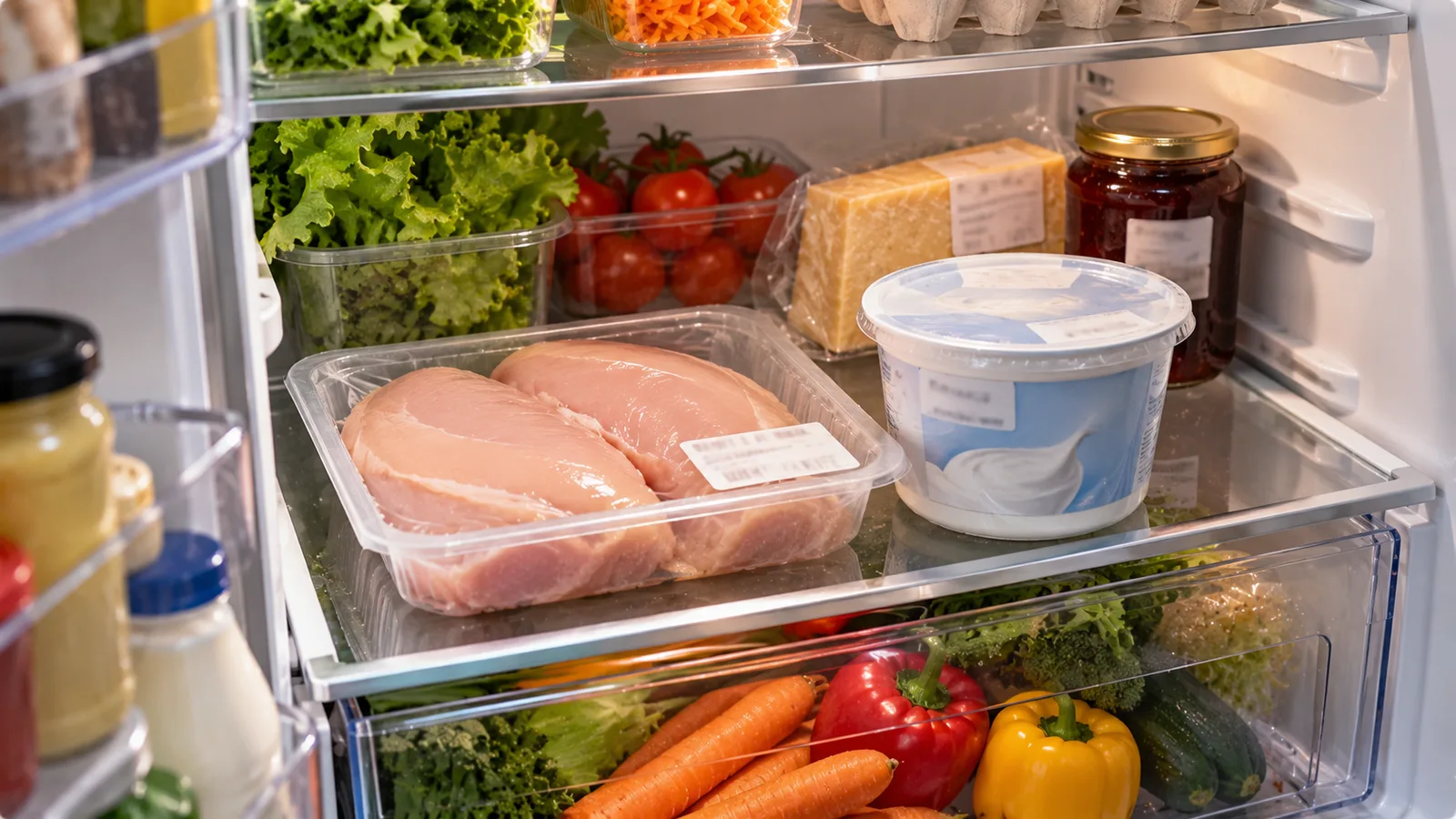
A weekly meal plan can fail for a surprisingly simple reason: the meals are scheduled in the wrong order.
You might buy fresh fish on Monday but plan to cook it on Friday, while a sealed packet of dry pasta sits in the cupboard with an earlier printed date. The two dates may look similar, but they do not mean the same thing.
In the European Union, “use by” is a food-safety date, while “best before” is primarily a quality date. Understanding that distinction helps you decide which foods must be used promptly, which can be checked later and which should never be eaten after their safety date.
This distinction is explained by the European Food Safety Authority (EFSA) and under EU food-information legislation, including Regulation (EU) No 1169/2011.
Best before and use by: the essential difference
| Label | Main meaning | What happens after the date? | Planning response |
|---|---|---|---|
| Use by | Food safety | Do not eat after the date | Cook, consume or appropriately freeze before the deadline |
| Best before | Expected quality | Food may remain suitable if correctly stored and not spoiled | Assess storage, packaging and condition before deciding |
| Use within X days of opening | Open-package storage limit | The original printed date may no longer be sufficient | Record the opening date and follow the shorter applicable instruction |
| Keep refrigerated / frozen | Storage condition | Incorrect storage may invalidate the printed shelf life | Follow the temperature and handling instructions |
Source: EFSA food date labelling and EFSA guidance on storage after opening.
The distinction applies to the wording on the actual product. It is not safe to classify an item only by its category. Different products within the same category can carry different date labels.
For example, one dairy product might have a use-by date, while another has a best-before date.
What does “use by” mean?
A use-by date is used where food may become unsafe after a relatively short period.
Foods bearing this date should not be eaten after it, even if they look and smell normal. Harmful microorganisms are not always detectable through sight or smell.
Examples can include certain fresh meat products, fish, ready-to-eat chilled foods and some dairy products. The exact label depends on the product.
EFSA specifically advises against eating food after its use-by date and stresses the importance of following storage instructions. See EFSA's consumer guidance.
What to do before the use-by date
If you will not eat the food in time, consider one of three options:
- Move the meal earlier in the week.
- Cook the food by the use-by date and follow appropriate guidance for cooling, refrigeration and leftovers.
- Freeze the product by the use-by date if freezing is appropriate for that product and its instructions.
The UK Food Standards Agency similarly advises cooking or freezing food before the use-by deadline, not waiting until the date has passed.
Freezing does not make food that has already become unsafe safe again.
What does “best before” mean?
A best-before date indicates how long a product is expected to retain its intended quality under the specified storage conditions.
After that date, flavor, aroma or texture may deteriorate, but the printed date alone does not establish that the food has become unsafe.
This is the distinction described by the European Commission.
Products that may carry best-before dates include certain dry foods, cereals, pasta, biscuits and shelf-stable packaged goods.
However, a best-before date is not permission to ignore spoilage, damaged packaging, contamination or improper storage.
For example, discard food with visible mold where it should not be present, or food from a swollen or leaking can. Do not taste questionable food as a safety test.
Best before means “assess the product,” not “automatically safe forever.”
Why smell and appearance cannot override a use-by date
Sensory checks can sometimes reveal spoilage, but they cannot reliably identify all dangerous microorganisms.
A product may look ordinary while presenting a microbiological hazard.
That is why EFSA advises that use-by foods must not be eaten after the printed date even when they appear normal. EFSA.
The same reasoning means that a suspicious smell before the use-by date is not something to ignore. A printed date assumes proper storage and handling.
If food has been left unrefrigerated when refrigeration was required, the label alone cannot guarantee its safety.
The third deadline: after opening
A product may have a best-before or use-by date several days or weeks away but a separate instruction such as:
- Refrigerate after opening.
- Consume within two days of opening.
- Keep covered and use within three days.
The opened-package instruction can become the more immediate deadline.
Opening may introduce microorganisms through hands, utensils or the surrounding environment. EFSA's scientific work explains why shelf-life guidance may change after a package is opened. EFSA.
For meal planning, record both dates:
Printed date + opening date + manufacturer's after-opening instruction.
Use the applicable earlier deadline. Do not assume the unopened-package date still applies unchanged.
Build a weekly meal plan around dates
Instead of scheduling meals solely by preference, sort groceries into three groups.
Group A: safety-critical foods
These are products with use-by dates.
Place them in the earliest appropriate meal slots, or arrange safe freezing before their deadlines.
Do not rely on a last-minute smell test.
Group B: opened perishables
These include products whose after-opening instructions now apply.
They may need to be used before unopened products with earlier printed dates.
Group C: quality-dated pantry foods
These are products marked best before, stored as directed and still in acceptable condition.
They are generally more flexible in a weekly plan.
The aim is to protect safety-critical foods first without unnecessarily discarding usable pantry items.
Worked example: shopping on Monday
Imagine buying the following groceries on Monday.
The dates are fictional and are used only to demonstrate scheduling.
| Product | Label or instruction | Planned action |
|---|---|---|
| Fresh fish | Use by Tuesday | Cook Monday or Tuesday, or freeze in time |
| Fresh chicken | Use by Wednesday | Schedule Tuesday or Wednesday, or freeze appropriately |
| Chilled prepared salad | Use by Thursday | Eat before the deadline |
| Opened yogurt | Consume within two days of opening | Record opening day and follow instruction |
| Dry pasta | Best before last week | Check storage, packaging and condition; do not treat date alone as proof of danger |
| Unopened oats | Best before next month | Keep for later meals |
A reasonable schedule would put the fish and chicken first, then the chilled salad.
The pasta and oats can fill flexible meal slots, subject to their actual condition and storage.
The key is not to cook everything immediately. It is to avoid placing foods with safety deadlines too late in the week.
A five-minute refrigerator check
Before generating or changing a meal plan:
- Look for products marked use by.
- Note the nearest dates.
- Check which packages have already been opened.
- Read any after-opening and storage instructions.
- Move suitable meals forward or arrange timely freezing.
- Check best-before products separately for quality and storage issues.
A simple note can be enough:
| Food | Date type | Date | Opened? | Next action |
|---|---|---|---|---|
| Fish | Use by | Tuesday | No | Cook Tuesday |
| Yogurt | Use within two days of opening | Opened Monday | Yes | Follow package deadline |
| Pasta | Best before | Passed | No | Assess before use |
This is more useful than a single undifferentiated “expires soon” list.
Can cooking extend the time available?
Cooking a use-by food before its deadline may allow it to be kept as a cooked leftover, provided safe cooking, rapid cooling and suitable refrigeration are followed.
That does not mean the original raw food can be kept indefinitely.
EFSA's consumer guidance describes cooking before the use-by date and then using the cooked food within a short refrigerated period or freezing it for later. EFSA.
Follow product-specific instructions and local food-safety guidance. Different cooked foods and storage conditions may require different handling.
If you cannot confidently store the cooked food safely, freezing an appropriate product before its deadline may be the better planning choice.
When freezing helps—and when it does not
Freezing can prevent an appropriately handled product from reaching its use-by deadline while still unfrozen.
It does not erase earlier unsafe storage or reverse spoilage.
Before freezing:
- Check whether the product is suitable for freezing.
- Freeze before the use-by date.
- Label the package with the freezing date.
- Follow safe thawing and subsequent cooking instructions.
EFSA notes that microorganisms may survive freezing and resume growth during thawing. It recommends careful thawing, including refrigeration where appropriate. EFSA.
Do not assume that every previously frozen and thawed product can simply be refrozen.
How date confusion affects food waste
The European Commission reports that a 2018 study estimated that up to 10% of annual EU food waste was linked to date marking.
This is an estimate about date-label confusion and related practices, not a claim that every item past its best-before date is safe.
Reducing unnecessary waste requires two separate habits:
Respect safety dates strictly, while making informed quality assessments for best-before products.
These habits are complementary, not contradictory.
Mistakes that disrupt meal planning
| Mistake | Why it matters | Better approach |
|---|---|---|
| Treating every date as a safety deadline | May create unnecessary waste | Read the actual wording |
| Ignoring a use-by date because food smells fine | Sensory checks cannot rule out hazards | Follow the use-by deadline |
| Planning fresh fish for the end of the week without checking its label | The meal may fall after the safety date | Schedule by the actual date |
| Forgetting when a package was opened | Opened shelf life may be shorter | Record opening date |
| Freezing food after its use-by date | Freezing does not restore safety | Freeze in time |
| Using only a calendar date without checking storage | Dates assume proper handling | Follow storage instructions |
A practical rule for your next grocery trip
Before adding a perishable item to your basket, ask:
On which day will I actually use this?
If the answer falls after its use-by date, choose a different pack, change the meal schedule or plan appropriate freezing.
For a best-before item, ask a different question:
Has it been stored correctly, and is it still suitable for use?
The safest and least wasteful weekly plan treats these as two different decisions.
Food dates are not just labels to read when cleaning the refrigerator. They are useful scheduling information at the moment you shop, open packages and assign meals to days.