
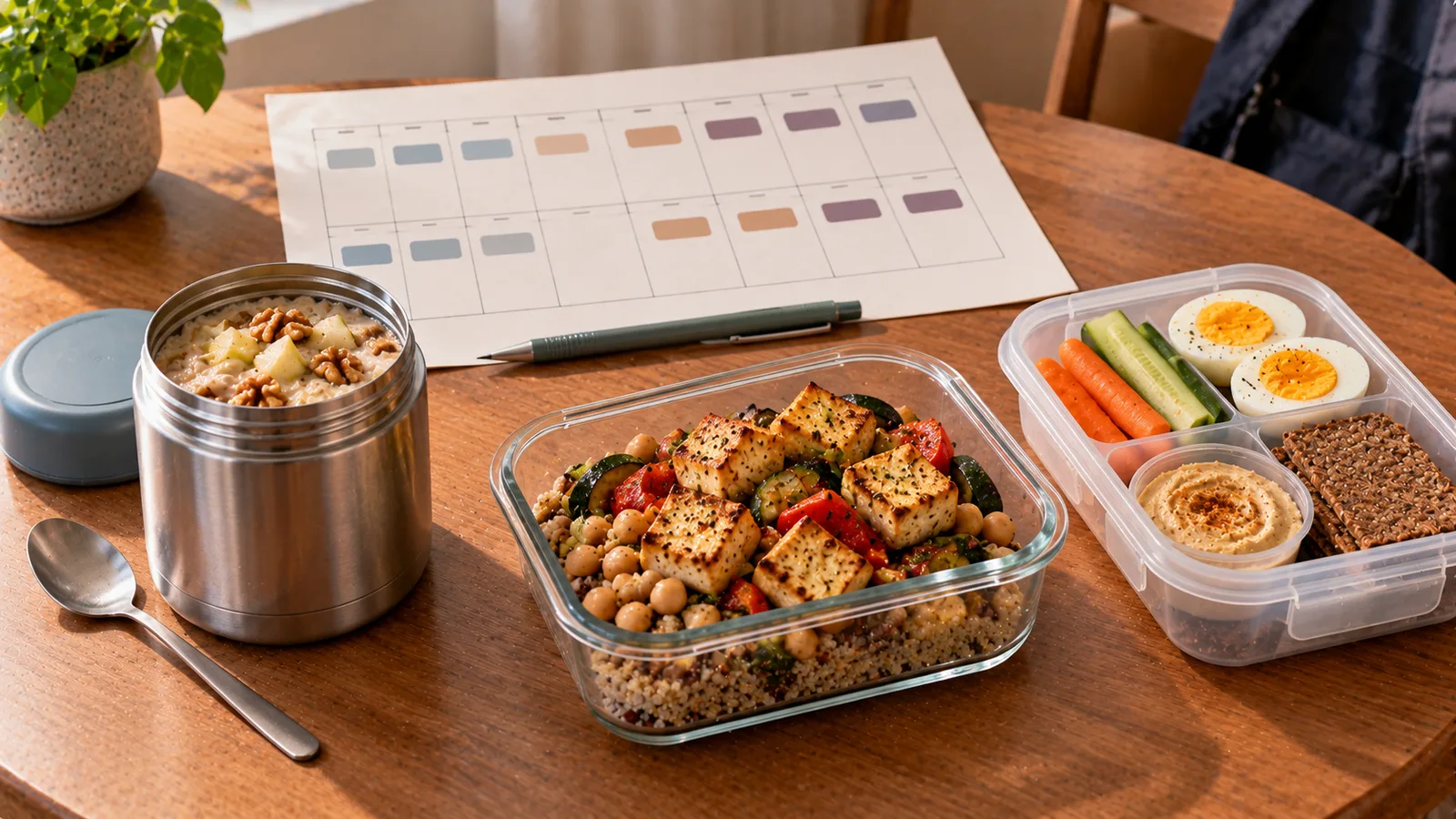
Meal planning becomes more complicated when your work schedule changes from week to week.
A meal plan built around breakfast at 7:00, lunch at 13:00 and dinner at 19:00 may work during a normal day shift. It becomes much less useful when next week starts with evening shifts and ends with nights.
For rotating-shift workers, the solution is usually not to create a completely different diet for every shift.
A more practical approach is to build a small number of meal blocks that can move with your waking and working hours.
Plan around your waking day, not the clock
Instead of labeling every meal strictly as breakfast, lunch and dinner, think in terms of:
- first meal after waking;
- main meal before or during work;
- second substantial meal;
- optional snack when needed.
The actual clock times can change.
For example:
| Shift | First meal | Main meal | Later meal |
|---|---|---|---|
| Day shift | 05:30–06:30 | 11:00–13:00 | 17:00–19:00 |
| Evening shift | 09:00–10:30 | 14:00–16:00 | 21:00–23:00 |
| Night shift | 15:00–17:00 | 20:00–22:00 | during night shift |
These are examples rather than rules. Your commute, breaks, sleep schedule and appetite may require different times.
The useful principle is that the meal structure stays recognizable even when the clock changes.
Build three shift templates
If your rota regularly includes day, evening and night shifts, create one reusable template for each.
Day-shift template
A typical structure might be:
- meal after waking;
- packed meal at work;
- optional snack;
- dinner after work.
Example:
First meal: eggs, whole-grain toast and fruit.
Work meal: rice bowl with chicken, tofu or beans and vegetables.
Snack: yogurt and fruit.
Dinner: potatoes, vegetables and a protein source.
Evening-shift template
You may have more time to cook before work.
Example:
First meal: oats with skyr and berries.
Main pre-work meal: pasta with lentil sauce and vegetables.
Work meal: wrap with eggs, beans or another protein source.
Optional later snack: yogurt, fruit or a sandwich.
Night-shift template
A night shift does not automatically require an entirely separate set of foods.
Example:
Meal after waking: rice, vegetables and tofu.
Meal before or early in the shift: pasta with tomato-lentil sauce.
Later meal or snack: yogurt with oats, fruit and nuts.
After the shift: a smaller meal if you are hungry before sleep.
The exact pattern should fit your appetite and sleep rather than forcing meals at predetermined clock times.
Use anchor meals
An anchor meal is a meal that remains relatively predictable regardless of the shift.
For example, your first meal after waking might usually contain:
- eggs or yogurt;
- oats or bread;
- fruit.
The time changes, but the meal requires almost no new planning.
You can create another anchor for work:
- grain or potatoes;
- protein source;
- vegetables;
- sauce.
Then vary the ingredients instead of reinventing the structure.
Separate meal planning from meal timing
These are two different decisions.
First decide what food you need for the next several days.
Then decide where each meal fits around each shift.
For example, you might prepare:
- 4 portions of rice;
- 3 portions of roasted vegetables;
- 3 portions of lentils;
- 2 portions of chicken or tofu;
- boiled eggs;
- yogurt;
- fruit.
Those foods can then be rearranged differently for a day shift and an evening shift.
This is more flexible than preparing containers labeled Monday breakfast, Monday lunch, Monday dinner and so on.
Plan the transition days first
The most difficult part of rotating-shift meal planning is often not the shifts themselves.
It is the transition between them.
Examples include:
- final day shift before an evening shift;
- evening shift followed by a night shift;
- final night shift followed by days off.
These days can involve unusual sleep, lower energy for cooking and meals at unfamiliar times.
When you receive your rota, identify these transition days before planning the easier days.
Give them the simplest meals.
For example:
- freezer meal;
- soup with bread;
- eggs and potatoes;
- pasta with a prepared sauce;
- rice bowl using leftovers.
Avoid assigning your most complicated recipe to the day when your sleep schedule is changing.
Cook components instead of seven complete meals
Component preparation works particularly well with rotating shifts.
Instead of preparing seven identical meal boxes, prepare building blocks.
Protein sources
Examples:
- cooked lentils;
- beans;
- tofu;
- eggs;
- chicken or fish if included in your diet;
- yogurt or cottage cheese.
Carbohydrate sources
Examples:
- rice;
- potatoes;
- pasta;
- bulgur;
- bread;
- tortillas.
Vegetables
Examples:
- roasted vegetables;
- frozen vegetables;
- salad vegetables;
- vegetable soup.
Flavor
Examples:
- yogurt-herb sauce;
- tomato sauce;
- salsa;
- pesto;
- soy-ginger sauce.
The same components can become different meals.
Rice + tofu + vegetables + soy sauce can become one meal.
Rice + beans + vegetables + salsa can become another.
Example: three-day rotating-shift plan
Suppose your rota is:
- Monday: day shift;
- Tuesday: evening shift;
- Wednesday: night shift.
A flexible plan could look like this.
Monday — day shift
After waking: skyr, oats and banana.
At work: lentil-rice bowl with roasted vegetables.
After work: potatoes, eggs and salad.
Tuesday — evening shift
After waking: eggs, bread and fruit.
Before work: pasta with lentil tomato sauce.
At work: rice bowl with tofu and vegetables.
Wednesday — night shift
After waking: potatoes, eggs and vegetables.
Before work: rice with tofu and broccoli.
During shift: yogurt, oats, berries and nuts.
Notice that the ingredient list remains relatively small even though the meal timing changes.
Keep a shift-friendly emergency meal
Rotas change. Overtime happens. Sleep may run longer than planned.
Keep at least one meal that requires almost no effort.
Examples include:
- frozen homemade soup;
- frozen portion of chili;
- eggs with toast;
- canned beans with rice;
- yogurt, oats and fruit;
- frozen vegetables with noodles and tofu.
The purpose is not to create the perfect meal.
It is to avoid having the entire week's plan collapse because one cooking session did not happen.
Match package sizes to the rota
Before buying food, check how many meals you will realistically eat at home and at work.
Suppose you have:
- three work meals to pack;
- two meals at home;
- one dinner with friends;
- one transition day where you expect to use the freezer.
You do not need groceries for seven completely separate dinners.
This prevents overbuying when a busy rota makes the week look more complicated than it actually is.
Use the freezer for schedule uncertainty
Rotating schedules make exact forecasts difficult.
The freezer provides flexibility.
Useful freezer options can include:
- soup;
- chili;
- curry;
- cooked rice;
- bread;
- tortillas;
- portions of prepared protein foods;
- selected cooked meals.
Check appropriate food-storage guidance for each item.
A useful strategy is to keep one or two portions unassigned.
They become backup meals for unexpected overtime, changed shifts or missed cooking sessions.
Pack food before you become tired
If possible, pack the next work meal while you still have energy.
For example:
- after cooking dinner;
- before an evening shift;
- shortly after waking for a night shift.
Relying on yourself to prepare a complicated meal immediately before leaving for work is less robust when sleep and shift times change.
Keep work meals easy to eat
The best packed meal is not necessarily the most elaborate one.
Consider:
- how long your break is;
- whether you have a refrigerator;
- whether you have a microwave;
- whether you can sit down;
- whether the meal travels well.
Useful formats include:
- bowls;
- wraps;
- sandwiches;
- pasta salads;
- soups in appropriate containers;
- yogurt with separate toppings.
Your meal plan should reflect the conditions at your workplace, not only what looks good in a weekly calendar.
Avoid planning every hour
A rotating-shift plan should create structure without becoming fragile.
If the plan says:
- eat at exactly 15:00;
- snack at exactly 18:15;
- eat again at exactly 22:30;
then a delayed break can make the plan feel broken.
A more flexible plan might say:
- substantial meal before shift;
- packed meal during main break;
- optional snack if needed;
- meal after shift depending on appetite.
This structure survives schedule changes much better.
Use a repeating rota when your work pattern repeats
If your shifts follow a predictable cycle, your meal plan can follow the same cycle.
For example:
Days 1–2: day-shift template
Days 3–4: evening-shift template
Days 5–6: night-shift template
Days 7–8: recovery or days-off template
Once you find meals that work well in each block, save them as a reusable framework.
You then change individual recipes rather than rebuilding the entire planning system every rota.
Keep days off flexible
Days off do not need to copy your workday meal schedule.
Use them for:
- cooking;
- grocery shopping;
- using leftovers;
- social meals;
- restocking freezer portions.
If your sleep is changing after night shifts, appetite and meal timing may also shift.
A flexible day-off plan handles this better than forcing normal clock-based meal times immediately.
A simple grocery framework for rotating shifts
A compact grocery list might include:
Protein foods
- eggs;
- yogurt or skyr;
- beans or lentils;
- tofu, tempeh or another preferred protein source.
Carbohydrate foods
- oats;
- rice;
- potatoes;
- pasta;
- bread or tortillas.
Produce
- several durable vegetables;
- one or two faster-to-use fresh vegetables;
- frozen vegetables;
- fruit.
Convenience and backup foods
- canned beans;
- canned tomatoes;
- frozen meal portions;
- simple sauces;
- freezer bread.
The goal is not to create an enormous list.
It is to buy ingredients that can move between different shift templates.
Review what actually happened
After one rota, compare the plan with reality.
Ask:
- Which meals were easy to take to work?
- Which meals were repeatedly skipped?
- Did I buy too much fresh food?
- Which shift made cooking hardest?
- Did I need more freezer meals?
- Were some portions too large or too small for a particular shift?
- Which transition day caused the most disruption?
Then modify the next rota.
This turns meal planning into a system based on your actual schedule rather than an idealized routine.
A practical planning sequence
When your next rota arrives:
- Mark each day as day, evening, night, off or transition.
- Identify the difficult transition days.
- Choose a meal template for each shift type.
- Count how many packed work meals you need.
- Choose a few overlapping ingredients.
- Assign the simplest meals to transition days.
- Prepare flexible components.
- Keep at least one backup meal.
- Pack work meals in advance where possible.
- Adjust the next plan based on what you actually used.
The key idea is simple:
do not force rotating shifts into a fixed clock-based meal plan.
Build a small set of reusable meal structures and move them with your work and sleep schedule.
That makes the plan easier to maintain when your rota changes again.