
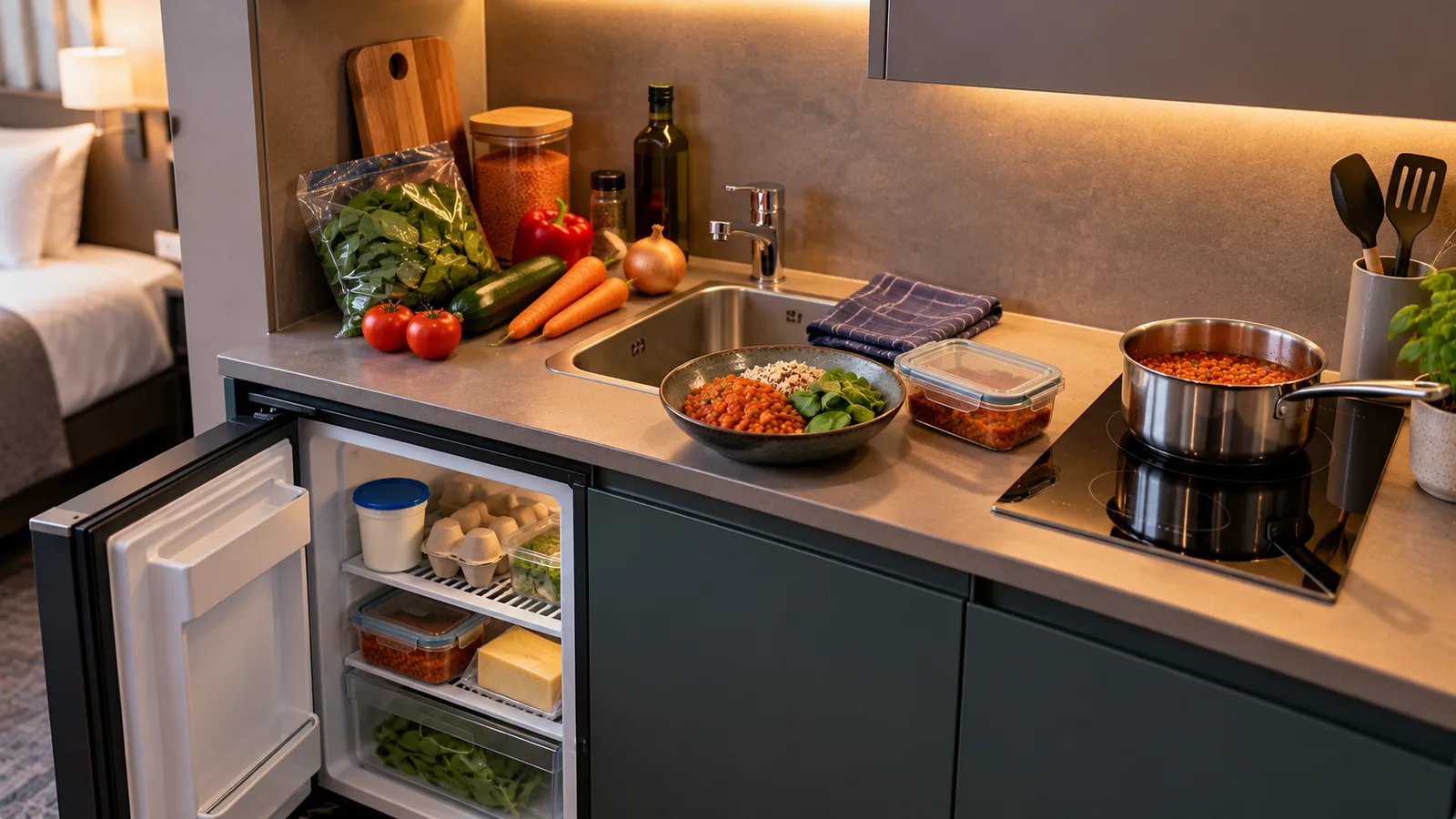
A hotel kitchenette gives you more flexibility than a standard hotel room, but it is not the same as cooking at home.
You may have only one or two burners, a microwave, a small refrigerator and a limited set of pans, knives and containers. Grocery packages can also be awkward because many are sized for households rather than a short stay.
A useful hotel meal plan therefore starts with the kitchen you actually have, then builds a small group of meals around ingredients that can be reused before checkout.
This guide uses a four-day stay for one adult as a practical example.
Check the kitchenette before buying groceries
Hotel kitchenettes vary considerably.
Before shopping, check what is actually available.
Useful items include:
- refrigerator;
- freezer compartment;
- microwave;
- stovetop or hot plate;
- oven;
- kettle;
- frying pan;
- saucepan;
- cutting board;
- knife;
- plates and bowls;
- cutlery;
- cooking utensils;
- food-storage containers.
Do not assume that "kitchenette" means a fully equipped kitchen.
If there is no oven, a meal plan based on roasting vegetables will not be practical.
If there is only one saucepan, choose meals that can be cooked sequentially rather than recipes requiring several pots at once.
Start with refrigerator capacity
A small hotel refrigerator can become the main constraint.
Before buying several days of food, look at:
- usable shelf space;
- door storage;
- whether there is a freezer compartment;
- whether the refrigerator appears cold enough for perishable foods.
Large containers, multipacks and oversized beverage bottles can consume most of the available space.
For a short stay, smaller packages can be more practical even when their price per kilogram is slightly higher.
The goal is not necessarily the lowest unit price. It is to buy an amount you can store and realistically finish.
A simple four-day structure
Instead of planning twelve completely different meals, reuse a small set of ingredients.
For example:
| Day | Breakfast | Lunch | Dinner |
|---|---|---|---|
| 1 | Yogurt, oats and banana | Sandwich with turkey, cheese and vegetables | Tomato-bean pasta |
| 2 | Eggs and toast | Leftover tomato-bean pasta | Chicken, rice and vegetables |
| 3 | Yogurt, oats and fruit | Chicken rice bowl | Vegetable omelet with bread |
| 4 | Eggs and toast | Leftover rice bowl | Quick chickpea tomato skillet |
This structure keeps the ingredient list relatively short while avoiding identical meals every day.
Grocery list for the four-day example
For one adult, a practical starting list might be:
Protein and dairy
- 6 eggs
- 300–400 g chicken breast or thigh
- 150 g sliced turkey or another sandwich protein
- 150 g cheese
- 500 g plain yogurt
- 1 can chickpeas, about 240 g drained
- 1 can beans, about 240 g drained
Grains and starches
- 250 g dry pasta
- 250 g dry rice
- 250–300 g oats
- 1 small loaf or package of bread
Vegetables
- 2 bell peppers
- 1 cucumber
- 3–4 tomatoes
- 1 onion
- 1 small bag of spinach or mixed greens
- 1 small bag frozen mixed vegetables if freezer space is available
Fruit
- 2 bananas
- 2 apples or other durable fruit
Pantry-style ingredients
- 1 small jar or carton tomato sauce
- small bottle of cooking oil
- salt
- black pepper
- one or two versatile seasonings
Exact quantities depend on appetite and calorie needs. The important principle is to choose ingredients that appear in several meals.
Day 1
Breakfast: yogurt, oats and banana
Combine approximately:
- 200 g plain yogurt;
- 50–60 g oats;
- 1 banana.
This meal requires no cooking and is useful on arrival day when you may not yet want to use the kitchenette.
Lunch: sandwich with vegetables
Use:
- bread;
- sliced turkey;
- cheese;
- tomato;
- cucumber or greens.
Avoid buying several different sandwich fillings for a four-day stay. One protein and one cheese can cover multiple meals or snacks.
Dinner: tomato-bean pasta
For approximately two portions:
- 160 g dry pasta;
- 1 can beans, drained;
- about 300 g tomato sauce;
- half an onion;
- 1 bell pepper;
- 10 g cooking oil;
- seasoning.
Cook enough for dinner plus the following day's lunch.
This immediately reduces the amount of cooking needed on Day 2.
Day 2
Breakfast: eggs and toast
Cook 2 eggs and serve with bread and some remaining tomato.
A frying pan is enough.
If the kitchenette does not have a frying pan but has a microwave, eggs can also be prepared using an appropriate microwave-safe method and container.
Lunch: leftover pasta
Reheat the second portion of the tomato-bean pasta.
Leftovers are particularly useful in a hotel kitchenette because they reduce:
- cooking time;
- dishwashing;
- the number of utensils needed;
- unused ingredients.
Dinner: chicken, rice and vegetables
For two portions, use approximately:
- 300–400 g chicken;
- 140–160 g dry rice;
- 250–300 g vegetables;
- 10–15 g oil;
- seasoning.
Cook enough for dinner and the following day's lunch.
If you only have one burner, cook the rice first and cover it while cooking the chicken and vegetables.
If you have two burners, both components can cook at the same time.
Day 3
Breakfast: yogurt, oats and fruit
Use the remaining yogurt with another 50–60 g oats and an apple or other fruit.
This helps finish the yogurt container rather than opening another breakfast product.
Lunch: chicken rice bowl
Use the refrigerated portion from the previous evening.
Add fresh cucumber, tomato or greens if available.
Dinner: vegetable omelet
Use:
- 2–3 eggs;
- remaining bell pepper;
- some onion;
- spinach or greens;
- a small amount of cheese.
Serve with bread.
This meal is useful near the end of a stay because it can absorb small amounts of vegetables left from earlier meals.
Day 4
Breakfast: eggs and toast
Use the remaining eggs and bread.
If there is fruit left, add it rather than buying another breakfast package on the final day.
Lunch: leftover rice bowl
If you intentionally cooked two portions on Day 2 and still have the second portion available within an appropriate refrigerated-storage period, use it for lunch.
Alternatively, use remaining bread, cheese and vegetables for a simple sandwich.
Dinner: chickpea tomato skillet
For a quick final meal:
- 1 can chickpeas, drained;
- remaining tomato sauce;
- remaining onion;
- any vegetables that still need to be used;
- a small amount of oil;
- seasoning.
Heat everything together in a frying pan or saucepan.
Serve with remaining rice or bread if available.
This final meal is intentionally flexible so that ingredients do not have to be discarded before checkout.
Build meals around ingredient overlap
Ingredient overlap is one of the most useful strategies for short hotel stays.
For example:
Tomatoes can be used in:
- sandwiches;
- egg breakfasts;
- rice bowls;
- omelets.
Onion can be used in:
- pasta sauce;
- chicken and vegetables;
- omelets;
- chickpea skillet.
Bread can cover:
- toast;
- sandwiches;
- a side for eggs;
- a side for the final meal.
This is more efficient than buying ingredients for four unrelated recipes.
Avoid ingredients with only one purpose
For a short stay, be cautious with ingredients that appear in only one meal.
Suppose a recipe requires:
- a full jar of a special sauce;
- one specific herb;
- a large bag of flour;
- a bottle of specialty oil.
If you need only a small amount once, most of the purchase may remain when you leave.
Either choose a substitute already used elsewhere in the plan or select a different recipe.
Package size matters more in a hotel
At home, buying a larger package can make sense because leftovers remain available next week.
In a hotel, checkout creates a hard deadline.
Suppose:
- 500 g yogurt costs €1.80;
- 1 kg yogurt costs €2.70.
The larger container is cheaper per kilogram.
But if you can eat only 500 g before checkout, buying 1 kg does not save money.
The relevant cost is the amount you actually use.
Plan around the checkout date
Work backward from your final meal.
Avoid opening large new packages on the final evening.
By the last day, your plan should increasingly use:
- leftovers;
- eggs;
- bread;
- remaining vegetables;
- opened sauces;
- canned foods.
This reduces food waste and makes packing easier.
One-pan meals are especially useful
A hotel kitchenette often has limited cookware and limited washing space.
Meals that can be prepared in one pan or one pot are therefore particularly practical.
Examples include:
- bean pasta sauce;
- chickpea skillet;
- omelet;
- vegetable rice;
- soup;
- simple stir-fry.
The objective is not merely convenience. Fewer cooking vessels also make a small kitchenette easier to manage.
What if you only have a microwave?
A microwave-only kitchenette requires a different plan.
Useful options can include:
- microwave rice;
- canned beans;
- pre-cooked lentils;
- frozen vegetables;
- eggs prepared safely in a microwave-compatible container;
- oatmeal;
- yogurt;
- sandwiches;
- salads;
- pre-cooked proteins.
Do not plan stovetop recipes if no stovetop exists.
The equipment check should happen before the grocery shop, not after it.
What if you have no freezer?
Do not rely on frozen foods simply because they are convenient at home.
Choose refrigerator-stable quantities you can finish within the stay.
For vegetables, this may mean buying:
- one or two individual peppers instead of a large frozen bag;
- a small salad package;
- carrots;
- tomatoes;
- cucumber.
Cooking oil can be an awkward purchase
A full-size bottle of oil may be excessive for a three- or four-day stay.
Possible solutions include:
- buying the smallest available bottle;
- choosing meals that require little oil;
- using a small amount of butter if it is already part of another meal;
- checking whether the accommodation provides basic cooking oil.
Do not assume shared condiments are available unless the hotel explicitly provides them.
Seasonings: keep the list short
You do not need a complete spice cabinet.
For a short stay, a versatile combination might be:
- salt;
- black pepper;
- paprika or mixed herbs.
If you already travel with small seasoning packets, they can reduce unnecessary purchases.
Otherwise, choose meals that work with one or two seasonings.
Use canned foods strategically
Canned beans and chickpeas are useful because unopened cans do not occupy refrigerator space.
Open them only when needed.
After opening, transfer unused contents to an appropriate covered container and refrigerate them rather than storing leftovers in an opened can.
For a short stay, recipes that use the entire drained can are particularly convenient.
Track drained weight when it matters
A can may state:
- net weight: 400 g;
- drained weight: 240 g.
If your recipe uses drained beans, the 240 g drained weight is the relevant amount.
This matters both for recipe planning and nutrition tracking.
A 400 g can does not necessarily provide 400 g of beans after the liquid is removed.
Plan leftovers deliberately
Leftovers should be part of the plan, not an accidental result.
Instead of:
"Maybe there will be pasta left."
Plan:
"Cook two portions of pasta on Day 1. Eat one tonight and refrigerate one for Day 2 lunch."
This makes grocery quantities easier to estimate and prevents leftovers from competing with another already-planned meal.
Label leftovers if necessary
In a small hotel refrigerator, several containers can quickly become confusing.
If you prepare multiple meals, note:
- what the food is;
- when it was cooked.
Even a simple note can help you use older food first.
Keep perishable food safely chilled
A hotel kitchenette does not change normal food-safety requirements.
Perishable foods such as:
- cooked meat;
- cooked rice;
- dairy products;
- eggs;
- prepared leftovers
should be stored at safe refrigeration temperatures and not left at room temperature for extended periods.
If the refrigerator does not appear to be cooling properly, do not rely on it for storing highly perishable food.
Cool leftovers promptly
Do not leave a large hot pot sitting on the counter for hours.
Divide leftovers into practical portions and refrigerate them promptly using suitable containers.
Smaller portions also cool more efficiently and are easier to reheat later.
Reheat only what you plan to eat
If you have two leftover portions, reheat one rather than repeatedly heating and cooling the entire batch.
This is more convenient and helps maintain sensible food-handling practices.
Grocery quantities for two people
For two adults, do not automatically double every package.
Some items may already come in useful two-person sizes.
For example, you might increase:
- chicken from 350 g to 650–700 g;
- dry rice from 150 g to around 300 g;
- eggs from 6 to 10–12;
- yogurt from 500 g to 750 g–1 kg.
But one bottle of oil, one onion or one seasoning container may already be sufficient.
Scale ingredients based on actual usage rather than multiplying the shopping list mechanically.
A simple planning formula
For each ingredient, ask three questions:
- How many meals use it?
- How much will those meals require?
- Can I finish the package before checkout?
For example, if you need tomatoes for:
- two sandwiches: 120 g;
- one breakfast: 80 g;
- two rice bowls: 150 g;
- one omelet: 100 g;
total planned tomato use is:
120 + 80 + 150 + 100 = 450 g
Buying approximately 450–500 g makes more sense than buying a large multipack simply because it has a lower unit price.
When convenience foods make sense
A hotel stay is one situation where paying slightly more for convenience can be rational.
Examples include:
- pre-washed salad;
- microwave rice;
- pre-cut vegetables;
- smaller packages;
- cooked legumes;
- individually portioned foods.
At home, you might choose the cheaper bulk alternative.
In a hotel, the smaller option can reduce:
- preparation time;
- equipment requirements;
- food waste;
- refrigerator use.
Evaluate the total situation rather than price per kilogram alone.
Eating out and cooking can coexist
Meal planning in a hotel kitchenette does not require cooking every meal.
If you know you will eat dinner at a restaurant on Day 3, do not buy groceries for a Day 3 dinner "just in case."
A hybrid plan can be more realistic:
- breakfast in the room;
- packed or leftover lunch;
- restaurant dinner.
The important part is to align grocery quantities with the meals you genuinely expect to prepare.
Example of avoiding overbuying
Suppose you are staying four nights and plan:
- four breakfasts in the hotel;
- three lunches;
- two dinners;
- three restaurant meals.
You need groceries for nine meals, not twelve.
Buying as though every meal will be cooked in the kitchenette is likely to leave excess food.
Nutrition does not need to be perfect for a short stay
A short hotel meal plan can still include a useful mix of:
- protein foods;
- vegetables and fruit;
- grains or other starches;
- dairy or alternatives;
- fats.
But you do not need to engineer every meal to identical macro targets.
It is usually more practical to look at the whole day or several days rather than trying to make each hotel meal nutritionally identical.
Example daily adjustment
Suppose breakfast is relatively light:
- yogurt;
- oats;
- banana.
Lunch is a moderate sandwich.
Dinner can then be a larger meal with:
- chicken;
- rice;
- vegetables.
On another day, a larger egg breakfast may be followed by a lighter leftover lunch.
Meal planning works better when portions can adapt rather than every meal being fixed to the same calorie value.
Before checkout
On the final day, inspect the refrigerator before buying anything else.
Prioritize:
- cooked leftovers;
- opened dairy;
- opened vegetables;
- bread;
- fruit;
- unopened shelf-stable foods.
Unopened shelf-stable products are easier to take with you than refrigerated leftovers.
If practical, plan the final meals around the ingredients that cannot travel easily.
Four-day plan at a glance
A compact version of the plan:
Day 1
- yogurt, oats and banana;
- turkey and cheese sandwich with vegetables;
- tomato-bean pasta, cook two portions.
Day 2
- eggs and toast;
- leftover pasta;
- chicken, rice and vegetables, cook extra for lunch.
Day 3
- yogurt, oats and fruit;
- chicken rice bowl;
- vegetable and cheese omelet with bread.
Day 4
- eggs and toast;
- remaining rice bowl or sandwich;
- chickpea and tomato skillet using remaining vegetables.
The plan deliberately reuses ingredients while still changing the format of the meals.
The main principle
Hotel-kitchenette meal planning is less about finding special "hotel recipes" and more about controlling constraints.
Start with:
- available equipment;
- refrigerator space;
- length of stay;
- number of meals you will actually cook.
Then choose a small set of ingredients that can serve several purposes.
Cook planned leftovers, buy package sizes you can realistically finish and let the final meals absorb remaining ingredients.
That approach usually produces a more practical short-stay meal plan than trying to recreate a full home kitchen inside a hotel room.