
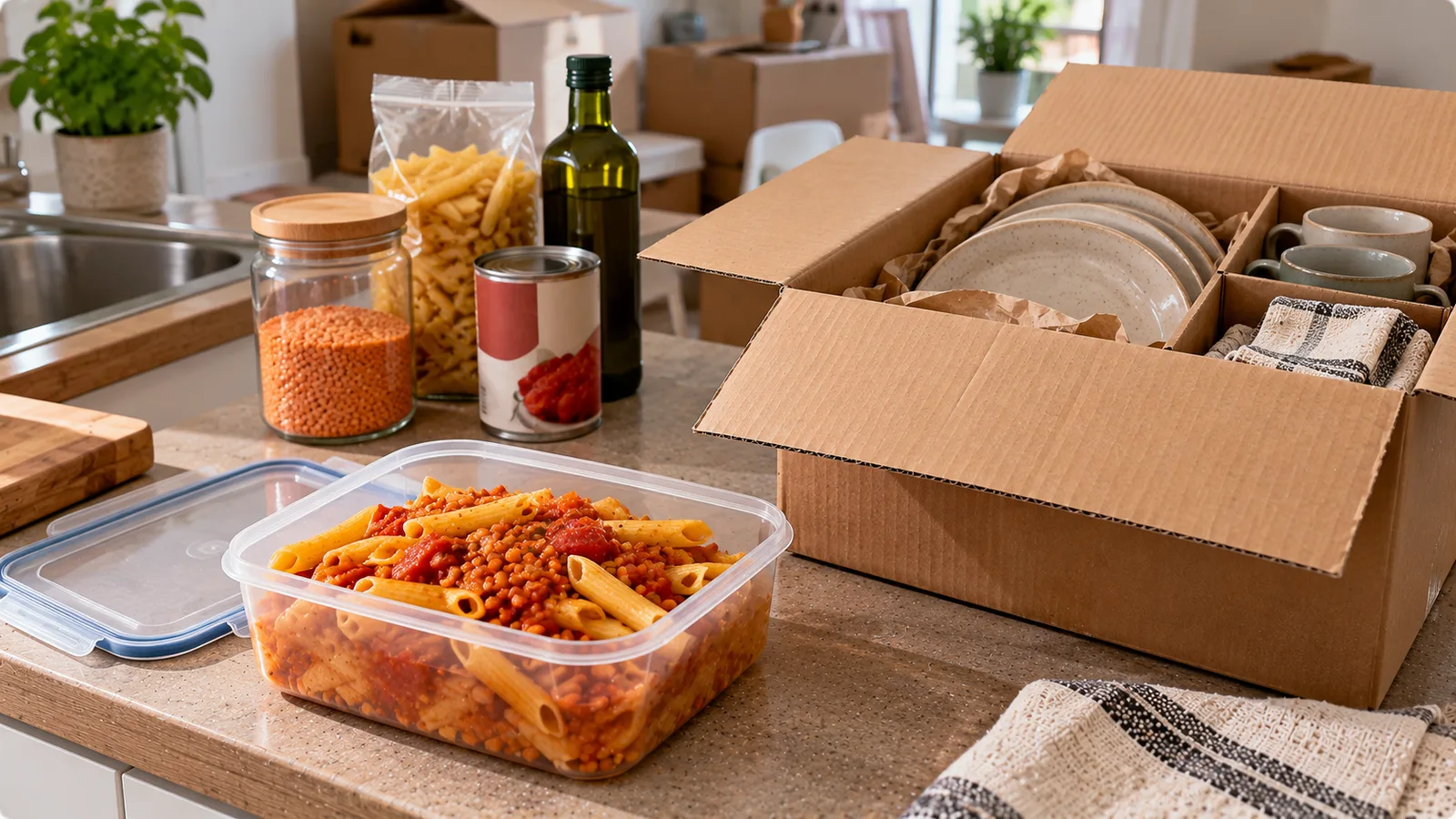
Moving house disrupts the routines that normally make eating simple. The fridge needs emptying, cooking equipment gets packed, shopping trips become unpredictable, and the first evening in a new home may arrive before the kitchen is ready.
The solution is not to prepare a complicated menu. It is to plan food around the changing kitchen, with fewer perishable groceries before the move, portable food on moving day, and simple meals while unpacking.
This guide gives you a practical seven-day plan, a strategy for using existing food, and a small grocery list that works without a fully equipped kitchen.
Plan around three different kitchen situations
Moving week is easier when divided into three phases.
| Phase | Kitchen situation | Food priority |
|---|---|---|
| Three to four days before | Most equipment available; fridge being emptied | Use perishables and existing pantry ingredients |
| Moving day | Limited cooking, uncertain timing and transport | Portable meals, safe storage and hydration |
| First two or three days after | Few utensils unpacked; shopping options may be unfamiliar | Simple meals using one pan, a kettle or no cooking |
Do not plan a fresh, ingredient-heavy recipe for the night when the stove is being disconnected.
Instead, choose meals that match the equipment and time you will actually have.
Step 1: Inventory the food you already own
Before buying anything, check four places:
- Fridge: fresh vegetables, opened sauces, dairy, eggs and leftovers.
- Freezer: frozen vegetables, meat, bread and prepared portions.
- Pantry: pasta, rice, beans, lentils, canned fish and oats.
- Open packages: half-used flour, crackers, cereals and spreads.
Separate the food into three groups.
Eat before moving: opened perishables, delicate produce, short-life leftovers and anything difficult to transport cold.
Transport if practical: unopened shelf-stable food, dry ingredients, canned products and a limited quantity of properly chilled food.
Discard if unsafe: food that has been stored at unsafe temperatures, spoiled items and leftovers whose storage history is uncertain.
A move is not a reason to consume questionable food.
Step 2: Stop buying food that creates more work
In the final few days, reduce purchases of ingredients that need special storage or several separate cooking steps.
A small shopping trip may still be useful, but focus on items you can finish before leaving.
Good options include bread, bananas, tomatoes, canned beans, tortillas and a small amount of fresh protein if you know when it will be cooked.
Avoid buying large packs of delicate produce or frozen food that you cannot realistically use or transport safely.
A useful question before every purchase is:
Will I eat this, pack it safely, or end up throwing it away?
A seven-day meal plan for moving week
This example covers three days before moving, moving day and three days afterward.
It is flexible rather than a strict calorie prescription. Adjust quantities to household size, appetite, allergies and access to equipment.
| Day | Kitchen status | Breakfast | Main meal | Second simple meal |
|---|---|---|---|---|
| Day −3 | Fully available | Oats with yogurt and fruit | Pasta with remaining vegetables and beans | Omelet with bread |
| Day −2 | Partly packed | Toast with eggs | Rice bowl with freezer vegetables and tuna or tofu | Soup using pantry ingredients |
| Day −1 | Almost packed | Overnight oats | Tortilla wraps with remaining cooked fillings | Bread, hummus and raw vegetables |
| Moving day | No dependable kitchen | Banana, yogurt or shelf-stable alternative | Packed sandwiches or wraps | Ready-to-eat supermarket meal or simple takeaway |
| Day +1 | One pan or kettle | Bread with peanut butter and fruit | Couscous with canned chickpeas and tomatoes | Eggs or tofu with vegetables |
| Day +2 | Basic cooking restored | Oatmeal | One-pot pasta with tomato sauce and lentils | Sandwiches with a side salad |
| Day +3 | Kitchen becoming functional | Yogurt or soy yogurt with oats | Rice, frozen vegetables and chicken or tofu | Bean and vegetable soup |
The goal is to avoid a daily decision-making problem when time and energy are limited.
You can swap meals freely according to what is left in the old kitchen.
Three days before: use the most perishable ingredients first
Start with fresh foods that are difficult to move.
Use leafy vegetables, opened dairy products, ripe tomatoes and cooked leftovers before they spoil.
An adaptable dinner is a pantry pasta:
- Cook whatever pasta you have.
- Sauté remaining vegetables in a little oil.
- Add canned tomatoes, beans or lentils.
- Combine with pasta and season.
- Refrigerate leftovers promptly if you plan to eat them later.
This uses several ingredients without requiring a new shopping list.
Another option is an omelet or tofu scramble using leftover vegetables.
Avoid preparing large quantities of leftovers if you will not have reliable refrigeration before moving.
Two days before: reduce freezer contents
Frozen food can be especially awkward to transport.
Plan meals using frozen vegetables, prepared portions or frozen bread while the freezer is still running.
If you have frozen raw meat or fish, thaw it safely in the refrigerator, not on the countertop, and cook it according to food-safety guidance.
Do not assume frozen food can remain safe for an entire moving day in an ordinary bag.
If transporting frozen food, use suitable insulated containers and enough ice or frozen packs to maintain safe temperatures.
If you cannot ensure that, use it before moving or arrange another safe solution.
One day before: pack the kitchen, not every eating utensil
Keep a small first-day kitchen kit accessible.
Useful items include:
- One pot or pan, if cooking will be possible.
- One sharp knife and a cutting board.
- A can opener.
- Plates or bowls and cutlery.
- A mug, reusable water bottle and dish soap.
- A clean food-storage container.
- A kettle if available.
Pack these together and label the box clearly for your own use.
Do not bury essential utensils beneath furniture or books.
For the last evening, choose a meal requiring minimal washing up, such as wraps with ingredients already prepared and safely refrigerated.
Moving day: plan food that travels well
Moving day may involve physical activity, waiting and unexpected delays.
Have food ready before the first box is carried.
A practical food bag might contain:
- Sandwiches or wraps.
- Bananas, apples or other whole fruit.
- Crackers or bread.
- Nuts or seed-based snacks where suitable.
- Drinking water.
- A shelf-stable meal or snack as backup.
If sandwiches contain meat, dairy, eggs or other ingredients requiring refrigeration, transport them in a cooler and keep them cold.
Shelf-stable foods are easier when refrigeration is uncertain.
Do not leave perishable meals in a warm car for hours.
Food safety when moving a fridge or freezer
Food safety is more important than avoiding a small amount of waste.
As general guidance, keep refrigerated perishable foods at approximately 4°C or colder and frozen foods at approximately −18°C or colder.
Perishable foods should generally not remain above safe refrigeration temperatures for more than two hours, or one hour in very hot conditions above approximately 32°C.
A closed refrigerator may keep food cold for about four hours during a power outage, while a full closed freezer may maintain its temperature for approximately 48 hours, or 24 hours if half full. These are emergency estimates, not guarantees for a refrigerator being carried, opened or transported.
Use a thermometer and follow the appliance manufacturer's moving instructions.
Do not rely on smell or appearance to judge whether temperature-abused food is safe.
For a long move, transporting only shelf-stable groceries may be the simplest choice.
The first grocery trip after moving
Do not immediately recreate your entire pantry.
Buy enough food for roughly two or three days, then learn where you will store everything.
Small starter grocery list for two adults
| Food | Example quantity | Uses |
|---|---|---|
| Oats | 500 g | Breakfast |
| Bread or tortillas | 1 package | Breakfast and wraps |
| Eggs or firm tofu | 6 eggs or 400 g tofu | Quick meals |
| Canned chickpeas or beans | 2 cans | Bowls, salads, soup |
| Canned tomatoes | 2 cans | Pasta and soup |
| Couscous or pasta | 500 g | Fast main meals |
| Frozen mixed vegetables | 750 g | One-pan meals |
| Tomatoes and cucumbers | About 700 g combined | Salads and sandwiches |
| Bananas or apples | 6 pieces | Breakfast and snacks |
| Yogurt or soy alternative | 500 g | Breakfast |
| Olive oil | Small bottle if needed | Cooking |
These are planning quantities, not nutritional targets.
Check which foods survived the move before buying duplicates.
If the refrigerator is not ready, prioritize shelf-stable items and buy refrigerated foods only when they can be stored safely.
Three easy meals for an unpacked kitchen
1. Chickpea couscous bowl
Equipment: kettle or one pot, bowl and fork.
For two servings:
- 120 g dry couscous.
- 1 can chickpeas, drained.
- 2 tomatoes.
- 1 small cucumber.
- 1 tablespoon olive oil.
- Lemon juice, salt and pepper.
Prepare the couscous according to its package directions. Mix with the chickpeas and chopped vegetables. Dress with oil and lemon.
Use a clean utensil and refrigerate leftovers promptly.
2. One-pot tomato and lentil pasta
Equipment: one pot and spoon.
For two to three servings:
- 180 g dry pasta.
- 1 can tomatoes, about 400 g.
- 1 can cooked lentils, drained.
- 1 small onion, optional.
- Water as needed.
- Olive oil and dried herbs.
Combine the ingredients in a pot with enough water to cook the pasta. Simmer, stir frequently and add water as needed.
Cook until the pasta is tender and the sauce has thickened.
3. Egg or tofu vegetable skillet
Equipment: one pan and spatula.
For two servings:
- 4 eggs or about 250 g firm tofu.
- 250 g mixed vegetables.
- 1 tablespoon oil.
- Seasonings.
Cook the vegetables, then add the eggs or crumbled tofu and cook thoroughly.
Serve with bread or tortillas.
What if you have no fridge on the first night?
Build meals around shelf-stable ingredients that do not require refrigeration before opening.
Examples include:
- Oatmeal made with water.
- Bread with peanut butter.
- Couscous with canned chickpeas.
- Canned fish or beans opened immediately before eating.
- Whole fruit.
- Shelf-stable milk or plant-based drinks in small packages.
Once a shelf-stable product is opened, follow its storage instructions.
Do not keep opened canned foods or prepared meals at room temperature overnight.
If the kitchen is completely unavailable, a purchased meal may be more practical than unsafe improvised storage.
How to keep moving-week food costs under control
Moving often creates unexpected expenses, and food spending can rise through repeated takeaway orders and wasted groceries.
A few decisions help:
Use existing food first. Treat the pantry and freezer as the starting point for your menu.
Plan one intentional takeaway. If you know cooking will be impossible on moving night, include it in the budget rather than treating it as a failure.
Buy a small starter shop. Avoid stocking every condiment before you know what is already in the boxes.
Choose overlapping ingredients. Bread, beans, tomatoes and eggs can support several different meals.
Track the cost of wasted food. Transporting a nearly empty jar of sauce may not be worthwhile, but throwing away expensive frozen food unnecessarily also has a cost.
There is no need to optimize every cent during a stressful week. The priority is a workable plan.
Adapting the plan for children or special diets
For children, keep familiar foods accessible and avoid relying on unfamiliar takeaway meals for every eating occasion.
For allergies, clearly separate safe food and check labels when shopping in an unfamiliar supermarket.
For vegetarian or vegan households, beans, lentils, tofu, oats and shelf-stable plant-based products can form the core of the plan.
For anyone who needs medically prescribed food handling or a specialized diet, plan those requirements before packing the kitchen.
A moving-week checklist
Before the move
- Check fridge, freezer and pantry.
- Plan meals using short-life ingredients.
- Avoid unnecessary fresh grocery purchases.
- Prepare a small food bag and drinking water.
- Keep a minimal kitchen kit accessible.
- Arrange safe cold storage if transporting perishables.
On moving day
- Eat before starting.
- Keep water accessible.
- Use a cooler for foods requiring refrigeration.
- Avoid leaving perishables in a warm vehicle.
- Keep one realistic dinner option ready.
After the move
- Confirm the refrigerator is operating at a safe temperature.
- Unpack the kitchen kit.
- Make a small two- or three-day grocery purchase.
- Prepare one-pot or no-cook meals.
- Return gradually to your normal meal routine.
Frequently asked questions
Should I meal prep before moving?
Only if you can store and transport the prepared food safely. Large batches are often inconvenient during a move. Using existing food and preparing a small number of portable meals is usually more practical.
What should I eat on moving day?
Choose easy-to-carry meals, fruit, water and suitable snacks. Keep perishable fillings cold.
Is it worth moving frozen food?
It depends on travel time, transport equipment and your ability to maintain safe temperatures. When reliable cold storage is unavailable, use the food beforehand or choose another safe option.
How much food should I buy after moving?
A small two- or three-day starter shop is often sufficient while you unpack and assess what you already own.
How can I avoid takeaway every night?
Keep a small kitchen kit accessible and plan meals that use one pan, a kettle or shelf-stable ingredients. Budget for takeaway on the one day cooking is genuinely impractical.
Sources
- USDA Food Safety and Inspection Service — safe handling and storage of perishable food.
- FoodSafety.gov: Food Safety During Power Outages — refrigeration and freezer guidance.
- FDA: Safe Food Handling — food temperature and storage principles.
The bottom line
A good moving-week meal plan is deliberately simple.
Use fresh and frozen food before leaving, keep moving-day meals portable, and start the new kitchen with a small grocery list and a few reliable recipes.
You do not need a perfect menu. You need food that fits the equipment, storage and time available each day.