
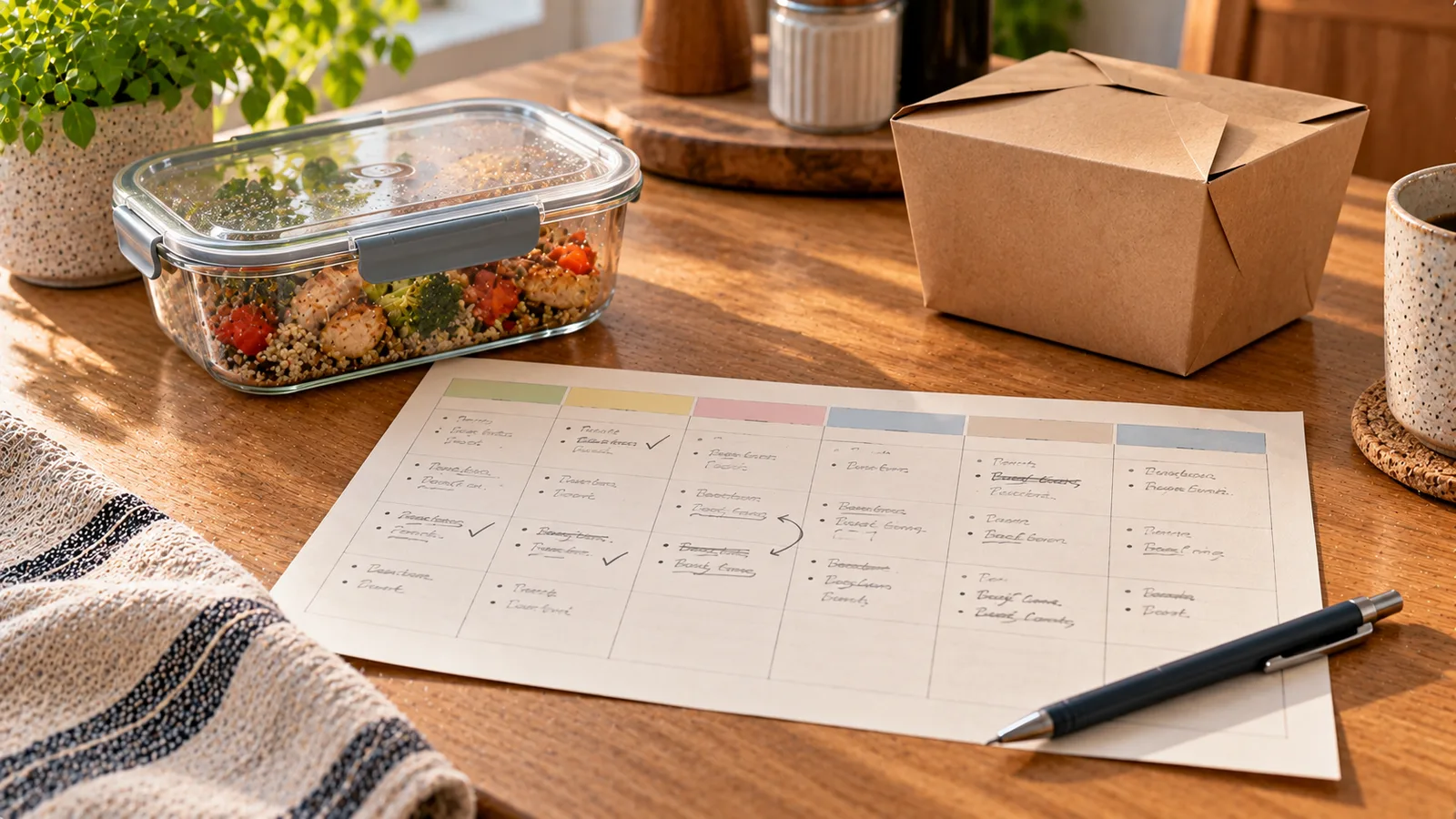
A meal plan can stop matching reality by Tuesday.
You planned to cook, but worked late. Someone ate the leftovers you expected to use for lunch. Friends suggested dinner out. A recipe produced twice as much food as expected. Fresh ingredients are approaching their use-by dates while several planned meals have not happened.
None of this means the meal plan failed.
A useful meal plan is not a contract. It is a working plan that should be adjusted when the week changes.
The goal is not to force yourself back onto the original schedule. The goal is to reorganize what remains so that you know what to eat next, what food needs attention and what no longer needs to be cooked.
First, stop trying to catch up
One of the easiest ways to make a disrupted meal plan worse is to treat missed meals as unfinished tasks.
Suppose you planned:
- Monday: chicken curry;
- Tuesday: lentil soup;
- Wednesday: pasta;
- Thursday: fish and potatoes;
- Friday: tacos.
You unexpectedly ate out on Tuesday.
You do not now need to squeeze Tuesday's lentil soup into Wednesday while still cooking everything else exactly as planned.
Instead, Tuesday's meal simply becomes an unused option.
It can move later in the week, move to next week, be frozen if appropriate, or disappear from the current plan.
Meal plans should follow the calendar you actually have, not the calendar you expected to have.
Step 1: Check what food is now most urgent
Before deciding which planned meal comes next, look at the ingredients you already bought.
Prioritize foods that are:
- already cooked;
- opened;
- highly perishable;
- approaching their use-by date;
- difficult to freeze;
- already thawed and requiring appropriate handling.
More stable ingredients can wait.
For example, imagine you have:
- cooked rice from yesterday;
- an opened container of yogurt;
- fresh spinach;
- unopened pasta;
- canned beans;
- frozen chicken.
The rice, yogurt and spinach usually deserve attention before the pasta and canned beans.
This changes the question from:
"What meal was scheduled for Wednesday?"
to:
"What should I use first?"
That is often a much better recovery strategy.
Always follow appropriate food-storage and food-safety guidance rather than relying only on the original meal plan.
Step 2: Count the meals you actually still need
Do not automatically preserve the original number of planned meals.
Look at the remaining week.
Suppose it is Wednesday morning and you originally planned dinners through Sunday.
But now:
- Thursday you will eat at a restaurant;
- Saturday you will visit family;
- there are two portions of leftovers in the refrigerator.
You may need only two or three additional cooked dinners.
Planning five new dinners would create unnecessary food and work.
A quick calculation helps:
Remaining eating occasions − meals already covered = meals still needed
For example:
- 5 dinners remaining;
- 2 dinners away from home;
- 1 dinner covered by leftovers;
means you need only:
5 − 2 − 1 = 2 additional dinners
That number is more useful than the original weekly plan.
Step 3: Turn leftovers into planned meals
Leftovers often become a problem because they sit outside the plan.
Bring them back into it.
Instead of:
Wednesday lunch: planned sandwich
change the plan to:
Wednesday lunch: leftover lentil soup
The sandwich ingredients can be used later if they remain suitable.
You can also transform leftovers rather than repeat the exact same meal.
For example:
- roasted chicken → wraps;
- cooked vegetables → omelet;
- rice → rice bowl;
- beans → tacos or salad;
- roasted potatoes → breakfast hash;
- cooked grains → grain bowl.
The purpose is not to invent a completely new recipe every time. It is to give already prepared food a specific place in the remaining schedule.
Step 4: Move flexible meals, not perishable ingredients
Some planned meals are easy to postpone.
A dinner based on:
- dried pasta;
- canned tomatoes;
- canned beans;
- frozen vegetables;
can usually move more easily than a dinner based on fresh fish and delicate greens.
When rearranging the week, move the meal with stable ingredients and keep the meal that protects the food most likely to spoil.
Example
Original plan:
| Day | Dinner |
|---|---|
| Wednesday | Fresh salmon, potatoes and spinach |
| Thursday | Bean pasta |
| Friday | Chicken curry |
Thursday suddenly becomes a restaurant night.
A practical revision could be:
| Day | Revised dinner |
|---|---|
| Wednesday | Fresh salmon, potatoes and spinach |
| Thursday | Restaurant |
| Friday | Chicken curry |
| Saturday | Bean pasta |
The pantry-based pasta moves because its ingredients tolerate the delay better.
Step 5: Reduce cooking before adding new meals
When a plan breaks, the instinct can be to immediately create a replacement plan.
First check whether you already have enough food.
Look for:
- leftovers;
- ingredients that can form a simple meal;
- freezer meals;
- bread and sandwich ingredients;
- eggs;
- canned beans or fish;
- yogurt and fruit;
- cooked grains;
- soup;
- other easy foods already available.
You may discover that the problem is not a shortage of meals but too many planned meals.
In that case, recovery means deleting cooking tasks rather than adding them.
Use a simple fallback meal
A meal plan becomes more resilient when one or two meals do not depend on a precise schedule.
A fallback meal should be:
- easy;
- based mostly on ingredients you normally keep;
- fast enough for a disrupted day;
- acceptable without extensive preparation.
Examples might include:
- eggs, bread and vegetables;
- pasta with a simple sauce and beans;
- soup with bread;
- rice with frozen vegetables and eggs;
- a sandwich with fruit or yogurt;
- beans in a wrap with vegetables.
The specific meal matters less than having an option that prevents one unexpected evening from forcing a takeaway order or a complete replanning session.
What if you missed the planned cooking day?
Suppose Sunday was supposed to be your preparation day, but you did not cook anything.
Do not automatically move the entire Sunday workload to Monday.
That can turn one missed session into an exhausting start to the week.
Instead, divide the original plan into three groups:
Must prepare
Food you genuinely need soon and cannot easily replace.
Can simplify
Meals that can become easier versions.
For example:
homemade chicken bowl with several components
might become:
chicken, rice and frozen vegetables
Can skip
Meals that are no longer necessary because your schedule changed, you have leftovers or another meal can cover the same slot.
This reduces the recovery workload.
What if you bought groceries for meals you will no longer cook?
Sort the ingredients by what can happen next.
Use now
Perishable ingredients that fit easily into another meal.
Freeze
Foods that freeze safely and well.
Move to another recipe
An ingredient may not need its original recipe.
Spinach intended for pasta might go into eggs or soup.
Carry into next week
Shelf-stable ingredients can simply become part of the next planning cycle.
The fact that you bought an ingredient for one recipe does not mean you must still cook that recipe.
What if you have too many leftovers?
Too many leftovers usually mean the plan underestimated yield or overestimated how often you would cook.
Start by counting portions.
Suppose your refrigerator contains:
- 2 portions of chili;
- 2 portions of chicken and rice;
- 1 portion of soup.
That is five meal portions already available.
Before cooking anything else, assign those portions to actual upcoming meals.
For example:
| Day | Meal |
|---|---|
| Wednesday lunch | Soup |
| Wednesday dinner | Chili |
| Thursday lunch | Chicken and rice |
| Friday lunch | Chili |
| Saturday lunch | Chicken and rice |
Now the rest of the plan can be built around those five portions instead of ignoring them.
If appropriate, freeze surplus portions early rather than waiting until you are tired of eating them.
What if an ingredient is missing?
A missing ingredient does not always require a shopping trip.
Ask three questions:
- Is the ingredient essential to the dish?
- Do I have a reasonable substitute?
- Would a simpler meal use the remaining ingredients better?
For example, if a recipe requires several vegetables but one is missing, the meal may still work without it.
If the missing ingredient defines the entire dish, moving that recipe to another day may make more sense.
The goal is to avoid turning every small mismatch into another planning task.
What if your appetite does not match the plan?
A plan predicts what you may want several days in advance.
Sometimes that prediction is wrong.
You might have planned a heavy dinner and want something lighter, or planned a small meal and be much hungrier than expected.
Instead of treating the plan as mandatory, adjust portions or exchange meals.
For example:
- move the larger meal to another day;
- use a smaller portion and add more later if needed;
- replace the meal with another planned option;
- use a flexible meal from your pantry or freezer.
Meal planning should support eating decisions, not override normal hunger and practical circumstances.
What if the whole week has changed?
Sometimes individual substitutions are not enough.
Perhaps work became unusually busy, several social events appeared or someone in the household became unavailable to cook.
At that point, stop repairing the original plan meal by meal.
Rebuild only the remaining days.
A five-minute reset
Write down:
- how many days remain;
- which meals will be eaten away from home;
- which leftovers already exist;
- which perishable foods need to be used;
- how many cooking sessions are realistic.
Then create the smallest workable plan.
Example
It is Thursday and the original plan is no longer useful.
You have:
- cooked chicken for two portions;
- spinach that should be used soon;
- eggs;
- pasta;
- canned tomatoes;
- frozen vegetables.
Your schedule:
- Thursday: home late;
- Friday: normal evening;
- Saturday: dinner out;
- Sunday: home.
A reset might be:
| Day | Dinner |
|---|---|
| Thursday | Leftover chicken + spinach |
| Friday | Pasta with tomato sauce |
| Saturday | Dinner out |
| Sunday | Eggs + vegetables + remaining ingredients |
You do not need to reconstruct Monday through Wednesday. Those days are finished.
Do not buy a second week of groceries
A disrupted plan can lead to another common mistake: shopping again before checking what remains from the first plan.
Before buying replacement meals:
- check the refrigerator;
- check the freezer;
- check the pantry;
- identify opened packages;
- count existing meal portions.
Then shop only for genuine gaps.
Otherwise, the recovery plan can create more waste than the original disruption.
Keep the next plan slightly less full
If your meal plans repeatedly fall apart, the problem may be that you are planning too many meals.
For example, if you regularly plan seven dinners but usually:
- eat out once;
- use leftovers once;
- have one unpredictable evening;
planning seven separate recipes creates excess work.
You might instead plan:
- 4 specific dinners;
- 1 leftover night;
- 1 flexible pantry/freezer meal;
- 1 open slot.
This is not incomplete planning.
It is planning for uncertainty.
Build flexibility into the week
A resilient weekly plan can contain different types of meals.
Fixed meals
Meals tied to ingredients or schedules.
Example: fresh fish that should be eaten early in the week.
Flexible meals
Meals that can move by several days.
Example: pasta with canned tomato sauce.
Leftover slots
Meals intentionally reserved for food already cooked.
Open slots
Times when you expect plans may change.
This structure is often more realistic than assigning a unique recipe to every meal.
A practical recovery order
When the week goes off plan, use this sequence:
- Remove meals you no longer need.
- Count existing leftovers.
- Identify the most perishable ingredients.
- Assign leftovers and perishables to upcoming meals.
- Move pantry- and freezer-based meals later.
- Simplify meals when time is limited.
- Buy only what is still missing.
This order protects food you already have before creating more work or spending more money.
Example: recovering a broken weekly plan
Imagine the original dinners were:
| Day | Original plan |
|---|---|
| Monday | Chicken curry |
| Tuesday | Lentil soup |
| Wednesday | Salmon and potatoes |
| Thursday | Pasta |
| Friday | Bean tacos |
| Saturday | Homemade burgers |
| Sunday | Vegetable soup |
By Wednesday morning:
- Monday's curry produced two extra portions;
- Tuesday became an unexpected restaurant dinner;
- the lentil soup was never cooked;
- Saturday is now dinner with friends;
- the salmon should be used soon.
A practical revised plan could be:
| Day | Revised plan |
|---|---|
| Wednesday | Salmon and potatoes |
| Thursday | Leftover chicken curry |
| Friday | Bean tacos |
| Saturday | Dinner with friends |
| Sunday | Lentil soup |
The pasta and homemade burgers disappear from this week's plan.
Nothing requires you to "make up" those meals.
Their shelf-stable ingredients can remain available for another week.
Use the disruption as information
A broken meal plan tells you something about how you actually live.
If the same problem happens repeatedly, adjust the next plan.
For example:
| Repeated problem | Possible adjustment |
|---|---|
| Too many leftovers | Cook fewer portions or schedule leftover meals |
| Fresh food spoils | Put perishable meals earlier in the week |
| Weeknights become too busy | Use faster meals or fewer cooking days |
| Plans change on weekends | Leave a weekend slot open |
| Grocery bill is too high | Plan around existing food before shopping |
| You repeatedly skip one type of meal | Stop planning it so rigidly |
| Recipes take longer than expected | Use simpler weekday recipes |
The purpose of reviewing the disruption is not to judge the week.
It is to make the next plan more realistic.
You do not need a perfect week
A useful meal plan can contain crossed-out meals, substitutions, leftovers and empty spaces.
Its job is to reduce decisions and help you use the food you have.
When the original plan stops matching reality, do not try to restore it exactly.
Protect the food that needs to be used, count the meals you still need, simplify the remaining cooking and rebuild only the part of the week that is still ahead.
That is not abandoning the meal plan.
It is using it as a flexible planning tool.